Prediction of Negative Perfectionism Based on Negativity/Pessimism and Emotional Inhibition Schemas: A Cross-Sectional Study with the Mediating Role of Rumination in Students

Author(s):
Mehrnoosh SamandarMehrnoosh SamandarMehrnoosh Samandar ORCID1,*, Farideh HosseinsabetFarideh HosseinsabetFarideh Hosseinsabet ORCID1,**, Ahmad BorjaliAhmad BorjaliAhmad Borjali ORCID1, Zahra NoorbakhshZahra NoorbakhshZahra Noorbakhsh ORCID2
1Department of Clinical Psychology, Allameh Tabataba'i University, Tehran, Iran
2Department of Clinical Psychology, Alzahra University, Tehran, Iran
Corresponding Authors:

IJ Psychiatry and Behavioral Sciences:Vol. 20, issue 2; e162137
Published online:Jun 02, 2026
Article type:Research Article
Received:Apr 26, 2025
Accepted:May 30, 2026
How to Cite:Samandar M, Hosseinsabet F, Borjali A, Noorbakhsh Z. Prediction of Negative Perfectionism Based on Negativity/Pessimism and Emotional Inhibition Schemas: A Cross-Sectional Study with the Mediating Role of Rumination in Students. Iran J Psychiatry Behav Sci. 2026;20(2):e162137. doi: https://doi.org/10.5812/ijpbs-162137

Abstract

Background:

Negative perfectionism is associated with psychological problems such as anxiety and depression. According to schema theory, early maladaptive schemas, such as negativity/pessimism and emotional inhibition, may contribute to perfectionistic tendencies. Rumination, defined as a repetitive focus on distress, may mediate this relationship. However, research examining these associations among Iranian students remains limited.

Objectives:

This study aimed to predict negative perfectionism based on negativity/pessimism and emotional inhibition schemas, with rumination as a mediator, among students in Tehran during the 2023 - 2024 academic year.

Methods:

This descriptive-correlational study included university students in Tehran during the 2023 - 2024 academic year. In total, 379 students were selected using convenience sampling. Eligibility criteria included enrollment at a university in Tehran and a moderate-to-high level of negative perfectionism, defined as a score of 69 or higher on the negative perfectionism subscale of the Positive and Negative Perfectionism Scale by Terry-Short. The Young Schema Questionnaire-Short Form, Third Edition; the Positive and Negative Perfectionism Scale by Terry-Short; and the Ruminative Responses Scale by Nolen-Hoeksema and Morrow were used. Data were analyzed using SPSS and AMOS with structural equation modeling.

Results:

The findings indicated that the direct effects of the negativity/pessimism and emotional inhibition schemas on negative perfectionism were significant (β = 0.36, P = 0.001; β = 0.39, P = 0.001). In addition, the indirect effects of these schemas on negative perfectionism via rumination were significant (β = 0.07, P < 0.05; β = 0.08, P < 0.05). These results suggest that reducing the negativity/pessimism and emotional inhibition schemas, as well as rumination, may decrease students' negative perfectionism.

Conclusions:

Negative perfectionism is a psychological vulnerability that may be influenced or exacerbated by negativity/pessimism and emotional inhibition schemas. Moreover, individuals with these schemas and negative perfectionism tend to engage in persistent cognitive processing, or rumination, about avoiding intimate relationships, suppressing emotions, maintaining excessive expectations, and experiencing an unusual fear of failure. However, these findings should be interpreted cautiously because the questionnaires were administered online, and limited information was available about participants' emotional or psychological conditions. In addition, the results may not be generalizable beyond the student population studied.

1. Background

Perfectionism was initially conceptualized as a unidimensional trait by Burns and defined as the pursuit of flawlessness that may lead to harm (1). Hamachek later distinguished between positive and negative perfectionism, with the former involving realistic goals and satisfaction and the latter involving unrealistic standards and rejection of mistakes. Subsequent research has primarily focused on negative perfectionism because of its strong association with psychological vulnerability.
Negative perfectionism is relatively prevalent among students. Studies have reported rates of 47% among Chinese first-year students and 44% among Spanish medical students, indicating its cross-cultural presence (2, 3).
Negative perfectionism is associated with multiple psychological problems exacerbated by academic pressures (4), including emotional-cognitive consequences such as anxiety, shame, guilt, depression, self-criticism, and irrational beliefs (5, 6), as well as behavioral manifestations such as procrastination and experiential avoidance (6, 7). It is also linked to well-being outcomes, such as reduced resilience, lower life satisfaction, impaired self-efficacy, stress, insomnia, and academic burnout (8). These findings underscore the need to explore the underlying mechanisms.
Early maladaptive schemas are central to models of perfectionism (9). According to Beck, such schemas contribute to psychological disorders through rigid beliefs (10). In Young's framework, schemas in the over-vigilance and inhibition domain, particularly negativity/pessimism (NP) and emotional inhibition (EI), are linked to emotional suppression and rigid standards. NP reflects persistent negative expectations and a focus on failure (9, 10), whereas EI involves the suppression of emotional expression to avoid rejection or criticism. Both schemas are associated with negative perfectionism (11), although they do not fully explain its persistence.
The relationship between schemas and perfectionism is not direct and is often mediated (12). Rumination, defined as repetitive and emotionally focused thinking that persists without external triggers, is a key mediating mechanism (13). Individuals with NP and EI schemas are more prone to rumination because of negative cognitive biases (14). Rumination has also been conceptualized as an emotional schema (15) and has been linked to negative perfectionism through sustained focus on failure and unrealistic standards (7, 8).
Interventions targeting rumination reduce maladaptive cognitive-emotional processes, and prior research supports the mediating role of rumination between maladaptive schemas and perfectionism (16). In addition, rumination is considered a transdiagnostic factor associated with emotional dysregulation and psychological vulnerability (17, 18).
Overall, these findings highlight rumination as a key mediator between maladaptive schemas and negative perfectionism.

2. Objectives

This study examined the mediating role of rumination in the relationship between negativity/pessimism and emotional inhibition schemas, and negative perfectionism among students.

3. Methods

3.1. Study Design

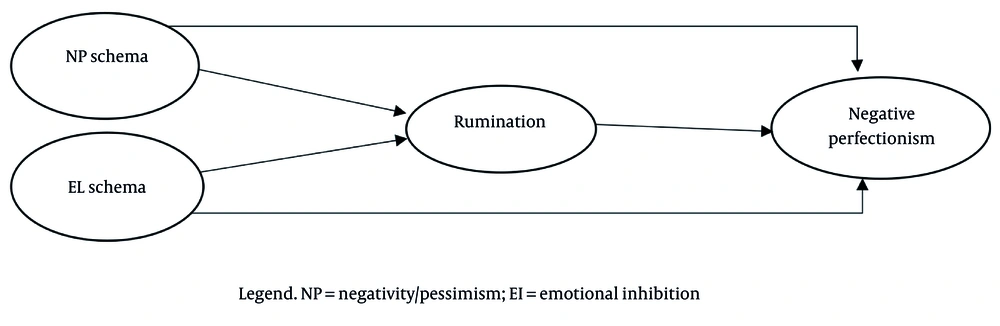
This study used a quantitative, applied, descriptive-correlational design and structural equation modeling (SEM) to examine the relationships among early maladaptive schemas, rumination, and negative perfectionism in university students Figure 1.
Conceptual Model of the Study (abbreviations: NP, negativity/pessimism; EI, emotional inhibition).
Figure 1.

Conceptual Model of the Study (abbreviations: NP, negativity/pessimism; EI, emotional inhibition).

3.2. Participants

The statistical population consisted of all university students in Tehran during the 2023 - 2024 academic year. A total of 379 participants were recruited using convenience sampling. The sample size was determined based on SEM recommendations suggesting 10 - 20 participants per parameter or at least 200 cases for moderately complex models. Given the model complexity, 379 participants were selected to reduce the effects of missing data, increase statistical power, improve parameter-estimation accuracy, and enhance generalizability. In addition, an a priori power analysis following MacCallum et al. indicated that for RMSEA = 0.05 versus 0.08, α = 0.05, and power = 0.80, a minimum of about 300 participants was required, confirming the adequacy of the final sample for detecting direct and indirect effects in the mediation model and ensuring stable estimates and fit indices.
The inclusion criteria were: (A) enrollment as a university student in Tehran and (B) a score of 69 or higher on the negative perfectionism subscale of the Positive and Negative Perfectionism Scale (PNPS), used as an operational threshold to ensure sufficient variability in maladaptive perfectionism rather than as a diagnostic cutoff. The exclusion criteria were ineligibility or incomplete or inattentive responses. Negative perfectionism was treated as a continuous construct, consistent with prior research using sample-based thresholds (19).
Participants provided informed consent. Confidentiality was ensured through anonymization and secure data storage. Participants with very high negative perfectionism or signs of severe distress were referred to counseling services when needed. The study adhered to ethical guidelines.

3.3. Procedure

The survey was designed to ensure broad access to university students and was created using the Porsline platform. Data were collected between July and October 2023 and were distributed via Telegram, WhatsApp, and Instagram, as well as through university student groups and direct messaging, to increase participation and sample diversity. Although nonrandom convenience sampling was used, efforts were made to reach students from different academic levels and universities, and reminders were sent to enhance response rates. However, no stratification by field of study or university was applied, which may limit representativeness.
Participants were instructed to complete the questionnaire independently. To improve data quality, attention-check items (e.g., "Please select 'Strongly agree' for this item") were included, and responses failing these checks or showing duplicate or patterned answering were excluded. All data were securely stored on a password-protected server, with access limited to the research team, to ensure confidentiality.
Before data analysis, the following data-screening procedures were conducted:
- Normality assessment: Skewness and kurtosis indices for all variables were within ± 2, indicating acceptable univariate normality.
- Multicollinearity check: Correlation coefficients and variance inflation factor (VIF) values were below 5, suggesting no multicollinearity issues.
- Missing data: Questionnaires with substantial missing or inattentive responses were excluded before analysis. The proportion of excluded cases was minimal and did not meaningfully affect the final sample size. Accordingly, listwise deletion was used, and all SEM analyses were conducted on 379 complete cases. Given the small amount of missing data, its impact on statistical power and generalizability was considered negligible.
Additional SEM assumptions were also examined. Linearity among variables (early maladaptive schemas, rumination, and negative perfectionism) was confirmed through bivariate scatterplots. Univariate outliers were assessed using standardized z scores (|z| > 3), and multivariate outliers were assessed using Mahalanobis distance; no influential cases were detected. Because the study used a single-group SEM design, homogeneity of covariance matrices was not required. Overall, the data were considered appropriate for SEM.

3.4. Measures

3.4.1. Young Schema Questionnaire-Short Form, Third Edition

The Young Schema Questionnaire-Short Form, Third Edition (YSQ-S3), assesses 18 early maladaptive schemas using a 6-point Likert scale (1 = completely untrue, 6 = completely true). Two subscales were used in this study:
- Negativity/pessimism: Items 17, 35, 53, 71, and 89.
- Emotional inhibition: Items 12, 30, 48, 66, and 84.
Subscale scores were calculated by summing the relevant items; higher scores indicate stronger maladaptive schemas (20). Cronbach's alpha values in this study were 0.785 for NP, 0.755 for EI, and 0.887 for the overall scale. The Persian version has demonstrated high reliability (α = 0.91) and construct validity through confirmatory factor analysis (21, 22). The Persian version of the YSQ-S3 has been validated in Iranian populations and has demonstrated strong psychometric properties, confirming its cultural applicability.

3.4.2. Positive and Negative Perfectionism Scale

The PNPS comprises 40 items: 20 for positive perfectionism and 20 for negative perfectionism. Items are rated on a 5-point Likert scale (1 = strongly disagree, 5 = strongly agree). Only the negative perfectionism subscale was used (score range, 20 - 100; cutoff ≥ 69). Cronbach's alpha in this study was 0.829. The scale's 2-factor structure and convergent validity have been confirmed previously (19). Previous studies have shown that the PNPS has a stable factorial structure, acceptable construct validity, and adequate discriminant validity across populations, supporting its use in assessing maladaptive perfectionism. In this study, negative perfectionism was treated as a continuous latent construct within the SEM framework, consistent with its theoretical and psychometric basis. The PNPS has also demonstrated acceptable reliability in Iranian student samples.

3.4.3. Ruminative Responses Scale

The Ruminative Responses Scale (RRS) evaluates rumination in response to negative mood using 22 items rated on a 4-point Likert scale (1 = never, 4 = almost always). Total scores range from 22 to 88, with higher scores indicating greater rumination. Subscales include reflection, brooding, and depression. Cronbach's alpha values in this study were 0.846 for reflection, 0.695 for brooding, 0.905 for depression, and 0.941 for the total scale. The validated Persian version was used (23). For SEM analyses, the total RRS score was used as the primary indicator of rumination. In addition, the psychometric properties of the RRS have been examined in Iranian samples, supporting its applicability in the Iranian cultural context.

3.5. Statistical Analysis

Data were analyzed using SPSS version 26 and AMOS version 24. SEM was conducted using the maximum likelihood estimation method. Negative perfectionism was modeled as a continuous latent variable in all SEM analyses. The inclusion threshold was used only for sampling and did not involve categorization in the analyses. This approach preserved variance and distributional properties, ensured consistency with prior dimensional conceptualizations, and maintained SEM assumptions. Consistent with previous PNPS validation studies, modeling negative perfectionism as a latent construct helped reduce measurement error and improve the accuracy and interpretability of structural paths.
Model evaluation followed a 2-step approach: (A) a measurement model to confirm the adequacy of latent constructs and (B) a structural model to test hypothesized relationships among variables. Model-fit indices included χ2/df ≤ 3, comparative fit index (CFI) ≥ 0.95 for good fit or ≥ 0.90 for acceptable fit, goodness-of-fit index (GFI) ≥ 0.90, and root mean square error of approximation (RMSEA) ≤ 0.06 for good fit or ≤ 0.08 for acceptable fit. These criteria were applied to evaluate both the initial and modified models. These cutoff values were determined based on commonly recommended guidelines in SEM (24). However, fit indices were interpreted cautiously because such thresholds represent general guidelines rather than absolute decision rules. The significance of indirect effects was further evaluated using bootstrapping with 5000 resamples and bias-corrected 95% confidence intervals (CIs). Bootstrapping is recommended over normal-theory tests because it does not assume a normal distribution of indirect effects. An indirect effect was considered significant when the 95% CI did not include zero.

4. Results

The descriptive statistics for demographic variables are presented in Table 1.
Table 1.Descriptive Statistics of Demographic Variables a
VariablesValues
Age (mean ± standard deviation)22.76 ± 2.44
Gender
Female280 (73.9)
Male99 (26.1)
Marital status
Single348 (91.8)
Married31 (8.2)
Education
Associate degree10 (2.6)
Bachelor's degree204 (53.8)
Master's degree160 (42.2)
PhD5 (1.3)

a Values are expressed as No. (%) unless otherwise indicated.

In this study, the mean age of the participants was 22.76 ± 2.44 years. Regarding gender, 73.9% of participants were female and 26.1% were male. Regarding marital status, 91.8% were single and 8.2% were married. The distribution of educational levels was as follows: 2.6% had an associate degree, 53.8% had a bachelor's degree, 42.2% had a master's degree, and 1.3% had a doctoral degree. In addition, participants were recruited from a variety of public and private universities across Tehran and represented different academic disciplines. The inclusion of students from multiple educational levels (associate, bachelor's, master's, and doctoral programs) contributed to variability in academic background and training, which may partially mitigate the selection bias associated with convenience sampling.
The overall scores and subscales of the research questionnaires are presented in Table 2.
Table 2.Descriptive Indicators of Total Scores and Subscales of Research Variables a
Variable and SubscaleMaximumMinimumKurtosisSkewnessMean ± SD
Negative perfectionism100240.099-0.16966.42 ± 13.144
Rumination
Total score8822-0.5410.21053.41 ± 14.270
Reflection205-0.7210.17612.22 ± 3.912
Brooding205-0.5020.28211.39 ± 3.313
Depression4812-0.5680.20529.80 ± 8.020
Schemas of the fifth domain
Total score11522-0.1500.38461.86 ± 16.459
NP schema305-0.6900.25115.77 ± 5.737
EI schema305-0.2770.52913.07 ± 5.421

a Abbreviations: EI; emotional inhibition; NP; negativity/pessimism; SD; standard deviation.

Table 2 presents the descriptive statistics for total scores and subscales of the research variables among 379 participants. In this study, the mean score for negative perfectionism was 66.42, with a standard deviation of 13.44. The skewness and kurtosis of negative perfectionism scores were -0.169 and 0.99, respectively. For rumination, the total mean score was 53.41, with a standard deviation of 14.27. The skewness and kurtosis values for rumination were 0.21 and -0.541, respectively. Regarding the rumination subscales, the mean scores were as follows: reflection, 12.92 ± 3.22; brooding, 11.39 ± 3.31; and depression, 29.80 ± 8.20. The skewness and kurtosis values for these subscales were as follows: reflection, skewness = 0.176 and kurtosis = -0.721; brooding, skewness = 0.282 and kurtosis = -0.502; and depression, skewness = 0.205 and kurtosis = -0.568. In addition, the mean score for maladaptive schemas in Domain V was 61.86 ± 16.54. The mean scores for the maladaptive schema subscales were as follows: NP schema, 15.97 ± 5.37, and EI schema, 13.70 ± 5.12. The skewness and kurtosis values for these subscales were as follows: NP schema, skewness = 0.251 and kurtosis = -0.690, and EI schema, skewness = 0.529 and kurtosis = -0.277.
In the inferential statistics section, Pearson correlation was used to examine relationships among the study variables. Pearson correlation coefficients were computed among the study variables. The results (Table 3) show positive associations among the examined constructs.
Table 3.Pearson Correlation Coefficients Among Study Variables a
variablesNegative PerfectionismRuminationOvervigilance and InhibitionNPEI
Negative perfectionism1----
Rumination0.551---
Overvigilance and inhibition0.340.4751--
NP0.3850.440.651-
EI0.360.4150.6150.6151

a Abbreviations: EI; emotional inhibition; NP; negativity/pessimism.

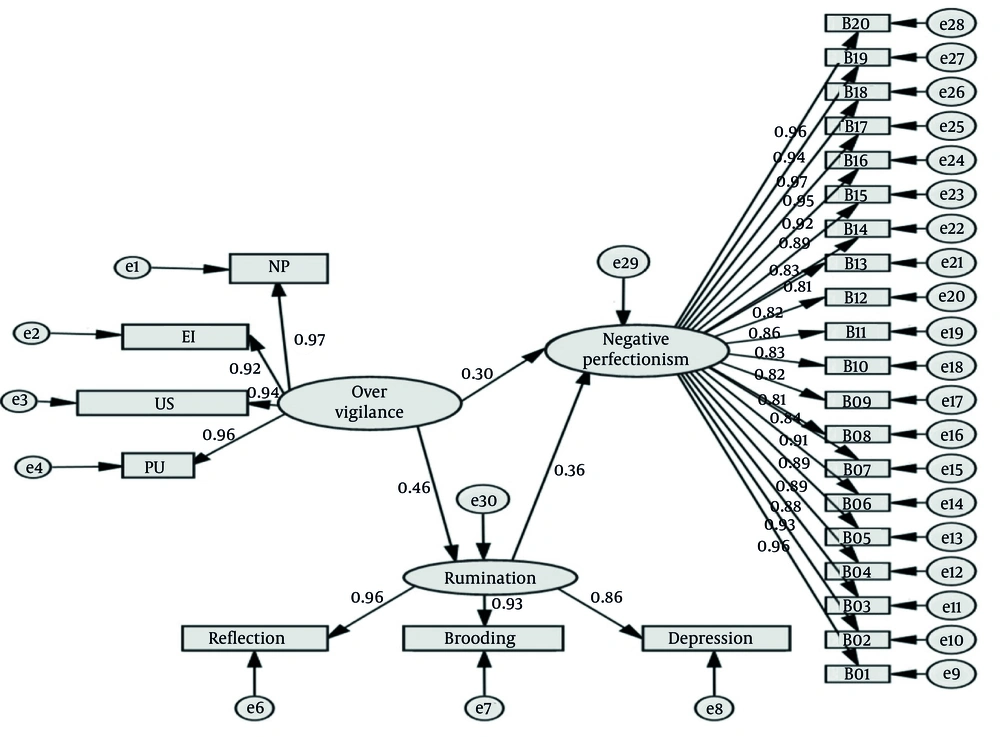
Path analysis was used to investigate the mediating role of rumination in the relationship between maladaptive perfectionism and the NP and EI schemas. Given the nature of this study, these 2 schemas were analyzed separately in different models. To explain the distribution pattern of maladaptive perfectionism scores based on the over-vigilance and inhibition domain schemas, with rumination as a mediator, SEM was used (Figure 2 and Table 4). The results presented in Table 3 indicate that rumination mediates the relationship between over-vigilance and inhibition domain schemas and maladaptive perfectionism.
Table 4.Fit Indices of the Model Before and After Modification a
Model statusX2dfX2/dfGFICFIRMSEA
Before model modification389.811312.970.830.840.085
After model modification246.291291.910.920.940.045

a Abbreviations: CFI, comparative fit index; df, degrees of freedom; GFI, goodness-of-fit index; RMSEA, root mean square error of approximation; X2, chi-square; X2/df, chi-square to degrees of freedom ratio.

Scatter Plot of Negative Perfectionism Scores Based on the Fifth-Domain Schemas with the Mediating Role of Rumination in Students After Model Modification (abbreviations: NP, negativity/pessimism; EI, emotional inhibition; US, unrelenting standards/hypercriticalness; PU, punitiveness; over-vigilance, over-vigilance and inhibition; e, error term; B, unstandardized path coefficient).
Figure 2.

Scatter Plot of Negative Perfectionism Scores Based on the Fifth-Domain Schemas with the Mediating Role of Rumination in Students After Model Modification (abbreviations: NP, negativity/pessimism; EI, emotional inhibition; US, unrelenting standards/hypercriticalness; PU, punitiveness; over-vigilance, over-vigilance and inhibition; e, error term; B, unstandardized path coefficient).

According to Meyers et al. (25), the fit indices of the structural model in the examined sample included chi-square (X2), the ratio of chi-square to degrees of freedom (X2/df), GFI, CFI, and RMSEA, which were 389.81, 2.97, 0.83, 0.84, and 0.085, respectively. Accordingly, CFI and GFI values greater than 0.90 and an RMSEA value less than 0.08 indicate good model fit. The initial RMSEA value above 0.08 suggested the need for model modification. After revisions, such as adding covariances between some error terms and removing nonsignificant paths, the model-fit indices improved. In the modified model, the X2 value decreased to 246.29, and the X2/df ratio decreased to 1.91. Moreover, GFI increased to 0.92 and CFI to 0.94. RMSEA also decreased from 0.085 to 0.045, indicating improved model fit.
Analysis of the modified model revealed that the over-vigilance and inhibition schemas had a direct effect (B = 0.30, β = 0.369, P < 0.001) on negative perfectionism. In addition, the over-vigilance and inhibition schemas accounted for 46% of the variance in rumination (B = 0.46, β = 0.53, P < 0.001). Furthermore, rumination had a direct effect (B = 0.36, β = 0.38, P < 0.001) on negative perfectionism. Overall, the predictor variables explained 19.4% of the variance in negative perfectionism. The indirect effect of over-vigilance and inhibition schemas on negative perfectionism through rumination was statistically significant, based on bootstrapped bias-corrected 95% CIs that did not include zero, confirming the mediating role of rumination. These findings indicate that over-vigilance and inhibition schemas are related to negative perfectionism through rumination. Furthermore, data analysis and model-fit indices indicated that the research model had a good fit. Initial results indicated that the premodification model had some fit weaknesses, requiring path adjustments and covariances between some error terms. The results showed that the over-vigilance and inhibition schemas had direct effects on rumination and negative perfectionism. In addition, rumination, as a mediating variable, transmitted part of the effect of over-vigilance and inhibition schemas to negative perfectionism.
The results from Table 5 indicate that rumination mediates the relationship between the NP schema and negative perfectionism.
Table 5.Fit Indices of the Model Before and After Modification a
Model statusX2dfX2/dfGFICFIRMSEA
Before model modification312.841242.520.870.880.081
After model modification198.431221.630.940.960.044

a Abbreviations: CFI, comparative fit index; df, degrees of freedom; GFI, goodness-of-fit index; RMSEA, root mean square error of approximation; X2, chi-square; X2/df, chi-square to degrees of freedom ratio.

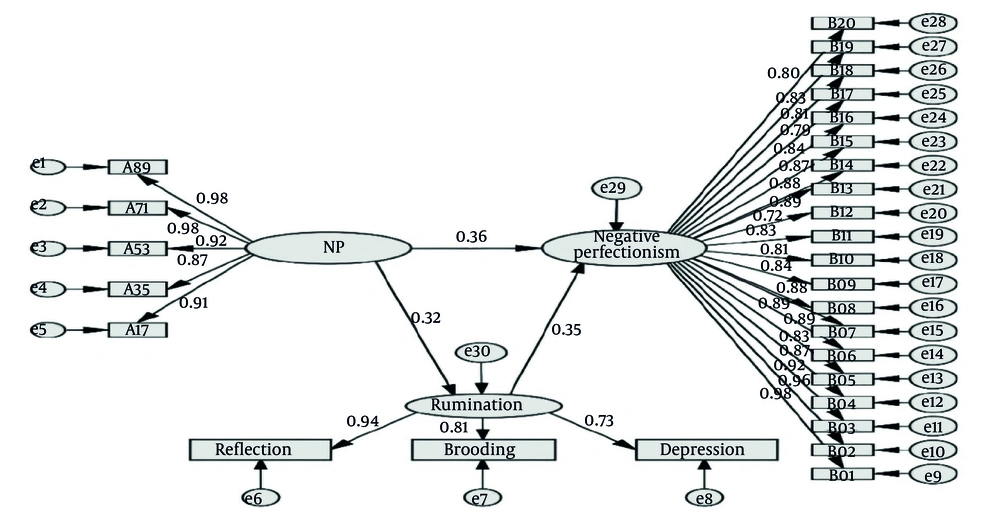
The fit indices of the structural model, including X2, X2/df, GFI, CFI, and RMSEA, were 312.84, 2.52, 0.87, 0.88, and 0.081, respectively. The obtained goodness-of-fit indices indicated that the model had inadequate fit. The RMSEA value exceeding 0.08 in the initial model suggested the need for model modification. The goodness-of-fit test for the data after model adjustments was conducted by establishing covariances between some error terms and removing nonsignificant paths. As a result, after a 2-degree reduction in the model's degrees of freedom, the X2 value decreased to 198.43, and the X2/df ratio decreased to 1.63. In addition, GFI increased to 0.94, CFI increased to 0.96, and RMSEA decreased from 0.081 to 0.044 Figure 3.
Scatter Plot of Negative Perfectionism Scores Based on the NP Schema with the Mediating Role of Rumination in Students After Model Modification (abbreviations: NP, negativity/pessimism; e, error term; B, unstandardized path coefficient).
Figure 3.

Scatter Plot of Negative Perfectionism Scores Based on the NP Schema with the Mediating Role of Rumination in Students After Model Modification (abbreviations: NP, negativity/pessimism; e, error term; B, unstandardized path coefficient).

Based on model modification and the reduction in degrees of freedom, the NP schema had a direct effect (B = 0.36, β = 0.144, P < 0.001) on negative perfectionism. In addition, the NP schema explained 32% of the variance in rumination (B = 0.32, β = 0.12, P < 0.001). Furthermore, rumination had a direct effect (B = 0.35, β = 0.37, P < 0.001) on negative perfectionism. Overall, the predictor variables accounted for 17.8% of the variance in negative perfectionism. The indirect effect of the NP schema on negative perfectionism through rumination was calculated to be B = -0.07. The bootstrapped bias-corrected 95% CI for the indirect effect did not include zero, indicating a statistically significant mediating effect. Therefore, based on the results, the NP schema is related to negative perfectionism through rumination. In other words, rumination mediates the relationship between the NP schema and negative perfectionism.
The results from Table 6 indicate that rumination plays a mediating role in the relationship between the EI schema and negative perfectionism.
Table 6.Fit Indices of the Model Before and After Modification a
Model statusX2dfX2/dfGFICFIRMSEA
Before model modification345.761280.860.870.870.085
After model modification214.321260.930.950.950.047

a Abbreviations: CFI, comparative fit index; df, degrees of freedom; GFI, goodness-of-fit index; RMSEA, root mean square error of approximation; X2, chi-square; X2/df, chi-square to degrees of freedom ratio.

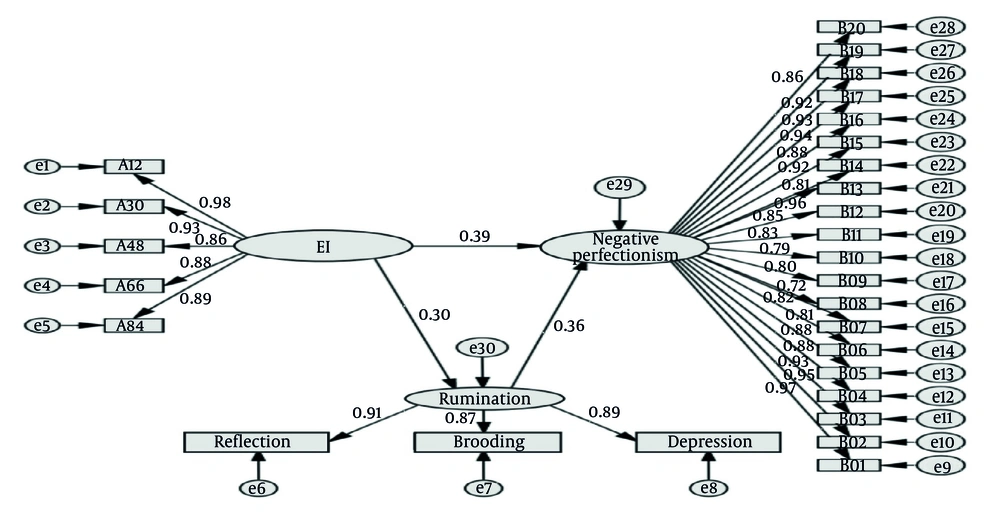
The fit indices of the structural model, including X2, X2/df, GFI, CFI, and RMSEA, were 345.76, 0.86, 0.87, 0.87, and 0.085, respectively. The RMSEA value exceeding 0.08 in the initial model indicated the need for model modification. After model adjustments, the fit indices improved. In the modified model, the X2 value decreased to 214.32, and the X2/df ratio decreased to 0.93. In addition, GFI increased to 0.93, CFI increased to 0.95, and RMSEA decreased from 0.085 to 0.047, indicating improved model fit. These findings confirm the mediating role of rumination in the relationship between the EI schema and negative perfectionism Figure 4.
Scatter Plot of Negative Perfectionism Scores Based on the EI Schema with the Mediating Role of Rumination in Students After Model Modification (abbreviations: EI, emotional inhibition; e, error term; B, unstandardized path coefficient).
Figure 4.

Scatter Plot of Negative Perfectionism Scores Based on the EI Schema with the Mediating Role of Rumination in Students After Model Modification (abbreviations: EI, emotional inhibition; e, error term; B, unstandardized path coefficient).

Analysis of the modified model revealed that EI had a direct effect (B = 0.39, β = 0.149, P < 0.001) on negative perfectionism and explained 30% of the variance in rumination (B = 0.30, β = 0.108, P < 0.001). In addition, rumination had a direct effect (B = 0.36, β = 0.38, P < 0.001) on negative perfectionism. Overall, the predictor variables explained 18.4% of the variance in negative perfectionism. The indirect effect of EI on negative perfectionism through rumination was calculated to be B = -0.08, and the bootstrapped bias-corrected 95% CI for the indirect effect excluded zero, supporting the mediating role of rumination. Therefore, the results suggest that EI is related to negative perfectionism through rumination and that rumination acts as a mediating variable in this relationship.

5. Discussion

The structural equation models showed acceptable to good fit. In the modified models, χ2/df ratios were below 2. CFI values ranged from 0.94 to 0.96, exceeding the 0.90 threshold and approaching 0.95. RMSEA values ranged from 0.044 to 0.047, indicating good fit (≤ 0.06). Based on standard SEM criteria (24), these results (CFI ≥ 0.90/0.95, RMSEA ≤ 0.08/0.06, and χ2/df < 3) collectively indicate that the proposed mediation models adequately fit the observed data. Consistent with the study objective of predicting negative perfectionism based on the NP and EI schemas, with rumination as a mediator in students, the results indicated that rumination mediates the relationship between the NP and EI schemas and negative perfectionism. Indirect effects were tested using bootstrapping with 5000 resamples and bias-corrected 95% CIs. The indirect paths from the NP and EI schemas to negative perfectionism through rumination were significant because the CIs did not include zero, supporting the mediating role of rumination. In the modified models, the predictors explained about 17% - 19% of the variance in negative perfectionism (R2), indicating a modest but meaningful effect in this cross-sectional study. These findings are consistent with prior research linking maladaptive schemas, rumination, and negative perfectionism in students (7, 8, 14, 16).
Although previous studies have demonstrated associations between cognitive schemas and perfectionism, between rumination and perfectionism, and between rumination and cognitive schemas, this study, for the first time in a non-Western sample of students, examined how rumination quantitatively mediates the effects of both the NP and EI schemas on maladaptive perfectionism.
Higher levels of early maladaptive schemas are associated with increased negative perfectionism, and individuals with negative perfectionism tend to exhibit more prominent maladaptive schemas. Research indicates that these schemas predict rumination, which in turn mediates the relationship between maladaptive schemas and negative perfectionism.
The findings indicated that rumination independently mediates the relationship between the NP and EI schemas and negative perfectionism. Prior research suggests that the NP schema is associated with cognitive patterns that increase repetitive negative thinking and sustained focus on potential failure, thereby reinforcing rumination (14). Similarly, the EI schema may promote rumination through emotional suppression and internalized emotional control, which indirectly contribute to maladaptive perfectionistic tendencies. Emotional schema therapy conceptualizes rumination as a maladaptive coping strategy stemming from emotional avoidance. Negative perfectionists may ruminate because of fear of mistakes and negative evaluation, leading to intensified self-monitoring and repetitive negative thinking.
Notably, the mechanisms through which the NP and EI schemas lead to rumination differ. The NP schema primarily fosters a cognitive focus on anticipated failures, which promotes repetitive thinking, whereas the EI schema operates through emotional suppression, generating internal stress that manifests as rumination. As a result, rumination strengthens the link between each schema and negative perfectionism.
Although these findings are consistent with Western research, the present study extends the literature by examining these relationships in a non-Western context. Cultural factors may influence perfectionism, emotional inhibition, and rumination. In collectivistic settings, such as Iran, social evaluation, family expectations, and interpersonal harmony may intensify concerns about mistakes and emotional control. Emotional inhibition may also be reinforced by norms of restraint and conformity. Thus, the mediating role of rumination may reflect culturally embedded cognitive-emotional processes rather than purely individual traits. Although structural relationships may show cross-cultural robustness, their magnitude and expression are likely shaped by sociocultural norms, highlighting the need for culturally sensitive schema-focused and rumination-based interventions.

5.1. Conclusions

In conclusion, the model showed good fit, with negative perfectionism directly related to the NP and EI schemas among students in Tehran. These schemas also indirectly affect negative perfectionism through rumination. Modifying these schemas may reduce rumination and negative perfectionism. The study findings are valuable for universities, educational centers, counseling services, and families seeking to improve students' mental health and academic performance. In addition, increasing awareness of the development of maladaptive schemas in childhood may help reduce negative perfectionism over time.

5.2. Limitations and Suggestions

This study has several limitations that may affect construct validity and model robustness. First, the anonymity of online respondents and the lack of information about emotional or clinical status may have influenced the accuracy of self-reports. Second, nonrandom convenience sampling may have introduced selection bias and limited external validity, despite efforts to recruit a heterogeneous sample. Future studies should use probability or stratified sampling across universities, disciplines, and regions. Third, the gender imbalance (73.9% female) may limit generalizability to male students because gender may influence cognitive-emotional processes. Fourth, the predefined inclusion threshold for negative perfectionism may have affected variability, although the construct was treated as continuous; future studies should examine unselected samples. In addition, confirmatory factor analysis was not conducted for the PNPS negative perfectionism subscale in this sample. Fifth, confirmatory factor analysis was not performed for the RRS, which may limit measurement confidence despite prior validation of its Persian version. Finally, although missing data were minimal, future research could use multiple imputation for greater robustness.
From an applied perspective, schema therapy may be useful for targeting maladaptive schemas, such as negativity/pessimism and emotional inhibition, using cognitive, experiential, and limited reparenting techniques. Rumination-focused interventions, including metacognitive therapy and rumination-focused cognitive behavioral therapy, may also help reduce repetitive negative thinking through attention training, detached mindfulness, and behavioral activation. University counseling centers are encouraged to combine schema-focused assessment with structured rumination-based interventions rather than relying solely on general stress-management approaches.

Acknowledgments

Footnotes

References

  • 1.
    Bouchard C, Rhéaume J, Ladouceur R. Responsibility and perfectionism in OCD: an experimental study. Behav Res Ther. 1999;37(3):239-48. [PubMed ID: 10087642]. https://doi.org/10.1016/S0005-7967(98)00141-7.
  • 2.
    Liu X, Zhang S, Zheng R, Yang L, Cheng C, You J. Maladaptive perfectionism, daily hassles, and depressive symptoms among first-year college students in China. J Am Coll Health. 2024;72(4):1094-102. [PubMed ID: 35549816]. https://doi.org/10.1080/07448481.2022.2068014.
  • 3.
    González-Calderón MJ, Baile JI. Prevalence and Determinants of Psychological Distress in Medical Students in Spain (2010 - 2024): A Narrative Review. Psychiatry Int. 2025;6(3):90. https://doi.org/10.3390/psychiatryint6030090.
  • 4.
    Lee J, Puig A, Kim Y, Shin H, Lee JH, Lee SM. Academic burnout profiles in Korean adolescents. Stress Health. 2010;26(5):404-416. https://doi.org/10.1002/smi.1312.
  • 5.
    Harper KL, Eddington KM, Lunsford J, Hoet AC. Perfectionism and the impact of intrinsic and extrinsic motivation in daily life. J Individ Differ. 2019;41(3):117-123. https://doi.org/10.1027/1614-0001/a000310.
  • 6.
    Daneshgu F, Barzegar Bafrui K, Hasani H. Investigating the role of negative perfectionism and experiential avoidance in academic stress with the mediating role of fear of negative evaluation in students at Yazd University. J Acad Learn Teach. 2023. https://doi.org/10.30473/etl.2023.64123.3801.
  • 7.
    Klein RG, Dooley D, Lapierre K, Pitura VA, Adduono D. Trait perfectionism and competitiveness: conceptual similarities and differences in a lab-based competitive task. Pers Individ Dif. 2020;153. 109610. https://doi.org/10.1016/j.paid.2019.109610.
  • 8.
    Richardson C, Gradisar M. Perfectionism and insomnia in adolescents: the role of vulnerability to stress and gender. J Adolesc. 2020;85(1):70-9. [PubMed ID: 33069095]. https://doi.org/10.1016/j.adolescence.2020.10.003.
  • 9.
    Dozois DJA, Beck AT. Cognitive schemas, beliefs, and assumptions: risk factors in depression. In: Beck AT, editor. Cognitive therapy: foundations, conceptual models, and applications. 2008:119-143. https://doi.org/10.1016/B978-0-08-045078-0.00006-X.
  • 10.
    Klibert J, Lamis DA, Naufel K, Yancey CT, Lohr S. Associations between perfectionism and generalized anxiety: examining cognitive schemas and gender. J Ration Emot Cogn Behav Ther. 2015;33(2):160-78. https://doi.org/10.1007/s10942-015-0208-9.
  • 11.
    Pourshahbaz A, Moloodi R, Mohammadkhani P, Fata L, et al. An etiological and maintenance model of perfectionism. Research Square. 2022. Preprint. https://doi.org/10.21203/rs.3.rs-1235520/v1.
  • 12.
    Soenens B, Vansteenkiste M. Are parents responsible for the rise of perfectionism? Comment on Curran and Hill. 2019;145(4):430-432. [PubMed ID: 30869929]. https://doi.org/10.1037/bul0000167.
  • 13.
    Portero AK, Durmaz DA, Raines AM, Short NA, Schmidt NB. The role of cognitive processes of rumination. Pers Individ Dif. 2015;86:277-81. https://doi.org/10.1016/j.paid.2015.06.024.
  • 14.
    Carlucci L, D'Ambrosio I, Innamorati M, Saggino A, Balsamo M. Co-rumination, anxiety, and maladaptive cognitive schemas: when friendship can hurt. Psychol Res Behav Manag. 2018;11:133-144. [PubMed ID: 29692638]. [PubMed Central ID: PMC5903493]. https://doi.org/10.2147/PRBM.S144907.
  • 15.
    Leahy RL. Emotional schema therapy: A bridge over troubled waters. In: Acceptance and mindfulness in cognitive behavior therapy: Understanding and applying new therapies. 2011. https://doi.org/10.1002/9781118001851.
  • 16.
    Nepon T, Flett GL, Hewitt PL, Molnar DS. Perfectionism, negative social feedback, and interpersonal rumination in depression and social anxiety. Can J Behav Sci. 2011;43(4):297-308. https://doi.org/10.1037/a0025032.
  • 17.
    Sarani Yaztappeh J, Mousavi SE, Shahkaram H, Kianimoghadam AS, Bakhtiari M, Didar F, et al. Prediction of emotional disorders based on neuroticism with emotion regulation, experiential avoidance, and repetitive negative thinking. Int J High Risk Behav Addict. 2023;12(2). https://doi.org/10.5812/ijhrba-134761.
  • 18.
    Jahanseir M, Mousavi Asl E, Moghadam Sadegh A, Fakhri A, Norouzi S. The effectiveness of transcranial direct current stimulation (tDCS) on severity of obsessive-compulsive symptoms, executive functions and rumination in people with obsessive-compulsive symptoms: A randomized clinical trial. Jundishapur J Chronic Dis Care. 2025;14(14). https://doi.org/10.5812/jjcdc-156556.
  • 19.
    Terry-Short LA, Owens RG, Slade PD, Dewey ME. Positive and negative perfectionism. Pers Individ Dif. 1995;18(5):663-78. https://doi.org/10.1016/0191-8869(94)00192-U.
  • 20.
    Young JE, Brown G. Young schema questionnaire-short form; Version 3. Psychol Assess. 2005. https://doi.org/10.1037/t67023-000.
  • 21.
    Yoosefi N, Etemadi O, Bahrami F, Fatehizade MAS, Ahmadi SA. An investigation on early maladaptive schema in marital relationship as predictors of divorce. J Divorce Remarriage. 2010;51(5):269-92. https://doi.org/10.1080/10502551003651951.
  • 22.
    Schmidt NB, Joiner TE, Young JE, Telch MJ. The Schema Questionnaire: Investigation of psychometric properties and the hierarchical structure of a measure of maladaptive schemas. Cogn Ther Res. 1995;19(3):295-321. https://doi.org/10.1007/BF02230402.
  • 23.
    Nolen-Hoeksema S, Morrow J. A prospective study of depression and posttraumatic stress symptoms after a natural disaster: The 1989 Loma Prieta Earthquake. J Pers Soc Psychol. 1991;61(1):115-121. [PubMed ID: 1890582]. https://doi.org/10.1037/0022-3514.61.1.115.
  • 24.
    Hu L, Bentler PM. Cutoff criteria for fit indexes in covariance structure analysis: Conventional criteria versus new alternatives. Struct Equ Modeling. 1999;6(1):1-55. https://doi.org/10.1080/10705519909540118.
  • 25.
    Meyers LS, Gamst G, Guarino AJ. Applied multivariate research: Design and interpretation. Applied multivariate research: Sage Publications; 2016. https://doi.org/10.4135/9781071802687.

Crossmark
Crossmark
Checking
Share on
Metrics

Purchasing Reprints

  • Copyright Clearance Center (CCC) handles bulk orders for article reprints for Brieflands. To place an order for reprints, please click here (   https://www.copyright.com/landing/reprintsinquiryform/ ). Clicking this link will bring you to a CCC request form where you can provide the details of your order. Once complete, please click the ‘Submit Request’ button and CCC’s Reprints Services team will generate a quote for your review.
Search Relations

Author(s):

Related Articles