


1. Background
Waterpipe tobacco smoking has a broad range of negative effects on health including, though not limited to, exposure to high concentrations of toxic chemicals, the incidence of cancers of different types, and cardiovascular disease (1). While many of the youth are aware of the risks of smoking cigarettes, most of them believe that waterpipe tobacco smoking is not as addictive or harmful as cigarette and other forms of tobacco smoking (2). This common belief has made tobacco smoking using waterpipe a prevalent practice among young adults and adolescents. In this line, the rate of waterpipe smoking from 7.3% among United State adolescents aged below 17 years old to 60% among 14-20 years old African teenagers have been reported (3, 4). A prevalence rate of 44% of waterpipe smoking is reported among high school students in Iran (5).
Most waterpipe consumers tend to smoke when they are with their friends or in a public place where the waterpipe is offered. The social aspects can reveal why in recent years waterpipe smoking has increased (6).
Prototype willingness model (PWM) is a behavior prediction model that considers the social nature of involvement in risky behaviors such as tobacco use of any kind. Gibbons and Gerrard suggest that high - risk behaviors in adolescents may not be planned; hence, they developed the prototype willingness model, which proposes, in addition to behavioral intention, a second path called behavioral willingness for high-risk behaviors. Behavioral willingness is assessed by asking participants how they react to a high-risk behavior in a certain social situation. In addition to intention and behavioral willingness, this model comprises attitudes, subjective norms, prototypes, and behavioral intention. When people have a positive attitude towards a certain behavior and perceive that there are significant factors tempting them to the behavior, they will be more willing to perform that behavior. Although behavioral willingness has been linked to behavioral intention, based on the PWM, willingness is differentiated as an inherent feature of purposeful behavior. According to the PWM, individuals have prototypes that play a role in high-risk behaviors and that people’s attitudes are directly associated with these preliminary prototypes or images (7) (Figure 1).
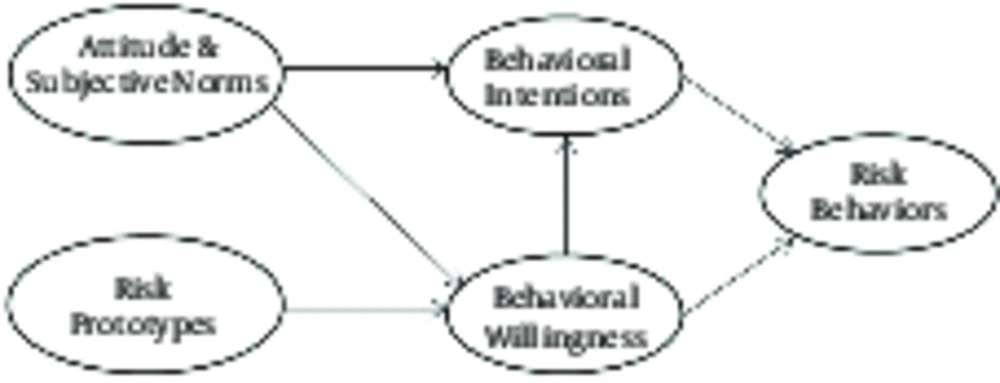
Figure 1.
The Prototype/Willingness Model
Currently, there are studies that depict the efficacy of PWM to explain why and how adolescents are involved in risky behaviors such as smoking and alcohol use (8, 9). Although there is evidence suggesting that the age of waterpipe smoking has reduced from adulthood to adolescence, few studies have been conducted in this regard, especially based on theoretical foundations. Only one theory-based study was conducted in Bandar Abbas, Iran, in 2014 concerning waterpipe consumption among adolescents (10). Therefore, there seems to be a need for studies on waterpipe smoking among adolescents to identify factors influencing this behavior in this sensitive age group.
2. Objectives
This study aimed to build on the PWM to predict waterpipe smoking among high school students in Birjand.
3. Materials and Methods
3.1. Participants and Procedures
This cross-sectional study, which aimed to determine the waterpipe smoking predictors, was undertaken on 432 high school students (10th to 12th grades) in Birjand, eastern Iran. The target population included all high school students in Birjand during the 2016 - 2017. The inclusion criteria were residence in Birjand, studying in high schools, and willingness to participate in the study. Using the multistage cluster sampling method, 432 students were selected from the 4 urban districts of Birjand. The city of Birjand was first divided into four geographic districts, and then from all high schools, 1 high school for girls and 1 high school for boys were randomly selected in each district. Afterwards, from all students in every high school, 54 students were randomly selected from the list and after giving the inclusion criteria were enrolled in the study.
During the implementation phase, two trained inquirers referred to the specified high schools and explained the study objectives for the students. After obtaining the participants’ consent, the students were given 20 minutes for filling it out.
3.2. Measurement Tools
In this study, a researcher-made questionnaire was used containing demographic questions as well as PWM - based questions on waterpipe smoking. Credibility of the questionnaire was evaluated through content validity indices, using the opinions derived from an expert panel (9 health education experts), and the values obtained for content validity index and content validity ratio were 0.88 and 0.91, respectively. In a pilot study, in order to assess the reliability of the questionnaire, the questionnaire was given to 30 high school students with similar characteristics to the study group, and Cronbach’s alpha coefficient was calculated.
3.2.1. Demographic Variables
The demographic variables of the study included age, sex, field of study, parent’s age, parent’s educational level, parent’s occupation, number of siblings, and history of waterpipe smoking among the family members and friends.
3.2.2. Waterpipe Smoking
Waterpipe smoking was evaluated by a basic question: “How often do you usually smoke waterpipe?”. A 6 - item measurement scale including “every day”, “3 - 5 times a week”, “1 - 2 times a week,” “once a month”, “seldom” and “never” was used for responding to this question. The scores of this part ranged from 5 points for the students who do not smoke waterpipe, to 0 points for students who smoke waterpipe every day. Only the students who had never smoked waterpipe were placed in the non-smoking group. This part also included some extra questions for waterpipe smokers, including the age of the first experimentation with a waterpipe, type of waterpipe used, the common place for smoking waterpipe, and the companion at the first time of waterpipe smoking.
3.2.3. Behavioral Willingness
The willingness construct was developed and studied, containing 8 questions about the individual’s performance in two simulated situations for waterpipe smoking in a family party attended by relatives and in a traditional teahouse attended by friends. The participant’s reaction against waterpipe smoking offers was questioned in 4 modes: (1) you will take the waterpipe and smoke it; (2) you will say “no, thanks” (and reject the offer); (3) you will leave the party; (4) you will smoke just once in order not to annoy them. The behavioral willingness questions were rated based on a 5 - point scale ranging from “strongly agree” (1 point) to “strongly disagree” (5 points). Cronbach’s alpha for this construct amounted to 0.82.
3.2.4. Waterpipe Smoking Intention
The behavioral intention was evaluated by 3 questions about the individual’s decision to smoke waterpipe: I have decided not to smoke waterpipe this year; I will always try not to smoke waterpipe; I do not want to start waterpipe smoking at all. The three questions were evaluated based on a 5 - point scale ranging from “strongly agree” (5 points) to “strongly disagree” (1 point). Cronbach’s alpha for this construct amounted to 0.88.
3.2.5. Prototypes
The prototype construct was developed with 13 questions about the adolescent’s prototypes about the attributes and characteristics of waterpipe smokers (such as intelligent, sociable, independent, etc.). These questions were evaluated based on a 5 - point scale ranging from “totally appropriate” (1 point) to “totally inappropriate” (5 points). Cronbach’s alpha for this construct amounted to 0.79.
3.2.6. Attitude
The attitude was evaluated by 9 questions about the positive and negative aspects of waterpipe smoking (like “waterpipe smoking risks are less than cigarettes”). The students responded to these questions using a 5 - point scale ranging from “strongly agree” (1 point) to “strongly disagree” (5 points). Cronbach’s alpha for this construct amounted to 0.86.
3.2.7. Subjective Norms
For the subjective norms construct, 5 questions were designed about the expectations and demands of parents and friends about waterpipe smoking, based on a 5 - point scale ranging from “strongly agree” (5 points) to “strongly disagree” (1 point). Cronbach’s alpha for this construct amounted to 0.71.
3.3. Ethical Considerations
This research was conducted in line with the ethical guidelines as approved by the ethics committee of the school of health of Birjand University of medical sciences. Before filling out the questionnaire, the objectives of the study were explained to the students, and they were ensured about data confidentiality. In addition, written informed consent was taken from all participants.
3.4. Statistical Analysis
The collected data were coded and entered into the SPSS software (version 18), and data normality was confirmed through Kolmogorov - Smirnov quantitative test. Data analysis was performed by descriptive statistics tests, Pearson correlation coefficient, independent t - test, ANOVA, and linear and logistic regression. First, predictors of behavioral intention and willingness were identified as the two mediator dependent variables of the independent variables (attitude, subjective norms, and prototype) via linear regression, and ultimately predictors of waterpipe smoking were determined as the main dependent variable via logistic regression analysis. In this study, P < 0.05 was considered as the significance level.
4. Results
A total of 239 (55.3%) female and 193 (44.7%) male high school students participated in this study. Their mean age was 16.55 ± 0.88 years. Fathers worked in the private sector in 52.6% of cases, and mothers were housewives for 81.2% of the participants. In terms of education, the majority of fathers (56.1%) had a high school diploma degree or a higher degree. Mothers, on the other hand, mainly (49.3%) held a degree lower than a high school diploma. In 21.3% of the cases, the participants reported a family history of waterpipe smoking in which the father accounted for 32.6% cases of consumption. Moreover, 145 (33.6%) of the participants declared that they had a friend who uses waterpipe. A total of 121 (28%) of the participants were invited by friend to smoke waterpipe, and for 66 (15.3%) of them, the invitation was along with insistence. From the participants, 75 (17.4%) consumed a waterpipe at present for 26.6% of whom, the onset age was 15. The majority of users (50.6%) maintained that their first experience of waterpipe smoking was beside their friends (Table 1).
Table 1.Demographic Characteristics of Participants
| Variables | Number | Percentage |
|---|---|---|
| Gender | ||
| Boy | 239 | 55.3 |
| Girl | 193 | 44.7 |
| Father’s occupation | ||
| Employee | 163 | 37.7 |
| Retiree | 42 | 9.7 |
| Private sector | 227 | 52.6 |
| Mother’s occupation | ||
| Housewife | 339 | 81.2 |
| Employee | 81 | 18.8 |
| Father’s education | ||
| Illiterate | 23 | 5.3 |
| Elementary | 167 | 34.6 |
| High school diploma or above | 242 | 56.1 |
| Mother’s education | ||
| Illiterate | 35 | 8.1 |
| Elementary | 213 | 49.3 |
| High school diploma or above | 184 | 42.6 |
| Waterpipe smoking in the family | ||
| Yes | 92 | 21.3 |
| No | 340 | 78.7 |
| Waterpipe smoking among friends | ||
| Yes | 145 | 33.6 |
| No | 287 | 66.4 |
| Current waterpipe smoking | ||
| Yes | 75 | 17.4 |
| No | 357 | 82.6 |
According to Pearson correlation test, all the constructs were positively correlated with waterpipe smoking (P < 0.01). Among the constructs of this model, the behavioral intention had a stronger correlation with waterpipe smoking (p < 0.001, r = 0.56). In other words, the greater positive behavioral willingness of adolescents towards waterpipe smoking increases the risk of waterpipe smoking in them (p< 0.001, r=0.64) (Table 2).
The results of linear regression analysis for the intention of waterpipe smoking among high school students in Birjand are shown in Table 3. All the three constructs of attitude, subjective norms, and behavioral willingness predicted behavioral intention significantly, accounting for 49% of the intention variance (R2 = 0.49; P < 0.001). The subjective norms construct was found as the most important predictor of behavioral intention with a 0.17 impact coefficient (Table 3).
Table 3.Linear Regression Analysis for Behavioral Intention Predictors in Participants
| Variables | R2 | B | SE | Beta | P Value |
|---|---|---|---|---|---|
| Behavioral intention | 0.49 | ||||
| Attitude | 0.09 | 0.01 | 0.22 | < 0.001 | |
| Subjective norms | 0.17 | 0.03 | 0.23 | < 0.001 | |
| Behavioral willingness | 0.16 | 0.02 | 0.36 | < 0.001 |
The results of the second linear regression analysis for the predictors of behavioral willingness are displayed in Table 4. Prototypes, subjective norms, and attitude could explain 54% of the behavioral willingness variance for waterpipe smoking (R2 = 0.54; P < 0.001). The main predictor of behavioral willingness was the attitude with the impact coefficient of 0.43.
Table 4.Linear Regression Analysis for Behavioral Willingness Predictors in Participants
| Variables | R2 | B | SE | Beta | P Value |
|---|---|---|---|---|---|
| Behavioral willingness | 0.54 | ||||
| Attitude | 0.43 | 0.03 | 0.49 | < 0.001 | |
| Subjective norms | 0.23 | 0.06 | 0.26 | < 0.001 | |
| Behavioral willingness | 0.07 | 0.02 | 0.11 | 0.003 |
Ultimate predictors of waterpipe consumption according to logistic regression are presented in Table 5. Behavioral willingness and behavioral intention were both effective on waterpipe smoking and explained 55% of its variance (R2 = 0.55; P < 0.001). The behavioral intention was a stronger predictor than behavioral willingness (P < 0.001; B = 0.25).
Table 5.Logistic Regression Analysis for Behavioral Willingness Predictors in Participants
| Variables | R2 | B | SE | Wald | OR | P Value |
|---|---|---|---|---|---|---|
| Waterpipe smoking | 0.55 | |||||
| Behavioral willingness | 0.19 | 0.03 | 33.95 | 1.22 | < 0.001 | |
| Behavioral intention | 0.25 | 0.05 | 21.20 | 1.28 | < 0.001 |
5. Discussion
The present study aimed to examine the factors predicting waterpipe smoking in adolescents in Birjand using the PWM. The results showed that 17.4% of the high school adolescents in Birjand had a history of waterpipe smoking. Similar to our study, Karimi et al. observed that the prevalence of waterpipe smoking was 17.3% among male adolescents aged between 15 and 19 years in Zarandieh, Iran (11). In addition, Reveles et al. asserted that waterpipe smoking in Brazilian adolescents amounted to 19.7% (12). Minaker et al. stated that 22.4% of high school students (grades 9 to 12) smoke waterpipe (13). Apparently, the easy and plentiful access to various forms of waterpipe, as well as the absence of strict rules on tobacco products sales, is a major cause of its increased consumption in recent years (14, 15). Due to the growing prevalence of waterpipe smoking among adolescent students, in order to control the use of tobacco products, the adolescents should be the primary target of preventive and educational interventions aiming at cutting tobacco consumption of any type. As a suitable environment, schools can be influential in prevention from waterpipe smoking by providing the students with influential and informative healthcare messages. The informative messages should highlight the long-term negative consequences of waterpipe smoking in health, as adolescents may be less vulnerable to the health risks associated with the use of different forms of tobacco products (16).
The results of the present study revealed that all the three constructs of attitude, subjective norms and behavioral willingness had a direct relationship with behavioral intention, and could predict 49% of the change in waterpipe smoking intention; this was consistent with the results of the study by Abedini et al. in high school students in Bandar Abbas, southern Iran (10). From these three constructs, the subjective norms construct was a more effective predictor of waterpipe smoking intentions, and this was in line with the results obtained by Hukkelberg et al. in their study on tobacco consumption in Norwegian adolescents. They argued that the intention of an adolescent for tobacco consumption is not the result of conscious thinking about tobacco smoking but primarily evoked by other people like parents or friends (17). Jamil et al. observed a positive correlation between having a family member with a history of waterpipe smoking and the individual’s waterpipe smoking and suggested that social norms and family customs have an important role in starting and continuing waterpipe smoking among young people (18). Therefore, interventions for preventing from waterpipe smoking at the interpersonal level may involve in encouraging the adolescents toward appropriate recreation through peer group networks, as well as empowering the family members to orient their adolescents toward promoting healthy behaviors by fostering healthy norms in the family.
The findings of this study showed that the constructs of prototype, subjective norms, and attitude had a positive correlation with behavioral willingness and explained 54% of the variance in behavioral willingness for waterpipe smoking and that the attitude was the most important behavioral willingness determinant. Barati et al. analyzed the social reaction path in the PWM and suggested that the positive attitude, subjective norms, and prototypes of the participants about cigarette smokers were associated with the willingness for tobacco consumption; these three constructs could explain 31% of the changes in behavioral willingness; and the behavioral subjective norms were the most important predictor of behavioral willingness (19). Moreover, Karimi et al. stated that attitude can be a significant predictor of waterpipe smoking among adolescents (11). Positive attitudes toward waterpipe smoking, such as believing that it has lower risks than cigarettes, increase the adolescents’ willingness to waterpipe smoking. This attitude can also be due to the good fragrance and pleasant taste of waterpipe, which disposes the adolescent’s willingness toward considering waterpipe smoking as an attractive leisure for socializing with friends (20). In the present study, the adolescents’ prototypes of waterpipe smokers, although being a poor predictor of behavioral willingness, could predict 0.07% of behavioral willingness. Similar to our findings, in a study by Spijkerman et al., the adolescents’ prototypes of doing risky behaviors showed a positive relationship and could predict 13% of the variance of behavioral willingness to tobacco smoking and 15% of the variance of alcohol consumption (21). Awareness of the adolescents’ mental prototypes about unhealthy role models can play an important role in the behavioral willingness toward risky behavior. In order to reduce the adolescents’ willingness to waterpipe smoking, preventive interventions should modify the adolescents’ prototypes and persuade them to replace these prototypes with healthy role models.
The results of this study showed that both behavioral willingness and behavioral intention could affect waterpipe smoking and explain 0.55 of the variance, and that behavioral intention was a stronger predictor than behavioral willingness. In most studies of the risky behaviors in adolescents, both the behavioral willingness and behavioral intention constructs had a strong relationship with unhealthy behaviors (10, 19, 22-24). However, the fact that which path could be a stronger predictor of the behavior was different in various studies. For example, similar to the present study, Andrews et al. introduced the behavioral intention as the significant predictor of cigarette smoking and alcohol consumption (22), while in other studies the behavioral willingness was observed as the more powerful predictor of cigarette, waterpipe, and other forms of tobacco smoking (10, 19). In addition, Pomery et al. considered the behavioral willingness as the predictor of substance abuse in early adolescence (at the age of 13) and the behavioral intention as the significant predictor of this behavior in middle adolescence (at the age of 16) (23). The differences in demographic characteristics and the environment where the adolescent grows up are most likely to alter his decisions to get involved in risky behavior. For evaluating the factors affecting waterpipe smoking among adolescents and especially for planning educational interventions for them, it is important to pay attention to the impact of behavioral intention and behavioral willingness.
One of the limitations of the present study was using a self - report questionnaire for data collection. Furthermore, the participants were high school students who were in their mid-teens and may not be representative of all adolescents. It is recommended to conduct a similar study for early adolescence and lower grades.
5.1. Conclusion
The results of the present study revealed that the PWM constructs could provide an appropriate theoretical framework for identifying the factors associated with waterpipe smoking in adolescents. Both the intellectual and social reaction paths are effectively involved in the use or non - use of waterpipe in high school students; hence, the use of health promotion strategies in order to improve the individuals’ planning and intention for avoiding waterpipe smoking in the near future, as well as modifying their incorrect willingness through preventive interventions can help reduce waterpipe smoking in high school adolescents.



