


1. Background
One of the most influential theories about the association between number magnitude and space is the spatial numerical association of response codes (SNARC) effect (1, 2). In parity judgment task, relatively small numbers are responded faster with left hand whereas relatively large numbers are responded faster with right hand. It is suggested that the SNARC effect reflects human internal representation of numbers as a line, the so-called ‘mental number line’ (MNL), and small to large numbers are mapped on a conceptual mental line with the left to right direction (1, 3).
Particular systems in the brain are closely linked with object individuation or visuospatial functions (4, 5). The neural circuitry in the parietal lobe contributes to the association between numbers and space. Particularly, intraparietal sulcus (IPS) is involved in the numerical and spatial processes (6). Simon et al. showed that the activation of bilateral IPS played a significant role in the SNARC effect (7).
The influence of reading direction on number representation and processing remains controversial; therefore, there is still a debate on the influence of reading direction on the SNARC effect. A preliminary study by Dehaene et al. in a group of 20 Iranian students with Persian as their native language and French as their second language showed a weaker SNARC effect in relation to French participants (1). Interestingly, the extent of the SNARC effect was modulated by the number of years spent in reading from left to right. Iranians with longer time to read from left to right were likely to exhibit a regular SNARC effect, whereas those with shorter time with this reading direction exhibited a reversed SNARC effect. Dehaene et al. proposed that reading experience might influence the association between numbers and space (1). Hung et al. also reported the influence of reading experience on the relationship between numbers and space in a sample of Chinese participants (8). However, other studies have reported inconsistent results. For example, Ito and Hatta found a reverse SNARC effect in Japanese people with habitual reading direction from the top of the page (9). They showed that small numbers were answered faster with the bottom choice and large numbers were answered faster with the top choice. They proposed dissociation between reading habit and the direction of the SNARC effect.
The Persian language is a mixed-reading language (10). Indeed, Persian people read and write words from right to left and read and write numbers from left to right. Therefore, the study of the SNARC effect in Persian people may reveal whether the general habitual reading or specifically numbers reading influence the SNARC effect. As mentioned above, Dehaene et al. examined the SNARC effect in a sample of bilingual Iranian students. However, the sample size was small and they all had spent several years in France (1). Therefore, we sought to investigate the SNARC effect in a large sample of Persian people with the mixed-reading habit.
Despite the large body of the research on different aspects of the SNARC effect in healthy individuals, relatively few studies have examined the SANRC effect in neuropsychiatric patients. Zorzi et al. examined SNARC effect in patients with right hemispheric damage, with and without neglect, using parity judgment task and comparison task (11). Their results showed the presence of SNARC effect in both patient groups and for both tasks. Prifits et al. also found preserved SNARC effect in patients with left hemispatial neglect (12). To our knowledge, no study has explored the SNARC effect in schizophrenic patients, which is the second aim of the study.
Schizophrenia is a major mental disorder with impaired cognitive functions in numerous domains, including working memory, verbal memory, social cognition, attention, and executive functions (13). Impaired visuospatial representation is among the most replicated cognitive dysfunctions in the patients (14, 15). Considering the close association between numbers and space, it is worth examining the SNARC effect in patients with schizophrenia.
2. Objectives
We first examined SNARC effect in a sample of Iranian students and then in a sample of schizophrenia patients using parity judgment and number comparison tasks.
3. Matrials and Methods
All participants had a normal or corrected-to-normal vision and were right-handed. The study was approved by the Ethics Committees of Kerman University of Medical Sciences. Written informed consent was obtained from all participants.
To examine the SNARC effect in a sample of individuals with mixed-reading language, we asked 58 (27 males, 49.1%) Persian students to perform number comparison task and parity judgment task. The students were recruited through advertisements on campus from May 2016 to December 2016. The mean age of participants was 23.7 years (SD = 3.4), mean years of education was 16.9 (SD = 1.2). All were born in Iran and their mother-language was Persian. Exclusion criteria were comprised of head injury, neurological disorder, and substance abuse.
To examine the SNARC effect in schizophrenia in the second part of the study, a group of 34 patients with schizophrenia (27 males) who met DSM-IV criteria for a lifetime diagnosis of schizophrenia participated in the study. Using a convenience sampling method, the patients were consecutively recruited from a major psychiatric hospital in Kerman, Iran, from May 2016 to December 2016. the scale for assessment of negative symptoms (SANS) and the scale for assessment of positive symptoms (SAPS) were used to assess the patients. All patients were taking antipsychotic medications, with mean chlorpromazine equivalent dose of 574.7 (SD = 390.6). The control group consisted of 34 healthy participants (27 males) screened for a personal or family history of psychotic illnesses.
3.1. Assessment Procedures
3.1.1. Number Comparison Task
The stimuli consisted of the Persian numerals 1, 2, 3, 4, 6, 7, 8, and 9 (~ 2° of visual angle) presented all in turn at the center of a computer screen. The numbers were presented in a pseudorandom order and a similar number did not appear in successive trials. The participants were asked to judge whether the appeared numbers were smaller or greater than 5 by pressing left or right keys.
Each trial started with the presentation of a fixation point for 700 ms in the middle of a computer screen. Then a Persian number appeared on the center of the screen. The stimulus disappeared as soon as the participants made a response. The interstimulus interval was 1sec. every digit was presented 12 times, resulted in a total of 96 trials per blocks.
There were two experimental blocks with a short break between them. In experimental block A, participants were asked to respond with their left hand to numbers smaller than 5 and with their right hand to numbers greater than 5. In experimental block B, the key assignments were switched, thus they responded to numbers smaller than 5 with their right hand and to numbers greater than 5 with their left hand. The order of tasks was counterbalanced. Every task was preceded by eight exercise trials. Response reaction time and error rate were dependent variables.
3.1.2. Parity Judgment Task
The stimuli were the same as number comparison task, except that all of the numbers in the range 0 - 9 were presented and there were 120 trials per block. The participants were asked to judge whether the presented numbers were even or odd by pressing left or right keys.
There were two experimental blocks with a short break between them. In experimental block A, the participants had to respond with the right hand to the odd numbers and with the left hand to even numbers. In experimental block B, the key assignments were switched. The order of tasks was counterbalanced. Each task was preceded by eight exercise trials. Dependent variables were reaction time and error rate.
3.2. Statistical Analysis
To analyze demographic and clinical data χ2 and Student t-tests were applied. The method applied by Fias (16, 17) was used for analyzing the data of both experiments one and two. This method was performed for both parity judgment task and comparison task, separately. P values < 0.05 were considered statistically significant. The SPSS software version 17 was used for statistical analysis.
4. Results
In the first step, the mean reaction time of the correct responses was calculated for each number for left and right responses, separately. Then the differences in reaction time between the right hand and left hand (dRTs) were calculated by subtracting the mean reaction time of left-hand responses from the right-hand responses.
Figure 1 shows the negative slope of a linear regression line while dRTs is plotted as a function of number magnitude for both tasks.
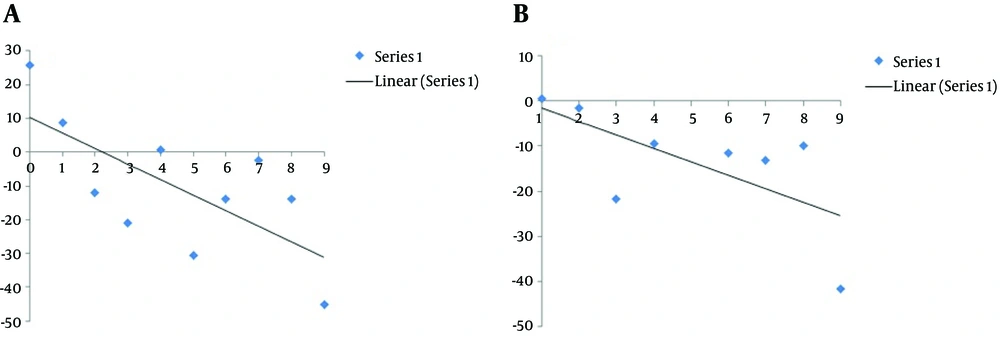
Figure 1.
Observed data and regression lines representing differences between right-hand and left-hand responses as a function of number magnitude. A, parity judgment task; B, the number of comparison task. Positive differences show faster left-hand responses; negative differences show faster right-hand responses
In the second step, two linear mixed models were used for each task with dRTs as the dependent variable and number magnitude as covariate. The main effect of number magnitude was significant for both tasks (P < 0.001). Models showed the following equations:
Parity judgment task: dRT = 8.3 - 4.3 (number)
Comparison task: dRT = 0.81 - 2.90 (number)
Table 1 represents the demographic and clinical characteristics of the control and patient groups. The two groups were well matched for age, gender, and years of educations.
Table 1.Demographic and Clinical Characteristics of Patients with Schizophrenia and Controls in Experiment 2
| Patients | Controls | P Value | |
|---|---|---|---|
| Age | 36.7 (9.4) | 37.2 (9.8) | NS |
| Education | 11.0 (3.3) | 11.6 (2.9) | NS |
| Male sex, No. (%) | 22 (76.5) | 22 (76.5) | NS |
| Edinburgh | 99.1 (2.9) | 100 (0) | NS |
| Length of illness, y | 11.1 (9.9) | - | |
| Age of illness onset, y | 25.1 (9.2) | - | |
| Mean Chlorpromazine equivalent, mg | 574.7 (390.6) | - | |
| SANS | 24.1 (6.1) | - | |
| SAPS | 21.2 (4.8) | - |
Similar to the previous section, two linear mixed models were used for each task, with dRTs as the dependent variable, group as the factor, and magnitude as the covariate. In the parity task, the main effect of group was not significant (F [1, 447] = 2.01, P = 0.15), the main effect of number magnitude was not significant (F [1, 601] = 2.30, P = 0.13), and the interaction effect between group and number magnitude was not significant (F [1, 601] = 0.81, P = 0.37).
In the comparison task, the main effect of group was not significant F [1, 7138] = 0.91, P = 0.34), the main effect of number magnitude was significant (F [1, 1216] = 34.7, P < 0.001), and the interaction effect between group and number magnitude was not significant (F [1, 1216] = 2.26, P = 0.13).
Models showed the following equations: Group: SCZ = 1, control = 0
Parity judgment task:
dRT = 20 - 36 (group) - 5 (number)
Comparison task:
dRT = 60 - 34 (group) – 15 (number) (Figure 2)
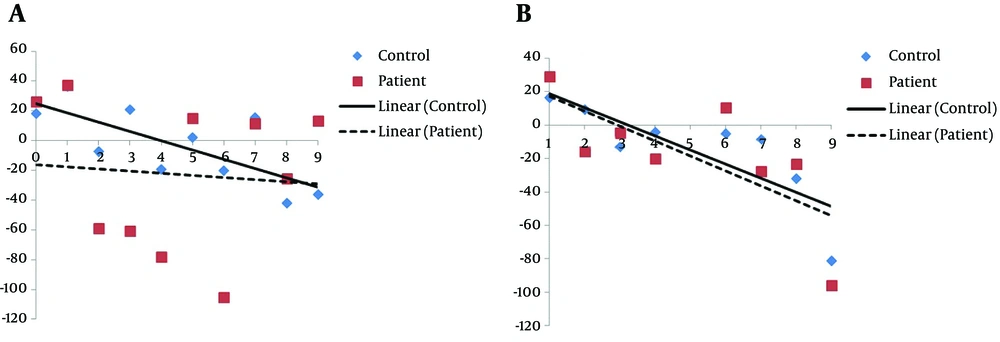
Figure 2.
Scatter plots of SNARC effect for patients with schizophrenia and control groups. A, parity judgment task; B, the number of comparison task
5. Discussion
The interaction between number and space (SNARC effect) is an interesting topic in cognitive neuroscience. In this study, we investigated this interaction at first in Persian speaking students and then in a group of Persian-speaking patients with schizophrenia, with ‘mixed-reading habit’.
Previous studies have shown a negative association between dRTs and number magnitude in English-speaking people, as the SNARC effect reflects the association between number magnitude and response side. Therefore, if Persian-speaking people show similar SNARC effect to English-speaking people, we would expect that greater numbers would elicit faster right hand than left-hand responses and small numbers would elicit faster left-hand than right-hand responses. The results showed that the SNARC effect is present in Persian people. As mentioned already in Persian the direction of reading and writing for words and numbers are inconsistent. Our finding is consistent with other studies showing there is no causal relationship between reading habit for words and SNARC effect. Ito and Hatta found a reversed SNARC effect in Japanese readers, suggesting the reading habits for words and the direction of the SNARC are independent (9). However, our findings are contrary to the studies by Dehaene et al. and Shaki and Fischer who have shown that the direction of word reading contributes to the SNARC effect (1, 18). The discrepancy of our results with those studies might be related to different sample sizes (Shaki = 16, Dehaene = 20), and the known flexibility of the SNARC effect, even within the participants. For example, Bachtold et al. showed reversed SNARC effect by asking participants to think of numbers as indicated on a clock face (19). Moreover, Shaki and Fischer observed that the SNARC effect was modulated by reading a short paragraph of text in either Hebrew or Russian in bilingual participants (18). Particularly, they showed that the strength of the SNARC effect could be modulated within a few minutes for a particular person (18).
One limitation of our study is that Persian university students have some interaction with the English language, thus one may argue that the observed effect is the result of familiarity with left to right reading direction. However, in the second part, healthy participants with fewer years of education who had less exposure to the English language also showed similar SNARC effect compared with the university students. Another limitation of our study was that all patients were on their medications. It is known that chronic psychotropic drug treatment may lead to structural remodeling of the brain. Therefore, more research is needed to examine SNARC effect in drug naïve schizophrenia patients.
According to our findings, we suggest that the direction of reading and writing of numbers affected the relationship between numbers and space in a culture with mixed-reading habit, not the direction of reading words.
The results also showed a classic negative slope for the patients with schizophrenia, which did not differ from that of controls. Comparison of SNARC effect in the patients and controls indicates that the position of a digit on the mental number line and response hand were congruent. This finding indicates that spatial nature of number representation (mental number line) is preserved in patients with schizophrenia. In fact, preserved SNARC effect shows that the patients may benefit from the congruency between the side of number presentation and its relative location on the mental number line. Our finding was consistent with two studies on neuropsychiatric patients that showed a standard SNARC effect in patients with left hemispatial neglect (11, 12).
A large body of neuroimaging and neuropsychological studies indicate that parietal cortex, particularly the horizontal portion of the intraparietal sulcus (IPS) is the core cortical circuits for number processing (20). Recently, using functional near-infrared spectroscopy Cutini et al. found the bilateral IPS and left angular gyrus activation in the SNARC effect, supporting the spatial nature of numerical magnitude representation (21). While a piece of evidence shows the relationship between cognitive and behavioral impairments in patients with schizophrenia is due to the disruption of the frontal cortex, the temporal cortex and the basal ganglia, pieces of evidence for the role of parietal lobe are not consistent (22). Although some researches did not find dysfunction of the parietal lobe in the patients, others have found its dysfunction, particularly in posterior parietal cortex. Our results may show that some region of parietal cortex, particularly intraparietal sulcus, is intact in schizophrenia.
In conclusion, our finding demonstrates that the representation of numbers in a culture with mixed-reading habit depends on the direction of number reading. Also, patients with schizophrenia showed similar SNARC effect compared to healthy individuals, indicating a preserved association between number and space in schizophrenia.


