




1. Background
In stressful circumstances, such as public health crises, the older adults' capabilities to cope with the tension diminish. It consequently decreases their mental health and well-being (1, 2). Mental vitality is one of the variables improving the older adults' quality of life and health condition. This variable is tied to the psychological well-being concept and attributes to a state where the individual feels positive, energetic, and delightful. In other words, there is a close relationship between mental vitality, happiness, and social interactions (3, 4). Happiness is another positive emotion, contrasting with negative emotions such as depression, anxiety, and despair (4, 5).
In the last two years, the coronavirus pandemic has been recognized as the most concerning public health crisis worldwide (6). Meanwhile, unlike the younger generations, older adults have been among the most vulnerable groups. Multiple studies have demonstrated that the coronavirus mortality rate is higher for older adults (7, 8). On the other hand, some studies have demonstrated that the frequency of mental disorders has increased, such that more than a third of people have had mental health problems and reduced well-being during the coronavirus pandemic (9, 10). The data suggest that the decline of social connections and consequently distancing from loved ones, loss of freedom, and unpredictable nature of the disease have exacerbated psychological disorders such as depression, anxiety, especially coronavirus anxiety, feeling lonely, and reduced positive emotions such as happiness and vitality (2, 9-11). A study conducted by Wang et al. (6) in China, with a high percentage of COVID-19 patients, reported that their well-being deteriorated due to simultaneous psychological problems such as anxiety, stress, and depression.
Physical activity has a positive physiological, psychological, and social impact and, therefore, is one of the health indicators (12). Older adults with proper activity will be physically and mentally healthier (13). Studies have demonstrated that exercise increases the number of new neurons, boosts the immune system, and enables the person to perform cognitive activities better, elevating their mental and psychological status (14-17).
If the present study can determine the impact of physical activity on the ability of older adults to adapt to the COVID-19 pandemic, we can utilize this information to improve the physical and mental well-being of the elderly population. This, in turn, will enable them to better cope with the disease and its associated challenges. Considering that older adults are among the most vulnerable groups in society and comprise about 10% of the Iranian population, according to the latest census (13), improving their health is one of the country's major priorities.
2. Objectives
This study investigated cognitive status, mental vitality, happiness, loneliness, and coronavirus anxiety among two groups of active and inactive older men during the COVID-19 outbreak.
3. Methods
3.1. Participants
This is applied research regarding purpose and causal-comparative in nature and method. The statistical population comprises 60-75-year-old men in Birjand city of Iran. According to Cochran's formula, at the confidence level of 95% and measurement error of 0.05, the sample size was determined to be 400 people using the convenience sampling method. The subjects were selected using the data from recreation, tourism, sports centers, and retirement associations in Birjand based on inclusion and exclusion criteria. In this study, 452 older adults entered the survey, but 400 people answered the questionnaire completely and registered it. Of these, 219 people were active based on the Sharkey physical activity index.
Inclusion criteria were an age of 60 - 75 years, injecting two doses of COVID-19 vaccine, scoring a minimum of 18 on the mini-mental status examination (MMSE), the ability to communicate verbally, literacy, cognitive health, no history of severe mental or physical disorders, no self-reported history of alcohol, narcotics, and drug addiction, and informed consent to participate in the study. Exclusion criteria included not completing the questionnaire or not answering the questionnaires thoroughly. In the execution phase, the researcher first sought to reach the subjects in person or through phone calls, then introduced himself, provided the necessary explanations about the research objectives and the confidentiality of the information, and obtained the oral consent of the older adults. The questionnaires were completed by individuals in the presence of the examiner.
3.2. Instruments
The researcher-made demographic characteristics questionnaire included information such as age, weight, height, marital status, education, and economic status.
3.3. Mini-mental Status Examination
This test is a structured method that evaluates the consciousness and cognitive status of the respondents. Cognitive functions studied in this test include orientation memory, recording, attention and computation, short-term memory, various language functions, and spatial thinking (18). Also, the reliability of this test is reported as 0.78 using Cronbach's alpha method (19).
3.4. Sharkey Physical Activity Index
A 5-point Likert index is used to score the questions. Thus, the total score ranges from 5 to 25 points. Given that the subjects in the present study were divided into active and inactive, the active individuals scored above 15, whereas the inactive individuals scored below five. The validity and reliability of this index have been reported as 0.78 and 0.82, respectively (20).
3.5. Oxford Happiness Inventory
This questionnaire consists of 29 questions with a 4-point scale from zero to 3, so the maximum total score in this test is 87, and the minimum is zero. The reliability of this questionnaire has been reported through Cronbach's alpha of 0.92 (21).
3.6. Subjective Vitality Scale
The scale measures the energy and desire of people to enjoy life and have optimal performance. It has seven questions that are measured based on a 7-point Likert scale (ranging from strongly disagree to strongly agree). The total scores range from 7 to 35 (22). Considering the Cronbach's alpha coefficient, the scale's reliability is 0.79 (23).
3.7. Social and Emotional Loneliness Scale for Adults
This scale includes 15 items and three subscales of romantic loneliness (five items), family (five items), and social loneliness (five items). The emotional loneliness score is obtained from the total scores of romantic and family subscales. Each item is on a 5-point Likert scale. The developers of this scale have reported Cronbach's alpha coefficient between 0.87 and 0.90, which indicates the appropriate internal consistency of the scale (24). Also, in Jokar and Salimi's research, Cronbach's alpha coefficients for romantic, social, and family loneliness subscales were 0.92%, 0.84%, and 0.78%, respectively (25).
3.8. Corona Disease Anxiety Scale
This scale measures the anxiety caused by coronavirus disease in Iran. The final version of this scale has 18 items and two components whose 1 to 9 items measure psychological symptoms and 10 to 18 items measure physical symptoms. The 4-point Likert scale is employed to measure the items (26). The reliability of this tool was obtained via Cronbach's alpha of 0.87 for the first factor, 0.86 for the second factor, and 0.91 for the whole questionnaire (26).
3.9. Data Analysis
Descriptive and inferential statistics (Kolmogorov-Smirnov test, covariance, and Pearson correlation) were employed to analyze the data using SPSS software, version 18. Statistical significance was defined at P ≤ 0.05.
4. Results
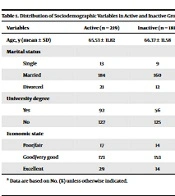
The Kolmogorov-Smirnov test results showed that all variables' frequency distribution corresponded to the normal distribution. Table 1 illustrates the demographic data for active and inactive participants. According to the chi-square test, there was no significant difference between active and inactive groups regarding demographic data such as age, marital status, education, and economic status (P ≥ 0.05).
Table 1.Distribution of Sociodemographic Variables in Active and Inactive Groups a
| Variables | Active (n = 219) | Inactive (n = 181) |
|---|---|---|
| Age, y (mean ± SD) | 65.53 ± 11.82 | 66.37 ± 11.58 |
| Marital status | ||
| Single | 13 | 9 |
| Married | 184 | 160 |
| Divorced | 21 | 12 |
| University degree | ||
| Yes | 92 | 56 |
| No | 127 | 125 |
| Economic state | ||
| Poor/fair | 17 | 14 |
| Good/very good | 173 | 153 |
| Excellent | 29 | 14 |
a Data are based on No. unless otherwise indicated.
The results of covariance analysis showed a significant difference between active and inactive groups in happiness, mental vitality, loneliness, coronavirus anxiety, and cognitive status.
The results suggested that active older adults earned significantly higher scores in cognitive status (P < 0.01), happiness (P < 0.02), and mental vitality (P < 0.01). Meanwhile, the levels of coronavirus anxiety (P < 0.03) and loneliness (P < 0.01) in active respondents were significantly lower in them (Table 2).
Table 2.The results of Covariance Analysis for Research Variables in Two Groups of Active and Inactive Older Adults a
a Values are expressed as mean ± SD.
b P-values (P < 0.05) refer to the significance level in covariance analysis (between-group differences).
Based on the results of the correlation test, an inverse correlation was observed between the cognitive status and corona anxiety in active and inactive elderly (r = -0.51 and P < 0.01).
5. Discussion
According to the results of this study, active older adults had better cognitive function than inactive ones during the coronavirus pandemic. Likewise, Esteban-Cornejo et al. (17) and Garcia-Hermoso et al. (12) showed that physical activity significantly affected the cognitive function of older adults and improved their mental processes. Sabia et al. concluded that older adults who engage less in physical activity and gain more weight tend to have lower cognitive performance (27).
Electrophysiological studies demonstrate that physical activity enhances cognitive function through increasing neuro-electrical activity and blood flow in brain networks. Consequently, it improves attention levels. Numerous mechanisms have been proposed to describe the relationship between physical activity and cognitive function. These mechanisms fall into two categories: Physiological mechanisms and learning-developmental mechanisms. Physiological mechanisms include physical changes resulting from physical activity, such as increased cerebral blood flow, changes in neurotransmitters in the brain, structural changes in the central nervous system, and improved arousal levels. It has been stated that physical activity stimulates cognitive development (28, 29).
Today, the important role of physical activity in preventing disorders and improving mental and social health is greatly emphasized. The research results by Lee et al. (30) showed that the coronavirus outbreak has increased negative emotions such as anxiety, loneliness, and depression and decreased positive emotions such as vitality and happiness. Similar to the results of the present study, Ai et al. (31) and Brady et al. (14) demonstrated that in the COVID-19 era, the older adults who were physically active and had regular physical activity had a more favorable mental status than the inactive older adults.
Generally, older adults who can do physical activity are more likely to cope with senescent challenges such as loneliness and anxiety and enjoy a better life (10, 15). On the other hand, regular physical activity affects the individual's temperament by preventing negative thoughts, elevates their vitality and happiness by changing hormones such as serotonin, stress hormones, and endorphins, and eventually increases their energy level (9, 16, 31).
In addition, the present study showed a significant correlation between cognitive status and coronavirus anxiety in both groups. Inactivity is one of the factors causing many mental disorders, such as anxiety and cognitive impairment. This study's results align with Psychou et al.'s (32) and Sepulveda-Loyola et al.'s (11) findings. According to these results, people who cannot cognitively regulate their emotions and, in other words, have lower psychological well-being are more vulnerable to coronavirus anxiety (32, 33).
We can explain the anti-anxiety effect of exercise based on various physiological, social, and mental mechanisms. Physiologically, exercise can have anti-anxiety effects by achieving physical fitness, affecting the level of neurotransmitters and stress hormones such as cortisol, and reducing muscle tension (32). Socially, it expands the network of relationships; thus, the person feels more secure and enjoys more social support, reducing their anxiety in the face of crises and problems (16, 34). Mentally, exercise can reduce anxiety by increasing the activity level and subsequently increasing self-confidence and feelings of self-sufficiency and self-efficacy (10, 32).
The present study only measured the physical activity of the subjects, and the type and intensity of exercise were not controlled, so it is suggested to conduct more studies to differentiate the effect of the type of exercise (aerobic and resistance) with different intensities (light, moderate, and severe) on the cognitive status of older adults.
5.1. Conclusions
According to the results of this study, active older men had a more appropriate cognitive status and mental health than their inactive counterparts, who experienced more loneliness and coronavirus anxiety. Therefore, engaging older adults in physical activities can be suggested as an effective technique to improve the cognitive status and mental health of older adults.