


1. Background
Social comparison creates a complex reaction in people; when one lacks the characteristics, possessions, or achievements of another, this reaction is called envy (1). Research with a long history considered envy more as an episodic construct (1, 2), but after it began to be discussed in the field of individual differences, it also appeared at the dispositional level (3, 4). Dispositional envy is assumed to be a single construct with two main components: (1) Feelings of inferiority resulting from negative upward social comparison, and (2) bad intention resulting from a sense of injustice, albeit subjectively (4).
The Dispositional Envy Scale (DES), adapted from Smith et al. (4), is one of the most common tools for measuring envy. It has been introduced as a reliable and internally consistent scale for measuring one-dimensional envy focused on feelings of inferiority, resentment, and hostility (3). The envy subscale of the vices and virtues questionnaire is also used as another measurement (5). In the Domain-Specific Envy Scale (6), dispositional envy is viewed from a different approach, defining envy as "the experience of intense unpleasant emotions when faced with negative social comparison".
Contrary to previous unidimensional approaches, based on the dual envy theory, recent studies have identified two types of envy: Benign and malicious (3, 7). According to this theory, upward social comparisons lead to both types of envy in important areas and are a source of threat to the individual (7). The unidimensional approach suggests a particularly negative and hostile reaction (8, 9), but according to the two-dimensional theory, there are two distinct responses to counter ego-threats: Through benign envy by improving one's own position or through malicious envy by devaluing a superior other (7, 10).
In general, people tend to compare with each other and are situationally sensitive when threatened, although there are differences in the type of negative affective response. According to these differences, two distinct components of envy were proposed by Lange and Crusius (11) at the dispositional level. According to the frequency theory of engagement in social comparisons (4), which takes a unidimensional view of the dispositional character of envy, both types of envy are characterized by feelings of inferiority and smallness, extreme comparison, and a disturbing experience when facing people higher than oneself (3, 11). However, there are differences between these two types of envy at different levels of motivation, emotions, and behavior. Malicious envy is a deep feeling of animosity and hatred towards a successful person perceived as unworthy, while the feeling of respect and admiration for the superiority of another can create benign envy, motivating a person to improve and succeed (3, 7, 10-12).
More precisely, the expression of both types of envy depends on situational threat, such that benign envy develops from sensitivity to prestige threat, and malicious envy from sensitivity to dominance threat, leading to different behaviors (3). To measure these two types of envy, the Benign and Malicious Envy Scale (BeMaS) was developed by Lange and Crusius (11). The results of this study, including exploratory factor analysis (EFA) and confirmatory factor analysis (CFA), showed that BeMaS reveals two factors. Both sub-components were confirmed in terms of psychometric indicators such as reliability, internal consistency, convergent validity, and dual separation (11).
An interesting result of this study showed that only the malicious envy scale showed a positive relationship when faced with unidimensional envy. In contrast, no correlation was shown with any previous measures of envy and benign envy (3, 11). This result can bring a new quality to studies. In line with the notion that the two envy forms clarify envy’s diverse relationships with motivation, emotion, and behavior, the dispositional BeMaSs also showed partly distinct correlational patterns with various outcomes (3).
The BeMaS was developed to increase understanding of the impact of envy on human behavior and interpersonal relationships. Envy can act as a motivator for personal growth, especially when benign envy is viewed as a positive force (11). However, malicious envy can lead to harmful behaviors, and understanding and managing this emotion is essential to maintaining mental health and social well-being (11). The BeMaS has high reliability and validity and is recognized as a valid tool for measuring envy in different cultures (13, 14). However, cultural differences in the interpretation of envy may affect research results (4). Despite its strengths, there is a need for further psychometric evaluation to confirm its applicability in different populations.
Malicious envy is recognized as a negative and destructive emotion that can lead to hostile and harmful behaviors. This type of envy is typically associated with negative feelings such as resentment, hatred, and a desire for revenge. It has the potential to contribute to the development of psychological disorders, including anxiety, depression, and personality disorders (9). Studies have been conducted in different countries to investigate the psychometric properties of BeMaS, the results of which indicate the reliability and validity of this scale in revealing two specific factors. For example, studies by Inoue and Yokota (13) in Japan, Kwiatkowska et al. (14) in the United States, Germany, Russia, and Poland, Fam et al. (15) in Malaysia, and Cirpan and Ozdogru (16) in Turkey.
In today’s world, envy is a prevalent phenomenon in human relationships that has profound effects on behavior and mental health. A precise understanding of the various dimensions of envy and its management is essential for maintaining mental well-being and improving social relationships. The utilization of the BeMaS and its development across different cultures can assist researchers in gaining a better understanding of envy and pave the way for effective interventions aimed at managing these emotions.
The primary objective of this study is to standardize the BeMaS within the Iranian population. By standardizing this questionnaire, we intend to provide a valid tool for measuring envy within Iranian culture that can assist researchers and practitioners in gaining a better understanding of the various dimensions of envy and its impacts on behavior and interpersonal relationships within this community.
2. Objectives
The objectives of the present study were as follows: (A) To examine the psychometric properties of the Persian Version of the Benign and Malicious Envy Scale (PBeMaS) utilizing CFA; (B) to assess malicious envy in an Iranian sample using the PBeMaS; (C) to confirm whether the PBeMaS is bidimensional, as was found in the original validation study by BeMaS (11); and (D) to replicate and extend the relationships of dispositional benign and malicious envy with appraisal patterns and achievement motivation.
3. Methods
3.1. Participants and Procedure
In the present study, 429 people (138 males and 291 females) participated using a convenience sampling method. Participation in the research was completely voluntary; participants had the right to withdraw from the study at any time. At the end of the survey, only the complete, approved, and final questionnaires were submitted to the database by the participants.
Two native speakers of English translated the items from English to Farsi separately, and any differences in opinion were resolved through consultation. Next, the Farsi translations were back-translated into English by two other individuals who were unaware of the original scale. After these two stages, the main and final wording of the Persian items was determined for implementation.
In total, 440 Iranian adults (67.83% female, 32.17% male, aged 18 - 61 years) were initially considered for the study after obtaining informed consent. Demographic and socio-economic data such as age, gender, marital status, and education were collected from the participants. Of these, 429 participants completed the survey without issues, while 7 participants answered only half of the survey, and 4 participants missed at least one answer, leading to their exclusion from the study.
Data was collected from approximately January to June 2021 using the Google Forms platform. Inclusion criteria for the study included Iranian adults aged 18 years and older. Exclusion criteria included individuals who were unable to provide complete responses or did not meet the age requirement. This study received ethical approval from the University of Zanjan Ethics Committee with the approval code IR.ZNU.REC.1401.025.
3.2. Measures
Demographic Questionnaire: This tool was designed by the research team to collect information on participants' gender, age, marital status, and education level.
3.2.1. Benign and Malicious Envy Scale
This self-report scale assesses envy using 10 items, divided into two factors — benign envy and malicious envy — each consisting of five items. Responses are recorded on a 6-point Likert scale ranging from 1 (strongly disagree) to 6 (strongly agree), with higher average scores indicating greater envy. The scale was first validated in four studies by Lange and Crusius (11), demonstrating appropriate validity and reliability. Subsequent research has also confirmed its adequate validity and reliability (13, 14).
3.2.2. Performance Failure Appraisal Inventory
Originally developed by Conroy, this self-report instrument is scored on a 5-point Likert scale (17). The original version contained 41 items and assessed components such as shame and embarrassment, fear of losing social influence, and fear of upsetting others. The reliability and validity of this instrument have been deemed acceptable for the Iranian population (18). In the present study, the Cronbach’s alpha coefficient was 0.898.
3.2.3. Achievement Motivation Test
This questionnaire presents 29 incomplete sentences to measure achievement motivation. The reliability coefficient for this tool has been calculated as 0.84, and a test-retest reliability coefficient of 0.84 has also been reported (19). In Iran, the Cronbach’s alpha for this questionnaire has been reported as 0.79. In the present study, the Cronbach’s alpha coefficient was 0.704.
3.3. Data Analysis
Statistical software, including IBM SPSS version 28.0 and Amos version 21.0, was used to analyze the collected data. Item analysis, CFA, correlation analysis, and reliability analysis were conducted. The structural equation modeling method was employed using a variance-based approach, and the analysis was conducted using maximum likelihood estimation.
4. Results
The demographic characteristics of the participants, including age (ranging from 18 to 61 years), gender (138 males and 291 females), marital status, and education, are presented in Table 1.
Table 1.Demographic Characteristics of Participants
| Variables | Values |
|---|---|
| Sample size | 429 |
| Age; mean ± SD | 33.58 ± 9.04 |
| Gender | |
| Male | 138 |
| Female | 291 |
| Marital status | |
| Single | 165 |
| Married | 246 |
| Divorced | 18 |
| Education | |
| Under diploma | 12 |
| Diploma | 36 |
| Bachelor degree | 183 |
| Master's or Ph.D | 198 |
4.1. Descriptive Analysis
Descriptive measures, including standard deviation, skewness, and kurtosis for all BeMaS items, are presented in Table 2. As can be seen, all items exhibit normal distribution, as they fall within the acceptable range of ±2. Additionally, various assumptions, such as normality using the Kolmogorov-Smirnov test, homoscedasticity, linearity, and absence of multicollinearity, were assessed. The results confirmed that all necessary assumptions for CFA were met.
Table 2.Descriptive Analysis for Benign and Malicious Envy Scale Items
| Items | Mean ± SD | Skew | Kur |
|---|---|---|---|
| 1. I focus on how I can become equally successful in the future, when I envy others. | 3.44 ± 1.52 | -0.26 | -1.20 |
| 2. I wish that superior people lose their advantage. | 1.78 ± 1.09 | 1.50 | 1.64 |
| 3. I try to improve myself, if I notice that another person is better than me. | 4.45 ± 1.21 | -1.22 | 1.26 |
| 4. Envying others motivates me to accomplish my goals. | 2.93 ± 1.60 | 0.20 | -1.44 |
| 5. If other people have something that I want for myself, I wish to take it away from them. | 1.62 ± 0.89 | 1.63 | 2.29 |
| 6. I feel ill will toward people I envy. | 1.96 ± 1.13 | 1.12 | 0.38 |
| 7. I strive to reach other people’s superior achievements. | 3.95 ± 1.42 | -050 | -0.67 |
| 8. Envious feelings cause me to dislike the other person. | 2.95 ± 1.58 | 0.22 | -1.40 |
| 9. If someone has superior qualities, achievements, or possessions, I try to attain them for myself. | 3.41 ± 1.42 | -0.31 | -1.12 |
| 10. Seeing other people’s achievements makes me resent them. | 1.83 ± 0.98 | 1.15 | 0.52 |
Abbreviations: Skew, skewness; Kur, kurtosis.
4.2. Construct Validity
To evaluate construct validity, we used the zero-order correlation method to examine the correlation of the BeMaS with other tools (Table 3). The results show a significant relationship between benign envy and achievement motivation (r = 0.18, P < 0.01), but no significant relationship was observed with fear of failure (r = 0.09, P > 0.01). In contrast, malicious envy has a strong significant positive relationship with fear of failure (r = 0.35, P < 0.01) and a significant negative relationship with achievement motivation (r = -0.28, P < 0.01). Overall, these results demonstrate the construct validity of the BeMaS.
Table 3.Descriptive Statistics and Zero-Order Correlations of the Scales
a P ≤ 0.01.
4.3. Reliability
The results of the reliability analysis and McDonald's omega indicated that both benign envy (5 items; α = 0.763, McDonald's omega = 0.759) and malicious envy (5 items; α = 0.745, McDonald's omega = 0.743) have good internal consistency. Based on these results, it can be concluded that the BeMaS is a reliable measure of benign and malicious envy.
4.4. Confirmatory Factor Analysis
To evaluate the two-factor structural validity of the BeMaS, CFA with maximum likelihood estimation was conducted using AMOS software (Table 4). As shown in Figure 1, there are two latent constructs (benign envy and malicious envy), each comprising 5 items. The results also showed a statistically significant value (P < 0.001) with χ² (df) values of 87.32. This two-factor structure of the BeMaS indicates a satisfactory model fit, with all fit indices meeting predetermined cut points (GFI = 0.95, CFI = 0.92, RMSEA = 0.08). Therefore, the factorial validity of the BeMaS is supported by the CFA results. A graphical representation of the two-factor structure model is shown in Figure 1.
Table 4.Model Fit Index (N = 429)
| Model | sbX2 | CFI | NFI | IFI | PNFI | GFI | RMSEA |
|---|---|---|---|---|---|---|---|
| 2-Factor | 116.83 | 0.92 | 0.90 | 0.92 | 0.60 | 0.95 | 0.08 |
Abbreviations: CFI, Comparative Fit Index; NFI, Normed Fit Index; IFI, Incremental Fit Index; PNFI, Parsimony Normed Fit Index; GFI, Goodness of Fit Index; RMSEA, Root Mean Square Error of Approximation.
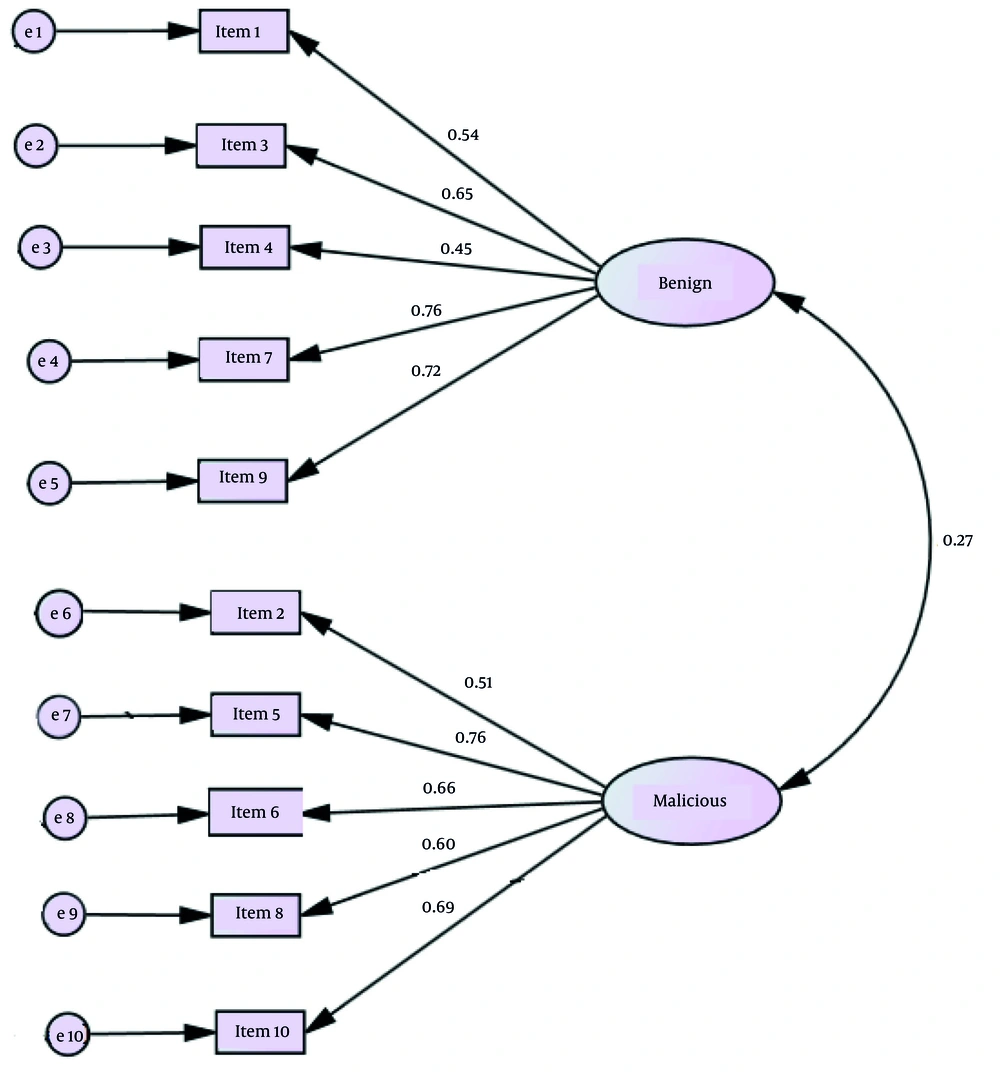
Figure 1.
Two-factor structure model for Benign and Malicious Envy Scale (BeMaS)
5. Discussion
The present study aimed to investigate the psychometric properties of the BeMaS as a tool for measuring two types of envy, benign and malicious, in Iranian adults. Due to the lack of valid measures in the current literature, this scale was chosen for the simultaneous assessment of benign and malicious envy, addressing the absence of such an instrument in the Iranian population. The psychometric evaluations of the BeMaS, which included CFA and Pearson correlation analysis, supported the excellent psychometric properties of the BeMaS for the Iranian adult population. Additionally, the BeMaS demonstrated satisfactory internal consistency.
The findings of this research are consistent with other studies conducted (13-16), and no inconsistencies were found, indicating the validity of the items in this questionnaire. This characteristic validates the questionnaire as a reliable tool for the Iranian population. The CFA model showed an acceptable fit to the data, including two factors from the original version (11).
To assess the construct validity of the BeMaS, we investigated the relationship between the BeMaS and other psychological variables. No significant relationship was found between benign envy and fear of failure, but a positive and significant relationship was observed between malicious envy and fear of failure. Additionally, there was a significant positive correlation between benign envy and achievement motivation, and a significant negative correlation was seen between malicious envy and achievement motivation. Therefore, the findings of the present study are consistent with previous studies, as these studies tend to depict malicious envy with negative consequences and benign envy with positive consequences (8, 11, 20).
Lange and Crusius (11) in their study raised the optimism that the BeMaS can effectively predict the distinct relationships of different forms of envy with other important personality traits and mental health. The results of the psychometric analyses, including CFA and Pearson correlation analysis, indicate very good validity of the BeMaS scale for the Iranian adult population. This finding is particularly significant given the absence of valid instruments in the existing literature for measuring envy within the Iranian population. Thus, the BeMaS emerges as a new and reliable tool in this area, which can significantly contribute to future research in the field of envy and psychology.
In general, the BeMaS showed acceptable psychometric properties in the present study for the Iranian adult population. However, some limitations of this study should be noted. Firstly, the number of participants in the present study was limited, which should be considered in the interpretation of the findings and their generalization. To better generalize the findings of the present research, future studies should examine the psychometric properties of the BeMaS in other populations. Additionally, the evaluations of the test level were used for psychometric evaluations in the present study. To overcome this limitation, the use of an item response theory approach is suggested for future studies.
5.1. Conclusions
In summary, the current research represents a step toward initiating more studies in the field of envy. Considering recent theorizing and the dual dimensions of envy — positive (benign) and negative (malicious) — the BeMaS appears to be an attractive measure of envy. The results of our study demonstrated that the BeMaS is a valid and reliable tool for measuring the two dimensions of malicious and benign envy in the Iranian population. This tool can assist researchers and clinicians in quickly assessing feelings of envy and stimulating research ideas. Therefore, the findings of the present study on benign and malicious envy can provide new insights and perspectives for a better understanding of this social phenomenon in future research.



