


1. Background
Obsessive-compulsive disorder (OCD), as defined in the DSM-5, is a mental disorder characterized by intrusive, anxiety-provoking obsessions and repetitive compulsive behaviors performed to reduce anxiety or prevent a feared event (1, 2). Common manifestations include excessive handwashing, repeated checking, or rigidly performed routines (3). The disorder affects about 2 - 3% of the global population, typically emerging in adolescence or early adulthood (4-6).
Obsessive-compulsive disorder substantially impairs quality of life, social functioning, and occupational performance, and without treatment may result in comorbid depression, other anxiety disorders, or suicidal behavior (7, 8). Recent neuropsychiatric evidence (2025) indicates that metacognitive beliefs are stronger predictors of obsessive-compulsive symptoms than perfectionism and responsibility, highlighting the central role of metacognition in OCD pathology (9).
Obsessive-compulsive disorder severely impairs daily functioning, making it crucial to identify cognitive and personality factors influencing its onset and severity (5). Beyond depression and social isolation, it disrupts family, work, and social life (10). Investigating these variables enables targeted interventions (11). A 2024 systematic review highlighted that integrative models combining cognitive, personality, and metacognitive domains best predict OCD severity across clinical and non-clinical groups, improving treatment and reducing the disorder’s psychological and economic burden (12).
Research shows that obsessive beliefs, perfectionism, and inflated responsibility significantly contribute to OCD severity (13, 14). Obsessive beliefs involve unrealistic responsibility for preventing harm or controlling thoughts (15). A 2024 survey found higher OBQ-44 scores correlated with increased checking and washing compulsions, even after controlling demographics (16). Perfectionism, defined as excessively high standards and self-criticism, also relates to OCD. A 2025 study showed positive perfectionism is inversely linked to symptom severity, while negative perfectionism has no direct effect (17). Inflated responsibility, an exaggerated sense of accountability for preventing harm, predicts compulsive behaviors. Prospective 2025 data confirmed responsibility beliefs predict checking behaviors over six months, underlining their role in symptom maintenance (10).
Studying these factors in vulnerable groups is vital. Young adults in Karaj, Iran, face social and cultural pressures that may shape OCD expression (18-21). Research in this non-clinical population can identify early risk markers. While focused on Karaj youth, the studied mechanisms — obsessive beliefs, perfectionism, responsibility, and metacognition — are relevant to broader populations and clinical settings.
Metacognitive beliefs, or attitudes toward thought control, mediate links between cognitive traits and OCD symptoms (22-26). They heighten anxiety by framing thoughts as dangerous or uncontrollable, fueling compulsions (24, 27). Negative metacognitive beliefs, shaped by perfectionism, obsessive beliefs, and responsibility, intensify symptoms (22, 24, 25). For example, positive metacognitive beliefs about worry (e.g., “Worrying helps me cope”) and negative beliefs about uncontrollability (e.g., “I cannot control my thoughts”) both exacerbate OCD (22, 24, 25). A 2025 study showed metacognition-focused interventions reduced compulsions more effectively than responsibility-targeted ones (9). Similarly, research on orthorexia found positive metacognitive beliefs about thought control predicted obsessive eating behaviors, suggesting metacognition shapes a spectrum of obsessive-compulsive conditions (28).
Despite extensive literature, gaps remain in understanding the precise mediating role of metacognitive beliefs — particularly how positive versus negative perfectionism interact with metacognitive processes (29, 30). Additionally, 2025 community research on parentification and OCD demonstrated that obsessive beliefs partially mediate the relationship between dysfunctional family roles and OCD symptom clusters, highlighting the need to integrate familial factors into cognitive–behavioral models (31).
2. Objectives
To address these gaps, this study aims to: (1) Quantify the direct effects of obsessive beliefs, positive/negative perfectionism, and responsibility on OCD symptoms in a non-clinical young adult sample from Karaj, Iran; (2) examine metacognitive beliefs (both positive and negative) as mediators between these cognitive-personality factors and OCD severity; (3) clearly articulate these research goals and situate them within the latest 2025 empirical findings; and (4) discuss how results obtained from a non-clinical urban cohort may generalize to other populations and clinical contexts. By explicitly stating study objectives, this research seeks to inform enhanced, metacognitively informed interventions for OCD symptom reduction and to provide a foundation for future longitudinal and cross-cultural investigations.
3. Methods
This study employed a cross-sectional, correlational design to examine relationships among obsessive beliefs, perfectionism, responsibility, and OCD symptoms in young adults aged 18 to 35 in Karaj, Iran.
3.1. Population, Sample Size Determination, and Sampling Method
3.1.1. Population and Rationale
The target population comprised all young adults (18 - 35 years) residing in Karaj, Iran. This developmental period is characterized by identity formation, academic and occupational pressures, and social role transitions, which may increase vulnerability to OCD‐related psychopathology.
3.1.2. Sample Size Determination
To ensure adequate statistical power for structural equation modeling (SEM), we conducted an a priori power analysis using G*Power 3.1 (Faul et al.) (32). Specifying α = 0.05, desired power (1 - β) = 0.80, and a small-to-medium effect size (f² = 0.04, corresponding to Cohen’s d ≈ 0.40), the analysis indicated a required sample of approximately 1,350 participants. Ultimately, 1,321 completed questionnaires were obtained, providing sufficient power for detecting direct and indirect effects in the hypothesized SEM.
3.1.3. Sampling Method and Bias Mitigation
We utilized multistage cluster sampling across Karaj, Iran’s ten administrative districts to improve representativeness while balancing logistical feasibility:
District selection: Four districts were randomly selected out of ten via random number generation.
Street selection: Within each chosen district, four streets were randomly selected.
Household selection: For each street, the total number of available postal codes (N) was divided by the target sample for that street (n) to calculate a sampling interval (a = N / n) (33). A random start (y) between 1 and a determined the first household; every aᵗʰ postal code thereafter was selected until the required number of households was reached.
Individual recruitment: Researchers visited selected addresses, explained study aims, and invited any resident aged 18 - 35 to participate. Upon consent, participants received a secure online link or QR code to complete the questionnaire. If no eligible resident was available, the next household on the postal list was approached.
Rationale for cluster sampling: Given the geographic spread of our target population across four distinct districts of Karaj, Iran and constraints on time and human resources, multistage cluster sampling offered an efficient and cost‑effective way to reach dispersed subgroups. By increasing the number of clusters (16 streets) and calculating the intraclass correlation coefficient (ICC ≈ 0.004), we ensured coverage of socioeconomically diverse neighborhoods and minimized sampling bias — advantages that simple random or stratified sampling could not provide within our logistical limits (34).
Bias mitigation: To mitigate bias, we calculated an ICC of 0.004 for the MOCI, indicating negligible clustering effects on standard errors, and we implicitly covered fourteen socioeconomic strata by selecting streets across varied districts — an approach that balanced representativeness with feasibility and ensured robust parameter estimation under real‑world constraints (35).
3.1.4. Inclusion and Exclusion Criteria
Inclusion: Young adults (18 - 35 years) enrolled in state universities in Karaj, Iran, who provided written informed consent and completed all study measures.
Exclusion: Individuals unwilling to participate, those who withdrew before finishing the questionnaire, or questionnaires with more than 10% missing responses on any key measure. To minimize dropout bias, participants were reminded by phone text once if they did not complete within two days.
3.1.5. Ethical Considerations and Incentives
The study adhered to the Declaration of Helsinki. Verbal and written informed consent were obtained from all participants. Confidentiality was maintained through anonymized codes. Participation was voluntary, with the right to withdraw at any time. As a token of appreciation — and to standardize incentives across all respondents — each participant was given a plastic folder with a snap‑button closure, a pen, and a small notebook upon completion of the questionnaire.
3.2. Instruments
Maudsley Obsessive-Compulsive Inventory (MOCI): Developed by Rachman and Hodgson (1977), this 30-item true/false questionnaire assesses OCD across four dimensions: Washing (11 items: 2, 5, 7, 8, 11, 14, 17, 20, 24, 27, 30), checking (9 items: 1, 3, 6, 9, 12, 15, 18, 21, 28), doubting (7 items: 4, 10, 13, 16, 19, 22, 26), and obsessive thoughts (3 items: 23, 25, 29). Total scores range 0 - 30; higher scores indicate greater severity. The Persian version shows test-retest reliability r = 0.80, internal consistency α = 0.70 - 0.80, and good construct validity (36-38); present study α = 0.91.
Obsessive Beliefs Questionnaire (OBQ-44): 44 items rated on a 7-point Likert scale (-3 = strongly disagree to 3 = strongly agree), assessing three subscales: Responsibility/threat estimation (16 items: 1, 5, 8, 10, 14, 17, 19, 22, 24, 27, 29, 31, 33, 36, 40, 43), perfectionism/need for certainty (16 items: 2, 4, 7, 9, 11, 13, 15, 18, 21, 23, 26, 28, 30, 34, 37, 41), and importance/control of thoughts (12 items: 3, 6, 12, 16, 20, 25, 32, 35, 38, 39, 42, 44). The Persian version shows α = 0.92, test-retest r = 0.82, and confirmed construct validity (39); present study α = 0.89.
Metacognitive Beliefs Questionnaire (MCQ-30): 30 items rated 1 - 4 (1 = do not agree, 4 = agree very much), covering five subscales: Uncontrollability/danger (6 items: 2, 8, 14, 17, 24, 30), positive beliefs about worry (6 items: 1, 7, 10, 19, 23, 28), cognitive self-consciousness (6 items: 3, 5, 12, 15, 18, 21), cognitive confidence (6 items: 4, 9, 13, 20, 22, 26), and need to control thoughts (6 items: 6, 11, 16, 25, 27, 29). The Persian version shows α = 0.80 - 0.93, with validated factor structure (40); present study α = 0.93.
Responsibility Questionnaire (Glenn and Nelson, 1998): 25 items rated 1 - 5 (1 = strongly disagree, 5 = strongly agree), with five dimensions: Self-management (9 items: 2, 3, 4, 6, 7, 8, 11, 12, 13), trustworthiness (4 items: 10, 19, 20, 21), conscientiousness (3 items: 16, 18, 23), organization (6 items: 5, 7, 9, 14, 15, 31), and progressiveness (3 items: 1, 14, 19). The Persian version demonstrates α > 0.70 and good construct validity (41); present study α = 0.94.
Positive and Negative Perfectionism Scale (PNPS): 40 items rated 1 - 5 (1 = strongly disagree, 5 = strongly agree), with 20 items each for positive (1, 3, 5, …, 39) and negative perfectionism (2, 4, 6, …, 40). Positive items assess striving and satisfaction with high standards (e.g., “I strive to do my best”); negative items assess distress over mistakes or imperfection (e.g., “I feel upset if my work is not perfect”). The Persian version shows α = 0.83 (positive) and 0.74 (negative), with validated two-factor structure (42); present study α = 0.89.
3.3. Data Analysis Method
Data were analyzed using SPSS version 25 and LISREL version 8.80 software. Descriptive statistics such as mean and standard deviation were used to describe the data. Path analysis was conducted using LISREL version 8.80 to test the research hypotheses.
3.3.1. Model Fit Indices and Interpretation
To evaluate the adequacy of the structural equation model, we used several well-established model fit indices. The chi-square to degrees of freedom ratio (CMIN/DF = 0.01) was substantially lower than the commonly accepted threshold of 3.0, suggesting excellent fit. Goodness-of-Fit Index (GFI = 0.99) and Adjusted Goodness-of-Fit Index (AGFI = 0.99) exceeded the recommended minimum value of 0.90, indicating high model accuracy. Additionally, the Comparative Fit Index (CFI = 0.99), Normed Fit Index (NFI = 0.99), and Incremental Fit Index (IFI = 0.99) were all above 0.95, confirming a very strong correspondence between the hypothesized model and the observed data. The Parsimony Normed Fit Index (PNFI = 0.99), which accounts for model complexity, also indicated an excellent fit (threshold > 0.50). Lastly, the Root Mean Square Error of Approximation (RMSEA = 0.001) was well below the acceptable limit of 0.08, further confirming minimal approximation error (43). Collectively, these values demonstrate that the proposed model represents the data structure very well, both statistically and practically.
3.3.2. Handling of Missing Data, Outliers, and SEM Assumptions
Cases with > 10% missing data on key variables were excluded, while remaining missing values were handled using Full Information Maximum Likelihood (FIML) in AMOS and LISREL, preserving sample size and yielding unbiased estimates under the MAR assumption; Little's MCAR test confirmed randomness of missingness (P > 0.05) (43). Data were screened for univariate outliers (± 3.29 SD) and multivariate outliers (Mahalanobis distance, P < 0.001), which were winsorized to nearest non-outlying values (44). Structural equation modeling assumptions were verified: Univariate normality (skewness -0.11 to 1.98, kurtosis -0.20 to 2.30), multivariate normality (Mardia’s skewness = 4.12, P = 0.15; kurtosis = 5.27, P = 0.08), and absence of multicollinearity (tolerance > 0.30, VIF 1.12–2.45) (44).
4. Results
Table 1 outlines the demographics of 1321 participants: 50.64% female, 51.32% university-educated, 50.87% under 25, and 52.38% single. Employment categories include students (26.80%), homemakers (24.30%), unemployed individuals (25.28%), and employed individuals (23.62%).
Table 1.Participants' Profiles (N = 1321)
| Variables | No (%) |
|---|---|
| Gender | |
| Female | 669 (50.64) |
| Male | 652 (49.36) |
| Education | |
| Non-university | 643 (48.68) |
| University | 678 (51.32) |
| Age (y) | |
| < 25 | 672 (50.87) |
| > 25 | 649 (49.13) |
| Marital status | |
| Married | 629 (47.62) |
| Single | 692 (52.38) |
| Employment | |
| Student | 354 (26.80) |
| Homemaker | 321 (24.30) |
| Unemployed | 334 (25.28) |
| Employed | 312 (23.62) |
Table 2 presents descriptive statistics for six variables. Mean scores range from 0.91 (obsessive beliefs) to 75.53 (metacognitive beliefs), with obsessive beliefs showing the highest standard deviation (49.64). Skewness is near zero, and kurtosis falls between -0.11 and 2.30, indicating an acceptable distribution.
Table 2.Descriptive Statistics of Research Variables
| Independent Variables | Mean | Median | Mode | Std. Deviation | Skewness | Kurtosis | Min-Max |
|---|---|---|---|---|---|---|---|
| Maudsley obsessive-compulsive inventory | 15.36 | 15.00 | 30.00 | 8.54 | 0.01 | -0.11 | 0.00 to 30.00 |
| Obsessive beliefs | 0.91 | 0.00 | 0.00 | 49.64 | 0.04 | 2.30 | -132.00 to 132.00 |
| Metacognitive beliefs | 75.53 | 76.00 | 120.00 | 20.68 | 0.02 | 1.11 | 30.00 - 120.00 |
| Responsibility | 75.25 | 75.00 | 75.00 | 20.13 | -0.05 | 1.64 | 25.00 to 125.00 |
| Positive perfectionism | 59.92 | 60.00 | 60.00 | 15.74 | -0.22 | 1.72 | 20.00 to 100.00 |
| Negative perfectionism | 59.36 | 60.00 | 60.00 | 16.73 | -0.01 | 1.38 | 20.00 to 100.00 |
Model fit indices demonstrate excellent alignment with data: CMIN/DF = 0.01, GFI, AGFI, NFI, CFI, IFI = 0.99, PNFI = 0.99, and RMSEA = 0.001 — all within or above recommended thresholds, confirming model adequacy (45).
The structural equation results are summarized as follows. Direct effects on OCD severity are depicted with their standardized coefficients in Figure 1 and detailed in Table 3. Obsessive beliefs positively predict OCD severity (β = 0.13, t = 4.75, P < 0.001), indicating a small effect; responsibility negatively predicts OCD severity (β = –0.18, t = -6.35, P < 0.001), a small‐to‐moderate effect; metacognitive beliefs positively predict OCD severity (β = 0.17, t = 6.22, P < 0.001), also small‐to‐moderate; and positive perfectionism negatively predicts OCD severity (β = –0.18, t = -6.75, P < 0.001), again a small‐to‐moderate effect. Negative perfectionism shows no meaningful direct impact (β = -0.03, t = -1.15, P = 0.25). All significant paths are highlighted by their P-values in Figure 2.
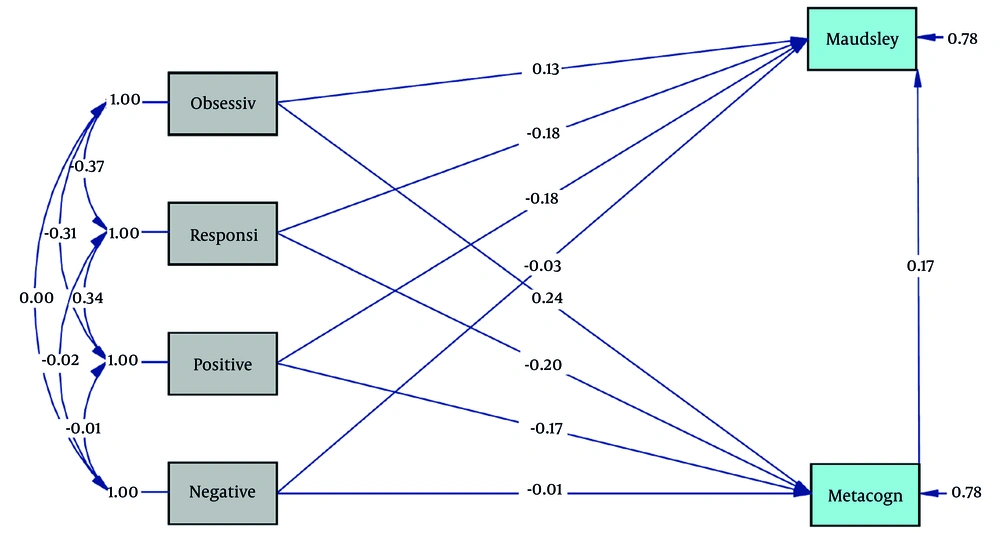
Figure 1.
Model standardized coefficients
Table 3.Values of Significance and Standard Coefficients in the Conceptual Model of the Research
| Independent Variables | Dependent Variable | Std. Coefficient | t-Value | P-Value |
|---|---|---|---|---|
| Obsessive beliefs | Obsessive-compulsive | 0.13 | 4.75 | < 0.001 |
| Responsibility | Obsessive-compulsive | -0.18 | -6.35 | < 0.001 |
| Metacognitive beliefs | Obsessive-compulsive | 0.17 | 6.22 | < 0.001 |
| Positive perfectionism | Obsessive-compulsive | -0.18 | -6.75 | < 0.001 |
| Negative perfectionism | Obsessive-compulsive | -0.03 | -1.15 | > 0.05 |
| Obsessive beliefs | Metacognitive beliefs | 0.24 | 9.01 | < 0.001 |
| Responsibility | Metacognitive beliefs | -0.20 | -7.51 | < 0.001 |
| Positive perfectionism | Metacognitive beliefs | -0.17 | -6.43 | < 0.001 |
| Negative perfectionism | Metacognitive beliefs | -0.01 | -0.31 | > 0.05 |
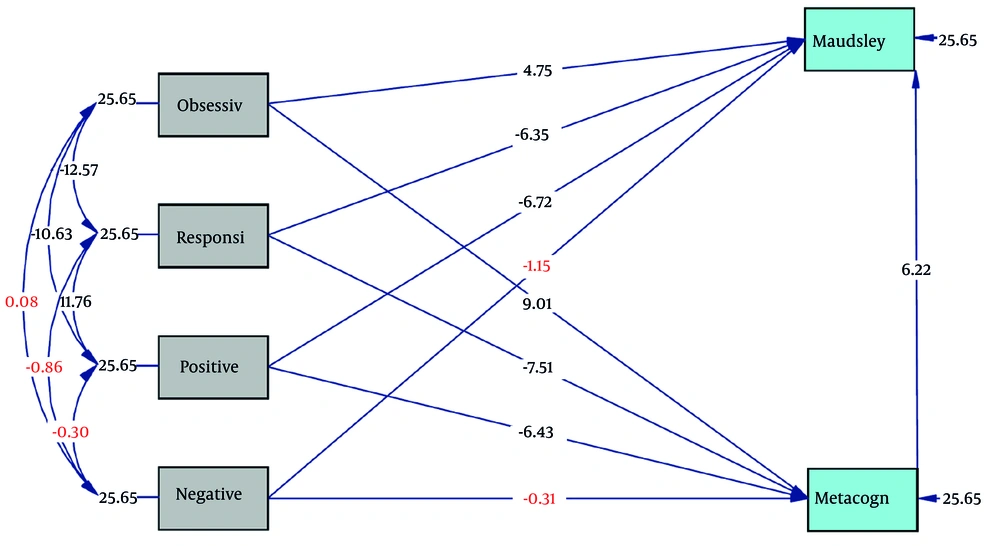
Figure 2.
Model significance coefficients
Indirect (mediated) effects via metacognitive beliefs are presented in Table 4 and likewise visualized in Figure 1 (standardized) and Figure 2 (significance). Obsessive beliefs exert a small positive indirect effect on OCD severity (β-indirect = 0.0408, P < 0.001). Responsibility (β-indirect = -0.034, P < 0.001) and positive perfectionism (β-indirect = -0.0289, P < 0.001) both produce small negative indirect effects. Negative perfectionism again shows no significant mediation (β-indirect = -0.0013, P = 0.76). These results together suggest that, while both direct and mediated pathways contribute to OCD severity, their magnitudes remain modest and interventions may need to directly target metacognitive processes for greater clinical impact.
Table 4.Path Analysis of Direct and Indirect Effects of Independent Variables on Obsessive-Compulsive
| Independent Variables | Dependent Variable | Direct Effect | Indirect Effect (via Metacognitive Beliefs) | Total Effect |
|---|---|---|---|---|
| Obsessive beliefs | Obsessive-compulsive | 0.13 | (0.24) × (0.17) = 0.0408 | 0.1708 |
| Responsibility | Obsessive-compulsive | -0.18 | (-0.20) × (0.17) = -0.034 | -0.214 |
| Metacognitive beliefs | Obsessive-compulsive | 0.17 | - | 0.17 |
| Positive perfectionism | Obsessive-compulsive | -0.18 | (-0.17) × (0.17) = -0.0289 | -0.2089 |
5. Discussion
The findings indicate that obsessive beliefs have a direct and significant effect on OCD, increasing its severity, consistent with prior studies (9, 14, 31). These beliefs, involving irrational thoughts about controlling one’s mind and behaviors, elevate anxiety and trigger compulsions, while also indirectly exacerbating OCD through metacognitive distortions (9, 14, 31). Maladaptive metacognitive evaluations — such as viewing intrusive thoughts as dangerous or indicative of personal failure — reinforce hypervigilance, cognitive fusion, and compulsive behaviors.
Responsibility was found to significantly reduce OCD symptoms, both directly and indirectly via metacognitive beliefs, aligning with previous research (24, 41, 46). High responsibility fosters accurate self-monitoring, adaptive coping, and interruption of compulsive cycles by counteracting dysfunctional beliefs like “not acting is dangerous”, highlighting its importance in educational and therapeutic interventions.
Metacognitive beliefs positively influenced OCD severity, consistent with prior studies (22-26). Negative beliefs about uncontrollability and danger of thoughts amplify distress, intrusive rumination, and ritualistic behaviors, while interventions targeting adaptive metacognitive strategies can mitigate symptoms (9, 30). Developmental stage and cultural factors in Karaj, Iran — such as familial expectations and community norms — may further shape responsibility, perfectionism, and OCD expression in this population.
Positive perfectionism directly reduces OCD symptoms and indirectly alleviates them via metacognitive beliefs, supporting adaptive coping and cognitive flexibility studies (24, 28-30, 47). Such individuals engage constructively with obsessions, reducing anxiety and compulsive behaviors. In contrast, negative perfectionism showed no significant direct effect on OCD, suggesting its influence may depend on interaction with maladaptive metacognitive beliefs (15, 47, 48).
Recent studies further contextualize these findings within contemporary OCD research. A randomized controlled trial comparing metacognitive therapy and cognitive behavioral therapy (CBT) demonstrated that modifying metacognitive beliefs plays a central role in reducing obsessive-compulsive symptoms, providing additional support for the mediating role identified in the present study (49). Similarly, recent work on episodic memory deficits in individuals with OCD shows how impaired memory can heighten doubt and reinforce obsessive beliefs about threat and control, aligning with the mechanisms described in our model (50). Together, these studies suggest that the cognitive-metacognitive pathways identified here are consistent with emerging evidence and reflect broader theoretical trends in current OCD research.
5.1. Limitations
Limitations include cluster sampling, young adult-dominant and gender-imbalanced participants, and reliance on self-report measures, which may introduce sampling and response biases. The cross-sectional design precludes causal inference. Future studies should employ broader, balanced, and longitudinal or interventional designs, include qualitative assessments, and replicate findings across other Iranian and international populations to confirm generalizability.
5.2. Conclusions
The study indicates that obsessive and metacognitive beliefs significantly increase OCD symptom severity, while positive perfectionism and responsibility reduce it, with obsessive beliefs and responsibility also exerting indirect effects through metacognitive beliefs; negative perfectionism shows no significant impact. These findings highlight the importance of addressing cognitive and metacognitive factors in OCD treatment, suggesting that interventions such as CBT and Metacognitive Therapy should target maladaptive beliefs about thought uncontrollability and danger, while reinforcing adaptive responsibility and positive perfectionism as protective mechanisms.
Although the sample size of the study was relatively large, the generalizability of the findings should be approached cautiously. The results are primarily relevant to young, urban adults in Karaj who share similar sociocultural and educational characteristics. Because the study used a non-clinical sample, extending these findings to clinical OCD populations may be limited, given the differences in symptom severity and cognitive distortions across clinical groups. Additionally, cultural variables related to responsibility, perfectionism, and thought control — which differ across Iranian regions and international settings — may restrict broader applicability. Nevertheless, the identified cognitive pathways, particularly the mediating role of metacognitive beliefs, are consistent with transdiagnostic models, suggesting potential relevance for similar populations. Further research involving multi-city sampling, clinical samples, and cross-cultural comparisons is recommended to strengthen and validate the external generalizability of these findings.
