
1. Background
It is commonly believed in many communities that doctors and surgeons tend to be arrogant and self-centered (1). However, if this is true, does the narcissism personality trait match the responsibilities of healthcare professionals well? Is empathy and genuine care crucial to the medical field? (2) Do traits such as narcissism, Machiavellianism, and psychopathy contradict the objectives and principles of providing healthcare services? Research indicates that optimal performance in any profession relies on the harmony between individuals’ personality traits and job demands, and doctors are no exception to this rule (3). In many cases, individuals fail to perform their duties effectively, not because of a lack of intelligence or technical skills but rather because of the mismatch between their personality traits and their jobs (4). Employed individuals who choose a career based on their personality traits can engage in work with good conduct and patience without enduring excessive psychological pressure and can be productive (4). The greater the compatibility and alignment between an individual’s personality traits and their job, the more feasible it becomes to achieve organizational goals (4, 5).
In recent years, psychologists have paid considerable attention to subclinical forms of socially harmful behavior. Among the most undesirable and dangerous social personalities identified by psychologists, three have attracted the most attention. These three personality traits include Machiavellianism, psychopathy, and narcissism, which have led to the introduction of a new facet of personality known as the dark triad (6). These personality traits have been conceptually clustered because of their multidimensional nature (7). Machiavellianism’s personality traits possess several distinct characteristics: Cold beliefs; manipulative, fault-finding, action-oriented, and unethical behaviors; lack of empathy and compassion; strategic long-term planning; profit-seeking motives (such as money and power); pursuit of personal goals; deceitfulness; exploitation; duplicity; and antisocial tendencies. Additionally, individuals with high levels of Machiavellianism exhibit traits such as dominance, mistrust, inflexibility, perfectionism, negative characterization of others, weak social cooperation skills, limited social and emotional understanding, artificial and planned intimacy, attempting to embarrass or portray others as guilty, selecting friends who can easily be deceived (8).
Narcissism is another personality trait of the dark triad (6). This trait refers to relatively stable individual differences characterized by arrogance, selfishness, grandiosity, self-love, and inflated self-perceptions. Furthermore, narcissistic individuals exhibit self-importance, fantasies about advancement, a strong desire for admiration despite a lack of social and interpersonal functionality, exploitation of others, a lack of empathy, boasting, aggressive behavior towards others, verbal abuse, emotional instability, low desirability, and extreme outwardness (9, 10). Narcissistic personality traits encompass self-centeredness, self-regulatory interpersonal relationships, and self-regulatory strategies. Self-centered individuals constantly seek respect, attention, and credibility at any cost. Their social relationships are more like role-playing games than genuine human relationships (11).
The third facet of the dark triad is psychopathy, which acts as the third side of the dark personality triangle (6). These individuals are not easily identifiable because they wear masks that allow them to adapt to their environment (12). Overall, psychopathy comprises a set of aggressive and unpleasant personality traits and behaviors that oppose societal norms, classified into four categories: Impulsiveness, thrill-seeking, and irresponsible behavior; deceitfulness and manipulation; playing games with others in interpersonal relationships; cruelty and lack of empathy; and antisocial behaviors. Various studies have shown that this personality trait is associated with overt aggression and relationship problems in ethical judgment, distinguishing right from wrong, self-serving righteous judgments, difficulties in accepting moral responsibility for actions, and explosive anger (12, 13).
The selection of these traits — Machiavellianism, narcissism, and psychopathy — for this study is rooted in their potential to disrupt the core principles of healthcare, which rely on empathy, integrity, and collaboration. Healthcare is fundamentally a service-oriented profession, where patient welfare and ethical responsibility take precedence. However, traits associated with the dark triad, such as manipulativeness, lack of empathy, and self-centeredness, directly conflict with these ideals. Understanding how these traits manifest in healthcare workers can provide insights into their influence on interpersonal relationships, teamwork, and patient care outcomes.
The study conducted by Claes et al. aimed to explore the personality traits of healthcare professionals participating in a clinical leadership program with a focus on Belgian physicians, comparing them to non-physician healthcare staff and physicians in the United States. Utilizing the Myers-Briggs Type Indicator (MBTI), participants assessed their preferences across four dimensions. Results revealed that Belgian physicians showed a preference for 'Thinking' over 'Feeling', whereas non-physicians demonstrated higher levels of 'Sensing' and 'Judging' traits. These findings suggest inherent differences in personality preferences between physicians and non-physicians, emphasizing the importance of understanding individual traits in clinical development programs (14, 15).
There has always been disagreement among theorists regarding the existence or nonexistence of dark personality traits. Some groups believe that these three traits indicate a single general personality trait and have failed to provide sufficient evidence for their existence (16, 17). Conversely, some researchers argue that, despite overlapping in some aspects and correlating with each other, these constructs are separate and exist (18, 19). Additionally, studies indicate that the role of these dark triad personality traits in health-related professions has received less attention (15).
Personality traits, including the dark triad, can also be shaped and influenced by cultural and societal contexts. For instance, collectivist cultures, which emphasize community and interdependence, might place a lower value on traits such as psychopathy, narcissism, or Machiavellianism, compared to individualist cultures. Healthcare workers in such cultural contexts may develop stronger tendencies toward empathy, collaboration, and self-sacrifice, which align more closely with the demands of their profession (20). Conversely, in cultures where individual success and self-promotion are more highly valued, traits like narcissism may be more prevalent or accepted. Therefore, it is important to emphasize that this study was conducted in Iran, and readers should carefully consider the generalization of these findings to other cultures, particularly Western cultures.
2. Objectives
The personality of healthcare providers significantly impacts their performance in patient care. Research indicates that personality is a strong predictor of performance, encompassing worker efficiency (21), a composite of adaptability, proactivity, and proficiency (22), and organizational commitment (23). Among the Big Five traits, agreeableness, extraversion, conscientiousness, and openness to experience are positively associated with better performance. For instance, agreeableness enhances workplace engagement (24), extraversion fosters organizational commitment (23), and conscientiousness improves individual proficiency and adaptability (22). Openness is linked to greater proactivity and dedication (22, 24). Conversely, neuroticism shows a negative association with performance, correlating with lower efficiency in nurses (21). These findings underscore the critical role of personality in healthcare performance.
Understanding the personality traits of hospital employees assists managers and staff in gaining more awareness of the various conflicts, ambiguities, and challenges in their work environment and fostering more dynamic interactions among them, which in turn leads to their inclination to take on more responsibilities towards achieving the organization’s common goals. Therefore, it is necessary to understand the personality traits of employees and their role in creating a desirable atmosphere in hospitals, which leads to increased productivity and effectiveness in hospitals.
The present study specifically aims to:
- Compare the prevalence of pathological personality traits (narcissism, Machiavellianism, and psychopathy) between healthcare staff and the general population.
- Examine differences in these traits among various professional roles within the healthcare system.
3. Methods
3.1. Study Design and Subjects
This causal-comparative study was conducted in hospitals and clinics affiliated with the Hamadan University of Medical Sciences in 2022. The research population consisted of healthcare system employees (nurses and physicians) in the city of Hamadan, a single city in Iran, who were employed in the year 2022. A total of 260 physicians, nurses, and individuals from the general population were selected using simple random sampling. All departments in the study centers were considered. Then, several samples were randomly selected from each department based on the required sample size and the number of personnel in each department from the list of nurses and general practitioners in each department. The comparison group (general population) was selected from various urban areas. The sample size was calculated based on the scores reported for Machiavellianism, narcissism, and psychopathy traits by Bucknall et al. (15), with a confidence level of 99% and test power of 80%, resulting in approximately 130 individuals for each group and 260 individuals in total.
3.2. Data Collection Tools
- The researcher-made demographic questionnaire included age, gender, and occupation.
- Dark Triad Questionnaire (2002): This questionnaire has three components that assess narcissism, Machiavellianism, and psychopathy on a 5-point Likert scale ranging from 1 (completely disagree) to 5 (completely agree). This questionnaire examined three aspects of dark personality. Each scale in the questionnaire consisted of four questions. Therefore, the score for each scale ranges from 4 to 20, and for all questions, it ranges from 12 to 60 variables (19). The validity and reliability of the Persian version of this questionnaire have been examined and confirmed by Atari and Chegeni (25) and it showed a Cronbach’s alpha of .82.
3.3. Research Procedure
After the proposal was approved and the necessary permits were obtained, the researcher visited the relevant centers and proceeded to sample after necessary coordination with the relevant authorities. Participants were asked to answer questions accurately in the questionnaire. Efforts were made to select an appropriate time to respond to the questionnaires so that the participants would have minimal engagement, tension, and stress, and the environment for answering the questions would be calm. Participants were given sufficient time to answer the questions, and the researcher was present during questionnaire completion to answer any questions and address ambiguities.
The inclusion criteria for entering the study were as follows: (1) Minimum of 1 year of clinical work experience; (2) employment in centers affiliated with Hamadan University of Medical Sciences; and (3) consent to participate in the study. The exclusion criteria for this study were having a history of using psychotropic drugs and hospitalization in the psychiatric ward. Additionally, for comparison with the study group, a group of the general population was selected, which met the following criteria: (1) Minimum diploma literacy; (2) no work experience in the healthcare system; (3) at least one year of residence in Hamadan, and currently residing in Hamadan; and (4) consent to participate in the study. The exclusion criteria for this group were the same as those for the primary study group.
3.4. Statistical Analysis
After data collection, the data were entered into a computer and analyzed using SPSS20 software. Means and standard deviations were used to describe quantitative data, and percentages and ratios were used to describe qualitative data. The independent t-test was used to test quantitative variables. The chi-square test was used to test the qualitative variables. The significance level was set at P < 0.05. Also, two-way ANOVA was employed to assess the interaction effects among variables, while logistic regression analysis was used to identify significant predictors of the outcomes.
3.5. Ethics Consideration
To comply with ethical principles, ethical considerations, such as confidentiality, informed consent of all participants, scientific trustworthiness, and intellectual rights of the authors of the works, have been observed in all stages of this research. The present study has been approved by the Research and Ethical Council of Hamadan University of Medical Sciences (IR.UMSHA.REC.1399.352).
4. Results
This study included 260 individuals who met the inclusion criteria. Of these, 130 were employees of healthcare centers and the other 130 were selected from the general population. According to Table 1 and Figure 1, the selected population groups did not show statistically significant differences in terms of age or sex. Table 1 compares baseline characteristics between two study groups: Healthcare staff and the general population, each comprising 130 participants. The mean age was similar in both groups, with healthcare staff having an average age of 41.1 ± 13.2 years and the general population 40.9 ± 13.1 years (P = 0.932). Regarding gender distribution, females constituted 69.2% (n = 90) of the healthcare staff group and 64.6% (n = 84) of the general population, while males accounted for 30.8% (n = 40) and 35.4% (n = 46), respectively, with no significant difference observed (P = 0.429). The t-test and chi-square test were used for comparisons.
Table 1.
Comparison of Baseline Variables in Two Study Groups a
| Variables | Healthcare Staff (n = 130) | General Population (n = 130) | P-Value |
|---|---|---|---|
| Age (y) | 41.1 ± 13.2 | 40.9 ± 13.1 | 0.932 b |
| Gender | 0.429 c | ||
| Female | 90 (69.2) | 84 (64.6) | |
| Male | 40 (30.8) | 46 (35.4) |
a Values are expressed as No. (%) or mean ± SD.
b t-test.
c Chi-square.
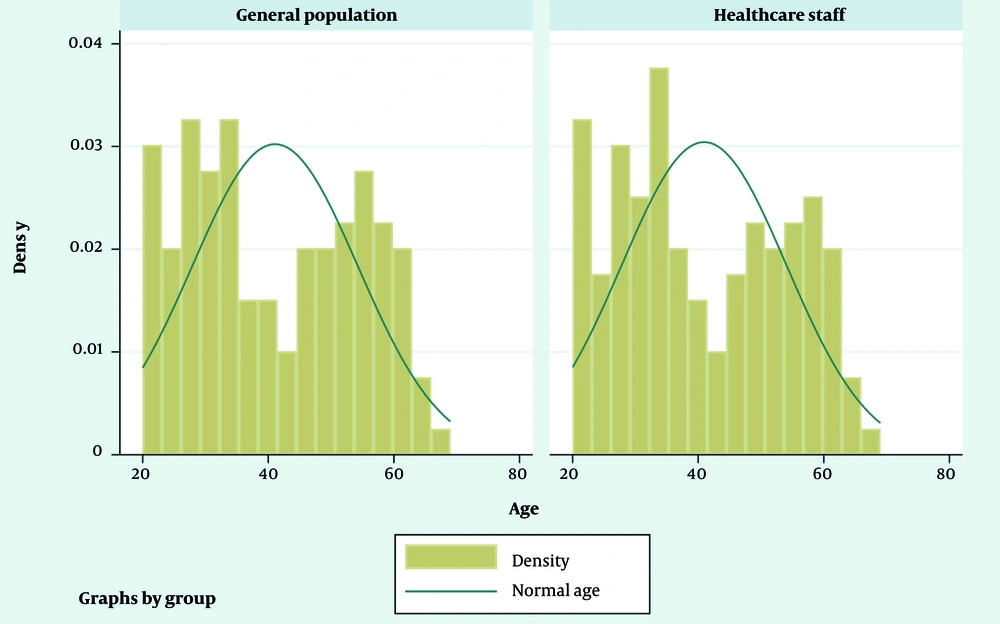
Figure 1.
Histogram (age distribution) of participants in the study
Based on Table 2, all scores on the dark personality dimensions of healthcare center employees were significantly lower than those of the general population. And the Figure 2 shows the box plot of dark personality dimensions in two study groups.
Table 2.
Comparison of Mean Dark Personality Dimensions Between Two Study Groups a
| Scales | General Population | Healthcare | P-Value |
|---|---|---|---|
| Narcissism | 4.0 ± 18.2 | 3.7 ± 16.8 | 0.003 |
| Machiavellianism | 11.1 ± 55.2 | 13.0 ± 51.3 | 0.010 |
| Psychopathy | 15.0 ± 52.6 | 16.7 ± 47.4 | 0.009 |
| Primary Psychopathy | 10.8 ± 32.6 | 11.9 ± 29.4 | 0.027 |
| Secondary Psychopathy | 7.0 ± 20.0 | 7.0 ± 17.9 | 0.019 |
a Values are expressed as mean ± SD.
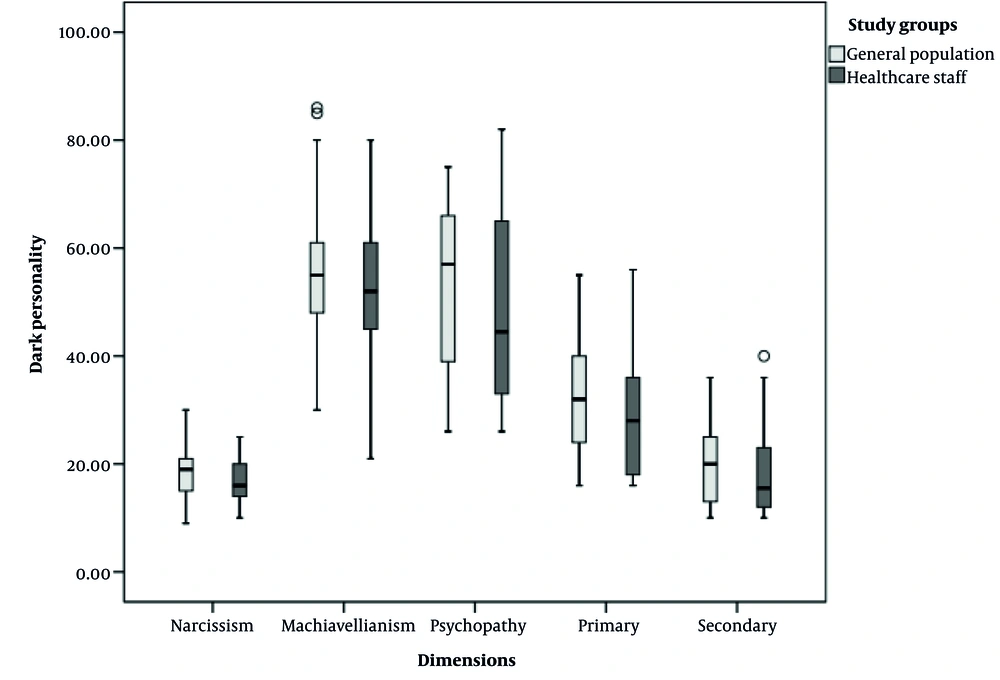
Figure 2.
Box plot of dark personality dimensions in two study groups
According to Figure 3, of the 130 healthcare center employees, nurses accounted for 36.1%, surgeons for 20%, and paramedical staff for 19.2% in terms of frequency. The assumption of normal distribution for the variables was evaluated using the Kolmogorov-Smirnov test and was confirmed.
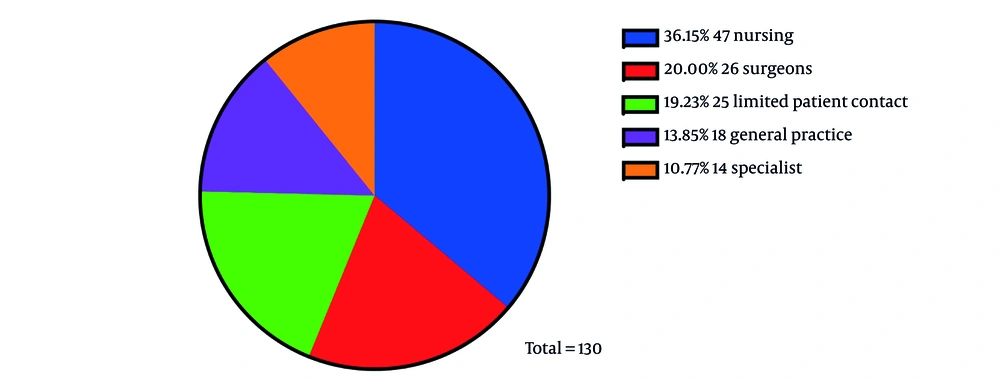
Figure 3.
Frequency of healthcare center employees based on occupation
Table 3 shows that the only significant scale among healthcare center employees was narcissism. Surgeons, specialist physicians other than surgeons, general practitioners, and paramedical staff achieved the highest scores. In pairwise comparisons between the groups using the Bonferroni test, the mean score of surgeons was significantly different from that of nurses and paramedical staff, but not from that of general practitioners and other specialist physicians. Nonsurgical specialists had significantly higher narcissism scores than nurses and paramedical staff, but there was no significant difference between surgeons and general practitioners. General practitioners did not differ significantly from surgeons and specialists but showed significant differences in their scores compared to nurses and paramedical staff. Nurses did not differ significantly from paramedical staff, but their scores differed significantly from those of other professionals.
Table 3.
Comparison of Mean Dark Personality Dimensions in Healthcare Center Employees Based on Occupation a
| Groups | Frequency | Narcissism | Machiavellianism | Psychopathy | Primary | Secondary |
|---|---|---|---|---|---|---|
| Surgeons | 26 | 19.3 ± 2.4 | 49.6 ± 13.8 | 50.1 ± 17.5 | 32.3 ± 12.8 | 17.8 ± 7.4 |
| Nurses | 47 | 15.3 ± 3.2 | 49.9 ± 13.9 | 49.7 ± 16.6 | 30.2 ± 11.4 | 19.5 ± 7.4 |
| General practitioners | 18 | 18.5 ± 3.4 | 55.4 ± 12.0 | 45.7 ± 17.9 | 27.4 ± 12.7 | 18.2 ± 6.6 |
| Non-surgical specialists | 14 | 18.8 ± 3.4 | 53.8 ± 10.9 | 39.9 ± 10.0 | 25.6 ± 8.1 | 14.3 ± 3.3 |
| Geriatricians | 25 | 14.6 ± 3.3 | 51.5 ± 12.1 | 45.7 ± 17.9 | 28.6 ± 12.8 | 17.1 ± 6.9 |
| P-value | - | 0.001 | 0.510 | 0.315 | 0.440 | 0.16 |
a Values are expressed as mean ± SD.
The Pearson correlation coefficient showed that age in both population groups had no statistically significant relationship with the dark personality dimensions. According to Table 4, a two-way ANOVA was conducted to examine the effects of gender (male vs. female), group (general population vs. healthcare workers), and their interaction on dark personality dimensions.
Table 4.
Comparison of Dark Personality Dimensions in Healthcare Workers and the General Population Based on Gender a
| Scale | General Population Group | Healthcare Group | Two Way ANOVA | Effect Size | Power | ||
|---|---|---|---|---|---|---|---|
| P-Value (Sex) | P-Value (Group) | P-Value (Sex × Group) | |||||
| Narcissism | 0.30 | 0.25 | 0.208 | 0.06 | 0.242 | ||
| Male | 17.0 ± 4 | 16.5 ± 4.18 | |||||
| Female | 18.74 ± 3.98 | 16.96 ± 3.38 | |||||
| Machiavellianism | 0.985 | 0.000 | 0.001 | 0.041 | 0.910 | ||
| Male | 58.75 ± 13.02 | 47.93 ± 14.64 | |||||
| Female | 53.57 ± 9.85 | 53.16 ± 11.8 | |||||
| Psychopathy | 0.484 | 0.010 | 0.775 | 0.000 | 0.059 | ||
| Male | 54.0 ± 15.38 | 47.95 ± 16.83 | |||||
| Female | 51.92 ± 14.83 | 47.08 ± 16.80 | |||||
| Primary psychopathy | 0.502 | 0.037 | 0.992 | 0.000 | 0.050 | ||
| Male | 33.25 ± 11.08 | 30.10 ± 13.03 | |||||
| Female | 32.25 ± 10.73 | 29.08 ± 11.24 | |||||
| Secondary psychopathy | 0.617 | 0.015 | 0.507 | 0.002 | 0.102 | ||
| Male | 20.75 ± 6.81 | 17.84 ± 6.76 | |||||
| Female | 19.66 ± 7.14 | 18.0 ± 7.16 | |||||
a Values are expressed as mean ± SD.
4.1. Narcissism
A significant main effect of gender was found (P = 0.03), with women scoring higher than men overall. However, the interaction between gender and group was not significant (P = 0.208), indicating that the gender difference in narcissism was consistent across both groups. The group main effect was also not significant (P = 0.25), suggesting no overall difference in narcissism between the general population and healthcare workers.
4.2. Machiavellianism
A significant main effect of group was observed (P < 0.001), with healthcare workers reporting lower levels of Machiavellianism than the general population. Interestingly, the interaction effect between gender and group was also significant (P = 0.001), indicating that gender differences in Machiavellianism varied across groups. Specifically, men in the general population had the highest Machiavellianism scores, while this difference was not observed among healthcare workers, where male and female scores were similar.
4.3. Psychopathy
A significant group effect (P = 0.01) was found, showing lower psychopathy scores among healthcare workers compared to the general population. No significant effects of gender or interaction were observed.
4.3.1 Primary Psychopathy
A main effect of group was found (P = 0.037), with healthcare workers scoring lower than the general population. There were no significant effects of gender or interaction, suggesting that this pattern held across both sexes.
4.3.2. Secondary Psychopathy
Again, a significant main effect of group was observed (P = 0.015), with healthcare workers scoring lower. No significant gender or interaction effects were found.
To determine the cut-point for each psychological trait, the median score was calculated for the variables of narcissism, Machiavellianism, psychopathy, primary psychopathy, and secondary psychopathy. Based on these medians, each variable was dichotomized: Scores less than or equal to the median were coded as “0” (low level), and scores greater than the median were coded as “1” (high level). The median values were as follows: Eighteen for narcissism, 55 for Machiavellianism, 50 for psychopathy, 31 for primary psychopathy, and 18 for secondary psychopathy. This binary classification was used as the outcome variable in the logistic regression models to examine the odds of elevated levels of these traits.
According to Table 5, based on the logistic regression analyses conducted for each of the dark personality dimensions, the following results were obtained:
Table 5.
Logistic Regression Results for Dark Personality Dimensions
| Groups and Predictors | P-Value | OR | 95.0% CI for B Lower Bound | 95.0% CI for B Upper Bound |
|---|---|---|---|---|
| Narcissism | ||||
| Age | 0.652 | 1.004 | 0.233 | 1.326 |
| Sex (ref: Female) | 0.320 | 0.764 | 0.976 | 1.016 |
| Group (ref: Health care) | 0.039 | 1.687 | 0.617 | 1.783 |
| Constant | 0.183 | .556 | 0.955 | 2.568 |
| Machiavellianism | ||||
| Age | 0.710 | 0.996 | 0.272 | 1.527 |
| Sex (ref: Female) | 0.860 | 1.049 | 0.987 | 1.027 |
| Group (ref: Health care) | 0.077 | 1.566 | 0.756 | 2.188 |
| Constant | 0.321 | 0.645 | 1.345 | 3.670 |
| Psychopathy | ||||
| Age | 0.458 | 1.007 | 0.165 | 0.958 |
| Sex (1) | 0.352 | 1.286 | 0.994 | 1.033 |
| Group (1) | 0.002 | 2.222 | 0.768 | 2.198 |
| Constant | 0.040 | 0.398 | 0.843 | 2.260 |
| Primary | ||||
| Age | 0.168 | 1.013 | 0.184 | 1.049 |
| Sex (1) | 0.327 | 1.299 | 0.974 | 1.014 |
| Group (1) | 0.199 | 1.380 | 0.590 | 1.677 |
| Constant | 0.062 | 0.440 | 1.214 | 3.248 |
| Secondary | ||||
| Age | 0.505 | 0.994 | 0.360 | 2.095 |
| Sex (1) | 0.984 | 0.995 | 0.233 | 1.326 |
| Group (1) | 0.007 | 1.986 | 0.976 | 1.016 |
| Constant | 0.746 | 0.868 | 0.617 | 1.783 |
- In the narcissism model, the variable "group" emerged as a statistically significant predictor. The odds of having a high level of narcissism in the general population were 1.687 times compared to healthcare workers (OR = 1.687, P = .039). Although age and sex were not statistically significant, their direction of effect suggested that older individuals had slightly higher odds of having a high level (OR = 1.004), while males had lower odds compared to females (OR = 0.764).
- In the Machiavellianism model, none of the predictors reached statistical significance. The odds of having a high level of Machiavellianism in the general population were 1.566 times compared to healthcare workers (OR = 1.566), and both age and sex had negligible effects (ORs close to 1).
- In the model for overall psychopathy, the odds of having a high level of overall psychopathy in the general population were 2.22 times compared to healthcare workers, and these observed differences are statistically significant (OR = 2.222, P = .002). Although sex and age were not significant, males showed a trend toward a higher level of psychopathy compared to females (OR = 1.286).
- For primary psychopathy, none of the predictors were statistically significant. However, the pattern was similar: The general population had higher odds of having a high level compared to healthcare professionals (OR = 1.380), and males again showed a slight tendency toward higher levels (OR = 1.299).
- In the case of secondary psychopathy, the odds of having a high level of secondary psychopathy in the general population were 1.986 times compared to healthcare workers, and these observed differences are statistically significant (OR = 1.986, p = .007). Neither sex nor age significantly predicted secondary psychopathy, and their effects were minimal (ORs near 1).
5. Discussion
The present study’s findings indicate that the average scores of dark personality trait dimensions in healthcare system employees were lower than those in the general population. In examining the differences in the three dimensions of dark personality, it was expected that although healthcare system employees had obtained lower scores in terms of narcissism, the difference in average scores between the two groups was not very significant (1.4 scores). However, regarding Machiavellianism and psychopathy traits, they had significantly lower average scores than the general population, with differences of 3.8 and 5.2 scores, respectively, indicating that healthcare personnel prioritize patient interests over personal interests and possess suitable ethical traits for working in these medical centers. Therefore, regarding personality traits, healthcare employees have desirable conditions and are constructive and productive in their performance.
According to the results of a study conducted in Beijing in a pediatric hospital with 200 participating physicians, dark personality traits, especially Machiavellianism, were associated with being constructive and productive (26). The results of this study indicate that healthcare staff exhibit lower average scores for dark personality traits than the general population. This difference may be attributed to various factors, including selection bias favoring individuals with specific traits such as empathy and resilience entering healthcare professions (27); the influence of occupational socialization within the healthcare environment, where prosocial behaviors are encouraged and dark traits may be suppressed; and the adaptive behavior of healthcare workers who learn to moderate their dark traits to fit professional demands and ethical obligations (28).
These personality traits, however, may not remain static throughout an individual’s career. It is plausible that exposure to high-stress environments, ethical challenges, and the emotional demands of healthcare work may shape and modify these traits over time. For example, healthcare providers might develop greater resilience or suppress certain dark traits through occupational socialization and professional growth. Conversely, prolonged exposure to stressful conditions may also amplify certain negative traits, such as narcissism, or lead to burnout and maladaptive behaviors (24). Longitudinal studies are necessary to explore these dynamic processes further and to identify key factors that promote positive personality development or mitigate potential negative outcomes in healthcare settings. Understanding these dynamics can inform recruitment strategies, training programs, and interventions aimed at supporting healthcare professionals’ well-being and improving patient care experiences (3).
However, in this study, we observed that surgeons had the highest narcissism scores compared with the other groups. This may be due to the social status of surgeons and the feedback they receive from individuals. Other studies have shown that surgeons have higher narcissism scores (15). Previous studies, including those in Poland (29) and a survey conducted in Mashhad by Aghli et al. (30), showed that healthcare personnel, including nurses, have a dark triad of traits that may be associated with psychological well-being and humor. A study conducted by Mohammadizadeh and Ashouri (31) also stated that stress in nurses is influenced more by internal variables than by demographic variables, and two essential predictor variables (neurotic personality traits and job enthusiasm) play a determining role. Further studies should be conducted in this area.
Consistent with the findings of the present study, a study conducted by Bucknall et al. (15) in England in 2015 aimed to investigate the pathological personality traits in the healthcare system. This cross-sectional study, conducted in several hospitals in England, included 248 healthcare staff and 159 individuals from the general population. Their findings indicated that healthcare workers had lower average scores than the general population in terms of narcissism, Machiavellianism, and psychopathy. In addition to consistent results, both studies used the same instruments to assess dark personality traits.
5.1. Conclusions
This study investigated pathological personality traits among medical staff at Hamadan University of Medical Sciences compared to the general population, revealing lower average scores in dark personality trait dimensions among healthcare workers, particularly in narcissism, Machiavellianism, and psychopathy traits. Understanding these personality traits is clinically significant, as it can inform interventions to address issues such as burnout, stress, and ethical conduct in patient care, ultimately improving healthcare delivery and patient outcomes.
5.2. Quality of Care
The lower levels of dark personality traits among healthcare workers indicate a potential for more compassionate and patient-centered care. Healthcare professionals with lower narcissism and Machiavellianism may foster better doctor-patient relationships, leading to improved patient satisfaction and outcomes.
5.3. Team Dynamics
Understanding the personality traits within healthcare teams can enhance collaboration and reduce conflicts. Teams composed of individuals with lower levels of these traits may exhibit better communication and cooperation, contributing to a healthier work environment.
5.4. Limited Insight into Context
Self-reported personality assessments may not capture the complexity of real-world behaviors, as individuals may lack awareness or insight into their own personality traits.
5.5. Recommendations for Healthcare Administration
Based on the findings, healthcare administration should focus on developing recruitment strategies to select candidates with positive traits like empathy and resilience, alongside implementing training programs to enhance interpersonal and ethical decision-making skills. Establishing support systems, such as counseling and stress management workshops, can help staff handle job-related challenges and mitigate negative traits.
5.6. Implications for Medical Education
To address the influence of personality traits on healthcare performance, medical education programs should incorporate training that fosters empathy, resilience, and emotional intelligence in students. Structured modules on interpersonal communication, ethical decision-making, and stress management can prepare future healthcare professionals to navigate the emotional and ethical challenges of clinical practice. Additionally, simulation-based learning and reflective practices can help students recognize and regulate traits that may negatively impact patient care, fostering a more constructive professional demeanor.
5.7. Potential Interventions for Personality Development
Targeted interventions such as resilience training, mindfulness workshops, and coaching can enhance self-awareness and emotional regulation in healthcare staff. Leadership programs and peer mentoring can foster positive traits like empathy and conscientiousness, while regular feedback and personalized development plans support continuous growth.
Future research should focus on longitudinal studies with more extensive and diverse samples to further explore the evolution and impact of personality traits on job performance and patient care quality and incorporate qualitative methodologies for deeper insights into the underlying factors influencing these traits among healthcare workers. Furthermore, cross-cultural studies could provide valuable insights into how cultural factors influence dark personality traits in healthcare professionals, offering a broader understanding of their prevalence and impact in diverse healthcare systems.
5.8. Limitations
Although the study included 260 participants, this sample may not be large enough to generalize findings to all healthcare professionals or the broader population. A larger sample could provide more robust results and allow for subgroup analyses. The study is confined to Hamadan city, which may limit the applicability of the findings to healthcare workers in different geographic areas or cultural contexts. Variations in healthcare systems, cultural attitudes, and demographic factors may influence personality traits differently in other regions. The study employs a causal-comparative design, capturing data at a single point in time. This approach does not allow for the examination of changes in personality traits over time or the influence of specific events (e.g., stressors in the workplace) on these traits. The reliance on self-reported measures for assessing personality traits may introduce bias. Participants might have a tendency to respond in socially desirable ways, potentially underreporting negative traits or overreporting positive traits. Additionally, future studies could explore the underlying reasons for the higher prevalence of narcissistic traits among surgeons, as well as the lower prevalence of other Dark Triad personality traits in healthcare professionals.