
1. Background
Attention deficit hyperactivity disorder (ADHD) represents a neurodevelopmental disorder that generally manifests during childhood (1) but frequently persists into adulthood (2). Three principal manifestations of this disorder — attention deficit, hyperactivity, and impulsivity — can profoundly impact various aspects of an adult’s life (3). Individuals diagnosed with ADHD often experience considerable impairments in academic performance, occupational status, daily functioning, and aspects of social functioning (4). In other words, their participation is negatively influenced in various aspects. The neuropsychological performance of adults with ADHD is of great importance, as notable correlations have been identified between essential and higher-order cognitive functions within this group (5). Selective attention, vigilance, inhibition, and interference control are significantly compromised in a substantial proportion of individuals affected by ADHD (5). Executive function consists of five primary domains: Fluency, planning, working memory, inhibition, and set-shifting (6). Different aspects of executive function can be influenced by the persistence of ADHD symptoms, ultimately resulting in behavioral challenges and negative functional consequences (7).
Sensory processing is a multisensory function through which environmental inputs are collected, processed, and integrated by the central nervous system, thereby facilitating appropriate and effective responses to one’s surroundings (8). Several studies have suggested the potential effects of sensory processing on various aspects of daily functioning and overall quality of life (9). Sensory processing also has considerable impacts on higher-order cognitive functions and adaptive behaviors (10). It is evident that sensory processing is a significant concern in ADHD, as a systematic review has indicated sensory gating and impaired sensory inhibition in adults with ADHD (10). Furthermore, adults with ADHD also reported significantly higher levels of hyper- and hypo-sensitivity in comparison to their non-ADHD counterparts (11).
2. Objectives
Additionally, evidence points to sensory processing challenges in adults with ADHD, underscoring the need to explore possible associations between neuropsychological deficits, sensory processing, and engagement in daily activities within this population. Therefore, the present study aimed to investigate the relationships between sensory processing, executive function, and participation in meaningful activities, with the goal of deepening our understanding of the associations between executive function, sensory processing, and involvement in meaningful activities among adults with ADHD.
3. Methods
Seventy adults with ADHD and 68 non-ADHD adults, aged 18 to 40 years, were recruited for this cross-sectional study from various clinics and centers across Tehran. Participants were selected using the convenience sampling method between January to December 2023. Written informed consent was obtained from all participants. Adults with ADHD were included in the study if they met all of the following inclusion criteria: Diagnosis of ADHD by a psychiatrist; age between 18 and 40 years; no intake of psychotropic medications on the assessment day; no significant cognitive impairments [mini-mental state examination (MMSE) score of ≥ 23]; ability to understand instructions and complete evaluation forms; and no neurological conditions, including stroke, seizures, or epilepsy. Non-ADHD adults were required to meet all the inclusion criteria except for the first criterion, which was the diagnosis of ADHD. The present study was approved by the Ethics Committee of Shahid Beheshti University of Medical Sciences (IR.SBMU.RETECH.REC.1401.505), and all participants signed the informed consent form before evaluations.
3.1. Instruments
Demographic characteristics of participants were collected using a demographic questionnaire. Executive function, sensory processing, and participation in meaningful activities were then evaluated.
3.1.1. Behavior Rating Inventory of Executive Function-Adult Version
Behavior Rating Inventory of Executive Function-Adult version (BRIEF-A) is an assessment tool used to evaluate executive function in adults over the age of 18. It considers the everyday behavioral manifestations of executive dysfunction. The self-report form of BRIEF-A comprises 75 items across 9 different clinical scales, including two indexes: The Behavioral Regulation Index (BRI) and the Metacognition Index (MI). The BRI includes inhibition, shift, emotional control, and self-monitoring. The MI is composed of initiation, working memory, planning/organizing, task monitoring, and material organization, which are scored on a 3-point scale (never, sometimes, often). The sum of the total scores represents the global executive composite (GEC). A higher total GEC indicates more severely impaired executive function (14). The BRIEF-A has good test-retest reliability (15).
3.1.2. Adult/Adolescent Sensory Profile
The sensory profile provides a sensory history of an individual’s responses to everyday sensory experiences. It assesses sensory thresholds on a continuum, anchored by the four outermost points of each scale: "Low Registration", "Sensation Seeking", "Sensory Sensitivity" and "Sensation Avoiding". The Adolescent/Adult Sensory Profile Questionnaire (AASP) can be completed in 15 to 20 minutes and consists of 60 items with a 5-point Likert scale response format (from 1 = rarely to 5 = almost always). Higher or lower scores indicate a higher or lower frequency of specific sensory responses in six sensory domains: Visual, auditory, taste, smell, touch, body position, and movement. It also encompasses two behavioral classifications: Emotional/social and activity level (16, 17). The Cronbach’s alpha score for different parts of the AASP ranges from 0.894 to 0.916 (P < 0.001) (17).
3.1.3. Engagement in Meaningful Activities Survey
The engagement in meaningful activity survey (EMAS) assesses the significance of activities for individuals, focusing on several key aspects. It emphasizes aligning an activity with one’s personal value system and needs. Additionally, it evaluates how well an activity demonstrates competence and mastery and its importance within one’s social and cultural group. The items in the EMAS encapsulate various propositions from occupational therapy and occupational science that focus on the components of meaningful engagement. The EMAS consists of 12 items, scored using a Likert scale from 1 (never) to 5 (always). Higher scores indicate a better quality of life and higher psychological well-being (18, 19). The Cronbach’s alpha score of the EMAS is 0.95 (19).
3.2. Statistical Analysis
In this study, continuous variables were expressed as mean ± standard deviation, while categorical variables were reported as frequency (percentage). A univariable analysis was conducted to explore differences in executive function, sensory processing, and participation in meaningful activities between adults diagnosed with ADHD and those without the condition. Independent samples t-tests were employed to assess these differences. Pearson and Spearman correlation coefficients were utilized to examine the relationships between BRIEF-A and AASP scores and EMAS scores. Given that some test subscales demonstrated a normal distribution while others showed a non-normal distribution, two distinct types of correlation coefficients were used based on the normality or non-normality of the paired variables. In the multivariable analysis, a stepwise linear regression model was employed to explore the predictive relationship between BRIEF-A and AASP scores with EMAS scores. Data analysis was conducted using SPSS for Windows, version 26.0 (SPSS Inc., Chicago, IL, USA), and statistical significance was set at P < 0.05.
4. Results
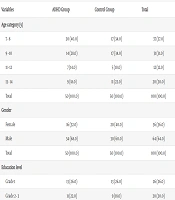
The demographic characteristics of adults with and without ADHD are presented in Table 1. The mean age of participants in the ADHD group (n = 70) was 28.05 ± 5.19 years; 51.4% were female, and 48.6% were male. The non-ADHD group included 68 adults with a mean age of 29.41 ± 6.39 years; 50% were male, and 50% were female.
Table 1.
Demographic Characteristics a
| Variables | ADHD (n = 70) | Non-ADHD (n = 68) | P-Value |
|---|---|---|---|
| Age | 28.05 ± 5.19 | 29.41 ± 6.39 | 0.174 |
| Gender | 0.868 | ||
| Female | 36 (51.4) | 34 (50) | |
| Male | 34 (48.6) | 34 (50) | |
| Education status | 0.987 | ||
| High school | 15 (21.4) | 8 (11.8) | |
| Undergraduate | 36 (51.4) | 48 (70.6) | |
| Graduate | 19 (27.1) | 12 (17.6) | |
| Occupation | 0.504 | ||
| Employed | 48 (68.6) | 40 (58.8) | |
| Housewife | 3 (4.3) | 7 (10.3) | |
| Student | 17 (24.3) | 21 (30.9) | |
| Unemployed | 2 (2.9) | 0 |
a Values are expressed as No. (%) or mean ± SD.
To determine the differences between adults with and without ADHD in executive function, sensory processing, and participation in meaningful activities, an independent samples t-test was performed. These differences were statistically significant for BRIEF-A (GEC P ≤ 0.05, BRI P ≤ 0.05, MI P ≤ 0.05), AASP (Low registration P ≤ 0.05, sensation seeking P ≤ 0.05, sensory sensitivity P ≤ 0.05, sensation avoiding P ≤ 0.05), and EMAS (P ≤ 0.05). The mean, standard deviation, and P-value scores of the independent samples t-test are presented in Table 2. The results indicate significant differences in all executive function variables, sensory processing, and participation in meaningful activities between the ADHD and non-ADHD groups.
Table 2.
Mean, Standard Deviation and Independent Sample t-test Results Between the Attention Deficit Hyperactivity Disorder Group and Non-attention Deficit Hyperactivity Disorder Group in Behavioral Rating Inventory of Executive Function-Adult Version, Adult/Adolescent Sensory Profile, and Engagement in Meaningful Activities Survey a
| Variables and Subscales | ADHD (n = 70) | Non-ADHD (n = 70) | P-Value b |
|---|---|---|---|
| BRIEF-A | |||
| GEC | 159.67 ± 22.65 | 111.76 ± 21.09 | 0.000 |
| BRI | 65.4 ± 9.04 | 45.94 ± 9.26 | 0.000 |
| MI | 86.65 ± 13.99 | 62.44 ± 13.49 | 0.000 |
| AASP | |||
| Low registration | 37.95 ± 8.45 | 31.63 ± 6.94 | 0.000 |
| Sensation seeking | 48.77 ± 6.72 | 44.54 ± 9.31 | 0.003 |
| Sensory sensitivity | 43.72 ± 9.49 | 36.17 ± 8.21 | 0.000 |
| Sensation avoiding | 43.81 ± 8.28 | 37.27 ± 7.75 | 0.000 |
| EMAS | 41.24 ± 7.97 | 46.63 ± 6.38 | 0.000 |
Abbreviations: BRIEF-A, behavioral rating inventory of executive function-adult version; GEC, global executive composite; BRI, Behavioral Regulation Index; MI, Metacognition Index; AASP, adult/adolescent sensory profile; EMAS, engagement in meaningful activities survey.
a Values are expressed as mean ± SD.
b P ≤ 0.05 is considered statistically significant.
The findings from the four sensory processing subscales indicated that the mean scores of adults with ADHD exhibit atypical patterns in low registration, sensory sensitivity, and sensation avoiding. These individuals fell into a range that was "higher than what is observed in most people". In contrast, non-ADHD individuals were "similar to most people" in all four sensory processing indices.
The correlation coefficients between BRIEF-A and AASP with EMAS scores in the ADHD group are presented in Table 3. The results showed a significant correlation between the EMAS and BRIEF-A subscales, including the GEC (r = -0.390, P ≤ 0.05), BRI (r = -0.467, P ≤ 0.05), and MI (r = -0.425, P ≤ 0.05) scores. The results also revealed that all four sensory processing subscales significantly correlate with the EMAS. A weak correlation was found between the EMAS and three sensory processing subscales: Low registration (r = -0.358, P = 0.002), sensation seeking (r = -0.368, P = 0.002), and sensory sensitivity (r = -0.322, P = 0.007), and a moderate correlation between the EMAS and sensation avoiding (r = -0.415, P < 0.001) was discovered.
Table 3.
The Correlation Coefficients Between Behavioral Rating Inventory of Executive Function-Adult Version and Adult/Adolescent Sensory Profile Variables with Engagement in Meaningful Activities Survey Scores in Adults with Attention Deficit Hyperactivity Disorder
| Executive Function and Sensory Processing | EMAS | |
|---|---|---|
| r | P a | |
| GEC | -0.390 | 0.001 |
| BRI | -0.467 | 0.000 |
| MI | -0.425 | 0.000 |
| Low registration | -0.358 | 0.002 |
| Sensory seeking | -0.367 | 0.002 |
| Sensory sensitivity | -0.322 | 0.007 |
| Sensory avoiding | -0.415 | 0.000 |
Abbreviations: GEC, global executive composite; BRI, Behavioral Regulation Index; MI, Metacognition Index; EMAS, engagement in meaningful activities survey.
a P ≤ 0.05 is considered statistically significant.
The results of the linear regression analysis are shown in Table 4. A stepwise linear regression model was employed to explore the predictive effects of the BRIEF-A and AASP scores on participation in meaningful activities among adults with ADHD. Behavioral Regulation Index and low registration were included as two predictive factors of participation (R2 = 0.277, BRI β = -0.400, P ≤ 0.05; low registration β = -0.237, P ≤ 0.05) in the linear regression analysis.
Table 4.
The Result of the Hierarchical Multiple Linear Regressions in Adults with Attention Deficit Hyperactivity Disorder
| R | R Square | Adjusted R Square | P-Value a |
|---|---|---|---|
| 0.526 | 0.277 | 0.255 | 0.000 |
a P ≤ 0.05 is considered statistically significant.
5. Discussion
In the present study, we aimed to compare executive function, sensory processing, and participation in meaningful activities in adults with ADHD with their non-ADHD peers and investigate the relationship between executive function and sensory processing with involvement in meaningful activities. Our findings indicated significant differences in executive function, sensory processing, and participation in meaningful activities among adults with ADHD compared to non-ADHD adults. Additionally, we found significant correlations between executive function and sensory processing with involvement in meaningful activities in adults with ADHD. Moreover, both executive function and sensory processing demonstrated a predictive effect on the participation of adults with ADHD.
Executive function is a fundamental neuropsychological function that can be impaired in neurodevelopmental disorders (20). Many studies have investigated the relationship between ADHD and executive function deficits, yielding significant results. Additionally, it has been proven that executive function disorders can predict symptoms of ADHD (21). Our findings showed that individuals with ADHD have poorer performance in executive function compared to non-ADHD adults.
An important question we sought to answer was the potential relationship between executive deficits and participation in meaningful activities of adults with ADHD. Findings from similar studies involving adolescents with ADHD indicate that deficits in executive function significantly impact their performance in complex cooking tasks (22). Research suggests that executive function in later adulthood plays a crucial role in helping individuals navigate obstacles, fostering a sense of control over their lives (23). This sense of control is closely linked to greater life satisfaction and positive affect, mainly through active participation in daily life functions (23). Additionally, correlations between executive function, quality of life, and depressive or anxiety symptoms have been suggested in recent studies (24). Our findings showed a moderate correlation between all three subscales of BRIEF-A and the EMAS. This finding, which shows a significant relationship between executive function and participation in meaningful activities, is consistent with studies conducted in this area. Considering the nature of EMAS, which assesses the subjective aspects of involvement, it can be concluded that executive function affects individuals’ sense of participation, life satisfaction, and understanding of environmental control.
Sensory processing in adults with ADHD has been examined in some studies. Results from studies investigating the sensory profiles of individuals with and without ADHD have highlighted significant differences in sensory processing patterns. Specifically, adults with ADHD demonstrated increased levels of both hyper-sensitivity and hypo-sensitivity compared to their peers without the condition (11, 25). Our findings were also aligned with results obtained in similar studies. We found that individuals with ADHD had significant differences in sensory processing patterns compared to their healthy peers and often fell into a category described as "more than most people". In contrast, non-ADHD peers are usually placed into a category defined as "similar to most people" in all sensory subscales, indicating that their sensory processing patterns are similar to most normal adults.
We examined the potential impacts of sensory processing problems on an individual’s participation. The relationship between sensory processing and participation in adults with ADHD is an unexplored area in research. Sensory processing can affect an individual’s daily functioning and social interactions. Similar studies on other populations, including individuals with serious mental illness, those with neurological problems, and older adults, have shown that sensory processing issues affect these individuals’ participation in occupations (26-28). Additionally, high sensitivity may negatively impact quality of life and daily functioning (9). The present study showed a weak to moderate correlation between all four sensory processing patterns — low registration, sensation seeking, sensory sensitivity, and sensation avoidance — and the EMAS.
Studies have demonstrated that individuals with ADHD encounter significant challenges across various domains of life, including family relationships, life skills, social skills, and academic performance (7), and these problems increase with age (29). The results of our study indicated that participation in meaningful activities was significantly different between adults with ADHD and their non-ADHD peers. The EMAS is one of the measures that assesses the degree of congruency of individuals’ participation with their values. Therefore, it can be concluded that the symptoms of ADHD can affect the subjective aspects of individuals’ involvement and, in turn, influence their satisfaction with participation in various daily activities.
No study has been conducted on the relationship between sensory processing and executive function and their impacts on participation in adults with ADHD. A few studies with a similar approach have been conducted in other populations. Research indicates that executive dysfunctions may exacerbate the negative impacts of adverse sensory processing on daily activity performance, particularly in older adults (28), and difficulties of adults with specific learning disabilities in using executive function abilities efficiently might be tied to a high sensory threshold and passive self-regulation strategies (30). The results of the linear regression analysis in our study indicated that both executive function and sensory processing significantly predict participation in meaningful activities among adults with ADHD. The study’s findings, which revealed a coefficient of 27.7 for the predictive impact of executive function and processing, highlight the need to investigate additional factors influencing participation within this population. This emphasizes the necessity for further research in this area, but given the observed correlation between sensory processing and participation in this population, the findings suggest that addressing these challenges and implementing suitable interventions, when needed, could enhance the participation of adults with ADHD.
Our study is one of the first to explore the relationship between sensory processing problems and executive function in individuals with ADHD; however, it has some limitations. First, the assessment test items could have been more pleasing for most participants. Adults with ADHD often struggle with tolerance to prolonged tasks. Secondly, recruiting adults with ADHD proved challenging, as they frequently do not seek treatment in non-acute situations. The findings highlight differences in executive functioning, sensory processing, and participation in meaningful activities between adults with and without ADHD, suggesting a possible association among these, although further research is needed.
5.1. Conclusions
The results of the present study indicated that individuals with ADHD have significant differences in executive function, sensory processing, and participation in meaningful activities compared to their healthy peers. Additionally, the correlation between executive function and sensory processing and participation highlights the importance of these factors in individuals’ involvement in meaningful activities. The predictive effect of executive function and sensory processing on participation in meaningful activities also highlights the importance of cognitive and sensory skills in enhancing the quality of life for individuals.