
1. Background
Suicidal ideation among medical and nursing students should be conceptualized as a student health problem situated within medical sciences training, rather than solely as part of the global burden of suicide. Recent evidence from Iranian medical sciences students indicates that suicidal ideation is associated with mental-health disorders, and studies in Iranian medical students have documented substantial levels of depression, anxiety, stress, and educational burnout (1-3). These data provide a regional empirical basis for examining suicidal ideation in medical and nursing undergraduates.
Depression is the most theoretically and empirically central predictor in the present model. Meta-analytic evidence links depression and hopelessness with suicidal ideation, attempts, and death; however, the present study does not assume that findings from general or Western populations transfer unchanged to Iranian student settings (4-6). Rather, we used these studies to justify depression as a primary psychological correlate while testing this association within a local medical sciences sample.
The proposed depression–addiction tendency–suicidal ideation pathway was guided by an affect-regulation account of addiction and by the interpersonal theory of suicide. Depressive symptoms can increase negative affect, hopelessness, perceived burdensomeness, and low belongingness; students may then rely on maladaptive coping behaviors that increase addiction tendency or behavioral dysregulation (7, 8). Addiction-related vulnerability may, in turn, heighten impulsivity, impair self-regulation, and intensify emotional dysregulation, thereby adding risk beyond depressive symptoms alone (8-10). This stepwise rationale supports testing addiction tendency as an indirect statistical pathway linking depression with suicidal ideation, while recognizing that cross-sectional data cannot establish temporal causality.
Age, marital status, residence, and economic status were included as covariates because prior suicide and student mental-health research has shown that demographic and social context can modify psychological risk (11, 12). In this analysis, these variables were not treated as broad cultural explanations; rather, they were included to adjust for the main depression and addiction associations and to examine whether smaller sociodemographic signals remained after the psychological variables were modeled.
2. Objectives
Because suicide risk prediction is probabilistic rather than deterministic, an integrated analytical strategy can provide both explanatory and discriminative information (13, 14). Multiple regression was used to quantify adjusted associations, ROC/AUC analysis was used to evaluate apparent discrimination in the same cross-sectional study sample, and SEM was used to explore direct and indirect statistical pathways. The study tested five prespecified hypotheses: H1) depression would show the strongest positive association with suicidal ideation; H2) addiction tendency would show an independent positive association; H3) addiction tendency would be consistent with an exploratory indirect pathway between depression and suicidal ideation; H4) selected sociodemographic variables would show smaller associations; and H5) the combined model would show high apparent discrimination within the same cross-sectional study sample.
3. Methods
3.1. Study Design and Setting
This descriptive-analytical cross-sectional study was conducted during the 2025 academic year among undergraduate medical and nursing students at Zahedan University of Medical Sciences (ZAUMS), Iran. The cross-sectional design was selected to examine concurrent associations between psychological and sociodemographic factors related to suicidal ideation. Although causal inference is not possible with this design, it enables estimation of statistical associations that can inform future longitudinal research.
The study received ethical approval from the Student Research Committee of ZAUMS (IR.ZAUMS.REC.1403.086).
3.2. Participants and Sampling
3.2.1. Eligibility Criteria
The inclusion criteria were: 1) active enrollment in the general medicine or nursing programs, 2) age ≥ 18 years, and 3) voluntary participation with written informed consent. The exclusion criteria were: 1) current use of psychiatric medication, 2) withdrawal from participation, or 3) incomplete responses that prevented scoring of the main variables.
3.2.2. Two-Stage Sampling and Random Selection
A two-stage stratified cluster sampling method was used to enhance representativeness across programs and training stages. Stage 1 (stratification and cluster listing): strata were defined by program (medicine vs nursing) and training stage/year (preclinical vs clinical). Within each stratum, classes and clinical-ward groups were treated as natural clusters; updated rosters and ward lists were used to compile the sampling frame of eligible students. Stage 2 (cluster-based random selection): within each stratum, clusters were selected proportionally to stratum size, and all eligible students in the selected clusters were invited to participate. The numbers approached, those who declined, and those excluded because of incomplete questionnaires were recorded to report response rates.
3.2.3. Sample Size
Sample size was estimated a priori based on the approved study protocol using the single-mean precision formula, which included Z2: n0 = (Z2 × σ2) / d2. Using α = 0.05 (Z = 1.96), σ = 17.69 from pilot data for addiction tendency, and an absolute precision of d = 1.79, the simple-random sample size was n0 = 375. Because participants were selected using a multistage design, a conservative design effect (DEFF) of 1.5 was applied, yielding a target sample of approximately 563 students. To account for non-response and incomplete questionnaires, 600 students were approached; 20 declined to participate, and 18 questionnaires were incomplete and excluded, resulting in 562 analyzable responses.
3.3. Instruments
Beck Scale for Suicidal Ideation (BSSI): 19 items scored 0 - 2, assessing thoughts and plans over the past week.
Beck Depression Inventory-II (BDI-II): 21 items scored 0 - 3; Persian psychometric evidence has been reported in Iranian populations (15).
Zargar Addiction Potential Scale (ZAPS): 36 items on a 4-point Likert scale with lie-detection items; Persian internal consistency has been reported previously (16).
3.4. Cultural Adaptation and Pilot Testing
The Persian versions used in this study had undergone forward-back translation, expert content review, and pilot testing (approximately 30 students) to ensure clarity and cultural relevance before full data collection.
3.5. Data Collection Procedure
After obtaining institutional permission, trained researchers explained the study aims in classrooms and clinical wards. Participation was voluntary and anonymous. Students completed the questionnaires privately and returned them in sealed envelopes to reduce social-desirability bias and ensure confidentiality. No personal identifiers were collected; each response sheet was coded numerically. Students with high suicidal-ideation scores were provided with contact information for university counseling services. All complete questionnaires were double-checked before data entry.
3.6. Statistical Analysis
Data were entered and analyzed in SPSS Version 26 and R Version 4.x. Descriptive statistics were used to summarize demographic and clinical variables. Pearson correlation was used to examine bivariate relationships. Multiple linear regression was performed to identify predictors of BSSI total scores. Binary logistic regression analyzed suicidal ideation as a dichotomous variable (BSSI ≥ 6) to assess apparent classification performance. ROC analysis evaluated discrimination using AUC. SEM with the lavaan package in R was used to examine hypothesized direct and indirect statistical pathways between depression, addiction tendency, and suicidal ideation. Indirect effects were evaluated using 5,000 percentile bootstrap resamples. Model fit was evaluated using CFI, TLI, RMSEA, and SRMR. All tests were two-tailed, with P < 0.05 considered statistically significant.
3.7. Diagnostic and Assumption Checks
Multicollinearity was assessed using VIF and tolerance values. Normality and linearity of residuals were assessed visually using histograms and Q-Q plots; homoscedasticity was evaluated using residual-fitted plots; and influential observations were examined using standardized residuals and Cook distance. HC3 robust standard errors were used for the primary linear regression to reduce sensitivity to heteroscedasticity. Ninety-five percent confidence intervals were calculated for regression coefficients and AUC, where available.
3.8. Ethical Considerations
All procedures complied with the ethical standards of the institutional research committee and the Declaration of Helsinki. Participants could withdraw at any time without penalty, and confidentiality was ensured throughout the study.
4. Results
4.1. Participant Characteristics
Of 600 eligible students approached, 20 declined to participate (participation rate 96.7%). Among the 580 who consented, 18 questionnaires were incomplete and were excluded; therefore, data from 562 students were analyzed (93.7% of those approached; 96.9% of those who consented). During data checking, the age variable was re-examined for implausible values, and the final age summary was corrected before reporting. The corrected mean age was 21.90 ± 2.10 years. Additional characteristics are summarized in Table 1.
Table 1.
Descriptive Statistics of the Sample (N = 562) a
| Variables | Values |
|---|---|
| Age (y) | 21.90 ± 2.10 |
| Gender | |
| Male | 308 (54.8) |
| Female | 254 (45.2) |
| Marital status | |
| Single | 516 (91.8) |
| Married/Other | 46 (8.2) |
| Economic status | |
| Low | 72 (12.8) |
| Moderate | 400 (71.2) |
| High | 90 (16.0) |
| Residence | |
| Urban | 306 (54.4) |
| Suburban | 226 (40.2) |
| Rural | 30 (5.3) |
| Field of study | |
| Nursing | 284 (50.5) |
| Medicine | 278 (49.5) |
| Recent adverse event | |
| Yes | 264 (47.0) |
| No | 298 (53.0) |
| Depression (BDI-II) | 13.20 ± 11.99 |
| Addiction tendency (ZAPS) | 35.10 ± 17.69 |
| Suicidal ideation (BSSI) | 4.05 ± 6.61 |
a Values are expressed as mean ± SD or No. (%). Abbreviations: SD, standard deviation; BDI-II, Beck Depression Inventory-II; ZAPS, Zargar Addiction Potential Scale; BSSI, Beck Scale for Suicidal Ideation.
4.2. Multiple Linear Regression (Primary Outcome: BSSI Total)
To test H1-H4, a multivariable linear regression with HC3 robust standard errors was performed. Predictors included depression, addiction tendency, and selected sociodemographic variables. The model explained 55.5% of the variance in suicidal ideation (R2 = 0.555; adjusted R2 = 0.547; overall P < 0.001).
The largest standardized effect was observed for depression (B = 0.351; 95% CI: 0.284 to 0.418; βstd = 0.637; P < 0.001). In practical terms, a one-standard-deviation increase in BDI-II score was associated with an approximately 4.21-point higher BSSI score. Addiction tendency showed a smaller but independent association (B = 0.052; 95% CI: 0.020 to 0.083; βstd = 0.138; P < 0.001); a one-standard-deviation increase in ZAPS score was associated with an approximately 0.92-point higher BSSI score.
Age, marital status, and residence showed smaller associations. Gender, field of study, recent adverse event, and economic status were not statistically significant in the adjusted model. The highest VIF was observed for addiction tendency (VIF = 5.99; tolerance = 0.17), indicating moderate shared variance with depression but not critical multicollinearity. The findings should therefore be interpreted as adjusted cross-sectional associations rather than causal effects. Detailed regression coefficients, confidence intervals, standardized effects, VIF, and tolerance values are presented in Table 2.
Table 2.
Multiple Linear Regression Predicting Suicidal Ideation (BSSI)
| Predictor | B | 95% CI | βstd | P-Value | VIF | Tolerance |
|---|---|---|---|---|---|---|
| Depression (BDI-II) | 0.351 | [0.284, 0.418] | 0.637 | < 0.001 | 3.34 | 0.30 |
| Addiction tendency (ZAPS) | 0.052 | [0.020, 0.083] | 0.138 | < 0.001 | 5.99 | 0.17 |
| Age (years) | 0.030 | [0.006, 0.054] | 0.057 | 0.046 | 3.72 | 0.27 |
| Marital status (unmarried vs married) | 2.061 | [0.773, 3.349] | — | 0.002 | 1.10 | 0.91 |
| Residence (rural vs urban) | 0.620 | [0.000, 1.239] | — | 0.050 | 1.73 | 0.58 |
| Economic status (trend) | −0.635 | [−1.300, 0.031] | — | 0.062 | 5.07 | 0.20 |
| Gender (female vs male) | 0.100 | [−0.662, 0.861] | — | 0.801 | 2.05 | 0.49 |
| Field of study (medicine vs nursing) | 0.475 | [−0.268, 1.217] | — | 0.210 | 1.97 | 0.51 |
| Recent adverse event (yes vs no) | 0.223 | [−0.647, 1.093] | — | 0.615 | 2.10 | 0.48 |
| Intercept | −3.572 | [−6.886, −0.258] | — | 0.035 | — | — |
4.3. Logistic Regression and ROC Analysis (H5)
Using a binary threshold for clinically significant ideation (BSSI ≥ 6), logistic regression showed high apparent discrimination in the same cross-sectional study sample (AUC = 0.92; 95% CI: 0.90 to 0.95). At the Youden-optimal probability threshold, sensitivity was 0.91 (95% CI: 0.84 to 0.95), specificity was 0.78 (95% CI: 0.74 to 0.82), and Youden J was 0.69. Because this model was evaluated in the same sample in which it was derived, the AUC may be optimistic and requires external validation before it can be interpreted as real-world screening performance. The ROC curve is shown in Figure 1.
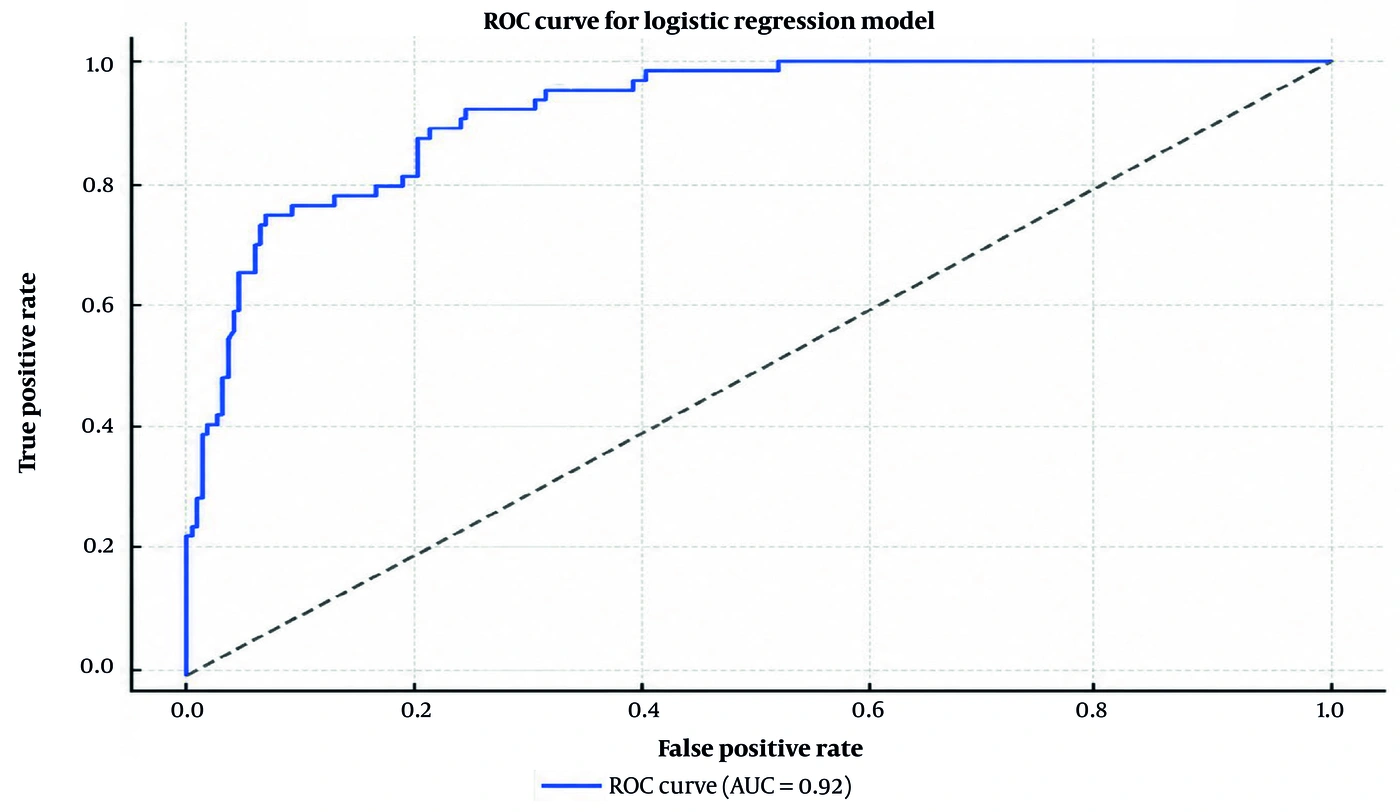
Figure 1.
ROC curve of the logistic model
4.4. Structural Equation Modeling (SEM)
To examine H3, a theory-driven SEM was used to evaluate direct and indirect statistical pathways. Depression showed the strongest direct association with suicidal ideation (β = 0.637; 95% bootstrap CI: 0.539 to 0.724; P < 0.001), followed by addiction tendency (β = 0.139; 95% bootstrap CI: 0.058 to 0.222; P < 0.001). Depression also predicted addiction tendency (β = 0.551; 95% bootstrap CI: 0.489 to 0.610; P < 0.001). The standardized indirect effect for the depression → addiction tendency → suicidal ideation pathway was 0.077, and the 95% percentile bootstrap CI did not include zero (0.033 to 0.124), supporting a statistically significant indirect pathway. Because the data are cross-sectional, this indirect effect should be interpreted as a statistical mediation pattern rather than evidence of temporal or causal mediation. The total standardized effect of depression on suicidal ideation was 0.713 (95% bootstrap CI: 0.645 to 0.769). Smaller direct associations were observed for age, marital status, and residence; however, their bootstrap intervals included or approached zero. Model fit indices were acceptable, although RMSEA and TLI indicate that the model should be interpreted cautiously. Model fit indices are presented in Table 3, standardized path coefficients and the indirect effect are summarized in Table 4, explained variance values are shown in Table 5, and the SEM path diagram is displayed in Figure 2.
Table 3.
Model Fit Indices for SEM
| Fit Index | Value | Acceptable Threshold | Interpretation |
|---|---|---|---|
| χ2 (df = 7) | 37.97 | Prefer non-significant | Significant; expected with large N |
| CFI | 0.954 | ≥ 0.95 (excellent) | Good |
| TLI | 0.889 | ≥ 0.90 | Near acceptable |
| RMSEA | 0.089 | ≤ 0.08 | Borderline acceptable |
| SRMR | 0.032 | ≤ 0.08 | Excellent |
Table 4.
Standardized Path Coefficients and Indirect Effect a
| Predictor → Outcome | β | P-Value | Interpretation | 95% bootstrap CI |
|---|---|---|---|---|
| Depression → Suicidal ideation | 0.637 | < 0.001 | Strong, significant | 0.539 to 0.724 |
| Addiction tendency → Suicidal ideation | 0.139 | < 0.001 | Small, significant | 0.058 to 0.222 |
| Depression → Addiction tendency | 0.551 | < 0.001 | Strong, significant | 0.489 to 0.610 |
| Age → Suicidal ideation | 0.055 | 0.226 * | Small; bootstrap CI includes zero | -0.120 to 0.111 |
| Marital status → Suicidal ideation | 0.094 | 0.123 * | Modest; bootstrap CI includes zero | -0.019 to 0.203 |
| Residence → Suicidal ideation | 0.056 | 0.081 * | Small; bootstrap CI crosses/approaches zero | -0.007 to 0.116 |
| Depression → Addiction tendency → Suicidal ideation (indirect) | 0.077 | < 0.001 | Indirect pathway; CI excludes zero | 0.033 to 0.124 |
a Standardized bootstrap estimates were based on 5,000 resamples. The indirect-effect confidence interval excluded zero, supporting an indirect statistical pathway; however, causal mediation cannot be inferred from this cross-sectional design.
Table 5.
Explained Variance (R2) for Endogenous Variables
| Outcome Variable | R2 | Interpretation |
|---|---|---|
| Suicidal ideation (BSSI) | 0.554 | 55.4% variance explained |
| Addiction tendency (ZAPS) | 0.303 | 30.3% variance explained |
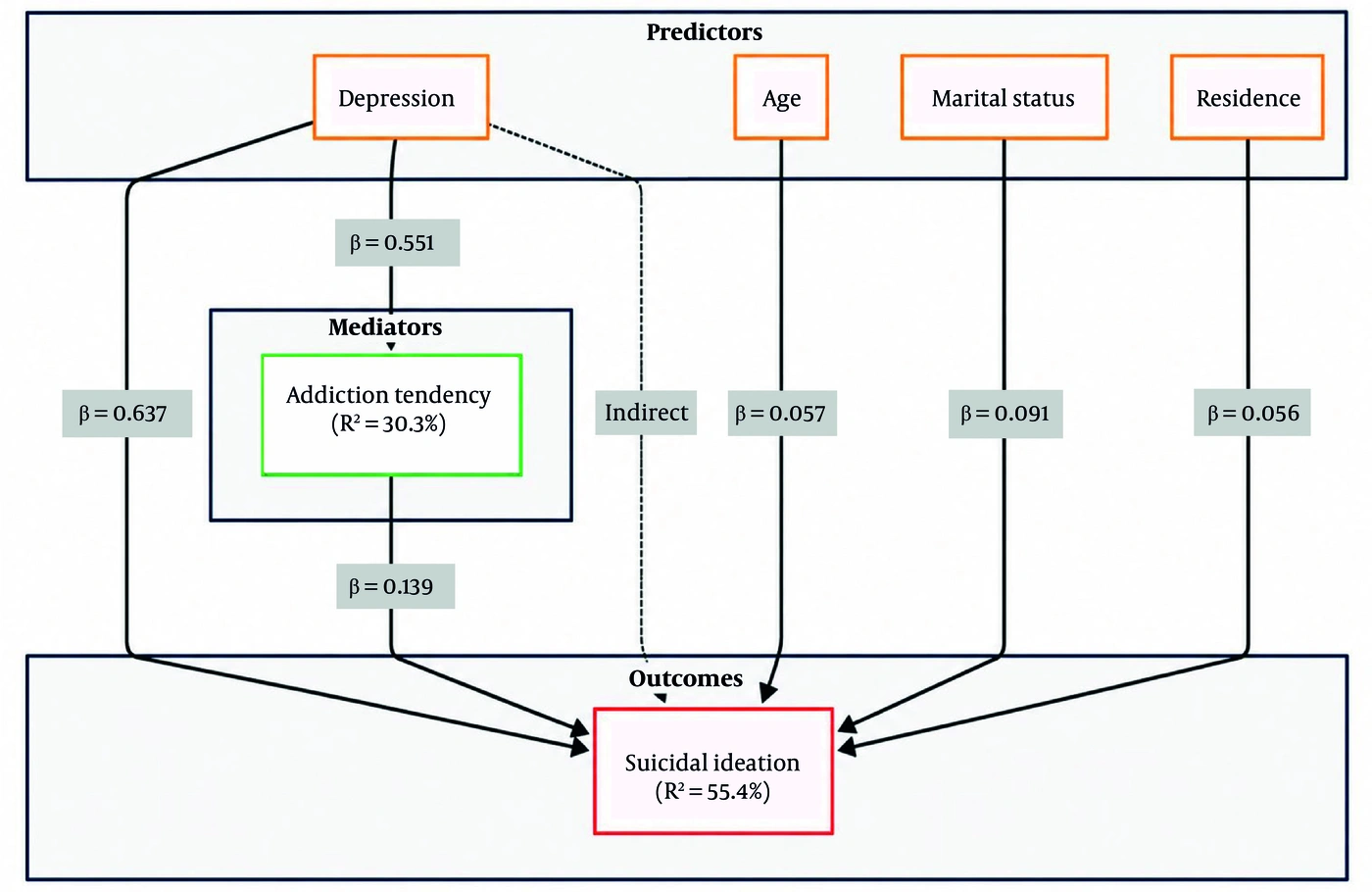
Figure 2.
Path model diagram (SEM)
The hypothesis-level findings are summarized in Table 6.
Table 6.
Summary of Hypothesis Testing a
| Hypothesis | Statement | Result |
|---|---|---|
| H1 | Depression positively predicts suicidal ideation | Supported |
| H2 | Addiction tendency independently predicts suicidal ideation | Supported |
| H3 | Addiction tendency is consistent with an exploratory indirect statistical pathway | Supported as an indirect statistical pathway; causal mediation not inferred |
| H4 | Selected sociodemographic factors show smaller associations | Partially supported |
| H5 | Integrated model demonstrates high apparent discrimination in the same cross-sectional study sample | Supported; requires external validation |
a Across analyses, depression was the dominant cross-sectional correlate of suicidal ideation. Addiction tendency contributed a smaller independent association and was consistent with an exploratory indirect statistical pathway. The high AUC indicates strong apparent discrimination in the same cross-sectional study sample but requires validation in an independent sample before practical screening use.
5. Discussion
This study examined cross-sectional correlates of suicidal ideation among Iranian medical and nursing students using regression, ROC, and SEM. Depression showed the largest standardized association with suicidal ideation, consistent with longitudinal and meta-analytic evidence indicating that depressive symptoms are among the most persistent risk factors for suicidal thoughts and behaviors (4-6, 17, 18). The present study extends this evidence to a single Iranian medical-sciences student sample while avoiding causal claims because of its cross-sectional design.
Evidence from cognitive-behavioral group therapy among nursing students was considered only as contextual literature for future intervention research, not as evidence supporting implementation in the present cross-sectional analysis (19).
Addiction tendency showed a smaller but independent association with suicidal ideation. The SEM pathway was consistent with a depression → addiction tendency → suicidal ideation sequence: the standardized indirect effect was 0.077, and its 95% percentile bootstrap CI excluded zero (0.033 to 0.124). This finding supports an indirect statistical pathway; however, because the study is cross-sectional, it should not be interpreted as causal mediation. The observed pattern is compatible with affect-regulation and ideation-to-action accounts, in which depressive symptoms may increase negative affect, maladaptive coping, psychological pain, and hopelessness, whereas addiction-related dysregulation can intensify suicide risk beyond mood symptoms alone (8-10, 20). Recent work from the same university context also supports the relevance of addiction readiness and perceived stress among students, providing a local rationale for examining addiction tendency alongside depression (21).
The sociodemographic findings were smaller in magnitude and less central than the psychological associations. Age, marital status, and residence showed modest associations after adjustment, whereas economic status was not statistically significant. These findings suggest that demographic variables may provide contextual information but do not substitute for direct assessment of depressive symptoms and addiction-related vulnerability.
The logistic model showed high apparent discrimination (AUC = 0.92), but this result was derived from the same cross-sectional study sample. Therefore, it should not be interpreted as evidence that the model is ready for clinical or campus implementation. As emphasized in the suicide-risk prediction literature, discrimination estimates can be optimistic without independent validation, and any screening use requires prospective external validation, calibration assessment, and evaluation of harms, feasibility, and referral capacity (13, 14).
5.1. Study Limitations
Strengths include the relatively large medical/nursing student sample, use of standardized instruments, and integration of explanatory and predictive analyses. Limitations include the single-site cross-sectional design, which precludes temporal or causal inference; reliance on self-report measures for sensitive constructs; potential nonresponse and missingness-related selection bias; absence of several unmeasured confounders, such as psychiatric comorbidity, family history of suicide, trauma history, sleep disturbance, and substance-use severity; and lack of external validation for the ROC model. Although bootstrapped percentile confidence intervals were calculated for the SEM indirect effect, these estimates remain exploratory because temporal ordering cannot be established. Future multicenter longitudinal studies should verify temporal ordering, repeat SEM in independent samples, and externally validate discrimination and calibration before any implementation decisions are made.
5.2. Conclusions
In this single-site cross-sectional study, depression had the strongest association with suicidal ideation among medical and nursing students, whereas addiction tendency showed a smaller independent association. SEM results were consistent with a statistically significant indirect pathway involving addiction tendency because the bootstrapped confidence interval for the indirect effect did not include zero. However, because the study was cross-sectional, this finding should be interpreted as a statistical mediation pattern rather than evidence of temporal or causal mediation.
The combined model showed high apparent discrimination (AUC = 0.92) in the same cross-sectional study sample; however, this performance may be inflated by overfitting and requires external validation in prospective multicenter samples before being used for screening or implementation decisions. Future work should prioritize longitudinal designs, independent validation samples, and replication of SEM indirect-effect estimates using bootstrapped confidence intervals.