


1. Background
The use/abuse of drugs, both legally and illegally, is a worldwide public health problem, and has serious impacts on the individual, family, society, and crimes. Drug abuse is a complex public health problem that is linked to the increased risk of serious infectious diseases, injury, death, family and social disruptions, unemployment, violence, crimes, and insecurity of the community (1).
The United Nations estimated that 246 million people, including 5% of people aged 15 - 64, used at least one illicit drug in the world in 2014. Drug-related deaths are unacceptable and preventable deaths; however, an estimated number of 207,400 drug-related deaths were reported in 2014 in the world (2). Opiates and its derivatives are at the top of the list of drugs that cause the greatest burden in terms of disease and drug-related deaths worldwide. In the United States, the death rate due to opioid overdose raised from 7.9/100,000 in 2013 to 9.0/100,000 in 2014 (3).
Overdose deaths are responsible for a third to a half of all drug-related deaths in Iran. Drug-induced deaths (illegal drugs) are the second most frequent cause of unnatural deaths in Isfahan province (4) and 5% of unnatural deaths among children and adolescents in this province are due to drug abuse (5). Iran in recent decades has seen a high risk for substance abuse and addiction. Drug abuse kills about 4000 - 5000 people in Iran each year, of which 57 to 65% of the deaths are due to poisoning related to opioids and stimulants. Drug-related deaths are caused by acute poisoning (55%), complications of long-term use and diseases such as AIDS and hepatitis (37%), and deaths from illegal synthetic drugs (around 8%). The country has a long history of drug abuse with poppy plants being grown in the region for several thousand years. Opium from the plant has been used and abused for its pharmacological and psychotropic effects.
In 1994, the country developed outpatient treatment centers in all provinces, designed prevention programs, developed self-help groups, and created educational films and publications addressing drug abuse. Although current laws still consider drug use as a crime, they also offer treatments for drug abuse. Despite many efforts, drug abuse is still the biggest health and social problem in Iran.
Recent reports have shown a rapid increase in heroin dependency and injecting drug use. The first large-sample nationwide study conducted in 2007 estimated the users of opium and heroin at about 3.76 million, and the annual increase rate of 8% (6). Iran has the highest rate of drug use/abuse per capita in the world, with one regular user per 17 population and one addict per five population aged 15 to 60 (3). Due to the stigma surrounding drug use and the criminalization of drug abuse in Iran, the real number of addicts and recreational users is unknown or under-reported. Legal restriction and social stigmatization have led drug users to deny and hide their actions. In addition, drinking alcohol is a crime and sin. Opium, its derivatives, and synthetic drugs are cheap, potent, and readily available in Iran. Socio-economic conditions in recent decades, American and European outrageous sanctions, high rates of youth unemployment, and high inflation rates have directly and indirectly resulted in turning ever more Iranians to hard drugs (2).
In order to assess the scope of the drug use/abuse issue, it is critical, first, to determine the number of individuals using/abusing drugs, the epidemiological/demographic features of the using/abusing population, and the type of drugs used/abused. The level of accuracy of the data collected depends on the methods used to obtain the information. Drug abuse is a criminalized behavior and therefore, traditional epidemiological methods often lead to varying degrees of underestimation. Social stigmatization and legal restriction of substance abuse make it extremely difficult to attain valid estimates of the incidence and prevalence of drug use/abuse in Iran (7).
One indirect method of estimating the issues of drug abuse is using secondary information sources such as rapid situation assessment (RSA). A rapid situation assessment (RSA) was conducted in Iran in 1998. An investigation using secondary sources such as the RSA on the status of drug abuse was conducted in 2002. The RSA method is ideally suited for conducting research among ‘hidden’ or marginalized populations (2).
One of the key forensic epidemiological indicators used to assess the gravity of the drug uses/abuse problem is to use epidemiological and forensic data from the Medical Examiner/Coroner’s office. For example, in the U.S. and a number of European countries, all drug-related deaths undergo a forensic investigation. This investigation attempts to recreate the circumstances surround the death by conducting a scene investigation, searching the death scene, reviewing medical and drug abuse history, and interviews with family, friends, co-workers, and the police. The body undergoes an external and internal examination and body fluids (blood, urine, bile, and eye fluids) undergo toxicological analysis. The analysis provides a list of the concentration and number of compounds detected within the body fluids (8). However, currently, this level of forensic investigation is not possible within the county of Iran.
At present, data on the prevalence and incidence of substance abuse in Iran cannot be directly measured due to social stigma and limits within the legal and forensic systems. However, many nations, like Iran, have relied on indirect sources of information to provide prevalence estimates. In the past, these indirect sources involved surveys, extrapolation from police reports, treatment centers, and drug-related mortality data (7). With the current limitations related to the forensic investigation, social stigma, and other cultural factors, the real numbers of addicts, recreational users, and drug-related deaths are underestimated; therefore, other methods should be used to estimate the drug epidemic in Iran. One promising method is to use mathematical and statistical models as an alternative approach to estimate the number of addicts, recreational users, and drug-related deaths.
For the study of processes in various disciplines, the dynamical system approach has turned out to be a valuable tool. The system dynamics approach is suitable to address the dynamic complexity of many public health issues (9, 10). This mathematical modeling approach also has been used in the study of alcohol consumption in Spain and its economic cost (11) and other contexts such as obesity, ecstasy, and heroin addiction (12).
We applied dynamical system approach to assess the transmission dynamics and the prediction of drug abuse in Isfahan province, Iran. Additionally, utilizing this model, we estimated the number of recreational users and addicts and estimated the impact of drug abuse on drug-related deaths for the years 2014 - 2023.
2. Objectives
In this study, we evaluated a system dynamics approach to model drug-related deaths in the next 10 years in Isfahan province.
3. Materials and Methods
In this retrospective descriptive study, we modified the alcohol abuse model proposed by Santonja et al. to predict the number of drug abusers and related deaths proportions in the next 10 years in Isfahan (11). To develop the model, the population of 15 - 64 years of age was divided into three subpopulations; namely, class A comprising individuals susceptible to becoming drug users, class M comprising individuals who were recreational users, and class R comprising individuals who were regular drug users (addicts) meaning that they consumed a considerable amount of drug in a habitual manner. Data were collected and used to build a dynamic model using Vensim® PLE, version 7.1.
3.1. Building the Dynamic Model
1- We assumed the population has a homogeneous mixture. That is, each person could contact any other person.
2- The transitions among three classes of the population are as follows:
• We consider that when someone reaches the age of 15 years, he/she becomes a member of the A (t) subpopulation.
• Recreational users are defined as individuals that use drugs only infrequently or occasionally, M (t). If these persons increase their intake of drugs, they will become a risk consumer, R (t).
• The R (t) individual becomes a member of subpopulation A (t) if leaving the drug abuse behavior.
3- Under the above assumptions, the transitions of subpopulation members can be modeled as follows:
• Individuals of subpopulation A(t) transit to M(t) because individuals in M(t) or R(t) transmit their drug use/abuse habit by social contact at rate β. Therefore, this is a nonlinear term modeled by βA(t) (M(t) + R(t))/P(t), and P(t) = A(t) + M(t) + R(t).
• An individual in M(t) transits to R(t) at rate α proportional to the size of M(t) if his/her drug abuse increases. This is a linear term modeled by αM (t).
• An individual in R(t) transits to A(t) when he/she gives up the drug abuse. An individual in R(t) transits to A(t) at a rate proportional to the size of R(t). Hence, this is a linear term modeled by γ R(t).
Under the above assumptions, the dynamic drug abuse model for the Isfahan population is given by the following nonlinear system of ordinary differential equations:

Equation 1.

Equation 2.

Equation 3.

Equation 4.
Where the constant parameters of the model are:
μ = the birth rate in Isfahan province.
Γ = the rate at which an addict gives up the drug consumption.
dA = the death rate in Isfahan.
β = the transmittal rate due to social contacts to increase drug abuse (family, friends, marketing).
D = the increased death rate due to drug abuse.
α = the rate at which an occasional drug user turns to a regular drug user (addict).
Figure 1 shows the diagram for the preliminary system modeling of drug abuse. Subpopulations are shown by boxes and transitions between them by arrows. Arrows are labeled by the parameters of the model.
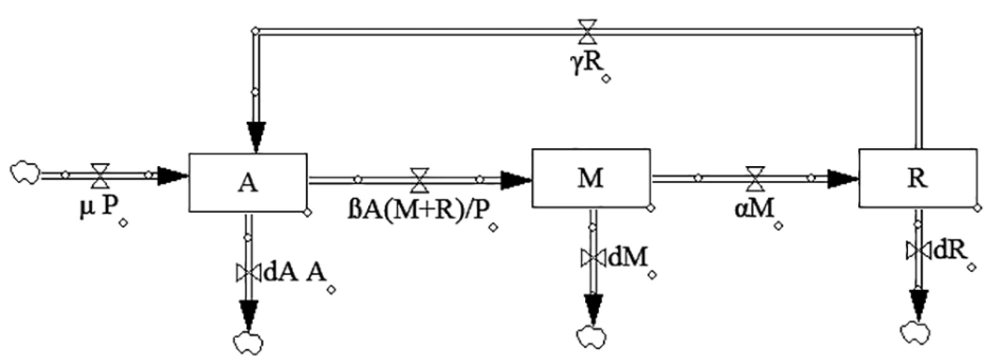
Figure 1.
Flow diagram of the mathematical dynamic model of drug abuse
3.2. Scaling the Model
Data in Table 1 were obtained from the Statistical Center of Iran and Legal Medicine Organization of Isfahan province. One of our objectives was to fit data to the model to scale the model. Therefore, we used the following idea for scaling the model (11):
Table 1.The Parameters, for Time t0 = 2013
| Parameters | Values |
|---|---|
| Year | 2013 |
| Total population of Isfahan province | 4,879,312 |
| > 15 years old | 3,903,449 |
| Subgroup A | 3606787 |
| Subgroup M | 199076 |
| Subgroup R | 97586 |
| Growth rate (μ) | 0.0137 |
| Death rate of dAA | 0.00548 |
| Death rate of dM | 0.00015 |
| Death rate of dR | 0.00304 |
| γ | 0.0135 |
Adding Equations 1 - 3 one gets:

Equation 5.
Dividing both members of Equation 5 by P (t), we have:

Equation 6.
If we define the rates (depending on time), we have:

Equation 7.
Equation 6 can be transformed into the Equation 8:

On the other hand, computing the derivative defined in Equation 7 and using Equation 8, we have:

Equation 9.
In an analogous way, we also have:

Equation 10.

Now, considering Equation 1, if we multiply it by 1/P, we have:

Equation 11.
In addition, using Equation 9 and substituting by the corresponding rates defined in Equation 7, one gets:

Equation 12.
Remainder equations can be scaled in the same way to obtain:

Equation 13.

Equation 13.
3.3. Estimation of Parameters
All the parameters of the model, except for α and β, were obtained from the Statistical Center of Iran and the Legal Medicine Organization of Isfahan province.
The parameters for time t = 2013 are presented in Table 1, including the total population of Isfahan province, the future susceptible population of drug users/abusers, recreational users, and addicts, besides growth rates and death rates for the latter three groups for the year 2013 and deaths related to drug abuse in Isfahan.
The parameters α and β were calculated by fitting the model with data from Table 1, giving β = 0.01864 and α = 0.016627. Then, the parameters and variables were entered into Vensim® PLE Software.
4. Results
Based on the parameters in Table 1, we estimated the total population of Isfahan province, the future susceptible population of drug users/abusers, recreational users, and addicts, as well as the growth rates and death rates for the latter three groups for the year 2013 - 2023 (Table 2). The calculations were based on an epidemiological mathematical model that predicts the drug abuser proportions in Isfahan in the next 10 years. Table 2 shows an expected increase of about 10 folds in deaths related to drug abuse in addicts and a 14% increase in the addict population in Isfahan province by 2023 (Table 2). Figure 2 shows a diagram of the dynamic drug abuse model.
Table 2.Estimation of the Proportion of Risk Consumers or Addicts (R(t)) and Recreational Users or Non-Risk Consumers (M(t)) Subpopulations and Their Deaths Related to Drug Abuse, 2014 - 2023
| Year | Population | Death | ||||
|---|---|---|---|---|---|---|
| Isfahan Province | Subgroup A | Subgroup M | Subgroup R | Recreational Users | Addicts | |
| 2014 | 4,946,160 | 3,648,280 | 198,853 | 99,281 | 29 | 296 |
| 2015 | 5,013,920 | 3,690,420 | 198,686 | 100946 | 59 | 599 |
| 2016 | 5,082,610 | 3,733,220 | 198,580 | 102579 | 89 | 906 |
| 2017 | 5,152,240 | 3,776,690 | 198,526 | 104184 | 118 | 1218 |
| 2018 | 5,222,830 | 3,820,840 | 198,525 | 105761 | 148 | 1535 |
| 2019 | 5,294,380 | 3,865,680 | 198,575 | 107,313 | 177 | 1857 |
| 2020 | 5,366,910 | 3,911,210 | 198,675 | 108,839 | 207 | 2183 |
| 2021 | 5,440,440 | 3,957,450 | 198,822 | 110,342 | 237 | 2515 |
| 2022 | 5,514,970 | 4,004,400 | 199,015 | 111,822 | 266 | 2850 |
| 2023 | 5,590,530 | 4,052,080 | 199,254 | 113,282 | 296 | 3191 |
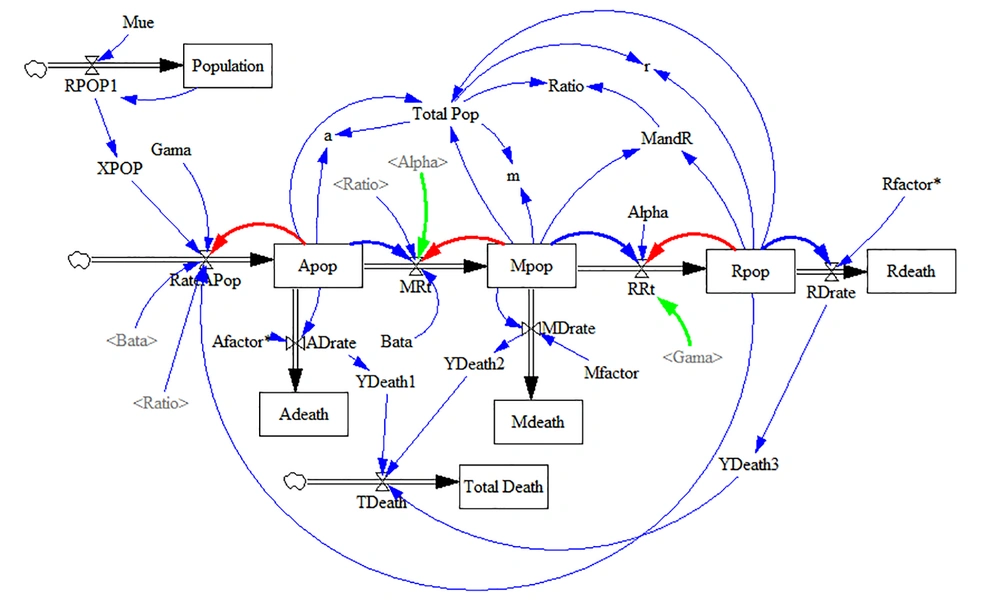
Figure 2.
The diagram of the dynamic drug abuse model
5. Discussion
Over the past few decades, Iran has been severely damaged by the consequences of substance abuse. Obtaining reliable estimates of the incidence and prevalence of drug use/abuse in Iran is critical in planning public health intervention programs, providing an infrastructure for treatment centers, and dealing with drug addiction more as a health problem and less as a crime. Iran is suffering from the second most severe addiction to opioids in the world (8).
Currently, data on the prevalence and incidence of substance abuse in Iran cannot be directly measured due to reasons such as social stigma and limits within the legal and forensic systems. However, many nations, like Iran, have relied on indirect sources of information to provide prevalence estimates. In the past, these indirect sources involved surveys, extrapolation from police reports, treatment centers, and drug-related mortality data (7). However, these sources have own limitations. We propose the next phase of determining the prevalence and incidence of drug abuse by introducing system thinking and system dynamics modeling to estimate the number of addicts, recreational users, and drug-related deaths in Isfahan province in the next 10 years.
For the study of processes in various disciplines, the dynamical systems approach has turned out to be a valuable tool. The system dynamics approach is suitable to address the dynamic complexity of many public health issues (9, 10). A system dynamics modeling approach has the potential to integrate our awareness about multilevel causes of health and their template of action, reaction, and feedback, and to promote our knowledge about how policy interventions affect the health of communities and populations (13).
Dynamic modeling can be a very powerful tool for drug use epidemiology and monitoring at national and international levels and complementary to indicators and direct data analysis (14). Instead of uni-dimensional ‘risk’ factors and unlike usual inductive or empirical methods of data collection and interpretation, it focuses on the structural factors that create a social environment and sustained health and it is nearer to a deductive approach. Dynamic models describe the behavior of a distributed parameter system in terms of how one qualitative state can turn into another. System dynamics approach is a tool or a field of knowledge for understanding the changes and complexity of a dynamic system over time. It is assumed that the model can accurately study the behavior of this process under different conditions by changing parameter values and observing changes in the results to describe a real-life process (15).
We suggest that the potential capability of this method be considered and believe that epidemiologists eventually will overcome their challenges with this method and complex dynamic models. We also expect that applying regression models will soon be used in the field of epidemiology. By using a system dynamics approach, we can estimate the economic burden of drug abuse in Iran in the next few years in terms of the direct costs of drug abuse, including health and non-health costs such as treatment of drug-related morbidity and deaths, and indirect costs related to decreased productivity.



