





1. Background
As defined by the American Psychological Association, a mentally retarded person refers to someone with an intelligence quotient (IQ) of less than 70 and a defect in adaptive functions, occurring before the age of 18 (1). These children have problems with their environment, which is disabling them from fulfilling community expectations of mental and physical activity. Nowadays, mentally retarded children are believed to have the same rights as normal children in accessing the same facilities (2). Mental retardation is a relatively common disorder, which affects about 1% - 3% of the population (3). Caring of a mentally retarded child at home is a challenging event and negatively affects the mental health of the family (4). Parents, especially mothers of children with mental retardation are exposed to psychological problems such as anxiety, depression, stress (5), as well as damaging social, financial, and emotional problems (6).
Teaching of resilience is one of the strategies to improve the mental health of individuals. Resilience is defined as the ability of people to overcome stress, the ability of adaptation and adjustment, self-esteem, emotional stability, and personality characteristics (7). It also means the ability to cope with difficult situations and to respond more flexibly to the pressures of life, resulting in the improvement of persons’ social function (8). Steinhardt and Dolbier found that the program of resilience increases more effective coping strategies and protective factors such as positive emotion, self-esteem, and self-leadership, as well as reduces negative emotions such as stress and depression (9).
Tele nursing is a educational method and as a part of the remote health system, it is considered an economical, easy, and unique communication medium for delivering nursing care to clients (10). Cellphone is a universal, low-cost, and personal device, referred as a social and cultural tool (11), which is easily acceptable, available, and accessible for people (12-15). Today, cellphones are considered as an integral part of human life and have various functions, one of the most important applications of which is short message service (16). A total of 83% of the world’s people use cellphone and 73% send SMS (17).
A text message, known as “short message service” or “short message,” allows transmission of short text-based messages (15). In addition, it is an interactive, simple, fast, and confidential technique (16), as well as practical and acceptable in psychosocial interventions (18). This method of communication improves the mental health of individuals (19) and provides patient-oriented care for clients (20).
SMS means exchanging letters and characters among people using cellphones (21). This method enables users to send text message up to 160 characters through a cellphone (22), and unlike telephone communications, it allows sending messages without any fear or disconnection with the other person (23). Simple use and low cost are the advantages of SMS, compared to other communications (24, 25). SMS requires less manpower and a nurse is able to follow-up 425 patients remotely, however, the use of cellphone for training has some barriers such as the small size of the screen (26) and the impossibility of face-to-face communication.
The researchers found that creation of resilience through psychological acceptance can reduce occupational stress and increase the mental health of staff and teachers who interact with mentally retarded people (27). However, the results of a study showed that participation in the resilience education cannot increase the resilience and well-being and decrease the psychological disturbances of adolescents (28). The researchers concluded that education through text message can reduce occupational stress in nurses.
Regarding the relationship between the nurse and the family of mentally retarded children, community health nurses are of great importance for family support and education to comply with and to maintain and care their children. Of course, teaching is the most important role of nurses at all levels of prevention.
2. Objectives
Regarding the contradictory results of studies and the novelty of short message in relation to client education, the researcher decided to conduct a study to determine the effect of resilience teaching via SMS on the stress of mothers of educable mentally retarded children.
3. Materials and Methods
3.1. Study Design
The present field trial study was conducted in 2016 - 2017 in the exceptional schools of Yasuj.
3.2. Study Sample
First, 250 mothers whose mentally retarded children were studying in exceptional schools, filled out the relevant questionnaires, and finally, 70 eligible mothers were selected to participate in the study using non-probability convenience sampling method. Then, the samples were divided into intervention and control groups based on block random allocation, each group consisting of 35 patients. According to Jalali (29) and considering the first type error of 5%, the test power of 80%, and an attrition rate of 15%, a total of 35 mothers were enrolled in each of the groups.
3.3. Method of Conducting the Study
Data were collected in two stages; before the intervention (first stage) and one month after the end of the intervention (second stage) in both groups, with this difference that the intervention was not performed in the control group.
In the intervention group, cellphone numbers were obtained from subjects, their phone was checked in terms of the Persian menu, and using SMS was trained. In addition, a fixed telephone number was taken to complete the questionnaires at the end of the study. To ensure that the messages are sent, the researcher activated the “delivery” option in his/her cellphone and checked the received message by people to be ensured of timely and correctly receiving of messages by the subjects.
In the teaching of short message service via cellphone, the sent messages were related to resilience (the concept of resilience, the characteristics of resilient people, internal and external support factors, and familiarity with methods of resilience creation). Four text messages were sent to the mothers each day, therefore, 180 messages were sent within 1.5 months. Each message is given a number. During this time, the feedback of messages was obtained every two weeks by fixed line or cellphone and recorded in the designed forms. In this method, the fluent sentences were sent regularly on the basis of the prepared pamphlet, and in order to prevent any mental disturbance, every four messages sent on a day were about a specific topic (for example, the concept of resilience, the characteristics of resilient people, and familiarity with the ways of resilience creation); that is, it was trying to conclude about the discussed subject immediately on the same day or eventually within three days (29).
3.4. Criteria
Inclusion criteria were full conscious, reading and writing skills, ability to communicate and answer questions, no multiple disabilities of children, no family member with hard curable physical or mental disease, knowing and full access to cellphone, having a cellphone, consent to participate in the study and signing the informed consent form, using SMS and the ability to read SMS, no use of neurological and psychiatric medications since 4 months ago, parenting stress score greater than 90, Children with an IQ of 55 - 70 whose mental retardation was diagnosed by a pediatrician and an expert on diagnostic tests of the Exceptional Education Office, and resilience score less than 50. Exclusion criteria were dissatisfaction of mother with the continuation of the study, encountering of mother or family with a new crisis during the research, and persons’ death or immigration.
3.5. Study Measures
The data were collected with the demographic characteristics questionnaire, the Connor-Davidson Resilience Scale, and the Abidin Parenting Stress Index. The demographic characteristics questionnaire consisted of two parts, mother demographic characteristics (education, age, occupation, and residence) and information about the disease including the history of mental illness, admission in the psychiatric department, and the history of psychoactive drugs and alcohol consumption by the mother. The Connor-Davidson Resilience Scale has 25 items, which are scored on the Likert scale from zero (completely false) to five (always true). The cutoff point for this scale is 50. In other words, a score of over 50 indicates a person with resiliency and the higher the score, the higher the person’s resilience will be and vice versa (8, 30). Connor and Davidson reported the Cronbach’s alpha coefficient of the resilience scale as 0.89. In addition, the reliability coefficient of the test-retest method was 0.87 at a four-week interval (8). Hagh Ranjbar et al. confirmed the validity and reliability of the Connor-Davidson Resilience Scale in Iran, and using the Cronbach’s alpha coefficient, they found a reliability of 0.84 for this scale (30). The Short Form Parenting Stress Index has 36 items including those with the same terms as the main long form with 101 items. This index was designed to measure the total stress in addition to the three domains of parental stress (31). The index has three subscales of parental disturbances, characteristics of trouble-making children, and parent-child ineffective interactions. The Cronbach’s alpha was also used by Shirzadi et al. to determine the reliability of this index; they reported the validity as 59% - 86%, the test-retest reliability as 92% - 97%, and the Pearson correlation coefficient as 38% - 84% (32).
3.6. Data Analysis
Data were analyzed using SPSS-21, by descriptive and inferential test, considering the 95% confidence interval.
3.7. Ethical Considerations
The present research was conducted after obtaining the permission and reference from the Research and Technology Deputy of the University and the Department of Special Education, obtaining confirmation from the Research Ethics Committee, approval of the project, and registration in Iranian Registry of Clinical Trials website. Then, during a telephone call from the school with mothers, the researcher introduced himself and stated the study objectives, importance, and method. Informed written consent was obtained; it was also explained that they are free to leave the study and that the information is confidential. To observe ethics in research, all teaching was provided to the control group as a booklet at the end of the intervention.
4. Results
The demographic characteristics of mothers with educable mentally retarded children are given in Table 1.
Table 1.Between Group Comparison of Demographic Characteristic of Mothers of Educable Mentally Retarded Children at the Beginning of Studya
aValues are expressed as mean ± SD or No. (%).
bT-test.
cChi-square test.
dFisher’s exact test
The findings showed that the level of mothers’ resilience in the intervention and control group at baseline (pretest) were in a close range, however, in the posttest, the level of mothers’ resilience was decreasing in the control group, while this rate increased in the intervention group with a steep slope (Figure 1).
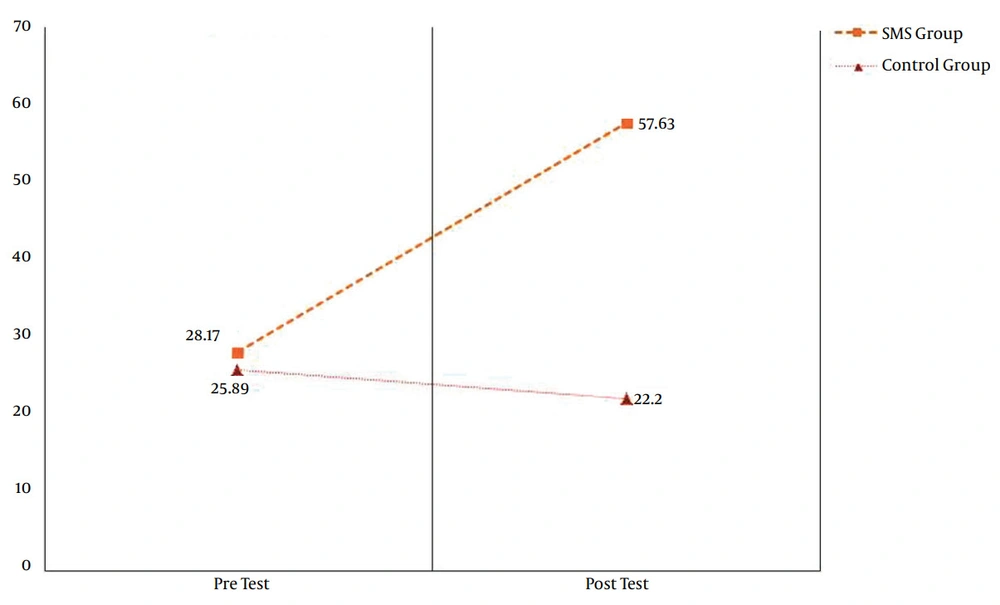
Figure 1.
The trend of changes in maternal resilience score in the intervention and control groups from the pretest to posttest (one month after the end of intervention)
Given the normal distribution of the dependent variable of stress in the studied groups at both assessment times, and since the P value was higher than 0.05 significance level in the Kolmogorov-Smirnov test, to determine the effectiveness of resilience education through short message on the stress of mothers with educable mentally retarded children, intra-group comparison of stress was done by paired t-test. Based on the results presented in Table 2, the stress of mothers with educable mentally retarded children in the intervention group (short message service) significantly decreased in the post-test (one month after the intervention) compared to pre-test (baseline) (P < 0.05), while the stress of mothers with educable mentally retarded children in the control group significantly increased in the post-test compared to the pre-test (P < 0.05).
Table 2.Within Group Comparison of Stress Score of Mothers of Educable Mentally Retarded Children in Intervention and Control Groupa
| Statistic Indices of Variable | Group | |
|---|---|---|
| Intervention (SMS) | Control (No Intervention) | |
| Pre parental stress score (at the beginning of study) | 126 ± 23.9 | 129.3 ± 21.8 |
| Post parental stress score (one month after completion of intervention) | 86.08 ± 18.5 | 135.2 ± 23.1 |
| P valueb | < 0.05 | < 0.05 |
aValues are expressed as mean ± SD.
bPaired T-test.
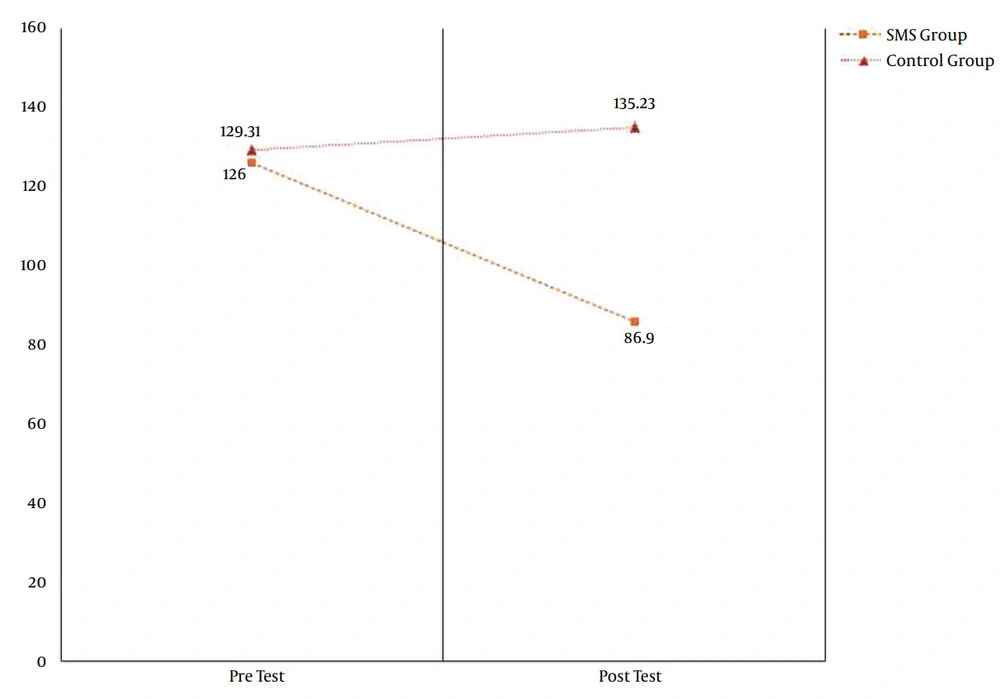
Figure 2.
The trend of changes in maternal stress score in the intervention and control groups from the pretest to posttest (one month after the end of intervention)
5. Discussion
The results showed that teaching via SMS was successful in increasing resilience and reducing stress in mothers of educable mentally retarded children.
According to the findings, in the posttest, mothers’ stress was significantly lower in the intervention group compared to the control group. Therefore, teaching via SMS was able to reduce mothers’ stress in the intervention group compared to the control group.
In line with the results of this study, the findings of Esbakiyan Bandpey et al. showed that SMS reduced job stress in nurses and there was a significant difference between the mean post-test scores of job stress in the intervention group compared to the control group. The difference between this study and the present research was the number of messages and the duration of the intervention (33). The results of Patnaik et al. also showed that teaching via SMS improved mental health and relieved stress in patients with diabetes mellitus. In this study, short message was sent weekly to the intervention group (34). In addition, according to a study by Rajabi et al. SMS-based consultation was effective in reducing adolescent aggression behaviors (35). Hingle et al. concluded that SMS-based interventions can increase the knowledge of people in regards to skin cancer preventive behaviors (36). Bin Abbas et al. concluded that sending a text message via cellphone increases the compliance with diabetes treatment and improves clinical outcomes in patients with diabetes (37).
According to the findings, one month after the end of the intervention, mothers’ resilience increased in the intervention group, however, it decreased in the control group. Consistent with these results, the study of Jafari et al. showed that the mean score of resilience in the intervention group was significantly higher than the control group and teaching of coping skills can increase resilience in drug dependent individuals (38). A study by Rezaie et al. showed that existential psychotherapy can increase the resilience of mothers of mentally retarded children (39). However, Skehill found that participation in the training program has no impact on resilience and well-being increment and psychological disturbances decrement in adolescents (28); this is inconsistent with the results of the present study, which may be due to the difference in the type of samples in these studies (mothers versus adolescents). A person who enjoys resilience, is a solver and flexible, adapts himself/herself with environmental changes, and immediately recovers after the stress relieves. People with very low levels of resilience can slightly adjust themselves to new situations and slowly recover from stressful situations to normal. Therefore, resilience can be improved in mothers of mentally retarded children using new technologies such as short message service.
Although the findings indicate a reduction in stress and an increase in resilience of mothers, this study also had some limitations including the possibility of contact and information exchange between the groups of intervention and control, which was reduced through communicating with mothers on various days. The existence of other communications ways such as media, as well as the mental status of the participants influenced their answer to the questionnaires, which was beyond the control of the researcher.
5.1. Conclusion
In general, it can be concluded that teaching via SMS can reduce stress and increase resilience in mothers of educable mentally retarded children. Therefore, given the destructive effect of stress on the daily lives of mothers to prevent short and long term mental and physical consequences of long-term stress, teaching via SMS can reduce stress and improve communication between client and health care providers, due to the fact that they are new, easy, and inexpensive. In other words, since a targeted nurse-client relationship is one of the main issues of nursing care, nurses can benefit from this educational method to educate clients.



