

1. Introduction
Generalized anxiety disorder (GAD) is a common psychiatric condition, which is more common in females. The associated individual and societal burden is substantial. GAD is characterized by excessive and inappropriate worrying that persists for months, in which patients develop somatic (such as palpitations, tremors, dyspnea, and others) and psychological (psychic) symptoms. In Europe, GAD lifetime prevalence is around 4.3% - 5.9%. Patients with comorbid major depression tend to have a more severe functional impairment.
GAD represents a multifactorial developmental disorder of a genetic-environmental interaction, with structural-functional changes in the amygdala-prefrontal circuitry. Extensive evidence in the literature supports the efficacy of certain selective serotonin reuptake inhibitors (SSRIs), serotonin and norepinephrine reuptake inhibitors (SNRIs), pregabalin and quetiapine. However, the ideal treatment for GAD should be determined by the clinical features of the patients, presence of comorbidities, patients’ preferences, and therapeutics availability (1). Psychotherapy, behavioral modification therapy, and cognitive therapy also play a vital role. Cognitive therapy, whether alone or combined with medications, provides a viable option in treating outpatients with primary, non-bipolar depression. Moreover, cognitive therapy alone seems to be an effective alternative to tri-cyclic antidepressants (2).
Panic disorder (PD) is a disabling condition that is often accompanied by other psychiatric and medical conditions, including GAD. The lifetime prevalence of PD is approximately 4.7%. The SSRIs and SNRIs are also used to effectively manage PD. Escitalopram, a highly selective SSRI, has proven to be of great value for PD. Furthermore, patients with PD are at an increased risk for suicide, which seems to be greater in patients with comorbid depression. Escitalopram has the potential to reduce numerous related symptoms. Additionally, compared to tricyclic antidepressants (TCAs) and monoamine oxidase inhibitors (MAOIs), it has a favorable tolerability that predicts a more successful initiation and maintenance, and a safer risk profile (3). TCAs appear to have an additional analgesic property when compared to escitalopram. TCAs can be used for GAD/PD patients, who already have painful comorbidities (4).
In this case report, TCAs, because of their analgesic effect, were used in a patient with lumbar spine problem (facet joints’ spondylosis) that was a localized form of osteoarthritis (OA) of the spine, and involved the facet/zygapophyseal joints. Facet joint osteoarthritis (FJOA) is linked to degenerative intervertebral disc disease, and both have an enormous impact on the health-care systems. FJOA is a functional failure of synovial facet joints due to variable degrees of loss of the synovial cartilage. Radiographic hallmarks are as follows: Narrowing of the joint space, subarticular bone erosions, subchondral cysts, osteophytes, and hypertrophy of the articular process. Risk factors for FJOA include age, sex, overweight, physical trauma, occupational factors, and smoking (5).
In FJOA, facetogenic spinal pain is a frequent and a debilitating cause of mechanical spine pain. Diagnostic blocks, including medial branch blocks (MBBs), are the only reliable approach to identify facet joints as the source of spinal pain. In the absence of a reference standard, MBBs actually serve more as a prognostic than diagnostic role, enabling the selection of patients who might respond to radiofrequency denervation treatment, which is the standard treatment for facet joint pain. Trials of intra-articular steroid injections have yielded disappointing results, while radiofrequency denervation have provided some benefits in approximately 60% of individuals for up to a year (6). Clinical and radiological data revealed that FJOA and IJD appear to augment the pathology of each other in a reciprocal fashion (7).
2. Case Presentation
The patient, N.T. was a 32- year old male from Baghdad, Iraq. He was completely healthy and athletic, apart from an asymptomatic hemangioma in the right lobe of the liver, approximately nine millimeters in diameter, which was diagnosed accidentally during an abdominal ultrasonography in August 2014.
In late 2012, the patient became involved in a confusing emotional relationship with an older female colleague while they were studying together through distance learning. The female was older by eight years. She was already divorced, with three children, and was from a different religious, ethnic and cultural background, living in a distant country. The female had prior martial and pre-marital experiences, and kept involving her male colleague (the patient) with details about these relationships, some of which dated back to the time she was 15 years of age. After a relatively short period, approximately four months, the patient developed neurotic manifestations, disturbing his social life, work, and family relationships. The female became the absolute center of his attention.
Approximately, they met together abroad two years later. They were studying together at a university in Europe where they became gradually more emotionally involved for about four months. In January 2015, the patient suffered from an acute back injury, due to lifting his female colleague on few occasions. The university’s medical counseling services, via general practitioners (GP), wrongly diagnosed him with a torn erector spinae muscle. He was prescribed with painkillers, mainly Naproxen 500 mg tablets on need, and Diazepam 5 mg tablets at night. The patient was advised to remain mobile, and engage in normal daily activities. Three weeks later, his pain became more frequent. He reconsulted his GP, who kept insisting that his condition was merely a torn muscle. The patient later became very busy with his university exams, and kept using analgesia for symptomatic relief.
In parallel to his medical condition, the patient also consulted the university’s mental counseling services, concerning his persistent anxiety, and the female’s past sexual life. The patient was advised against this relationship during one of the counseling sessions, to be protected from a depriving relationship. However, the patient ignored this professional opinion.
On March 2015, the patient had a very harsh verbal argument with his female colleague in public concerning her past sexual life, and their relationship ended completely. At this point of time, the patient was suffering from his yet undiagnosed lumbar spine problem. Within few days, he consulted a specialist rheumatologist. Based on the specialist opinion and the Magnetic Resonance Imaging (MRI) report of the lumbar spine, the diagnosis of mild-to-moderate FJOA worst at the level of L4 - L5 and L5 - S1 was confirmed (Figure 1), with an accompanying mild intervertebral disc circumferential bulge and minimal disc degeneration at L5 - S1. Luckily, there was no definite neural impingement. The focus of the pain was the right facet joint of L5 - S1, and the rheumatologist decided to infiltrate the affected joint with Depo-Medrone and a local anesthetic. This procedure was performed under fluoroscopy guide. The patient was also prescribed Etoricoxib 90 mg tablet once a day for 10 days, and diazepam 5 mg tablet once daily for a week.
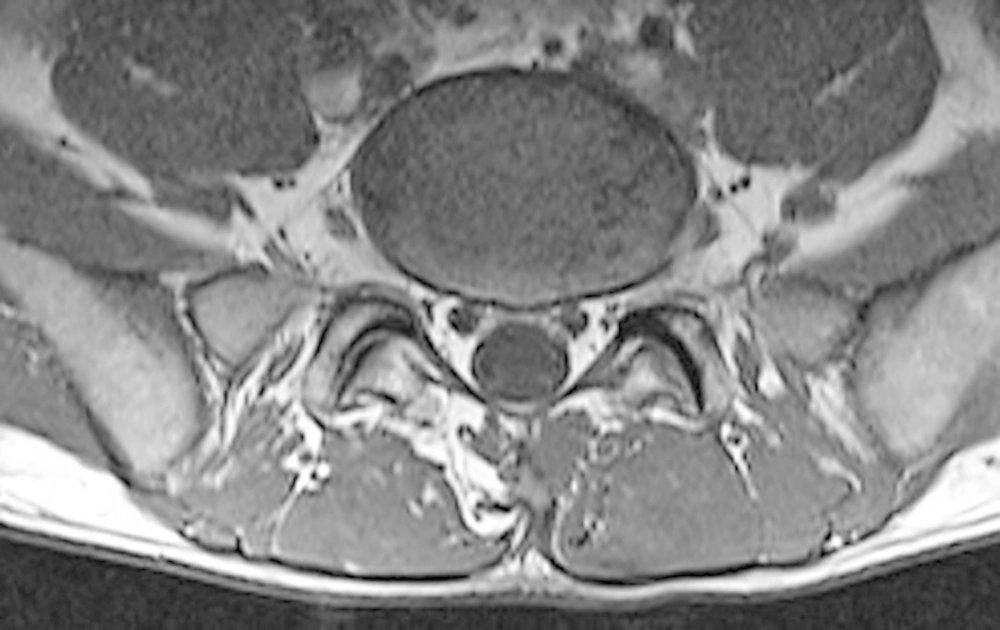
Figure 1.
A Cross- Sectional MRI of the Lumbar Spine, Showing Facet Joint Degeneration at L5-S1, with a Mild Circumferential Disc Bulge
Within a week, the patient travelled to meet his family for social support, and he underwent 20 sessions of physiotherapy. Physiotherapy included transcutaneous electrical nerve stimulation (TEN), muscle stretching, heat therapy, passive and active exercises, and low-level laser therapy (LLLT) of the lumbar spine. Simultaneously, the patient sought a psychiatrist consultation. The psychiatric evaluation was in line with the medical report provided by the university’s counseling services.
Quoted from the University psychiatric evaluation, The relationship has ended, but he is still feeling anxious and preoccupied, this is affecting his day-to-day living. The patient was diagnosed with GAD and depression. The psychiatrist prescribed amitriptyline 25 mg tablets once daily at night, and Escitalopram 10 mg tablets once daily in the morning. The patient was compliant with his medications, with exception of Escitalopram, because it was not available at local pharmacies. Further, the patient was forced to travel back to his university on April 2015 to solve his interim suspension decision, which was issued by the university against him. The suspension decision was based upon a complaint filed by his female colleague at the day of their public argument.
The suspension decision was later removed, and the patient went back to his country on June 2015. He kept suffering from lumbar backache, which further augmented his depression. He also developed panic attacks mainly at nights. Based on the psychiatric re-consultation the psychiatrist, insisted on initiating 10 mg Escitalopram tablets to control his panic disorder (PD). Within one month of being compliant about his medications, and receiving family support particularly from his mother, his panic attacks disappeared and his depression regressed.
The patient compliant with his medications, physiotherapy, and regular swimming. He kept taking oral analgesic medications in the form of Loxoprofen Sodium 60 mg tablets three times daily, and Eperisone 50 mg tablets three times a day, both of which were eventually tapered and later discontinued. The patients used nutritional supplements of chondroitin sulfate and glucosamine for six months, and the patient subjectively reported them to be very effective.
Mr. N.T. started to gain some of his routine daily activities by September 2015, and his psychiatric status was good, apart from sporadic depression, while panic attacks were completely absent. His medications for depression and PD were tapered, and then discontinued. He resumed working as a researcher at the university on February 2016. He was able to engage a normal social life. There were sporadic flashbacks of his traumatic emotional experience. However, they were no longer interfering, to any degree, with his normal life.
3. Discussion
The complications arose from the coexistence of a chronic psychiatric problem and a chronic lumbar spine problem. The lumbar pain was often very distressing, and it highly interfered with his daily activities for nearly a year. The patient thought that he would be disabled indefinitely. Family support, particularly from patient’s mother, was a corner stone for recovery, and was paralleled by therapeutic intervention from a specialist rheumatologist, a psychiatrist, and a physiotherapist. All worked within the context of a multi-disciplinary team approach. Physiotherapy and swimming were successful adjuncts to the therapeutic intervention.
In October 2015, the patient was scheduled for a Medial branch blocks (MBBs) procedure and a subsequent radiofrequency ablation. This procedure was later cancelled due to patient improvement. In late 2015, the patient started to recover substantially at all levels, including ‘psychologically’, and he is currently resuming his normal life.
In conclusion, this case embodies the true meaning of physical-psychological interaction of an illness, which led to a delay of a full recovery. The psychological roots of this problem date back to late 2012 in the form of a depriving relationship with an older female.

