


1. Background
1.1. Iran Market of Drug Addiction Treatment
The market of drug addiction treatment (DAT) is an important research topic both in addiction to medicine and health economics. This social field interacts with policy making rules, treatment centers’ services, and patients’ needs and demands with regard to illicit drug market. Therefore, to understand DAT market, regulating policies and the patients’ changing responses in the market should be studied.
Based on the latest report by Iran Ministry of Health, there are 5883 active outpatient DAT centers countrywide. The numbers of centers certified by Ministry of Health and State Welfare Organization are 4743 and 1140, respectively. Meanwhile, there are 239 governmental centers and 5644 clinics that belong to private sector (1).
The current study was the second phase of the authors’ longitudinal study on evaluating drug treatment network in Tehran. The current study was designed to provide an outline of treatment services, along with communicative and economic aspects of these centers through tracking their advertisements in newspapers.
For the second time, the current study used newspaper ads for DAT centers as an indirect, but available, data to depict the DAT market in Tehran. Results of the current study revealed a second picture to understand DAT menu offered by the market, its media representations, and economic circulations, as well as their changes from May 2009 to November 2012 (the first and second phase of the study). Such longitudinal survey of newspaper ads followed by phone interviews was an indirect method to analyze the trend of the DAT market. The current study can help both academicians and policy makers to have a better understanding of drug policies, media imaging, and economic circulation in the DAT market in Iran in a period of 3.5 years.
1.2. A Transformation in Iranian Drug Market: From Opiates to Amphetamine-Type Stimulants
In 2009, Iran seized the largest amount of opiates in the world, i.e., 427,147 kg equal to 84% of the global total opium, and 25,580 kg morphine and heroin, which was 28% of the global total abduction (2). Although during the next three years, the rate of seizing crystalline heroin, morphine, and opium decreased by 17.6%, 63.8%, 32.5%, respectively; seizing methamphetamine increased (676%) during the same period, from 571 kg in 2009 to 4431 kg in November 2012 (3). Also, several studies reported that methamphetamine misuse was escalated in Iran (4-6). Table 1 demonstrates illicit drug seizing by Iran’s anti-narcotics police from 2009 to 2012. This information clarifies the current situation of Iran drug market and demonstrates a transition in drug market from opiates to amphetamine-type stimulants (ATSs).
Table 1.Iranian Seized Drugs, from 2009 to 2012 (UN Drug Report, 2009; 2012)
| Index | 2009 - 2010 | 2010 - 2011 | 2011 - 2012 | ||||||
|---|---|---|---|---|---|---|---|---|---|
| Amount (kg) | Percentage | Growth (%) | Amount (kg) | Percentage | Growth (%) | Amount (kg) | Percentage | Growth (%) | |
| Heroin | 24947 | 4 | -5 | 27988 | 6 | +12 | 20559 | 4 | -27 |
| Morphine | 18284 | 3 | +139 | 5150 | 1 | -72 | 6620 | 1 | +29 |
| Opium | 566130 | 82 | -2 | 343505 | 77 | -39 | 381920 | 77 | +11 |
| Cannabis | 61300 | 9% | -25 | 53308 | 12 | -13 | 64873 | 13 | +22 |
| Methamphetamine | 571 | 1 | +281 | 1578 | 3 | +176 | 4431 | 9 | +181 |
| All drugs | 686471 | 100 | -6 | 448900 | 100 | -35 | 493902 | 100 | +10 |
1.3. Media Representation of Drug Addiction Treatment Centers
Newspaper advertisement, as a nongovernmental, cheap, and vast social representation, is an influential method to promote the brand and treatment menu of drug treatment centers. In the current study, for the second time, the centers were traced through their ads and it was tried to evaluate their media representations, treatment menus, and economic circulations in Tehran. Figure 1 shows some ads of these DAT centers in newspapers.
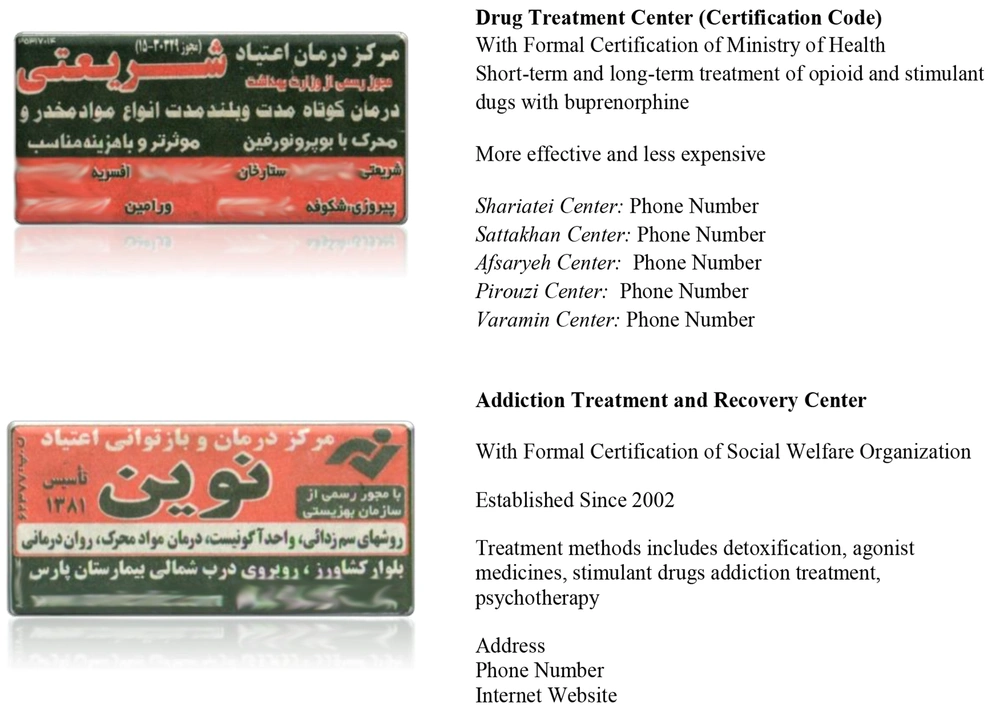
Figure 1.
Samples of drug treatment centers’ ads in Tehran newspapers and their contents
2. Objectives
The current longitudinal study aimed at evaluating DAT network in Tehran. The trend study, as one of the common longitudinal studies, was applied to detect changes in the treatment market. It provides information about “net changes at an aggregate level” through “sampling different groups of people at different times from the same population” (7). The trend study was applied in two time periods, May 2009 and November 2012, in three steps: (1) collecting related advertisements, (2) content analysis of advertisements, and (3) telephone structured interview. The methodology of the first phase of the study is already introduced (8).
3. Materials and Methods
3.1. Data Collection: Advertisements
The first phase of the current trend study was started in April 2009. The period of 21 April to 21 May 2009 (25 working days) was defined for the research team to collect all DAT ads in Tehran newspapers. Again, on the second phase of the study, the period of 22 October to 22 November 2012 (25 working days) was defined to collect all related ads in Tehran newspapers.
In Tehran, newspapers usually publish a collection of classified ads as an appendix, called Niazmandiha (classified), covering DAT center ads, too. Therefore, to analyze the newspaper ads of these centers, the short ads were used.
In the second phase, November 2012, the number of newspapers that published the short ads, including the ads regarding DAT centers, decreased from four newspapers in the first phase (Iran, Jam-e-Jam, Keyhan, and Hamshahri) to two newspapers (Hamshahri and Keyhan) due to their editorial policies, which is related to the development of internet advertising popularity in Iran.
In November 2012, around 99 DAT centers advertised their treatment services and menus through 1343 newspaper ads, in two main Tehran newspapers. However, in the first phase, 66 DAT centers in Tehran propagated their services with 1704 ads in the four main newspapers.
The DATs published their ads, without any significant differences, in the newspapers on various days, up to 13.5 times in November 2012 and 25 in May 2009. Therefore, the number of ads collection (1343 ads in Nov 2012 and 1704 in May 2009) for content analysis could be reduced to the number of centers, and calculate the results based on it. Furthermore, on both phases, the media permissions were obtained to use their ads as research materials in the project.
3.2. Content Analysis of Advertisements
To analyze the selected ads, content analysis was employed as a systematic, objective, and quantitative method to analyze communicative issues (9, 10). This method was applied through three steps on both phases of the current study.
1. Drawing out the main codes of ads such as introducing the DAT center, addiction treatment, and their medicines. Thus, the contents of the ads were analyzed based on their codes.
2. Second, all drawn codes were re-categorized and their quantitative values were calculated.
3. Finally, the role of the newspaper ads in DAT process was analyzed.
3.3. Telephone Structured Interview
On the third step, telephone structured interviews were conducted with the centers that published their ads in the newspapers in November 2012. To evaluate the function of centers regarding DAT, interview questions were asked about six aspects of treatment programs.
3.3.1. MMT, BMT, and OMT
Are you prescribing methadone/buprenorphine/opium tincture maintenance treatment (MMT/BMT/OMT) for your patients? In case of a positive answer, they were asked: How much does the MMT/BMT/OTM cost, including medicines, urine analysis (UA), and consultation?
3.3.2. MD and BD
Do you administer methadone/buprenorphine detoxification (MD/BD) to patients in the center? In case of a positive answer, they were asked: What are the MD/BD package items including, medicines, urine tests, psychological consultations, and other medical services? How much does MD/BD package cost for a patient?
3.3.3. RD/URD
Do you provide rapid or ultra-rapid detoxification (RD/URD) in the center”? In case of a positive answer, they were asked: What are RD package items, including treatment and aftercare services?; how much does RD/URD package cost, including medicine, urine analysis, consultation, and complete patient payment?
3.3.4. Naltrexone
Do you suggest naltrexone treatment for patients in the center? In case of a positive answer, they were asked: Are you prescribing just naltrexone capsules in your recovery program or you offer naltrexone implants too? How much does the capsules or implant programs cost in the center?
3.3.5. Stimulant Drugs
Do you provide outpatient cognitive-behavioral treatment for stimulant use disorders, based on matrix manual? In case of a positive answer, they were asked: What are the matrix treatment package features (11), including duration of the treatment, psychotherapy sessions, and pharmacological treatment? How much does matrix treatment cost in the treatment center?
3.3.6. Residential Treatment
Do you offer residential treatment in the center?” In case of a positive answer, they were asked: What are the residential treatment package items, including medical, psychological, and social working services? How much does residential treatment cost in the treatment center?
To provide reliable and valid information, the researcher acted out as a client on the phone conversations with the secretaries, physicians, or managers. In Tehran, the DAT centers, which advertised their treatment services in daily newspapers, received tens of phone calls from clients on getting more information, including the treatment features and prices. Therefore, the responsible person that answers the clinic’s phone should be a trained staff to explain the general features and expenses of the treatments to clients. As the current study interview questions were limited to the general features and expense of DAT, they could provide valid information.
In addition, as previously explained (8), complexities of Iran DAT market made the data collection harder. Since there was a significant gap between formal and real price of DAT, the DAT center directors and staff proceeded with utmost caution in declaring their price rates. To conduct the above structured interview and collecting valid financial information, the examiner initially pretended as a client on the phone where the conversation was mainly made with the secretaries, physicians, or managers. For each and every phone interview, the examiner remembered to finally disclose that all the questions were part of a research on DAT market analysis and that the name of their center together with private information would remain confidential. Although all interviewees were free to withdraw from the study, none of them did it. The current study was reviewed and its protocol was approved by the Ethics Committee of Iranian National Center for Addiction Studies, Tehran University of Medical Sciences.
4. Results
4.1. Advertising Representation of the Centers
In the second phase of the study, November 2012, the number of newspapers that published ads, including the ads of DAT centers, decreased from four newspapers in May 2009 to two newspapers (Hamshahri and Keyhan) in Tehran. Generally, based on the newspapers formal information on their advertising costs, 99 centers paid 406,974,030 Rials (from 2010 to 2013, Iran suffered from severe sanctions by the United Nations, Europe, and the United States, due to its nuclear program. Therefore, the total inflation rate rose to 86.7% in three years (21.5% inflation rate in 2010, about 30.5% in 2011, and 34.7% in 2013). Also, the exchange rate of Iran Rials to US Dollar increased from 11,000 Rials to about 32,000 Rials for US$1 (12). Thus, to find the increasing-decreasing rates of prices, Iran Rials was worked on, paid by Iranians) (US$12,718) for 1343 newspaper ads in November 2012. Also, on average, each center published 13.57 ads, which cost 4,110,840.8 Rials (US$128.46), and each ad cost about 303,030.3 Rials (US$9.4).
In addition, 1343 newspaper ads of the centers were made from 122 ads, repeated daily, and each ad typically covered 6.51 cm2 of the newspapers pages. About 93% of them were in grayscale and only 7% of the ads were colored. In addition, 83% of the advertisers used a stereotype to advertise their services and centers based on the findings, and just 17% of the centers used more than one advertising type (Table 2).
Table 2.Advertising Representations of Drug Treatment Centers in Tehran, November 2012
| Variables | Sum | Valuea |
|---|---|---|
| Advertising cost for clinic, Rial | 406,974,030 | 4110840.8 ± 591299 |
| Number of ads per month | 1343 | 13.57 ± 11.01 |
| Printed area of the ad in month, cm2 | 644.08 | 6.51 ± 3.6 |
| Number of ads types per month | 122 | 1.23 ± 0.52 |
| Colored ad | 8 | 7 |
| Grayscale ad | 114 | 93 |
| Clinics with more than one ad type | 17 | 17 |
a Values are expressed as mean ± SD or percentage.
4.1.1. Introducing the Center
Through newspaper ads, centers introduced themselves through six main codes: branding information, treatment type, clinical team, center facilities, permission source, and financial issues.
Nonetheless, similar to the previous study results in 2009 (8), the most important part of this introduction was branding information, including the center name, physician name, address, office phone, and cell phone number.
Generally, 92% of the advertisers called themselves as outpatient DAT clinics and 6% of them were residential on inpatient treatment centers. Besides, 86% of the ads mentioned the name of centers, 98% indicated the office phone numbers, 62% included the address of centers, and 47% mentioned cell phone numbers as their contact information.
Although in May 2009 about 33% of the ads indicated a physician’s name as one of the most important advertising elements, the importance of this item seems to decrease in the social identity of the DAT centers, and only 10% of advertisers in November 2012 used it. The priority of Governmental License increased for the centers, as it was mentioned by 100% of the centers in 2012, compared to 38% in 2009. In November 2012, about 18% of the centers indicated State Welfare Organization License title, code, or both in their ads, but 86% of the clinics highlighted their licenses issued by Ministry of Health in their ads.
Furthermore, the facilities and advantages of centers were advertised by 41% of them through three themes. About one-fifth of the centers pointed to the working time through two codes: day and night (19%) and 24 hours (2%). In addition, the advertisers used three adjective codes of specialized (15%) (having proficiency in drug treatment), calm and relaxing (3%), and healthy (1%) to describe the facilities of their centers.
Besides, the priority of mentioning the members of the medical team was emphasized to attract audience, as 10% of the advertisers pointed to their psychiatrists and 3% indicated the involvement of psychologists in their medical team. Also, a center presented its clinical team as experienced. However, in 2009, only two (3%) centers pointed to their social working team and four (6%) clinics highlighted their psychiatry experts. Meanwhile, the importance of social workers decreased in the field, as none of the ads indicated them during the second one-month research period. Unlike May 2009 study, the frequency of official price code declined and only one ad pointed to it. However, the centers stated some other financial codes, such as insurance (4%), discount (1%), and lowest cost (8%) (Table 3).
Table 3.Type and Information of Advertisements by DAT Centers
| Variebles | No. (%) |
|---|---|
| Center facilities | |
| Admission capacity | 1 (1) |
| Day and night | 19 (19) |
| 24 hours | 2 (2) |
| Specialized | 15 (15) |
| Healthy condition | 1 (1) |
| Calm and relaxing environment | 3 (3) |
| Center type | |
| Outpatient | 91 (92) |
| Inpatient | 6 (6) |
| Branding information | |
| Cell phone number | 47 (47) |
| Office phone number | 97 (98) |
| Address | 61 (62) |
| Physician name | 10 (10) |
| DAT center name | 85 (86) |
| Financial issue | |
| Good offers | 1 (1) |
| Discount | 1 (1) |
| Lowest cost | 8 (8) |
| Prices | 1 (1) |
| Insurance | 4 (4) |
| Licensing organization | |
| License code of Ministry of Health | 85 (86) |
| Ministry of Health | 16 (16) |
| License code of State Welfare Organization | 10 (10) |
| Social Welfare Organization | 8 (8) |
| Clinical team | |
| Experienced clinical team | 1 (1) |
| Social worker | 0 (0) |
| Psychologist | 3 (3) |
| Psychiatrist | 10 (10) |
| Treatment advantageous | |
| Craving treatment | 0 (0) |
| Without withdrawal pain | 1 (1) |
| Without side effects | 0 (0) |
| Aftercare services | |
| Rehabilitation | 1 (1) |
| Follow-up | 1 (1) |
| Relapse prevention | 1 (1) |
| Treatment duration | |
| Gradual | 0 (0) |
| Long-term | 5 (5) |
| Short-term | 6 (6) |
| Just one day | 0 (0) |
| Ultra-rapid | 0 (0) |
| Rapid | 1 (1) |
| Treatment setting | |
| Outpatient | 9 (9) |
| Inpatient | 7 (7) |
| Drug | |
| Other drugs | 5 (5) |
| Opiates drugs | 18 (18) |
| Stimulant drugs | 29 (29) |
| Medicine | |
| New medicines | 13 (13) |
| Naltrexone | 0 (0) |
| Methadone | 52 (53) |
| Buprenorphine | 34 (34) |
4.1.2. Treatment Types
Although 79% of the advertisers used a general code, addiction treatment, only 34% of the ads clearly defined the DAT center menu including maintenance, detoxification, or outpatient cognitive behavioral therapy (CBT) for stimulant use disorders based on the matrix model (11). A comparison between the two periods indicated a decrease in the detoxification treatment, as the previous dominant treatment type. In May 2009, about 66% of the ads pointed to detoxification in their treatment menus, but in November 2012, it decreased to 20%. Furthermore, there was a new emerging code in the treatment menus, matrix (8%), which related to treatment of stimulants addiction.
4.1.3. Treatment Features
In the ads of centers, DAT features were stated in four themes: treatment setting (16%), treatment duration (12%), treatment advantages (1%), and “aftercare services and outcomes” (3%).
In both study phases, 16 advertisers pointed to the treatment setting, including inpatient (7) and outpatient treatments (11). Although only 12% of the ads mentioned it on their treatments representation (three codes), it was indicated by 68% of the ads in May 2009 (six codes). The treatment duration in the ads of centers comprised two categories: long-term and short-term. However, 7% of the centers advertised their short-term treatments by two codes, rapid (1%) and short-term (6%). Nonetheless, they used just one code, long-term (5%), to represent their maintenance treatments. Also, similar to the previous phase, there was little difference between the frequency rates of these two categories.
Furthermore, only one clinic pointed out the treatment advantages as a treatment without withdrawal and pain. Besides, three advertisers assured their audience that the treatment process was followed by aftercare services, including follow-up (1%), rehabilitation (1%), and relapse prevention (1%). However, treatment advantages were mentioned by 30% of the ads in May 2009.
A comparison between ads in the two time periods with regard to drug treatment features showed that such features declined from its dominant position in May 2009, i.e., from 100% of the ads to one-third of them in November 2012. In other words, the importance of treatment features decreased to attract patients to the clinics compared to other factors (Table 3).
4.1.4. Psychological Services
Approximately 36% of the advertisers mentioned their psychological services. Also, 13% of the centers introduced their psychological team in the advertisements. Besides, similar to the previous study, the majority of the ads used a general code, i.e., consultation (22%), and about 14% applied two rather detailed codes, i.e., couple therapy (8%) and group therapy (6%).
4.1.5. Drugs and Medicines Representation
One of the most important features in drug treatment centers is mentioning the types of drugs involvement, which accounts for more than half of the ads. Interestingly, the mentioned frequency of stimulant drugs (29%) was 11% more than opioid drugs (18%) in the ads of centers.
In addition, 100% of centers advertised their medicines, i.e., methadone, buprenorphine, etc. Similar to the previous study, methadone was the most prescribed medicine, mentioned by 52% of the ads, compared to 39%, in May 2009. Additionally, the importance of buprenorphine increased from 27% in May 2009 to 34% in November 2012. Nonetheless, there was no advertisement for naltrexone. However, about 13% of the centers used a vague code, new pharmacotherapies, previously mentioned by only one clinic in May 2009. A comparison between the two time periods revealed that the medicines and drugs had a more serious role in introducing the centers and attracting their audience, since the medicines were mentioned by just 47% of the ads in May 2009 (Table 3).
4.2. Results of Phone Interviews
Similar to the previous study, the centers were called to gather more information regarding the treatments and the services they offered a day after the ads were published. Out of 99contacted centers, 87 (87%) centers completed the telephone interview and all of them contested to use their data for the study.
4.2.1. Maintenance Treatments
4.2.1.1. Naltrexone Maintenance Treatment
Based on phone interview results, it seems that naltrexone treatment was eliminated from DAT market in Tehran, although it was the cheapest treatment choice in May 2009. A comparison between the two studies showed that offering naltrexone capsules decreased from 34% of the centers in May 2009 to only 3% of them in November 2012. No center offered naltrexone implant, although it was offered in 27% of the clinics in the previous study.
4.2.1.2. Methadone Maintenance Treatment
Methadone maintenance treatment (MMT) was the most popular treatment in Tehran, as its facilities were offered by 85% of the centers. More than half of this long-term service was presented in a treatment package, including medicines, urine tests, psychological consultations, and other medical services. In addition, MMT typically costs about 1,185,270 Rials (US$37.03) per month, which increased about 16% compared to its cost in May 2009. However, considering the inflation US$ - Iran Rial exchange rates, the cost actually decreased.
4.2.1.3. Buprenorphine Maintenance Treatment
A comparison between two studies demonstrated that buprenorphine maintenance treatment (BMT) grew 28% in Tehran and its availability increased from 59% of centers in 2009 to 83% of the centers in November 2012, which actually was close to MMT rate. Meanwhile, about half of the centers offered BMT package as part of their services, which cost about 1,216,390 Rials (US$38.01) per month, a 51% increase from 591,667 Rials (US$18.4) in May 2009 (Table 4).
Table 4.The Costs of Different Treatment Programs in Tehran
| Variables | Valuesa |
|---|---|
| Maintenance Treatment Program | |
| Opium tincture treatment | |
| Tincture costs (mn), Rial | 2,400,000 ± 257,300 |
| Opium tincture availability | 1 (1) |
| Buprenorphine maintenance treatment | |
| BMT cost (mn), Rial | 1,216,390 ± 560,740 |
| BMT availability | 71 (83) |
| BMT availability | 35 (49) |
| Methadone maintenance treatment | |
| MMT cost (mn), Rial | 1,185,270 ± 506,810 |
| MMT availability | 74 (85) |
| MMT package | 43 (58) |
| Methamphetamine Addiction Treatment Program (No. of the Centers; 42 (48%)) | |
| Meth addiction cost | |
| Meth addiction treatment costs, Rial/mn | 2658000 ± 1722680 |
| Length of meth addiction treatment, d | 91.4 ±41.8 |
| Cost of a psychotherapy session, Rial | 207700 ± 88080 |
| Psychotherapy in meth addiction treatment | |
| Number of psychotherapy sessions | 21.37 ± 7.8 |
| Psychiatry services | 27 (64) |
| Other psychological interventions (e.g. CRAFT) | 1 (3) |
| Matrix treatment program | 34 (89) |
| Psychotherapy and consultation | 4 (11) |
| Pharmacological treatment in meth addiction | |
| Inpatient services | 2 (5) |
| Offering buprenorphine | 3 (7) |
| Offering methadone | 0 (0) |
| Offering unique treatment menu for both opioid and stimulant addiction | 3 (7) |
| Offering pharmacological treatment services | 18 (43) |
| Meth addiction treatment | |
| Meth addiction treatment package | 17 (40) |
| Meth addiction treatment availability | 42 (48) |
| Residential Addiction Treatment (No. of the Centers; 6 (7%)) | |
| Residential treatment costs, Rial | 23.3 ± 5.9 |
| Buffet cost | 5 (83) |
| Peer group counselling services, Madadyari | 6 (100) |
| Social working services | 5 (83) |
| State Welfare Organization licensing | 6 (100) |
| Psychological services | 6 (100) |
| Pharmacological treatment | 0 (0) |
| Medical services | 6 (100) |
| Compulsory residential treatment | 3 (50) |
| Length of residential treatment | 2,466,666.7 ± 644310 |
| Drug Addiction Treatment Services and Their Costs | |
| Index | Average Price, Rial |
| Methadone maintenance | 1,185,280 |
| Buprenorphine maintenance | 1,216,400 |
| Buprenorphine detoxification | 150,000 |
| Opium tincture maintenance program | 240,000 |
| Matrix | 2,658,000 |
| Residential treatment | 2,466,660 |
| Rapid/ultra-rapid detoxification | 8,428,570 |
a Values are expressed as mean ± SD or No. (%).
4.2.1.4. Opium Tincture Maintenance Treatment
Opium tincture (OT) is a new medicine authorized by Iran Ministry of Health and introduced to a few qualified centers in 2011. In the current study, only one clinic offered OT, which cost 2,400,000 Rials (US$75) per month. However, it was reported that 14 DAT centers added OT to their treatment menu in Tehran by 2012 (13).
4.2.2. Detoxification Programs
4.2.2.1. Buprenorphine Detoxification
Since Iran Ministry of Health prohibited methadone detoxification, it was nearly eliminated from the DAT market. Instead, offering buprenorphine detoxification (BD) treatment method increased in Tehran. Therefore, 99% of these centers have a fixed cost for any buprenorphine dose needed in BD program. However, the cost of such treatment decreased by 165%, and is 1,000,000 ± 107,830 Rials (US$31.25) in Tehran.
4.2.2.2. Rapid Detoxification
Based on telephone interviews, a total of 12 clinics (12%) offered rapid detoxification (RD) (nine centers) or ultra-rapid detoxification (URD) services (three centers). On average, they apply the rapid detoxification process for patients in 5.71 days. Also, RD service costs about 8,428,570 ± 2,752,610 Rials (US$263.39) and URD treatment costs about 4,300,000 ± 829,880 Rials (US$134.37). A comparison between two studies with regard to rapid detoxification price demonstrated that the cost of this treatment rose 44% during three years and it is the most expensive treatment of drug addiction in Tehran; although according to Iran Ministry of Health regulations, URD is still a prohibited medical method in Iran due to low success rate and high adverse events.
4.2.3. Methamphetamine Addiction Treatment Programs
During three years from 2009 to 2012, a new field emerged in the DAT market for the treatment of stimulants addiction focusing on methamphetamine (meth). Based on the telephone interview results, 42 (48%) centers offered methamphetamine addiction treatment and 40% offered it in a complete treatment package, designed for methamphetamine addiction. Meanwhile, 7% of the centers had a unique treatment menu for both opioid and stimulants addiction. Pharmacological treatment menus in Tehran were categorized into seven codes for methadone addiction: tramadol (2%), psychiatric medicines (16%), detoxification medicines similar to opioid addiction cases (2%), buprenorphine (2%), and other medicines (9%), although the national guidelines do not allow using opioid agonist medicines such as tramadol and buprenorphine to treat stimulants addiction (11).
In addition, 90% of the centers, which provide stimulant treatment program, reported that they offer psychotherapy, including intensive outpatient CBT based on matrix model (89%), consultation (8%), community reinforcement approach and family training (CRAFT), and other psychological interventions (3%), in their meth addiction treatment program. These programs typically include 21.3% psychotherapy sessions, 67% of which included psychiatrists in the treatment team too. Two centers offered inpatient services for meth addiction treatment. Besides, meth addiction treatment on average costs 2,658,000 Rials per month, and took about 91.4 days (Table 4).
4.2.4. Residential Treatment Programs
There were six residential centers (7%), which advertised residential treatment in the newspapers and all of them participated in the telephone interviews. All of these centers were licensed by State Welfare Organization. Furthermore, their treatment programs included both medical and psychological services. Although 83% of them claimed that they offered pharmacological intervention for their patients, it was limited to analgesics. Besides, 83% of them forced patients to stay during their treatment program, although it is illegal in Iran. None of these centers offered social working services, but instead they attempt to educate rehabilitated patients to help newcomers and called it, Madadyari. Madadyar (occupational therapy assistant) is a rehabilitated patient (peer group counselors) taking a one-year course on drug DAT counseling and works as a counselor in the residential center. These residential treatment programs take 23.3 days and cost 246,666.7 Rials, on average. Furthermore, half of the centers added surcharge to the cost entitled buffet cost (Table 4).
5. Discussion
5.1. Drug Addiction Treatment Centers: Changing Advertising Representation
The current longitudinal study was conducted in two phases, in May 2009 and November 2012, to investigate DAT market of Tehran from 2009 to 2012. The study provided a dynamic schema of the advertising representations of DAT centers and their treatment menus in Tehran. In other words, the current longitudinal study through collecting advertisements, content analysis, and telephone interviews with centers in three years could shed light on the treatment market and its transformations, which can be useful to monitor the trend of the health market.
Newspaper ads of DAT centers were influential on attracting patients due to their four important criteria of availability, accessibility, widespread publicity range, and media popularity. However, the second phase of the trend study demonstrated that the role of this medium changed. First, the average cost of each ad increased from 172,960.5 Rials (US$16.31) in 2009 to 303,033.3 Rials (US$9.46) in 2012, which showed 75.2% rise (without considering inflation). Second, although the number of clinics that represented themselves through the newspaper ads increased from 66 in May 2009 to 99 in November 2012, each clinic decreased frequency of its newspaper ads from 25.81 in May 2009 to 13.57 in November 2012, i.e., a 47% decrease. In conclusion, advertising budget of centers decreased from 4,465,660 Rials (US$421.2) in May 2009 to 4,110,840.9 Rials (US$128.46) in November 2012.
Furthermore, 66 advertiser clinics employed 383 codes to introduce their centers (43%) and their treatment menus (57%) in May 2009. However three years later, 99 clinics (33% increase) used 923 codes (140% increase), including 592 codes to introduce DAT center (64%) and 331 codes (36%) to advertise their DAT program in November 2012. It seems that the shares of the center introduction and treatment menu significantly changed. Therefore, the centers employed more codes and spaces to describe the treatment, since addiction treatment is gradually formed as a unified and obvious package, covering medicines and medical processes. The advertisers paid more attention to their branding information, clinical team, official certification, and financial advantages to attract their potential customers.
Table 5.Analysis of the Newspaper Advertisement Market in Tehrana
| Index | Introduced DAT Center Code | Drug Treatment Code | All Codes |
|---|---|---|---|
| May 2009 | 165 (43) | 218 (57) | 383 (100) |
| November 2012 | 592 (64) | 331 (36) | 923 (100) |
a Values are expressesd as No. (%).
Notably, residential treatment centers were represented in newspaper ads to market their services; six residential treatment centers advertised in the newspapers in 2006 (compared to 0 in 2009). Meanwhile, since drug treatment demand seemed to transform from opiates to ATSs in Tehran, the treatment market adapted itself to respond to the emerging trend of ATSs use in the country. Therefore, the codes for stimulant drugs recently appeared in the ads (Table 5).
5.2. Drug Addiction Treatment Centers: Developing Treatment Menu
As expected, market for DAT centers got oriented to stimulant drugs, especially methamphetamine treatment in Tehran. Thus, the treatment menu changed to cover new additional demands of patients. In this regard, about half of the centers offered methamphetamine pharmacological and psychological treatment services, although 89% of the therapeutic options focused on matrix treatment model.
Regarding the menu of treatment options in DAT centers of Tehran, there was a range of treatment choices from detoxification, maintenance, and residential to psychological programs with different cost levels. The RD remained as the most expensive short-term treatment, 8,428,570 Rials (US$263.39) on average, which its cost escalated 100% from 4,432,300 Rials (US$138.50) in 2009 to 8,428,570 Rials (US$263.39) in 2012. Methadone/buprenorphine maintenance programs were the cheapest long-term ones costs 1,185,280 Rials (37.04US$) for MMT and 1,216,400 Rials (38.01US$) for BMT per month. Furthermore, opium tincture maintenance program, that was a new treatment modality in the market and only 14 centers offered it in Tehran, was more expensive than its other choices as it costs on average 2,400,000 Rials (US$75) per month.
Although naltrexone treatment was the cheapest treatment modality in May 2009, it was nearly eliminated from DAT market in Tehran, as none of the advertisements or interviewers mentioned its capsules, implants, or programs in their ongoing services. Besides, residential treatment programs cost 2,466,660 Rials (US$77.08). In comparison, the most expensive choice in long-term treatments was methamphetamine addiction treatment, based on package of matrix model, as it costs 2,658,000 Rials (US$83.06) per month, and the DAT centers administrators can provide the whole of their ads budget through 1.5 patients on meth dependent, or even 0.5 of a customer on RD treatment (Table 4).
5.3. Conclusions
In conclusion, longitudinal trend analysis of DAT market using newspaper ads, as an indirect, but rapid and feasible method, provided a dynamic picture of DAT network. The current study showed that opioid maintenance therapy continues its services and market development, besides DAT services emerge in response to methamphetamine crisis in Iran.


