


1. Background
Cigarette smoking is one of the most important public health problems (1). Based on the findings of the global youth tobacco survey (1999 - 2001) in 75 regions of 43 countries, 13.9% of the adolescents aged 13 to 15 years were current smokers (2). A major concern is that the age of initiating smoking is falling (3). The majority of the smokers begin using tobacco before the age of 18 years (4). This emphasizes the importance of research on smoking in adolescents to help policy makers improve their strategies to prevent or delay adolescent cigarette smoking acquisition.
Cigarette smoking is a complicated behavior; and a range of socio-demographic, environmental, behavioral, and personal indicators are associated with the adolescents’ smoking acquisition (5, 6).
The majority of the studies conducted on the Iranian adolescents are cross sectional; therefore, the reported relationships between the factors and the smoking stages are based on stage prevalence and not on transitional probabilities. In this study, for the first time, we determined the odds of initiation, quitting, and the relapsing smoking stages in adolescents using a probabilistic discrete event system (PDES) model according to the level of some predictors. In this study, there can be a comparison of the results with the results of longitudinal studies and more information about smoking behaviors in adolescents can be gained.
2. Objectives
This study determined the personal and environmental predictors of transition across smoking stages using a PDES model with cross sectional data.
3. Materials and Methods
In this cross sectional study (during November and December of 2010), using a multistage sampling method, 4 903 students (14 to 19 years) were, randomly, selected. At the first stage, 57 high schools were, randomly, selected from five regions of Tabriz city, northeast of Iran. At the second stage of the sampling procedure, 196 classes (82 boys classes and 114 girls classes, respectively) were, randomly, selected with considering the type of school and the number of the students in each school. Finally, 4 853 students completed a self-administered multiple-choice anonymous questionnaire. Before the completion of the questionnaire, we explained the goals of the study and the confidentiality of the information, and the subjects were ensured about the voluntary nature of their participation. More details about the sampling method of the study can be found elsewhere (7). The study protocol and its questionnaire have been approved by the East Azerbaijan province education organization and the ethics committee of Tabriz University of Medical Sciences.
3.1. Smoking Stages
We used a valid algorithm to assess the smoking behaviors in all subjects (8). In this study, in addition to smoking behavior algorithm, we used less error-prone questions about smoking patterns such as smoking in the past 7 days and past 30 days and when they tried a cigarette the first or the last time. The students were classified into three stages of cigarette smoking continuum (9-11) as follows: (a) Never Smoker: adolescents who have never smoked (even a puff); (b) Current Smoker: adolescents who have tried cigarette smoking (even a puff) and had smoked in the past 30 days; and (c) Ex-Smoker: adolescents who smoked cigarettes and had not smoked since 30 days before completing the questionnaire.
3.2. Smoking Predictors
The attitude towards smoking among the subjects was measured in a similar manner to that of Hill et al. with a 6 item questionnaire (12). The general risk taking behavior was measured using the question “Do you enjoy doing a little risky actions?” with “Yes” and “No” responses according to Kaplan et al. (5). The socio-economic status of the students was achieved using their fathers’ education, mothers’ education, family assets, and family income using a principal component analysis (PCA) model. Finally, the students were classified into one of the two socio-economic status levels of high and low. Other predictors of smoking transition were having a smoker friend, having a smoker in the family, and being of the male gender.
3.3. Data Analysis
In this study, we used the smoothed age-specific prevalence of smoking stages from 4 853 subjects across every predictor’s strata for predicting the transitional probabilities of smoking stages. After smoothing the proportion of smoking stages, we estimated the age-adjusted transitional probabilities of smoking stages using the probabilistic discrete event system (PDES) model according to the levels of the predictor variables. The PDES model was well described by Shu et al. (13); and its application for the modeling of smoking behavior was illustrated by Lin et al. (14). According to the classification of the smoking stages, the PDES model is shown in Figure 1.
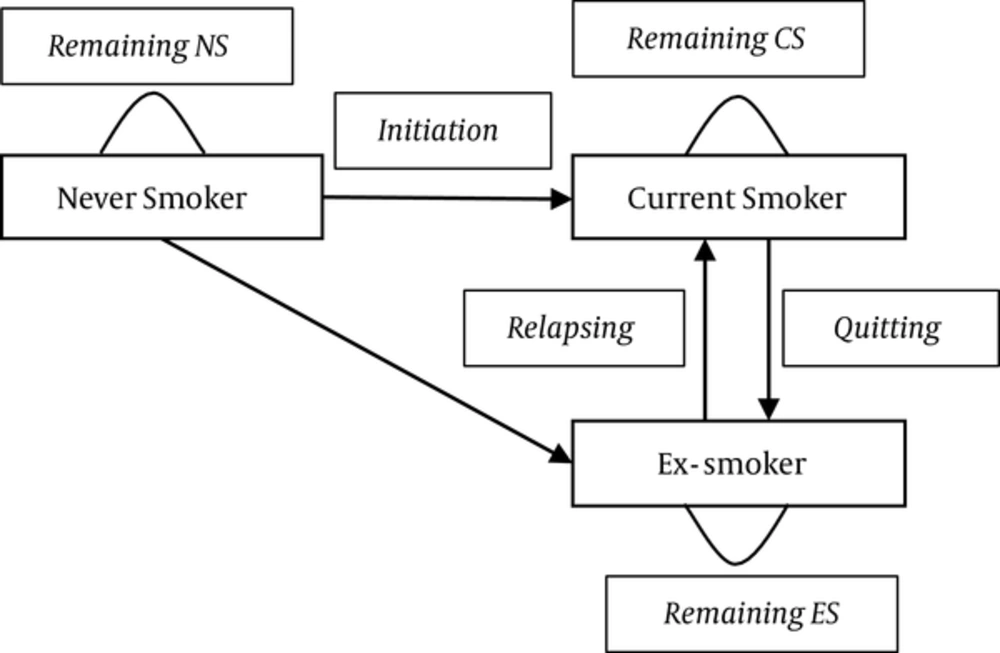
Figure 1.
Probabilistic Discrete Event System Model of Smoking Stages Behavior
To estimate the revealed transitions (initiation, quitting, relapsing, and the probabilities of remaining at the same stage for one year), we first estimated the smoothed proportion of smoking status using multinomial p-splines. With p-spline smoothing, we could remove the noise from the crude data; and fitting this model, also, provides a functional relation between age and prevalence proportions, which makes it possible to calculate the confidence intervals (15). After smoothing the age-specific prevalence of smoking stages in each level of the predictors, we estimated the transitional probabilities from never smoker to current smoker and ex-smoker, current smoker to ex-smoker, and relapsing from ex-smoker into cigarette smoker using PDES model, considering the prevalence proportions of two consecutive ages. This could estimate the age-specific transitional probabilities for 14, 15, 16, 17, and 18 year old subjects. Under the assumption that the age-specific transition probabilities remain more stable over time (no cohort effect), data from a cross sectional study could provide a snapshot of the states (Never Smoker, Current Smoker, Ex-smoker). In this model, given the status of smoking at age (a), we wanted to know what the transition probabilities are for each age, ending up in one of the three states one year later at age (a+1) (16). The smoothed age-specific prevalence of smoking stages is shown in Table 1.
Table 1.The Smoothed Prevalence of Smoking Stages in Various Ages
| Smoking Stages | Age (year) | |||||
|---|---|---|---|---|---|---|
| 14 | 15 | 16 | 17 | 18 | 19 | |
| NS | 84.5 (83.1 - 85.8) | 80.7 (79.5 - 81.8) | 75.8 (74.4 - 77.3) | 69. 8 (67.3 - 72.2) | 62.4 (58.8 - 66.3) | 53.9 (48.9 - 59.5) |
| CS | 3.6 (2.9 - 4.2) | 5.6 (4.8 - 6.2) | 8.49 (7.6 - 9.4) | 12.7 (11.2 - 14.4) | 18.56 (15.6 - 21.9) | 26.14 (20.9 - 31.8) |
| EX | 11.9 (10.7 - 13.2) | 13.78 (12.8 - 14.8) | 15.7 (14.4 - 16.9) | 17.5 (15.6 - 19.5) | 18.9 (16.0 - 22.2) | 19.89 (15.9 - 24.4) |
Abbreviations: CS, current smoker; EX, ex-smoker; NS, never smoker.
After the estimation of the 1-year transitional probabilities of smoking stages for ages 14 to 15, 15 to 16, 16 to 17, 17 to 18, and 18 to 19 in terms of the predictor factors, we calculated the odds of initiation (the probability for a never smoker to progress to a current smoker / the probability for a never smoker remaining a never smoker), the odds of quitting (the probability for a current smoker to progress to an ex-smoker / the probability for a current smoker remaining a current smoker), and the odds of relapsing (the probability for an ex-smoker to progress to a current smoker / the probability for an ex-smoker remaining an ex-smoker) for every studied ages, separately (age-specific odds). Finally, using a logistic regression model, we modeled the relationship between the predictors and the smoking stages. In this model the odds ratio (OR) and 95% confidence interval for the OR of the transitions through the stages, were calculated by predictor variables. The OR ≥ 4 was classified as a strong risk factor and 2 ≤ OR < 4 was classified as a moderate risk factor for smoking stages.
3.4. Ethical Considerations
The authors have adhered to the appropriate ethical standards, and the study was approved by the ethical committee of Tabriz University of Medical Sciences.
4. Results
Out of the 4 853 sample students, 2 087 (43%) were boys and 2 766 (57%) were girls. The mean and the standard deviation of the students’ age was 15.69 ± 0.73 (14 to 19 years age range). The results of this study is summarized in Table 2. The results showed that factors such as being a boy, having a positive attitude towards smoking, and having a smoker friend were highly associated with the initiation of smoking. Being a boy increased the odds of transition from the never smoker stage to the current smoker stage by 8.9-fold the odds of the initiation of smoking in girls. In contrast, having a smoker friend is the most important factor in preventing one from quitting smoking. Also, this factor is an important factor in the relapsing of an adolescent from an ex-smoker into a current smoker. The most important factors associated with the prevention of quitting smoking were having a smoker friend, having a positive attitude towards smoking, and being a boy. Also, out of the mentioned factors in this study, having a smoker friend was the most motivating factor for relapsing into smoking in the adolescents.
Table 2.The Odds Ratios Estimation of the Transition Through Stages by Predictor Variables
| Factor | Initiation | Quitting | Relapsing |
|---|---|---|---|
| OR (95% CI) | OR (95% CI) | OR (95% CI) | |
| Having a smoker friend | |||
| Yes | 5.2a (3.6 - 7.6) | 0.08a (0.07 - 0.09) | 7.5a (3.8 - 14.7) |
| Attitude toward smoking | |||
| Positive | 8.2a (6.5 - 10.5) | 0.17a (0.12 - 0.22) | 2.3a (1.5 - 3.3) |
| Sex | |||
| Boy | 8.9a (7.9 - 10.0) | 0.29a (0.22 - 0.39) | 0.97 (0.6 - 1.6) |
| Having a smoker in family | |||
| Yes | 1.0 (0.9 - 1.1) | 0.55a (0.48 - 0.63) | 2.1a (1.5 - 2.9) |
| General risk taking behavior | |||
| Yes | 2.0a (1.5 - 2.7) | 0.40a (0.37 - 0.43) | 2.3a (1.4 - 3.9) |
| Socio-economic status | |||
| High | 2.2a (1.6 - 3.0) | 0.77 (0.47 - 1.25) | 0.58a (0.36 - 0.96) |
aSignificant at level of 0.05.
5. Discussion
Cigarette smoking which has become increasingly common among the Iranian students, is a public health concern (17). In the present study, the probability whether a subject will be in a same or a different stage one year later is defined as transitional probability. The detailed methodology of this estimation is presented in another study (16).
The results of this study showed that having a smoker friend, having a positive attitude towards smoking, and being a boy were the main predictors of the initiation of smoking; and general risk taking behavior and having a high level of socio-economic status were moderate predictor factors. Because of the different effects of the predictors on smoking stages’ progression in different social contexts, it is necessary to study them separately in each society (18). Therefore, we can plan preventive and control programs considering the extent of the problem and the specific risk factors. The important longitudinal studies that were conducted on the Iranian students, showed different findings. The report by Mohammadpoorasl et al. with a latent transitional analysis showed that being a boy (OR = 7.8), having a smoker friend (OR = 1.8), and having a positive attitude towards smoking (OR = 3.3) were the main predictors of the transition from never smoker to regular smoker stages (15). In another study on the male students in Tabriz (north-west of Iran) in 2010, participating in friendship smoker groups (OR = 1.35) and having a higher socio-economic class (OR = 2.7) were the most important predictors in the transition from never smoker to regular smoker stages (19). To compare our findings with the above mentioned studies (18, 19), it is necessary to pay attention to the different definitions of smoking stages. Mohammadpoorasl et al, in their studies (18, 19), used the standard NHIS current smoking definition which is based on the lifetime smoking of ≥ 100 cigarettes. He categorized the students as having smoked at least 100 cigarettes in their entire life and smoking daily or almost every day as a regular smoker (11). But we used the NSDUH-S current smoking definition. In our definition, a current smoker is an ever smoker who, during the past 30 days, has smoked a cigarette (11). Another point is that our estimation is based on the new method derived from transitional probabilities of a cross sectional study. However, the validity of the PDES method for the behavioral modeling of the smoking stages was evaluated in other studies (9, 14). These results are similar to those of the previous studies focusing on variables such as having general risk-taking behaviors (5, 20), having a smoker in the family (21, 22), and having a smoker friend (5, 23, 24). Recent research on smoking has concentrated on the identification of the psychosocial predictors of the initiation of smoking. All in all, these studies have reported that having positive beliefs about smoking, parental smoking, friends’ smoking, and risk taking were significant predictors for both the onset and the continuation of smoking. However, various study results are in line in the same direction; but, there is some discrepancy among the definitions of smoking stages. The observed differences may be due to the differences in the definitions and the measurement tools. In most countries in the middle East and South Asia, smoking behavior is more prevalent in male adolescents than female ones, while in the US and the West European countries the difference in the smoking rate between men and women is declined (25). Parents’ and peers’ smoking influence the smoking behavior through the acceptance of cigarette smoking (23). The link between the parents’ and the peers’ smoking with the smoking acquisition found in this study reinforces the previously reported results. Intervention programs should endeavor to make more use of the ability and the willingness of the students to play a role in reducing smoking acceptance among their smoker friends (26). According to the present study results, peer smoking and friends’ encouragement are the most important predictors of relapsing into a current smoker.
Though in the majority of the studies on the adolescents, the smoking acquisition behavior usually proceeds from one stage to the next (18, 19, 23), adolescents may remain in the same stage or move back to the previous stages. It is important for the policy makers and the researchers to understand the predictors of transition from non-smoker to current or regular smoker stages, or to know the factors associated with quitting those who remain as current smokers. In our defined model for smoking behavior, we calculated the 1-year probability of becoming an ex-smoker in contrast with the probability of remaining a current smoker in terms of the odds of quitting. The results of the study in Table 2 showed that all the defined factors except the socio-economic status are preventive factors in quitting smoking. Recently many researches have considered the ways of helping smoker adolescents to quit smoking (27-29). In a study conducted on the Korean adolescents, the predictors of smoking cessation were the intention to stop smoking, the amount of cigarette use, self-efficacy, and paternal smoking status (30).
5.1. Strengths of the Research
This is the first cross sectional study on the predictors of cigarette smoking initiation, quitting, and relapsing with a PDES model. In the previous studies by Chen (9), the extraction of the transitional probabilities was introduced. But, in the present study we extended the method for a situation where the data are not imbalanced according to the age with a modified PDES method. The criteria for the definition of smoking behavior in comparison with the other cross sectional and longitudinal studies, is another strength point of this study. According to this definition model we can show initiation, quitting, and relapsing stages in smoking behavior. Future studies should determine the other specific predictors on the adolescents’ smoking in longitudinal studies and with the use of the PDES method in cross sectional studies. Computation with these methods needs the assumption that the changes in the smoking behavior for the subjects of the same age between two consecutive years is negligible, in contrast to the changes in smoking behavior across ages in a year.
5.2. Conclusion
According to the results, prevention efforts will need to be multifaceted on targeting the reduction of the smoking initiation risk factors and quitting of smoking and the development of protective factors to reduce the probability of smoking initiation and relapsing. An important public health implication is that parents’ smoking and peer's smoking are the most important behavioral predictors to target in helping prevent adolescents from smoking initiation. Based on these findings, the studies testing the interventions focused on helping parents and smoker friends to quit smoking, as well as, increasing the self-esteem and the self-efficacy of the adolescents especially in the boys, and investment on changing the attitude of the students about smoking, would be valuable.


