


1. Background
Based on epidemiological studies, a minor, yet significant, part of the society exhibits intentional self-injurious behaviors (1). In its latest classification (DSM-5), the American Psychiatric Association defines non-suicidal self-injury (NSSI) as deliberate, self-inflicted destruction of body tissue without suicidal intent and for purposes not socially sanctioned. These behaviors include cutting, burning, biting, and scratching the skin to reduce mental discomfort (2, 3).
Understanding pathological behaviors in terms of reason and purpose, such as self-injurious behaviors at a certain time in a particular patient, is often difficult, but it can greatly help manage the patient. Different models conceptualize possible reasons for self-injurious behaviors, considering the effect of different factors in play (4). In order to better understanding the factors associated with the onset and maintenance of NSSI behaviors, Klonsky et al. developed The Inventory of Statements About Self-Injury (ISAS). The four major categories for NSSI are environmental, drive, affect regulation, and interpersonal functions. The instrument includes six specific functional models, namely, environmental, anti-suicide, sexual, affect regulation, dissociation, and boundaries (5, 6).
Self-injury is one of the most dangerous behaviors among substance abusers. They are six to eight times more likely to engage in self-injurious behavior (7). In the Iranian substance abuse population, it seems trait impulsivity is the main psychological index for self-injurious behavior. In order to evaluate risky and impulsive behaviors, Barrett’s, Dickman’s, and Zakerman’s measures of impulsiveness have been localized and used among substance abusers in Iran (8).
2. Objectives
The present study was conducted to study the psychometric properties of ISAS in Iranian population of opioid and alcohol abusers for the identification of intentional self-injury and the associated factors in this population.
3. Methods
This psychometric study investigates the statistical population of substance and alcohol abusers in Iran. Monroe believes a sample size of 200 to 500 is suitable for factor analysis study (9). Using a convenient sampling method, 470 participants were selected. Data were collected from multiple provinces in Iran (Tehran, Mazandaran, Lorestan, Khuzestan, and Semnan). Informed consent was obtained from all participants before the study.
In this descriptive cross-sectional research, the statistical population included abusers of opioids and/or alcohol recruited from addiction rehabilitation camps, prisons, hospitals, and addiction treatment clinics dispensing methadone. The minimum and maximum age of the participants were 16 and 67 years, respectively (mean = 31.9 ± 9.37). Almost all participants (99.5%) were opioid abusers only, and 68 individuals (14.5%) were abusing both opioid and alcohol. The mean age at the time of the first and the last self-injury events were 19.1 years and 24.7 years, respectively.
The inclusion criteria were: a history of intentional self-injurious behaviors; a history of opioid abuse documented by urine dipstick and/or alcohol abuse; no addiction to stimulants; clinical diagnosis of opioid abuse by a psychiatrist or a clinical psychologist based on DSM 5 criteria; the patient’s informed consent for participation in the research; a history of induced injury or intentional damage to self (based on self-declaration). The exclusion criteria were: psychotic symptoms; neurological disorders; serious suicidal thoughts based on a psychiatric interview; and history of stimulant abuse.
3.1. Measures
3.1.1. The Inventory of Statements of Self-Injury
Klonsky and colleagues developed ISAS in 2008 and evaluated it on 235 college youth with a history of at least one occasion of non-suicidal self-injury (5, 6). The first part of the questionnaire examines deliberate behaviors without suicidal intentions. These include cutting, biting, burning, pinching, hair plucking, intense scratching, hitting oneself against a surface (such as hitting one’s fist or head against the wall), preventing wound healing (such as scaling the scalp), rubbing the skin on a rough surface, needling the body, swallowing harmful objects, etc. Participants were asked to estimate the number of times that each behavior was performed.
There were five other questions in the descriptive section including age at the time of onset, the experience of pain while performing self-injurious behaviors, frequency of these behaviors in the presence or absence of others, time interval between feeling the motive for self-injury to do it, and whether the individual wanted to stop the behavior. The second part deals with assessing 13 self-injurious behaviors: affect regulation, interpersonal boundaries, self-punishment, self-care, anti-dissociation/feeling-generation, anti-suicide, sensation-seeking, peer-bonding, interpersonal influence, toughness, marking distress, revenge, and autonomy (5, 6).
Individual’s experiences in each function were evaluated by one of the following three scores: 0-not relevant (two points), 1-somewhat relevant (four points), 2-very relevant (six points). Therefore, the score of each of the 13 self-harming behaviors could range from two to six (5, 6). This version of the questionnaire has been localized in other countries such as Turkey, Sweden, and Australia (10-12).
3.1.2. Barrat Impulsiveness Scale
Ernest Barrett developed Barrat Impulsiveness Scale (BIS) in 1977 and its eleventh edition in 2004. This questionnaire consists of 30 items, evaluating cognitive impulsivity, motor impulsivity, and disorganization as three distinctive factors. Each item has four choices, and the highest score is 120. Two independent evaluators categorized 58 impulsivity actions with a kappa coefficient of 0.83 (P < 0.0001). The calculated Cronbach’s alpha coefficient for reliability of Barrat’s impulsivity scale was 0.845 with the following values for the subscales: 0.781 for cognitive impulsivity, 0.741 for motor impulsivity, and 0.437 for disorganization factor (13). Ekhtiari et al. observed that the Persian translation of Barrett’s impulsivity scale has desirable validity and reliability in Iran with a reliability level of 0.83 (7).
3.1.3. The Distress Tolerance Scale
Simons and Gaher developed the Distress Tolerance Scale (DTS) in 2005 as a self-assessment for distress tolerance and studied its reliability for six months. Their results showed the questionnaire had a high internal consistency (α = 0.89). In addition, distress tolerance was stable in six months (r = 0.61). The scale includes 15 items and 4 subscales called emotional distress tolerance (items 1, 3, and 5), being attracted by negative emotions (items 2, 4, and 15), mental distress estimation (items 6, 7, 9, 10, 11, and 12), and adjustment attempts to alleviate distress (items 4, 8, and 13) (14). Azizi estimated the alpha coefficient for each of the subscales of tolerance, attraction, evaluation, and adjustment to be 0.75, 0.77, 0.70, and 0.75, respectively. The re-test reliability coefficient for the whole scale was 0.81, and for the subscales of tolerance, attraction, evaluation, and adjustment was 0.71, 0.69, 0.77, and 0.73, respectively (9).
3.2. Procedure
First, two psychologists who were experts in both Persian and English languages translated the scale into Persian. Next, a native translator expert in the field back-translated the scale into English. Then, the translation team compared the English back-translation with the original text to ensure the accuracy of the concepts and to identify any differences. After agreement on the final English back-translation, the Persian version was adjusted accordingly. To assess the content validity, two methods of (CVR [Content validity ratio]) and (CVI [Content validity index]) were used. Rubio suggested experts’ opinions are the best way to evaluate the content of an inventory (15). No questions were omitted or changed. The obtained values indicated the adequacy of the content validity of the Persian version of the statements about self-harm. After verifying the accuracy of the translation, the questionnaire was tested and re-tested within 20 days in a small sample (30 qualified participants) in a preliminary study. Afterward, authorization to distribute the questionnaire among the target population was obtained. Then we distributed the questionnaire to the sample population in prisons, addiction rehabilitation camps, hospitals, addiction treatment clinics dispensing methadone, and NA centers.
4. Results
In this study, we used both descriptive, to indicate the central and distributive tendencies, and inferential statistical methods. Confirmatory factor analysis was used to investigate and verify the subscales of the scale, and in other words, to confirm the construct validity. To conduct the aforementioned statistical calculations, we used SPSS.24 and Amos.21 software.
Table 1 shows the demographic and descriptive characteristics of the participants, including age and the type of drug they used.
Table 1.Frequency of Self-Injurious Behaviors Without Suicidal Intention
| Self-Injurious Behaviors | N | Mean of Repeat |
|---|---|---|
| Swallowing chemicals | 469 | 2.96 |
| Needle-sticking | 466 | 20.29 |
| Rubbing skin against rough surfaces | 467 | 15.01 |
| Wound picking | 468 | 0.33 |
| Punching | 469 | 3.39 |
| Severe scratching | 470 | 2202.56 |
| Hair pulling | 470 | 8.9 |
| Pinching | 470 | 1.48 |
| Carving | 469 | 8.44 |
| Burning | 470 | 2.46 |
| Biting | 467 | 4.21 |
| Cutting | 468 | 19.46 |
The main self-injurious methods used were cutting, severe scratching, punching, needle sticking, wound picking, burning, biting, hair pulling, and self-pinching. Among participants, 39% reported pain during self-injury, and 18.1% of them felt no pain. The interval between having self-injurious motivation and carrying it out was less than one hour in 62.3% and between one to three hours in 30.8% of the cases.
First, using the exploratory factor analysis, we confirmed the subscales and verified the validity of the construct in an Iranian population. Before conducting exploratory analysis, we used Kaiser-Myer-Olkin (KMO) test and Bartlett’s test to examine the sample size. Kaiser-Myer-Olkin value of 0.909 was highly significant (approximate. chi-square 9225.388, df = 741, P < 0.001), which exceeds the recommended value of 0.6 for Bartlett’s test of sphericity.
4.1. Intra-class Correlation Coefficient
After estimating Intra-class Correlation Coefficient (ICC), we calculated it using the standard error of measurement and the SD formula. After verifying the accuracy of the translation, the questionnaire was tested and re-tested in a preliminary study within 20 days in a small sample (30 qualified participants) with an ICC result of 0.761. The final ICC was ± 2.62, which showed desirable reliability for the questionnaire.
4.2. Exploratory Factor Analysis
We randomly divided the data into two parts and conducted exploratory factor analysis (EFA) with principal components analysis (PCA) method on the first half and confirmatory factor analyses (CFA) on the other hand in order to confirm the factor structure obtained in EFA of the first part as recommended by Harrington (16). Principal component analysis indicated a single factor with 13 items could explain 68% of the variance (Eigen value = 8.85). Factors Loadings ranged from 0.80 to 0.87 (Table 2)
Table 2.Exploratory Factor Analysis with Varimax Rotation (N = 235)
| Function Scale | Factor Loading | |
|---|---|---|
| Inventory of Statements About Self-Injury (ISAS) | Affect regulation | 0.77 |
| Interpersonal boundaries | 0.81 | |
| Self-punishment | 0.80 | |
| Self-care | 0.85 | |
| Anti-dissociation/feeling-generation | 0.83 | |
| Anti-suicide | 0.84 | |
| Sensation-seeking | 0.83 | |
| Peer-bonding | 0.85 | |
| Interpersonal influence | 0.71 | |
| Toughness | 0.82 | |
| Marking distress | 0.77 | |
| Revenge | 0.87 | |
| Autonomy | 0.81 |
As shown in Table 2, all sub-tests are under one sub-factor. Hence, this questionnaire is a one-factor instrument in Iranian population.
4.3. Consistency
The internal consistency of all questions was high. In Table 3, the mean, standard deviation, and Cronbach’s alpha of all subscales are calculated. The total Cronbach’s alpha coefficient was 0.93.
Table 3.Cronbach’s Alpha for the Hidden Factor of “ISAS” in Iranian Populationa
| Subscales and Questions (When I Self-Harm, I Am...) | Mean ± SD |
|---|---|
| Affect regulation | |
| Calming myself down | 1.06 ± 0.7 |
| Releasing emotional pressure that has built up inside of me | 1.11 ± 0.73 |
| Reducing anxiety, frustration, anger, or other overwhelming emotions | 0.47 ± 0.66 |
| Interpersonal boundaries | |
| Creating a boundary between myself and others | 0.95 ± 0.72 |
| Demonstrating that I am separate from other people | 0.84 ± 0.74 |
| Establishing a barrier between myself and others | 0.80 ± 0.75 |
| Self-punishment | |
| Punishing myself | 1.07 ± 0.75 |
| Expressing anger towards myself for being worthless or stupid | 0.83 ± 0.79 |
| Reacting to feeling unhappy with myself or disgusted with myself | 0.99 ± 0.75 |
| Self-care | |
| Giving myself away to care for myself (by attending to the wound) | 0.70 ± 0.78 |
| Creating a physical injury that is easier to care for than my emotional distress | 0.81 ± 0.74 |
| Allowing myself to focus on treating the injury, which can be gratifying or satisfying | 0.80 ± 0.78 |
| Anti-dissociation/feeling-generation | |
| Causing pain so I will stop feeling numb | 0.73 ± 0.72 |
| Trying to feel something (as opposed to nothing) even if it is physical pain | 1.00 ± 1.18 |
| Making sure I am still alive when I do not feel real | 0.76 ± 0.77 |
| Anti-suicide | |
| Avoiding the impulse to attempt suicide | 0.76 ± 0.77 |
| Responding to suicidal thoughts without actually attempting suicide | 0.81 ± 0.70 |
| Putting a stop to suicidal thoughts | 0.85 ± 0.77 |
| Sensation-seeking | |
| Doing something to generate excitement or exhilaration | 0.57 ± 0.70 |
| Entertaining myself or others by doing something extremely | 0.63 ± 0.70 |
| Pushing my limits in a manner akin to skydiving or other extreme activities | 0.75 ± 0.70 |
| Peer-bonding | |
| Bonding with peers | 0.61 ± 0.71 |
| Fitting in with others | 0.63 ± 0.73 |
| Creating a sign of friendship or kinship with friends or loved ones | 0.65 ± 0.74 |
| Interpersonal influence | |
| Letting others know the extent of my emotional pain | 1.02 ± 0.74 |
| Seeking care or help from others | 0.72 ± 0.74 |
| Keeping a loved one from leaving or abandoning me | 0.97 ± 0.74 |
| Toughness | |
| Seeing if I can stand the pain | 0.86 ± 0.75 |
| Demonstrating I am tough or strong | 0.72 ± 0.70 |
| Proving I can take the physical pain | 0.77 ± 0.74 |
| Marking distress | |
| Creating a physical sign that I feel awful | 0.77 ± 0.74 |
| Proving to myself that my emotional pain is real | 1.01 ± 0.73 |
| Signifying the emotional distress I experience | 0.81 ± 0.75 |
| Revenge | |
| Getting back at someone | 0.84 ± 0.74 |
| Getting revenge against others | 0.74 ± 0.77 |
| Trying to hurt someone close to me | 0.67 ± 0.72 |
| Autonomy | |
| Ensuring that I am self-sufficient | 0.40 ± 0.63 |
| Demonstrating that I do not need to rely on others for help | 0.84 ± 0.79 |
| Establishing that I am autonomous/independent | 0.71 ± 0.70 |
aThe Cronbach alpha (α) for all items was 0.93.
Cronbach’s alpha of 0.7 indicates a high internal consistency (17); therefore, the internal consistency of this sub-scale is desirable.
4.4. Convergent and Divergent Questionnaire
The correlation between this instrument with a convergent instrument (Barrat Impulsiveness Scale) was positive and significant (P = 0.01, r = 0.82).
In addition, its correlation with the distress tolerance scale, a divergent instrument, was negative and significant (r = -0.179, P = 0.000).
4.5. Confirmatory Factor Analyses
Confirmatory factor analyses were performed with AMOS 21 on the second part of the data (N = 235) and concluded the primary model was unsuccessful in fit with data (χ2 = 287.70; P < 0.001; df = 56; χ2/df = 4.42, CFI = 0.91; RMSEA = 1.12; GFI = 0.83) (Figure 1). Based on the modification indices provided by AMOS, many error covariances were correlated, and observed variables were related. After correlating five error terms according to the largest modification indices, satisfactory fit indices were obtained (χ2 = 158.09; P < 0.001; df = 58; χ2/df = 2.7; CFI = 0.96; RMSEA = 0.08; GFI = 0.90) (Figure 2).
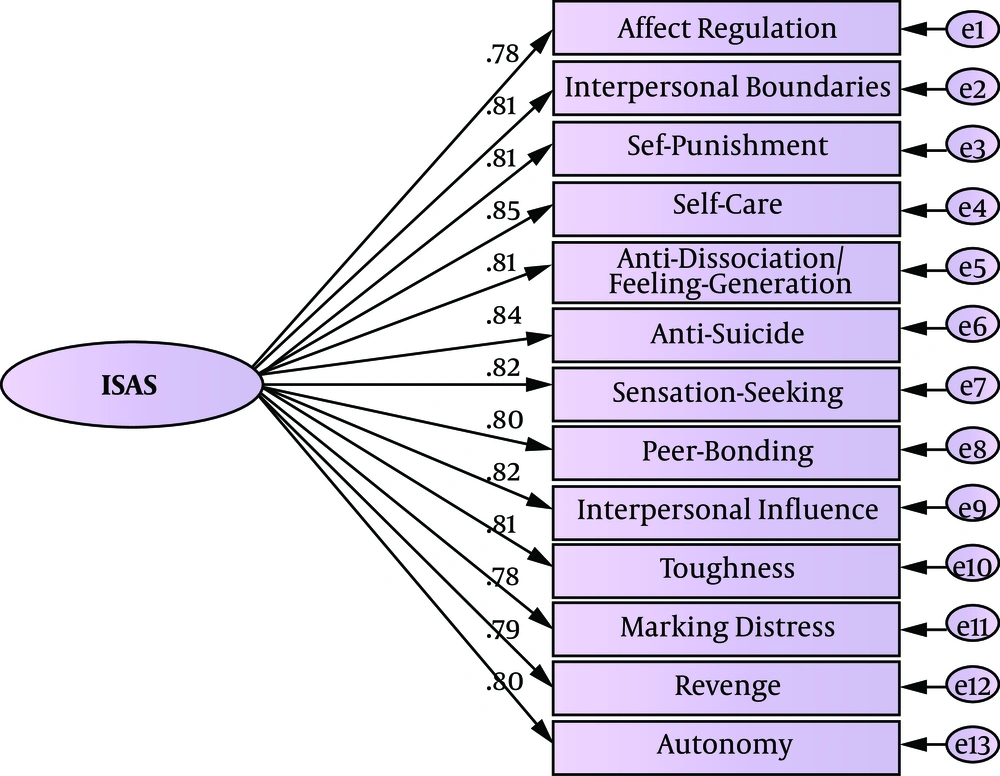
Figure 1.
Factor confirmatory factor analysis for “ISAS”
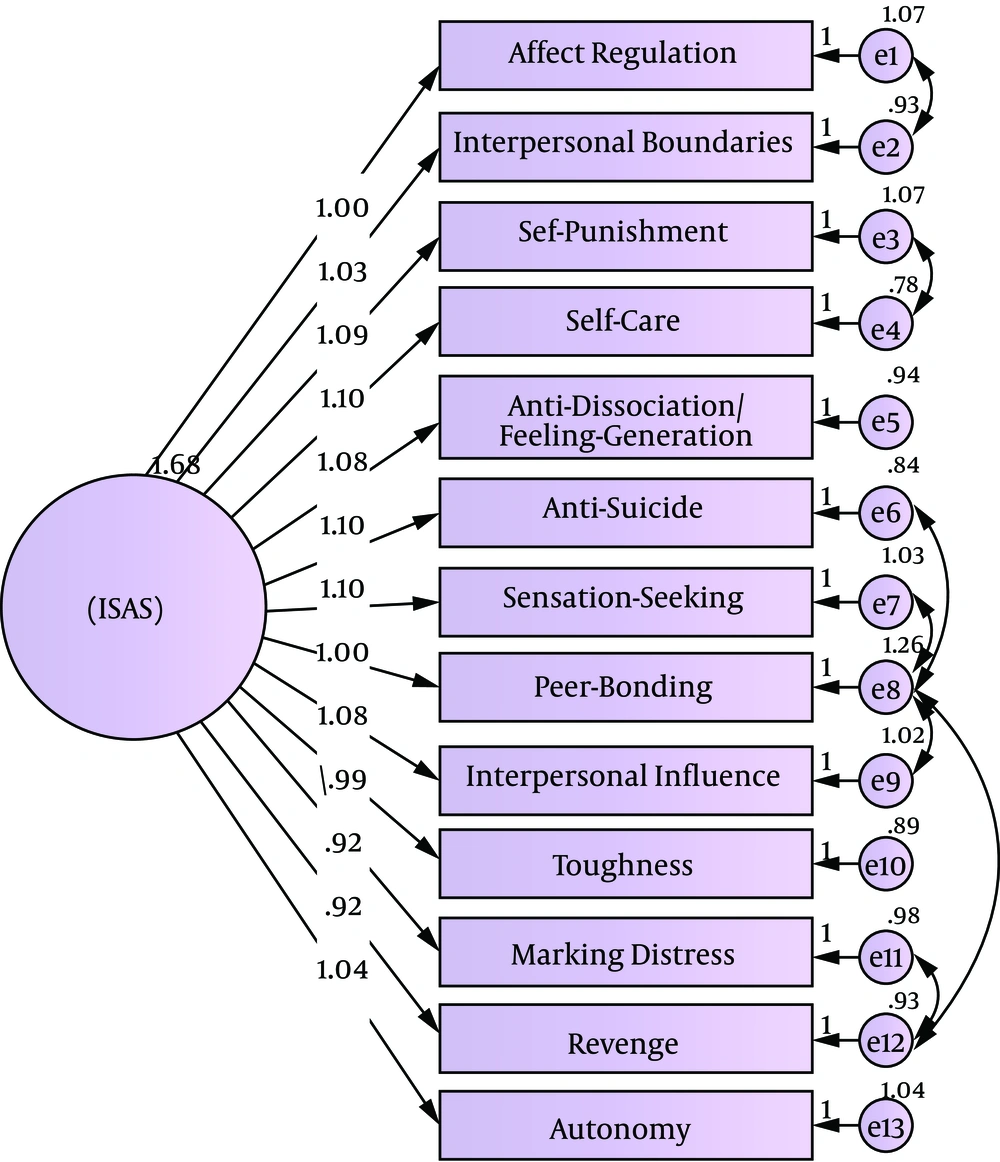
Figure 2.
Factor confirmatory factor analysis for “ISAS”
In addition, question S4 and question S8 had the heaviest and weakest factor loadings, respectively.
5. Discussion
The present study provided evidence for psychometric properties of the Inventory of Statements About Self-Injury in a sample of opioid and alcohol abusers in Iran. The results showed ISAS is a useful inventory for the Iranian population. Findings have noetic and conceptual implications for understanding the measurement of non-suicidal self-injury in opioid and alcohol abusers. the results show the frequency of NSSI and its functions are relatively stable over time. The behavior with the greatest stability was severe scratching. Burning, pinching, and pulling hair were three of the most common and clinically severe NSSI behaviors.
The results of the confirmatory factor analysis after the exploratory factor analysis showed the factor loadings of all sub-inventories were more than 0.6, indicating that the factor rotation caused an increase in the power of factor loadings sub-inventories. Cronbach’s alpha for the total score and both hidden factors were similar to the original version of the inventory in a study by Klonsky et al. (5, 6), which was higher than 0.7, indicating this inventory had a good fit for the Iranian population of opioid and alcohol abusers.
The results of the study by Klonsky et al. have suggested separate categories (interpersonal and intrapersonal) for NSSI functions (5, 6). However, some studies emphasize NSSI functions overlap and are interrelated (18). According to a meta-analysis, intrapersonal functions are less common causes of NSSI compared to interpersonal functions such as emotional regulation, which is often difficult for substance abusers. Nevertheless, the above-mentioned study, as well as the current study, do not suggest that focus should only be on one function in an individual (19). In factor analysis, “Self-care” and “peer-bonding” had the highest and lowest factor loadings, respectively. The theory of social learning supports these findings. Sometimes adolescents, by injuring themselves, reinforce self-care behavior, seek attention from their family, and gain social status among their peers.
Substance abuse is associated with suicidal tendencies. Non-lethal suicide attempts can be a risk factor for future suicide attempts and one of the main reasons for hospitalization in psychiatric wards (20). This study examined self-cutting and slit wrestling, the most important types of self-injurious behaviors among drug abusers (21, 22). Limited access to dangerous means of suicide may play an important role in reducing self-injury attempts in the studied sample. The most important groups at risk are youths, prisoners, and all those committed intentional self-injurious behaviors during their lifetime (23).
Given the convergent and divergent validity, there is a positive and significant correlation between both distress tolerance and impulsivity with intentional self-injurious behaviors, consistent with previous studies. In addition, alcohol abuse and self-injurious behaviors are associated with low degrees of distress tolerance (19). Distress tolerance, an individual difference variable, points to the capacity of experience and resistance to emotional distress. Distress tolerance has increasingly been seen as an important concept in development, a new insight into the onset and maintenance of mental health, as well as prevention and treatment of mental disorders. People with low distress tolerance engage in behavioral deviances such as drug abuse in an erroneous attempt to deal with their negative emotions and to relieve their psychological pain (10). Impulsivity is also a key factor in the incidence of NSSI behaviors (23). Addiction is a powerful predictor of the persistence of drug abuse, and understanding the relationships between these factors can help reduce the recurrence of drug abuse (24).
Moreover, ISAS is the first inventory localized among opioid and alcohol abusers in Iran, which can safely and reliably examine NSSI behavior in this population. Therapists can now evaluate patients’ responses to the treatment and follow up on their progress over time. In addition to interview, therapists can use this instrument to create treatment plans. This tool can also be used to monitor treatment progress and reduction in self-injurious behaviors. Therefore, it is important to adequately train the staff to use this instrument.
A limitation of this study was respondents’ low educational level; the researcher resolved this limitation by personally reading all the questions for the participants. Also, the fact that very few study participants (1.06%) were females makes it difficult to generalize the results to the female population. In addition, this study only examined individuals, abusing opioids, and alcohol. Manifestations and related functions may be different in abusers of other substances and hence limits the generalizability of the findings. Future studies can examine self-injurious behaviors and the applicability of ISAS, as an instrument, in the female population as well as in abusers of substances other than opioids and alcohol.
The most important achievement of this study is that it provides thorough evidence based on data collected from a sample covering a variety of cultures and ethnicities from multiple regions of the country, including the north, south, east, west, and central parts of Iran. Therefore, this tool can be used as a representative measure of relevant behaviors in the Iranian population.
5.1. Conclusions
The Persian version of the Inventory of Statements About Self-Injury has high validity and reliability among the Iranian population of opioid and alcohol abusers. Further research is needed to investigate the causal relationship between clinical symptoms and suicidal ideation and decreased resilience.


