


1. Background
Drug consumption has always been proposed as the first preventable cause of various diseases and deaths worldwide (1). Unfortunately, in addition to the consumption of traditional and natural drugs, a greater and more ruinous disaster in communities, which are known as psychoactive drugs, has been observed (2). Drug abuse is a non-adaptive pattern of drugs consumption, which leads to frequent problems and adverse consequences, and includes a set of cognitive, behavioral, and psychological symptoms (3). Severe psychological dependence occurs after psychoactive drugs consumption, which is proposed to be much more common than physical dependence (4). Consumption of these drugs will have many side effects, including reduction of appetite, changes in vision, vision hallucinations, increase in heart rate and blood pressure, body temperature increase, nightmares, sudden attacks of panic, insanity, and severe contraction of the jaw, learning disorder, lack of concentration, amnesia, convulsion, and even sudden death (5). Currently, a tenth of death cases around the world is caused by smoking and psychoactive drugs, which will be increased to one-sixth by 2030 (6). Despite harm reduction programs and advanced drug use treatment system in Iran, psychoactive drug use is increasing (7, 8). In the recent years, the fever of drugs and psychoactive drugs consumption has grown among different social classes of the country; this issue as a cultural and social damage will threaten the physical and mental health of the society (7, 9). According to the results of a national study, being of male gender, having an older age, having general risk taking behavior, higher smoking stage, self-injury, and higher socioeconomic class were factors associated with increase in the use of illegal drugs among students. The rapid spread of psychoactive drugs consumption among the student population will have detrimental consequences, such as physical and mental diseases, suicide, reckless driving, destruction of public property, aggressive behaviors, emotions, lack of identity and risky sexual behaviors, and shows the necessity of planning and formulation of preventive intervention strategies at universities (10). However, more research on epidemiology and health-related implications are a prerequisite for any kind of planning, awareness of the existing conditions, and understanding the current situation of drug consumption among students (7).
2. Objectives
Due to the newness of the subject and legal restrictions on the consumption of psychoactive drugs, there is not enough evidence about the prevalence of consumption of these drugs among Iranian students; therefore, by relying on the highly sensitive role of students of medical sciences universities as caregivers of health of the society, it was decided to conduct the present study to determine the prevalence and causes of the tendency towards psychoactive drugs abuse in students of Yazd Shahid Sadoughi University of Medical Sciences, during year 2015.
3. Materials and Methods
3.1. Study Design and Area
This cross sectional study (descriptive-analytical) was conducted in Yazd Shahid Sadoughi University of Medical Sciences, during year 2015. Yazd province is in the center of Iran and has an area of 131 575 km2 and a population of 1 074 428 (2011 census).
3.2. Sampling
Overall, 195 subjects was calculated as the required sample size for this study. In order to increase the power of the study, 250 people were considered.
Inclusion criteria were being a student, who was studying at this university at the time of the research, while students transferred to other universities or students, who were guests from other universities were excluded. After considering the inclusion and exclusion criteria, 250 people were selected using systematic sampling, and self-made questionnaires were distributed between them. In the initial step, to collect the sample, a stratified sampling technique proportional to faculty and class size was used. To carry out the systematic sampling approach and select students from faculties and classes, the sampling fraction value (k) was calculated. Sampling fraction value (k) was calculated by dividing N (total number of community members) by n (the number of estimated samples). The class list of students was taken after calculating sampling fraction value (k = 13), then, the first person was randomly selected after entering in any class. In the next step, the next person was selected by sampling fraction value interval.
3.3. Study Measures
A self-made questionnaire was used to collect data. The mentioned questionnaire composed of two parts: the first part included demographic information of students (age, gender, marital status, ethnicity, place of residence, domicile, field of study and its grade, academic semester, etc.), and the second part included 8 questions related to psychoactive drugs consumption and causes of tendency among students. Content validity of the questionnaire was used and confirmed by experts and its reliability was confirmed by Cronbach’s alpha coefficient, which was 0.86. It should be noted that in this study, at first, informed consent was obtained in order to participate in the study by describing and explaining the objectives of the study to the target population.
3.4. Data Analysis
After data collection, the data was coded and analyzed using the SPSS software version 16 and frequency tables, charts, and Chi-square, and also logistic regression test was used in order to estimate the odds ratio (OR) for demographic variables affecting the consumption of psychoactive drugs. Significance level was considered at P < 0.05.
4. Results
During this study, 250 (51.2% females and 48.8% males) students of Yazd Shahid Sadoughi University of Medical Sciences (YUMS) were selected using systematic random sampling and questionnaires were distributed between, and finally, all participants in the study filled out this questionnaire (percentage of responsiveness was 100%).
Finally, 14 students stated that they were consuming psychoactive drugs. In other words, the percentage of psychoactive drugs consumption was obtained at 6.5% with the duration of use equal to 2.36 ± 2.05 years. Also, 173 students (69.2%) from a total of 250 examined students had experienced drug consumption, and 48 students (19.2%) were smokers. Demographic investigation showed that there was a significance difference between consumer students of psychoactive drugs and non-consumer students of psychoactive drugs in certain areas (Table 1).
Table 1.Demographic Characteristics of Students of Yazd Shahid Sadoughi University of Medical Sciences in Terms of Psychoactive Drugs Consuming
| Independent Variable | Consumer Students of Psychoactive Drugs Number (%) | P Value |
|---|---|---|
| Age (21 - 25 years old) | 14 (100) | 0.037 |
| Sex (male) | 10 (71.4) | 0.081 |
| Marital status (single) | 12 (85.7) | 0.25 |
| Ethnicity (Persian) | 06 (42.2) | 0.050 |
| Place of residence (non-native) | 13 (92.9) | 0.055 |
| Domicile (dormitory) | 09 (64.3) | 0.024 |
| Field of study (health) | 03 (21.4) | 0.920 |
| Semester (one) | 04 (28.6) | 0.578 |
| degree (bachelor) | 06 (42.9) | 0.767 |
| History of drug consumption (yes) | 14 (100) | 0.010 |
| Status of drug consumption in father (smoker) | 11 (78.6) | 0.001 |
| Status of drug consumption in mother (smoker) | 04 (28.6) | 0.002 |
| Daily exposed to cigarette smoke (yes) | 14 (100) | < 0.001 |
The average age of students was 21.97 ± 2.25 and a statistically significant difference was found in terms of age between consumer students of psychoactive drugs and non-consumers; so that, all the consumer students of psychoactive drugs were in the age group of 21 to 25 (P = 0.037). The majority of consumer students of psychoactive drugs were boys, yet this gender difference was not significance (P = 0.081).
Ethnicity of people had a statistically border difference between consumer students of psychoactive drugs and non-consumer students (P = 0.05). Also, a statistically border relationship was found between consuming psychoactive drugs by students and their place of residence (P = 0.055). The highest frequency percentage (64%) of consumer students of psychoactive drugs was related to students, who resided in the dormitory (P = 0.024).
The results of this study showed that there was no significant relationship between psychoactive drugs consumption and field of study, semester, and grade (P > 0.05). All students had experienced drug consumption in their past among the group of consumer students of psychoactive drugs (P = 0.01). Also, a statistically significant difference was found between consumers of psychoactive drugs and non-consumers of these drugs in terms of drug consumption in parents (P < 0.05) and being exposed to cigarettes (P < 0.001). The results showed that 78.6% of fathers and 28.6% of mothers of consumer students of psychoactive drugs consumed drugs.
In this research, the type of consumed drug by students was also investigated, with the results presented in Figure 1.
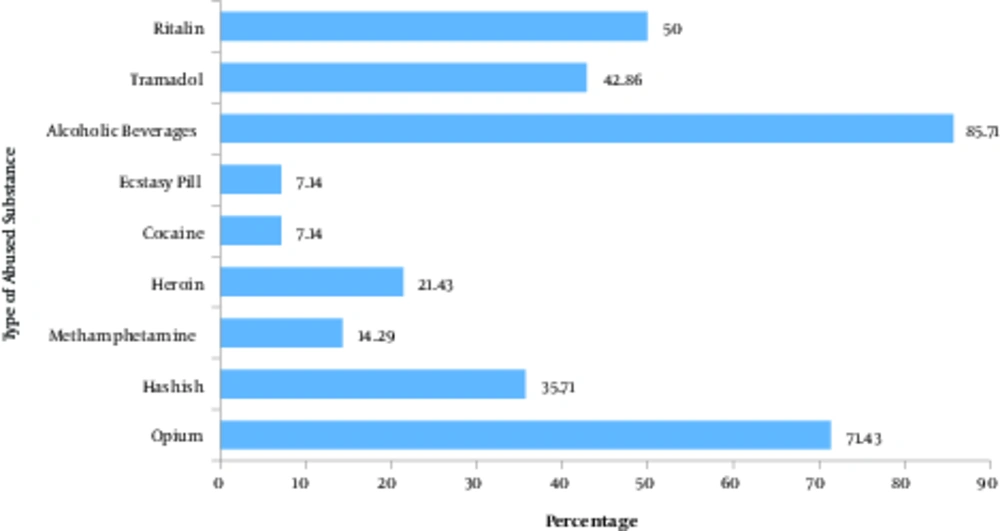
Figure 1.
Percentage of Consumed Drugs by Consumer Students
According to Figure 1, it was found that from 14 consumer students of psychoactive drugs at the time of research, 10 students consumed opium, 5 students Hashish, 2 students methamphetamine, 3 students heroin, 1 student ecstasy pills, 1 student cocaine, 12 students alcoholic beverages, 6 students tramadol, and 7 students Ritalin.
The results related to the causes of tendency of students towards psychoactive drugs consumption are shown in Table 2; according to these results, the main factor of tendency of students to psychoactive drugs consumption was failure to meet their emotional needs with a prevalence of 35.7%. However, the lowest frequency of tendency of students to psychoactive drugs consumption was related to family dispute factors in addition to the lack of educational accomplishment with a prevalence of 7.1%.
Table 2.Frequency Distribution of Causes of Tendency to Psychoactive Drugs Consumption Among Students
| Factor of tendency | The Number of Consumer Students of Psychoactive Drugs |
|---|---|
| Unemployment | 4 (28.6) |
| Addiction of friends and relatives | 3 (21.4) |
| Failure to meet their emotional needs | 5 (35.7) |
| Family disputes | 1 (7.1) |
| The lack of educational accomplishment | 1 (7.1) |
| Total | 14 (100) |
In this study, students’ motivation regarding consumption of psychoactive drugs was also evaluated with the results presented in Table 3. According to the results, the most important causes of students’ motivation regarding consumption of psychoactive drugs was taking pleasure with a prevalence of 50%.
Table 3.Frequency Distribution of Motivation of Consuming Psychoactive Drugs Among Students
| Motivation of Tendency | The Number of Consumer Students of Psychoactive Drugs |
|---|---|
| Entertainment | 04 (28.6) |
| Take pleasure | 07 (50) |
| Endure life’s problems | 01 (07.1) |
| Conformity | 01 (07.1) |
| Sense of curiosity | 01 (07.1) |
| Total | 14 (100) |
As results of multivariate analysis in Table 4 indicate, the odds ratio was obtained as 2.78 (95% CI: 1.18 to 6.54) for male students with this value being statistically significant (P = 0.019). The results showed that the possibility of consuming psychoactive drugs among boys of universities was 2.78 times greater than female students. The odds ratio was 13.08 (95% CI: 2.08 to 22.06) for non-native students (P = 0.006). The results indicate that the factor of being a non-native student was a powerful risk factor for tendency of students towards psychoactive drugs consumption. In the findings of logistic regression test, the odds ratio was estimated as 2.65 for consuming drugs by the father and 3.33 by the mother (P < 0.05). These results prove the fact that drug consumption by parents is an important risk factor for psychoactive drugs consumption by their children. The odds ratio was 3.82 (95% CI: 1.95 - 11.23) for being exposed to cigarette smoke during the day (P = 0.014). The obtained results indicate that the students, who are exposed to cigarette smoke during the day are 3.82 times more likely to be inclined to psychoactive drugs consumption.
Table 4.Effect of Demographic Variables on Consumption of Psychoactive Drugs
| Independent Variable | P Value | Odds Ratio (OR) | %95 CI | ||
|---|---|---|---|---|---|
| Lower Bound | Upper Bound | ||||
| Gender | Male | 0.019 | 2.78 | 1.18 | 6.54 |
| Female | - | 1 | - | - | |
| Place of residence | Native | - | 1 | - | - |
| Non-native | 0.006 | 13.08 | 2.08 | 22.06 | |
| Domicile | Dormitory | - | 1 | - | - |
| Leased | 0.128 | 0.270 | 0.051 | 1.45 | |
| Parental house | 0.996 | 0.089 | 0.003 | 1.98 | |
| Ethnicity | Fars | - | 1 | - | - |
| Lor | 0.156 | 0.15 | 0.011 | 2.054 | |
| Turk | 0.193 | 0.299 | 0.049 | 1.84 | |
| Kurd | 0.599 | 0.584 | 0.079 | 4.33 | |
| other | 0.998 | 0.025 | 0.002 | 1.781 | |
| Status of drug consumption in father | Yes | 0.045 | 2.65 | 1.62 | 8.25 |
| No | - | 1 | - | - | |
| Status of drug consumption in mother | Yes | 0.018 | 3.33 | 1.32 | 10.56 |
| No | - | 1 | - | - | |
| Being exposed to cigarette smoke | Yes | 0.014 | 3.82 | 1.95 | 11.23 |
| No | - | 1 | - | - | |
| History of drug consumption | yes | 0.996 | 2.12 | 0.012 | 12.430 |
| No | - | 1 | - | - | |
5. Discussion
The goal of this study was to determine the prevalence and causes of tendency to psychoactive drugs abuse among the students of Shahid Sadoughi University of Medical Sciences in Yazd. The prevalence of psychoactive drugs consumption was 5.6% (14 people out of 250), 173 people (69.2%) had experienced drug consumption; while, from the total of 250 students of the sample group, 51.2% were female and 48.8% were male.
The sample distribution based on the age showed that 100% of students had been in the age range of 18 to 30, so that, drug consumer students were in the age range of 21 to 25. Given that the study of drugs consumption among students of public universities considered the age range of 18 to 25 as consumers, and the age of onset of addiction between the ages of 16 to 20, and young people between 18 and 31 as the age range of those at risk (16), 100% of the mentioned community was made of up young students that are among populations at risk of drugs abuse.
Of the total students of the sample group, 72.4% were single (181 people) and 27.6% were married (69 people), and from the total of consumer students, 85.7% were single, 71.4% were male and 29.6% were female. In similar studies, the percentage of consumers in the group of male students was more than female students (11, 12). Distribution of consumers based on marital status has indicated that over 80% of consumers are single (12, 13), yet no significant relationship was found in the present study.
It could be stated that consumer students of the university were among groups vulnerable to addiction, and the tendency of students has had a significant relationship with their own or family history of tobacco consumption.
From a total of 250 people, 48 people were consumers of cigarette (19.2%), and 14 people used psychoactive drugs (5.6%), and from this number, 50% were consumers of Ritalin, 42.86% consumer of Tramadol, 85.71% consumer of alcoholic beverages, 7.14% consumer of ecstasy pills, 7.14% consumer of cocaine, 21.43% consumer of heroin, 14.29% consumer of methamphetamine, 35.71% consumer of Hashish, and 71.43% consumer of opium.
In a study that evaluated the consumption situation of psychoactive drugs among students in England during year 1996, it was reported that only 11% do not consume alcoholic beverages (14), and another study considered alcohol as the most common consumed drug among students (15). Given that the mentioned students live and study in a Muslim country, it is expected for alcoholic beverages consumption to be lower than other drugs, but unfortunately, in other researches, including the study of Sohrabi et al. in accordance with the current study, the highest consumption of psychoactive drugs was allocated to alcoholic beverages (12).
One of the notable findings in this study was determining the tendency and motivation factor of consumption among students; so that, the results indicate that the main factor of tendency to psychoactive drugs was failure to meet emotional needs, and taking pleasure was the most important consumption motivation for students.
The strategic report, which has been conducted by the Narcotics Committee, propounded the causes of irritants consumption because of creating, strengthening, and raising the following modes, high sexual pleasure, concentration and energy, good mood experience, thinness, beauty, joyance, excitement, curiosity, narcotic withdrawal, working, awakening, lack of morphine, temerity, and audacity (16).
A study that investigated the prevalence of drugs consumption and its associated factors among the students of Nazar Abad city, propounded entertainment and curiosity as the most common motivations of students for drugs consumption (17), and another study considered the lack of appropriate recreational facilities as the cause of tendency (18). The results of the current study also showed that the most common motivation of consumption was taking pleasure while 28.6% of students were seeking entertainment and 7.1% were motivated out of curiosity.
In the study of Foroutani et al. a statistically significant relationship was found between psychoactive drugs consumption by students and their place of residence; so that, 95% of students were non-native (18). In another study, although drugs consumption in non-native students had been more than native cases, no relationship was observed (19), and in the current study, a statistically border relationship was found between psychoactive drugs consumption by students and their place of residence (P = 0.055).
Physical and mental health of students (as the elites of the society) is a concern of planners and decision makers, and training goals cannot be achieved unless we pay attention to students’ health. When a number of people enter the university, the educational goal is training efficient and well-educated people, and when physical and psychological damage is encountered among students, in fact, the training process is impaired in addition to enduring treatment costs. Given that the graduates of medical sciences universities enter the cycle of providing health care services after graduation, paying attention to this group is more important.
Since the findings of this study were only from one university, the results cannot be generalized to the entire population of students; this issue can considered as a limitation of the current study. Therefore, it is recommended for further studies to be conducted with a greater sample size.
5.1. Conclusions
Considering the most important factors causing trends towards psychoactive drugs among Yazd University students was the lack of emotional support, psychological and social problems, and history of drug abuse in parents; both parents and university officials must make greater efforts to solve psychological, social, and emotional problem of the students. Also, other governmental officials, by proper planning, to create recreational centers, and sport and art classes in different fields in order to fill students’ free time, and establishment training classes and workshops enhancing students’ information about risks and dangers of psychoactive drugs, can have a more effective role in solving the social and emotional problems of students. Overall, education development, promoting life skills, and improving recreational facilities and also creating a relaxed and tension-free atmosphere for students to participate in research, sport and cultural programs can be used as a preventive program, which bring back the goals of higher education.

