


1. Background
Modern humans, also known as Homo sapiens (Latin, “wise man”), have a remarkable ability to recognise faces and facial expressions of other individuals with high speed and accuracy (Figure 1). This remarkable ability seems to have an evolutionary basis (1, 2). The interethnic diversities in face recognition abilities have not been fully explored so far, and no study has been performed on Iraqi populations.
Some individuals have exceptional face recognition skills and are known as “super-recognizers”. These individuals are the exact opposite of people with a medical condition, known as “prosopagnosia” or “face blindness”. In this condition, an individual has deteriorated or limited abilities to recognise faces (3-9).

Figure 1.
The right half of the portrait is clear and normal, while the left half is blurred and obscured; the latter indicates the viewer's inability in face recognition.
Russel, Davis, and colleagues have carried out intensive research on prosopagnosia and super-recognition. Specific tests have been used to examine facial recognition abilities. These tests include the modified cambridge face memory test and cambridge face perception test (3, 10). The correlation between handedness and complex visual analytic skills has been studied before. Previous studies have emphasised on the significance of handedness, cerebral dominance patterns, and visual skills (11-15). The present study, performed on an Iraqi population, may be considered complementary to previous efforts. In this regard, Gauthier, Kanwisher, McCarthy, Casper, and colleagues investigated specific areas of the brain, located on the inferior surface of the temporal lobe and fusiform gyrus, which are critical to face-specific processing (16-20).
Ethical approval was obtained for this observational study from the ethics committee and review board of the faculty of medicine, university of Baghdad (No., 620-73; May 15, 2016). The level-of-evidence in this research is level 4, and inferences are based on the classification system by the oxford center for evidence-based medicine (CEBM) (21, 22).
2. Objectives
This cross sectional study, performed on a population of Iraqi medical students, aimed to identify potential super-recognizers and to determine the correlation of face recognition abilities with gender, handedness, and ethnicity. The conclusions are based on inferential statistics and hypothesis testing.
3. Materials and Methods
This cross sectional, observational study recruited subjects from the medical faculties of university of Baghdad and Iraqi University, both located in Baghdad, Iraq. The participants were exclusively undergraduate medical students (males and females), who were right- or left-handed and belonged to 4 main ethnic groups: Arabs, Kurds, Turks, and Christian ethnicities.
A cross sectional analysis was carried out by distributing an electronic form of the face recognition test (E-test) via the Intranet system of each university. The double-blind approach was applied in this study. The demographic data of the participants were collected using Google forms, besides the face recognition test (23, 24). The online survey was distributed among the participants via the Intranet network system of the universities, known as Iraqi network learning environment (INLE) (25). The data were collected over 2 weeks, and the total number of the participants was 384; however, only 309 participants completed the survey.
The gathered data were tabulated after the measurement of descriptive and nonparametric inferential statistics in SPSS v.20 and Microsoft Excel 2016. The collected data were categorical and did not follow a normal distribution pattern. Therefore, nonparametric, inferential statistics were measured, including Mann-Whitney U test and Kruskal-Wallis H test. Intergroup comparisons were made to compare face recognition scores (scale, 0 to 14) with gender (male vs. female) and handedness (right-handed vs. left-handed). A P-value of 0.05 was considered statistically significant with a 95% confidence interval (95% CI).
A literature review was carried out from October 2, 2016 to November 20, 2016. The review was performed systematically in medical and paramedical databases, including PubMed/Medline, Cochrane Library, Scopus, Embase, CINAHL, Google Scholar, and unpublished (grey) databases. Specific keywords were used for the purpose of literature review in parallel with medical subject headings (MeSH) in the databases of the national center for biotechnology information (NCBI) (26). Boolean operators were also used to retrieve the highest level of evidence (27). Previous studies, including observational and experimental research, were evaluated using the critical appraisal skills program (CASP) tools (21). The literature was appraised in accordance with the Oxford CEBM guidelines (22).
4. Results
In this study, data were collected over 2 weeks. A total of 309 participants fully and accurately completed the survey (Figures 2 - 4). The participants included males (n, 101) and females (n, 208). The majority of the participants were right-handed (n, 277), while left-handed individuals accounted for approximately 10.4% of the population. The ethnic groups included Arabs (n, 288), Kurds (n, 12), Turks (n, 7), and Christians (n, 2).
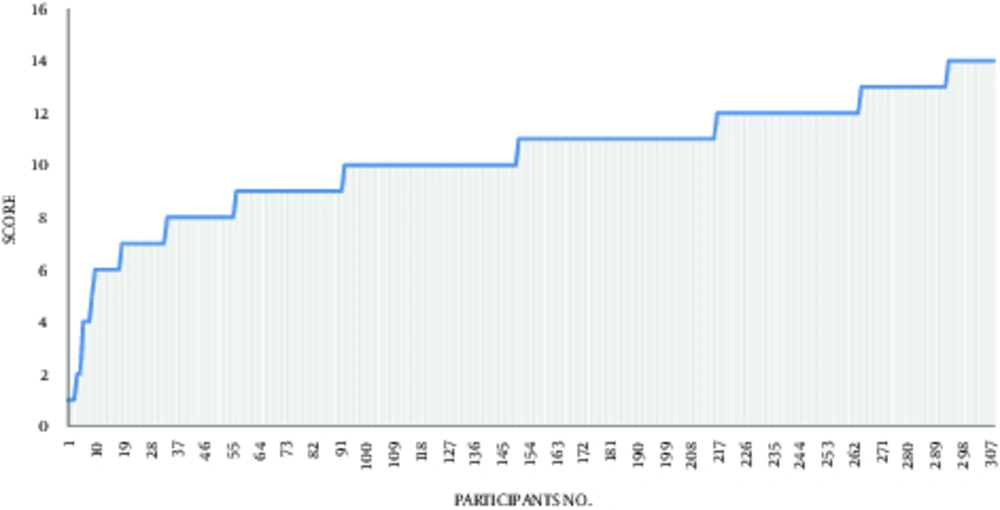
Figure 2.
The Line Chart of Participants (1 - 307) Versus the Score of Face Recognition Ability
The participants’ age was within the range of 17 - 25 years (Figure 3); the average age of the participants was 20.35 (± 1.77) years. The average score was 10.27 (± 2.32) on the face recognition test, and the scores ranged from 1 to 14. Approximately 51.5% of the subjects were categorised as potential super-recognizers, as they obtained scores above 10 out of 14 on the face recognition test.
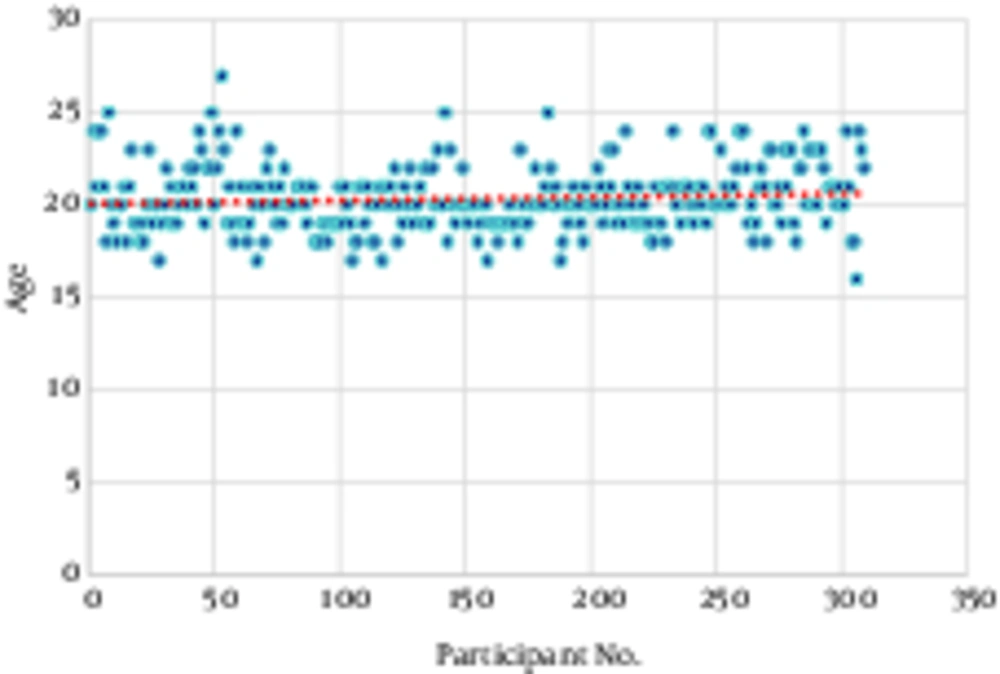
Figure 3.
Participants (X-axis) and Age (Y-axis)
There was a significant difference in face recognition scores in terms of gender; males obtained higher face recognition scores (10.72 vs. 10.05; P = 0.027), as assessed by the Mann-Whitney U test. Furthermore, the average rank of males was 170.95, while the average rank of females was 147.25. Based on the findings, handedness was not a determinant factor for the scores (Figure 4), and there was no significant difference between right-handed and left-handed individuals on Mann-Whitney U test (10.29 vs. 10.09; P = 0.394).
With respect to the interracial (interethnic) comparison, there was a significant difference between Arabs and Kurds (10.19 vs. 11.5; P = 0.022); Kurds showed better face recognition abilities, compared to Arab participants. Other interethnic correlations were not statistically significant due to the small sample size of Turk and Christian ethnicities.
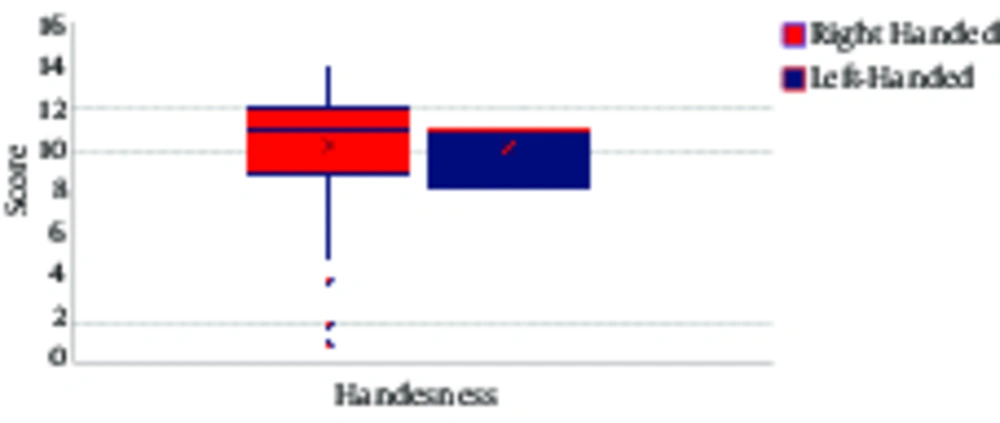
Figure 4.
The Boxplot Presentation of Scores: Gender Comparisons (top) and Handedness Comparisons (Below)
5. Discussion
This study aimed to analyse face recognition abilities in a selected Iraqi population, including undergraduate medical students. The main objective was to quantify face recognition abilities versus handedness, gender, and ethnicity. Accordingly, different face recognition skills were assumed between right-handed and left-handed individuals, males and females, and various ethnic groups, including Arabs and Kurds.
In 2016, Al-Hadithi and colleagues assessed the visual analytic skills in correlation with handedness and patterns of cerebral dominance (12). Moreover, Al-Imam et al. suggested further studies on a specific population, including users of novel psychoactive substances (NPS). The analyses can be further extended to include visual analytic skills and face recognition abilities (11, 12).
Although the present study has an observational design, it lacks findings from neuroimaging techniques, including positron emission tomography (PET), magnetic resonance imaging (MRI), and functional MRI (fMRI). These imaging modalities can be used to determine the correlation of face recognition abilities with parameters inherent to specific cortical areas of the brain, including the surface area of certain cerebral cortical gyri, energy consumption, metabolic rate, and vascular phenomena. All these parameters can be potentially studied while performing face recognition tasks (28-30) using fMRI to acquire images with reliable spatial and temporal resolution.
Although this study was only performed on humans, it can be also applicable in biometrics and artificial intelligence for tracking and identifying offenders and criminals worldwide in either the cyberspace or real life. Davis and colleagues suggested that prosopagnosia could be either developmental or acquired as a consequence of specific cortical neuronal damage (3, 4). Overall, exploitation of super-recognizers is invaluable, particularly in law-enforcement and intelligence agencies (5-9).
The correlation between handedness and complex visual analytic skills has been studied before, emphasising on the significance of handedness, cerebral dominance patterns, and visual skills (11-15). Gauthier, Kanwisher, McCarthy, Casper, and colleagues investigated specific areas of the brain in relation to face recognition abilities. These higher cortical areas are located on the inferior surface of the temporal lobe and have a significantly larger surface area, compared to other cortical regions (16-20).
Recently, Wu and Zhang studied the use of artificial intelligence for the purpose of facial recognition of criminals and offenders (31). Furthermore, there have been several attempts (2004 - 2016) to assess the role of NPS, research chemicals, and cognitive enhancers (32-34). For instance, visual and facial recognition abilities can be explored in a selected population of NPS users and compared with a normal control group via quasi-experimental studies, randomised controlled trials (RCTs), or pragmatic RCTs (pRCTs).
Future research attempts should include larger sample sizes, especially from different ethnic groups, in parallel with proper randomization and stratification. Subjects should be recruited from different populations (multicenter studies), with particular attention to various age groups. The face recognition abilities may decline or vary with aging. RTCs can also accurately compare a normal population with a population of NPS users in relation to facial recognition abilities.
The level-of-evidence in the literature was assessed in accordance with the Oxford CEBM guidelines (Table 1). A total of 34 bibliographic resources were categorised into reviews and systemic reviews (n, 5), experimental and quasi-experimental studies (n, 7), observational studies (n, 16), expert opinions (n, 2), and web pages (n, 4). The overall level-of-evidence is level 4 in this study.
Table 1.Critical Analysis of Bibliographic Resources
| Web Pages | Textbooks and Expert Opinions | Reviews or Systematic Reviews | Observational Studies | Experimental and Quasi-Experimental Studies | Total | ||
|---|---|---|---|---|---|---|---|
| Level of evidence | 5 | 5 | 2b or 1a | 2b | 3b to 1b | ||
| Statistical analysis | None | 4 | 2 | 3 | 1 | 0 | 10 |
| Descriptive | 0 | 0 | 0 | 2 | 1 | 3 | |
| Inferential | 0 | 0 | 2 | 13 | 6 | 21 | |
| Total number | 4 | 2 | 5 | 16 | 7 | 34 | |
| Publication date | Before 2012 | 0 | 1 | 4 | 5 | 4 | 14 |
| After 2012 | 4 | 1 | 1 | 11 | 3 | 20 | |
5.1. Conclusion
Facial recognition abilities of humans are critical for everyday activities, behavioral interactions, social bonding, and survival mechanisms. Kurds were found to have superior facial recognition abilities, compared to Arabs. Males obtained higher scores on the facial recognition test, while no significant difference was found between right-handed and left-handed individuals.
Overall, super-recognizers are individuals with exceptional abilities to recognise faces. Hence, their skills are highly sought after by police units, intelligence agencies, and counter-terrorism units. These agencies tend to recruit super-recognizers for identification and pursuit of offenders, criminals, and terrorists. The main objective is to enforce the law and fortify the criminal justice system. On the other hand, individuals with prosopagnosia have very limited facial recognition abilities. This population can be further studied to analyze the underlying developmental and neural mechanisms of this phenomenon. Superior facial recognition abilities are also valuable for practical application in anthropometric studies, biometrics, artificial intelligence, and evolutionary biology.
The present study is the first attempt to quantitatively evaluate the face recognition abilities of a student population, while highlighting the differences between males and females, right-handed and left-handed individuals, and different ethnic groups. The results are applicable in the fields of physical anthropology and neurosciences. Moreover, they can be applied as a framework for subsequent studies on populations of individuals with neurological impairments, such as prosopagnosia.



