Introduction
Iranian Traditional Medicine (ITM) is rich in intact information about plants that have been used to treat various diseases, especially skin disorders. Herbal drugs have been used worldwide in traditional medicine for treatment of various diseases. World plant biodiversity is the best source of herbal medicine and still about 60%-80% world population trust on plant based medicines which are being used since the ancient ages as traditional health care system (1).
Use of traditional remedies and plants in the treatment of burns and wounds is an important aspect of health management and at the same time is an efficient way to provide cheaper healthcare options. Several indigenous plants and formulations described in folkloric and Ayurvedic systems of medicine have been reported for the management of cuts, bruises, burns and wounds (2). The famous texts on ITM claim many of herbs and several formulations as potential wound healing agents (3-6). Review on ITM references showed that herbal therapy was the major treatment prescribed by Iranian physicians for wound healing. According to ITM references, herbals which were used to treat wounds have shown healing activity as well as flesh growing and cicatrizant properties (3-5).
Topical formulations, traditionally named “Zemad”, “Marham” and “zaroor”, were the most ancient pharmaceutical dosage forms used in ITM for burn and wound healing. According to the belief of many Iranian traditional scholars, "Hippocrates" was the first who invented “marham” in order to combine two medicinal components with different therapeutic effects for a single target. Based on ITM manuscripts, “Zemad” is a combination of fine and pulverized drugs with or without beeswax and oils. “Marham” is a combination of fine and pulverized drugs with beeswax, oils, animal fats or bone marrows. “Zaroor” is combination of fine and pulverized powder drug form which sprayed on the wound area. These topical forms were used for injuries, wounds and some swellings (7).
There are many herbal prescriptions which have been used for wound healing in ITM. The combination of Aloe vera (L.) Burm.f. (aloe), Commiphora myrrha Engl. (myrrh) and Boswellia carteri Birdw. (frankincense) has been prescribed by ITM scholars in the form of “Zaroor” or “Zemad” for wound healing (3-5).
Boswellia carteri (Burseraceae) is known as “Kondor” in Persian language and containing, Boswellic acid, the main well-known active component of the resin. Anti-inflammatory effects of B. carteri as well as its ethnomedicinal use to treat rheumatoid arthritis and other inflammatory diseases have been proven (8). Moreover, B. carteri oil has demonstrated antimicrobial activity (9). Anti-inflammatory, antinociceptive and antioxidant effects of other species of Boswellia have been established as well (10). Myrrh (“Morr” in Persian) is a yellow-brown aromatic oleo-gum resin obtained from the stems of the genus Commiphora, particularly C. myrrha (Burseraceae). It has been demonstrated that myrrh has broad spectrum of biological properties including antibacterial, antinociceptive, anti-inflammatory and anti-ulcer activities. Moreover, it has been reported that myrrh has antioxidant and immunopotentiating properties (11). Aloe vera (Liliacea,”Sabr” in Persian) has been widely cultivated in China and used as a traditional medicine to induce wound healing. Moreover it has been proved as an anti-cancer and anti-viral agent. Several studies have been shown that aloe gel (derived from A. vera) improves wound healing after topical and systemic administration. Several polysaccharides have been detected or isolated from the gel, including mannan, galactan, glucomannan, arabinorhamnogalactan and glucuronic acid-containing polysaccharide that have antioxidant, anti-microbial, anti-inflammatory, anti-cancer and anti-malaria properties (12-14).
In general, according to the mentioned effects of the species which are important in wound healing, the formulation containing A. vera, B. carteri and C. myrrha could be a good candidate for wound healing. So, in the present study, a topical poly herbal paste consisting of A. vera gel and B. carteri and C. myrrha oleo gum resins was prepared and in order to develop a method for quality control of the prepared formulation, HPTLC fingerprinting of PHP has been performed. This formulation has been prepared and used in Iranian Traditional Medicine for many years to treat wounds in patients. Although we have not carried out any clinical trials yet, the traditional usage of the formulation shows the importance of formulating and standardizing the formulation, as the beginning steps of the mass production insight.
Experimental
Plant materials
Aloe vera leaves were purchased from Institute of Medicinal Plants in karaj. Boswellia carteri and Commiphora myrrha were purchased from Tehran herbal market. The samples were authenticated by Mr. M. Kamalinejad, Department of Pharmacognosy, School of Pharmacy, Shahid Beheshti University of Medical Sciences, Tehran, Iran.
Chemicals
All the reagents, media, solvents and HPTLC silica gel 60 F254 plates (20×20 cm) were purchased from Merck Company (Germany).
Preparation of herbal powders
The oleo gum resins of myrrh and frankincense were washed with water and dried in room temperature, then they were powdered and passed through 40 mesh sieve.
Fresh Aloe vera leaves were sliced and the gel was separated from other parts of the leaves. Then the gel was freeze dried. Temperature of the condenser and average chamber pressure were adjusted at -40 °C and 50 mL Tour (VirTis, benchtop SlC). After four days aloe powder obtained from frozen aloe gel and was passed through 40 mesh sieve (15).
Plant materials analysis
The various physicochemical parameters such as loss on drying (all plants), total ash (all three plants), acid insoluble ash (Boswellia carteri) and matter insoluble in ethanol (Commiphora myrrha, Boswellia carteri) were determined according to the plants monographs in British Pharmacopoeia (16).
Formulation of a topical preparation
Based on ITM manuscripts we prepared a poly herbal product for wound healing containing aloe, myrrh and frankincense (10%) which has been used in form of “Zemad” (3).
Paste was chosen as the most suitable base for preparation of poly herbal formulation due to its similarity to Zemad which have been used in ITM. Two kinds of pastes have been made; oily paste and hydrophilic paste.
Hydrophilic paste components were included: herbal powder containing: aloe, myrrh and frankincense (10 %, as mentioned in ITM references), glycerin (20 %), methyl and propyl parabens (0.20 % and 0.05 %), sodium metabisulfite (0.26 %), hydrophilic base 69.5%. Different concentrations (0.5 %, 1% and 2 %) of the hydrophilic base were made by using carbomer 940. In order to prepare hydrophilic paste, first several concentrations of carbomer 940 (0.5 %, 1 % and 2%) were dissolved in warm water. Then NaOH 0.1 M solution was added gradually to the mixture until the gel was formed, also pH was measured to achieve desired pH. In another bowl, herbal powders were triturated and levigated with glycerin. Finally, this mixture gradually was added to the gels which were made of several concentrations of carbomer 940. In addition, methyl and propyl parabens has been dissolved in ethanol and added to the formulation as microbial preservative, also sodium metabisulfite has been dissolved in distilled water and added to the formulation as an antioxidant.
Oily paste components were contained: herbal powders (10 %) containing; aloe, myrrh and frankincense, vaseline, oserin, beeswax, glycerin, methyl and propyl parabens. herbal powders were triturated well, then powders were levigated with glycerin. In the other bowl, vaseline, oserin and beeswax were mixed together. Then, this mixture was gradually combined with levigated herbal powder. Finally methyl and propyl parabens has been dissolved in ethanol and added to the formulation as a microbial preservative, and BHT has been dissolved in ethanol and added to the formulation as an antioxidant. These formulations were evaluated with some of the tests, containing physical stability of formulations (thermal stability, mechanical stability). The physical stability of formulations was evaluated by testing the physical changes like phase separation, color, odor, and consistency.
Short term thermal stability
In short term stability tests, samples of the paste formulations were submitted to temperature of 40 ˚C for 1 week and then were put to temperature of 4 ˚C for 1 week. After fourteen days, samples were observed for changes like phase separation, color, odor, etc.
Mechanical stability
In mechanical stability, samples of the paste formulations were weighed and put in centrifuge. Centrifugation was performed at 3750 rpm for 15 min to evaluate the accelerated deterioration of the paste with a Hettich centrifuge. After centrifugation process, the mechanical changes of the paste like phase separation were investigated.
Determination of pH
The pH of formulated paste diluted 1:10 in distilled water was measured using a digital pH meter.
All measurements were made at room temperature in triplicate for each analyzed sample.
Viscosity measurement and evaluation of rheological properties of PHP
The viscosity of PHP was measured at room temperature in triplicate, using a cone/plate Brookfield DV-Ш Ultra Programmable Rheometer (Brookfield, USA). 0.5 g of the sample was used in each test. Different shear rates and shear stresses were applied on the sample, and the resulting rheogram was constructed to determine the rheological behavior and viscosity of the PHP.
Microbiological tests
Microbial limit tests including: total aerobic viable count (TAVC) and tests for specified bacteria (Staphylococus aureus, Pseudomonas aeroginosa and Candida albicans) were performed on PHP according to WHO guideline (17). Sabouraud Dextrose Agar, Mannitol Salt Agar and Cetrimid Agar were used as selective and differential media for Candida albicans, Staphylococus aureus and Pseudomonas aeroginosa, respectively. PHP was diluted with normal saline (1:10) and cultured in the special medium.
HPTLC fingerprinting of poly herbal paste
In order to extract PHP components for HPTLC, PHP was extracted with methanol. For this purpose, 5 g of PHP was weighed in a flask, and then 20 mL of methanol was added to it. Flask was put in sonicator for 15 min to extract the phytochemical constituents of PHP, then the supernatant was removed and poured into a centrifuge tube and centrifugation was performed for 10 min. After wards, the supernatant of centrifuged solution was removed and concentrated at room temperature (4: 1). In addition, methanol extracts of A. vera, C. myrrha and B. carterri were processed and used as standard materials.
Thin layer chromatography was performed by spotting methanol fractions of poly herbal paste and standards on pre-coated silica gel plate using Camag Linomat 5 automatic sample spotter and 100 µL Hamilton syringe. The samples, in the form of band of length 8 mm, were spotted 10 mm from the bottom using nitrogen aspirator. The development was carried out using mobile phase systems І (toluene: ethyl acetate: heptan: formic acid 80:20:10:3) and ІІ (n-butanol: n-propanol: acetic acid: water 30:15:10:5), respectively. At the first, plates were developed with solvent system І to the distance of 185 mm in order to separate less polar constituents. Then they were dried and developed with solvent system ІІ to the distance of 90 mm to detect higher polar substances. Pre-saturation of the chromatographic chamber was performed for both systems for 30 min. The plates were sprayed with methanolic sulfuric acid 10 % reagent, and then the plates were put on the heater with 105 ◦C for 3 to 5 min. Densitometric scanning was performed on Camag TLC scanner III with Wincats 1.3.0 software (Camag, Switzerland) at 366 nm in the fluorescence mode with slit dimension of 6.00×0.20 mm, micro. Repeatability for Rf of the spots was controlled.
Results and Discussion
Analysis of plant materials
The results of analysis of the plants, used in the formulation have been shown in table1. The results were in the normal range mentioned in British pharmacopeia (16).
Table1
Analysis of A.vera,B.carteri, C.myrrha
| Plant materials material% | Total ash% | Acid insoluble ash% | Loss on drying% | Ethanol soluble |
|---|---|---|---|---|
| A. vera | 15 | - | 7.5 | - |
| B. carteri | 1.3 | 0.3 | 4.0 | 57.5 |
| C. myrrha | 6.2 | - | 8.4 | 41.0 |
Formulation of a topical preparation
Paste with hydrophilic base has demonstrated to be more stable than the oily base. Also the hydrophilic base has more acceptance than the oily base among the patients, nowadays. Recent investigations have been reported that moisture and good hydration are necessary factors for re-epithelialization and angiogenesis, so these factors could be considered as the most important external factors responsible for optimal wound healing (17-19). The moist regulation of wound has been reported to have multiple advantages namely prevention of tissue dehydration and death, alleviation of pain sensation, promotion of angiogenesis, breakdown of dead tissue and fibrin, and interaction between growth factors and target cells (20). For this purpose, a hydrophilic base was selected for preparation of PHP.
Paste containing oily base has not been shown good results in thermal and mechanical stability tests. Among several pastes containing different concentration of hydrophilic base, gel 2 % has been investigated to be the most stable base towards thermal and mechanical changes.
Passing through short term thermal and mechanical stability tests, the paste containing 69.5 % of hydrophilic base (gel 2% made with carbomer 940), 10 % active ingredients (containing A. vera gel,B. carteri oleo gum and C. myrrha oleo gum), 20 % of glycerin, 0.26 % of sodium metabisulfite, 0.20 % of methyl paraben and 0.05 % of propyl paraben showed the most stability towards physical changes, so it was selected as poly herbal paste (PHP) for viscosity measurement and fingerprinting studies. PHP was yellow with herbal odor. In addition to its appropriate consistency and pH value (5.00 ±0.05), the final formulation was spread easily on the skin. The results of microbiological tests were consistent with WHO guideline (21).
Determining the rheological behavior of PHP
The determination of rheological behaviors is one of the most important evaluation characteristics of topical products (22). Rheological behavior of topical formulations has a substantial effect on the spread ability of the formulation, its retention and contact time on the skin surface (23).
The rheogram of PHP has been shown in Figure 1. According to the figure, the rheogram of PHP was non-linear indicating non-Newtonian behavior. Since the curve did not start from the origin of the coordinates, it could be concluded that PHP showed the plastic (Bingham) rheological behavior.
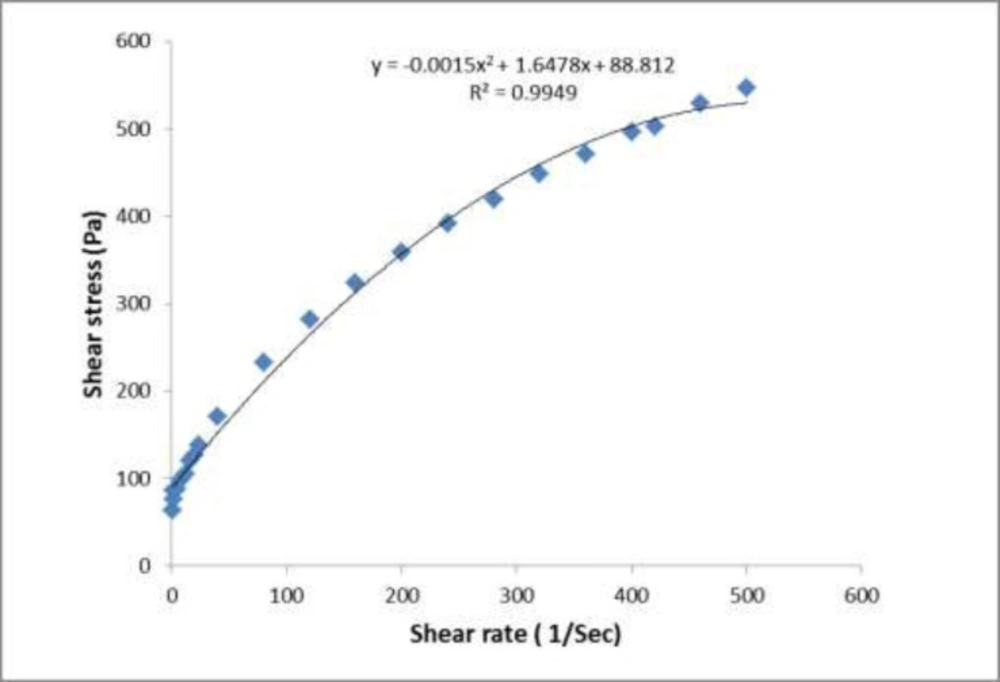
Figure 1
Rheogram of Poly Herbal Paste, (containing aloe, myrrh and frankincense), showing the presence of a plastic behavior. (n = 3, data points are presented as mean ± SD
The calculated viscosity and Bingham yield stress of PHP were 0.78 Pa.Sec and 183.06 Pa, respectively, obtained from the slope and y-intercept of the equation (y = 0.78x+ 183.06) corresponding to the linear part of PHP rheogram (Figure 2). Since the amount of Bingham yield value was greater than real yield value, the results were not reliable. So, the amount of real yield value should have been obtained.
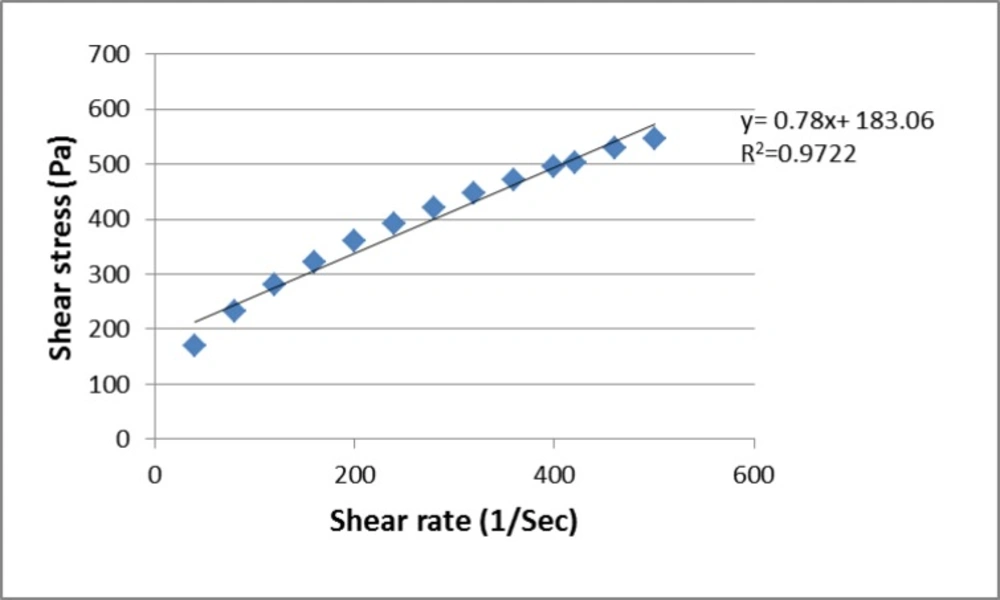
Figure 2
The linear part of Poly Herbal Paste, (containing: aloe, myrrh and frankincense), (n = 3, data points are presented as mean ± SD
In order to measure the real yield value of PHP, the log10 values of shear stress were plotted against the log10 values of shear rate (Figure 3). By calculating the antilog of y-intercept of the equation (y = 0.3456x+ 1.7497) corresponding to the linear plot, the real yield value was determined (73.5 Pa).
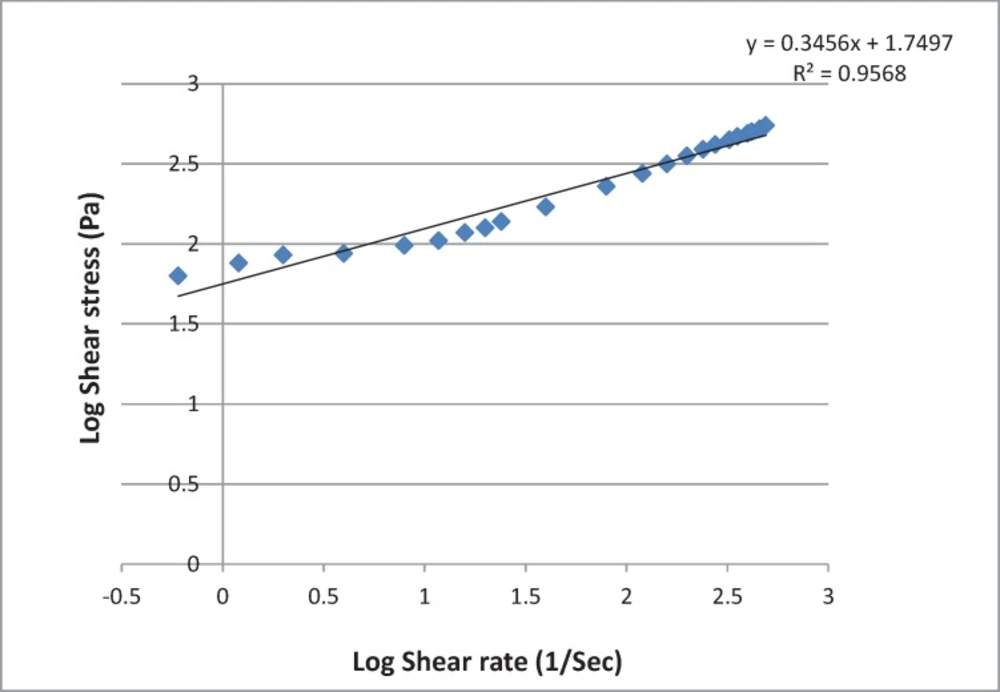
Figure 3.
The linear plot of log shear stress-log shear rate for Poly Herbal Paste, (containing aloe, myrrh and frankincense), (n = 3, data points are presented as mean ± SD
HPTLC fingerprinting of polyherbal paste
The fingerprint provided a means of a convenient identity check for the finished product. The HPTLC fingerprint can be used efficiently for the identification and quality assessment of the formulation (24). Also HPTLC study of the extracts and poly herbal formulation was carried out to ensure the correlation between them (25).
The detection of PHP contents with different polarities was performed by utilizing methanol fraction of the paste. For spotting the PHP fractions and standards, different volumes (10-100 µL) were tested. Finally, volume of 15 µL was chosen for B. carteri, A. vera and C. myrrha methanol extracts, while 10 µL was the best volume for PHP fractions. Among several investigated solvent systems, system І (toluene: ethyl acetate: heptan: formic acid 80:20:10:3) and ІІ (n-butanol: n-propanol: acetic acid: water 30:15:10:5) were found to be the most selective and repeatable systems for detecting low and high polar substances, respectively. Development of the plate was performed with systems І and ІІ in two stages which led to detection of less polar compounds in the upper half of the plate and medium and higher polar substances in the lower half. Sulfuric acid reagent was used and the plate heated at 105° C for 3- 5 min which appeared in different colored spots (under UV light at 366 nm). The HPTLC chromatograms of PHP and standards have been shown in (Figure 4). The peaks that existed both in the standards and PHP with reasonable heights and good resolution were assigned as "characteristic peaks" for identification of each plant extract in PHP. The chromatograms showed the characteristic peaks of the plant extracts with max Rf values of 0.22, 0.52 and 0.75 related to A. vera, B. carteri and C. myrrha extracts, respectively. The Rf of the spots were the same in repeated experiments. It was observed that the chromatogram of the formulation matched exactly with that of each plant extract as shown in Fig.4. Thus HPTLC studies confirmed that there was good correlation between extracts and PHP formulation.
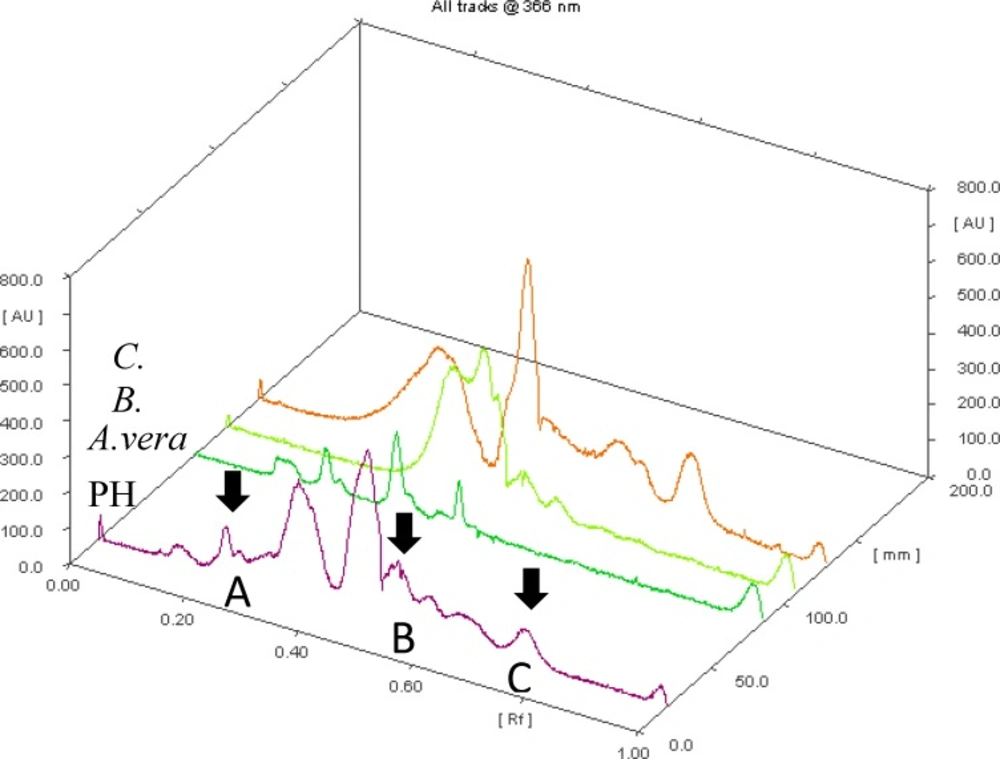
Figure 4
HPTLC fingerprint of Poly Herbal Paste including Aloe vera; Boswellia carteri; Commiphora myrrha; and the plant extracts. Arrows show the characteristic peaks of the plant extracts in PHP chromatogram (A: Aloe vera; B: Boswellia carteri; C: Commiphora myrrha)
Conclusion
In the current study, we prepared a poly herbal paste for wound healing, based on the Iranian Traditional Medicine (ITM). This formula has been made from the powders of Aloe vera gel, Boswellia carteri and Commiphora myrrha oleo gum resins which containing several polysaccharides, boswellic acid, sesqui- and triterpenoids compounds. Stability and rheological behavior evaluations as well as microbiological tests showed that the prepared formulation was stable with no growth of pathogenic microorganisms and suitable for topical application. HPTLC fingerprinting of PHP confirmed the presence of compounds corresponding to each of the plants used in the formulation. Moreover, characteristic peaks were observed in PHP profile, so HPTLC fingerprint could be used as an applicable method for quality control assessment of the prepared formulation. Regarding to the antioxidant, anti-inflammatory and antimicrobial effects of the mentioned plants (8, 10, 12-14 and 26-28), PHP could be an appropriate candidate for wound healing with respect to its traditional use in ITM.