Preliminary study
In order to find the suitable conditions for the chiral separation of carvedilol, a series of preliminary experiments were conducted at different pH and buffer compositions. In the preliminary analysis we used 25 mM phosphoric acid (pH = 2.1), 25 mM disodium hydrogenphosphate – 25 mM sodium didydrogenphosphate (pH = 7) and 25 mM sodium tetraborate (pH = 9.3) background electrolytes (BGEs) respectively and modified the buffer pH by adding a 0.1M sodium hydroxide solution.
In comparison with other commonly used
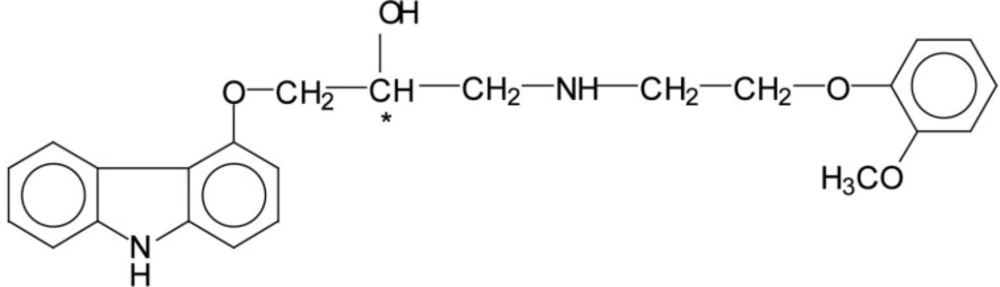
β-blockers (pK
a values around 9-9.5) carvedilol has a pK
a value of 7.97; the explanation of this discrepancy being attributed especially to the inductive effect of the
β-
O-atom, which lowers the basicity of the amino group (
12).
For a basic drug like carvedilol with a pKa > 7.0 its net charge at a pH between 2 and 5 is not significantly different, showing that analyte charge is insensitive to pH. It is, nevertheless, well known that the electroosmotic flow (EOF) is sensitive to pH in the range between 3.0 and 7.0; as it decreases considerably with decreasing pH. The migration time of carvedilol increased when the pH of the buffer increased from 2 to 5, and decreased as the pH was increased from 5 to 7.
The most suitable BGE proved to be a 25 mM phosphoric acid solution at a pH of 2.5; using this buffer we obtained well-shaped peak for carvedilol with a migration time of 6.8 minutes. At this low pH the effect of the EOF is minimal, and the analyte will migrate mostly through its own electrophoretic mobility.
Method optimization
Buffer ionic strength, pH, CD type and concentration, as well as applied voltage, temperature and injection parameters were optimized.
The first requirement for inclusion complexation is fitting the analyte into the CD cavity, thus selecting the appropriate CD is related to the shape and dimension of the analyte.
Several CDs (native and derivatized) were tested in order to obtain chiral resolution of carvedilol enantiomers. Initial concentration of 10 mM neutral CDs were added to the buffer solution, while for charged CDs we added a concentration of 5 mM in order to limit the increase of ionic strength which generated high currents and instability of the electrophoretic system.
No chiral separation only an increase of the migration time was observed when using α-CD and γ-CD. Clearly α-CD was not able to separate the carvedilol racemic mixture because its cavity is too small, β-CD allowed chiral resolution while γ-CD was not able to guest the studied analyte probaby because carvedilol molecule is too small. Stereoselective interactions of the two enatiomers were observed also in the case of β-CD derivatives, HP-β-CD and RAMEB; as substitution at the secondary hydroxyl rim on the surface of the CD can affect selectivity of the separation, as it will provide additional interaction points with the analyte.
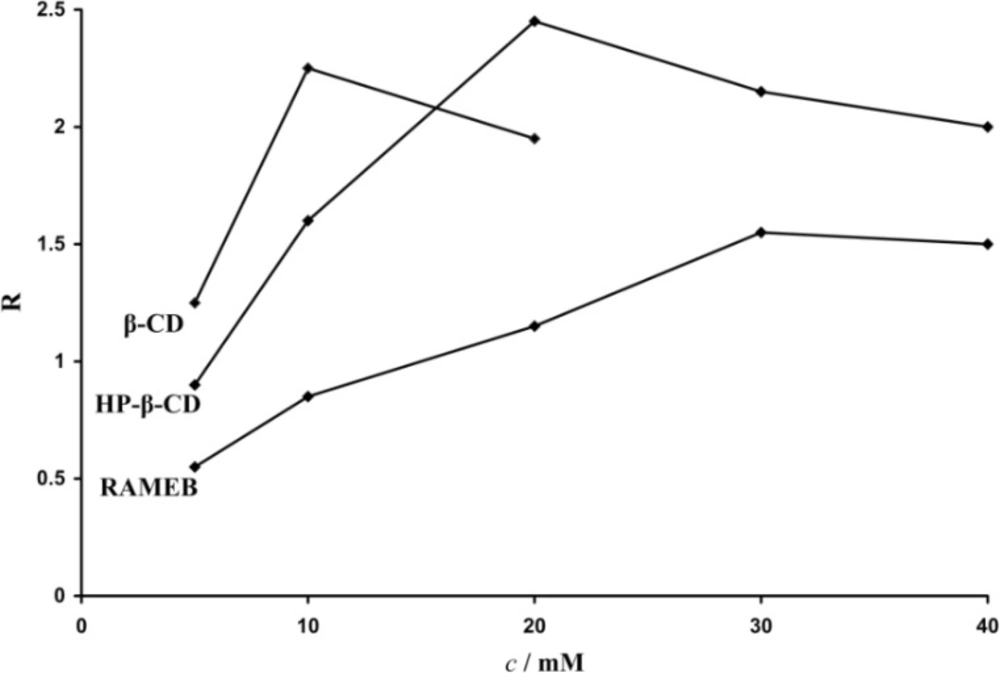
If complexation was observed but insuficient resolution was achieved, we increased the concentration of the chiral selector (5-40 mM) until satisfactory separation was obtained. When using
β-CD as chiral selector the maximum concentration was 20 mM, due to its poor solubility in aqueous solutions. Resolution of the enantiomers was calculated and the optimal concentration for the separation was determined.
Figure 2 shows the effect of chiral selector concentrations on the carvedilol enantiomers separation.
Effect of CD concentration on the chiral resolution (electrophoretic conditions: BGE 25 mM phosphoric acid, pH = 2.5, voltage + 20 kV, temperature 20 ˚C, hydrodinamic injection 50 mbar/3 s., UV detection 242 nm).
The CD concentration plays a very important role in the chiral resolution, and should be carefully controlled in order to find the optimal experimental conditions. The optimal concentration depends on the binding affinity of the two enantiomers with the chiral selector. The migration times increased with an increase in CDs concentration. This is due to longer residence time of the analyte in the complex form as well as to an increase in the viscosity of the buffer with a reduction of the mobility of the analytes.
An increase in the pH value of the BGE increased migration times but no direct correlation due to increase or decrease of the pH on the chiral resolution was obtained. At low pH values there is more time for the analyte to interact with the CD to result in increased time spent in the capillary; while at pH values above 5 where the effect of the EOF becomes more significant, the migration times of the analytes increased. Low operational pH was found to be essential for the resolution of carvedilol enantiomers. A buffer pH of 2.5 was elected for the separation.
The use of an ionized CD (SBE-
β-CD) resulted in long migration times (above 20 minutes) but only a small peak splitting and also a severe peak tailing was observed at a pH of 2.5. At this pH, SBE-
β-CD is negatively charged while carvedilol is positively charged, consequently SBE-
β-CD moves towards the anode while carvedilol towards the cathode (
13,
14).
The use of a dual CD system, which include a combination of a neutral and a charged CD (10 mM β-CD + 5 mM SBE-β-CD) led to an increase of migration times but only a small peak splitting has been observed.
But, using a phosphate buffer solution with a pH of 7 and 5 mM SBE-β-CD as chiral selector led to the baseline chiral separation of the two enantiomers and a very fast separation time (5 minutes), the two enantiomers migrating faster than the EOF. An increase in the SBE-β-CD concentration didn’t increase resolution of the separation.
The chemical composition and the concentration of the buffer can affect the baseline stability, peak shape and separation selectivity. The enantiomer separation using phosphoric acid as BGE was better than those compared with disodium hydrogenphosphate – sodium didydrogenphosphate and sodium tetraborate buffers. A slight increase in the migration time of the analyte was observed with increasing buffer concentration, but only little influence on the separation could be observed. Hence a 25 mM phosphoric acid buffer was elected for the enantioseparation.
Addition of an organic modifier such as methanol or acetonitrile to the phosphate buffer resulted in longer migration times but there was no significant improvement in the chiral separation.
Running voltage did not have a strong effect on the resolution; while a decrease in temperature led to extension in analysis time and to a slight increase of the chiral resolution. An optimal voltage of + 20 kV and a temperature of 15 0C was elected, in order to obtain an adequate resolution of the separation and a satisfactory analysis time.
A high injection pressure of 50 mbar and a fast injection time of 1 second provided a reasonable sample load and maintained resolution. The amount injected was enough to achieve a sufficient signal/noise ratio but not large enough to cause band broadening.
The electrophoretic mobility of carvedilol stereoisomers decreased with increasing capillary length because of the longer migration time to the detection window.
The migration order of the two enantiomers was determined by injecting a solution of the racemate enriched with the pure enantiomer separately. The first peak to pass the detector window was determined to be R(+) carvedilol followed by S(-) carvedilol.
Table 1 summarizes the experimental conditions (concentration and type of chiral selector, pH, voltage, temperature) and the results (migration times of the separated enantiomers, separation factor, resolution) obtained for the CDs that exhibited chiral interactions with carvedilol enantiomers.
| CD-derivative | pH | Voltage / kV | Temperature / 0C | t1 / min | t2 / min | Rm | | R |
|---|
| 10 mM β-CD | 2.5 | 20 | 15 | 11 | 11.5 | 1.69 | 1.04 | 2.74 |
| 20 mM HP-β-CD | 2.5 | 20 | 15 | 12.9 | 13.5 | 1.98 | 1.04 | 2.54 |
| 30 mM RAMEB | 2.5 | 20 | 15 | 15.4 | 15.9 | 2.32 | 1.03 | 1.98 |
| 5 mM SBE-β-CD | 2.5 | 20 | 15 | 21.2 | 21.6 | 3.17 | 1.03 | 0.83 |
Taking in consideration the aspects presented above we can conclude that the optimal electrophoretic conditions for the carvedilol enantioseparation are: BGE: 25 mM phosphoric acid chiral selector: 10 mM β-CD, buffer pH = 2.5, applied voltage: + 20 kV, temperature: 15 0C, injection pressure/time: 50 mbar/1 s, UV detection at 242 nm. Also HP-β-CD (20 mM) or RAMEB (30 mM) can be used successfully as chiral selectors in the enantioseparation of carvedilol, with good chiral resolutions but longer migration times.
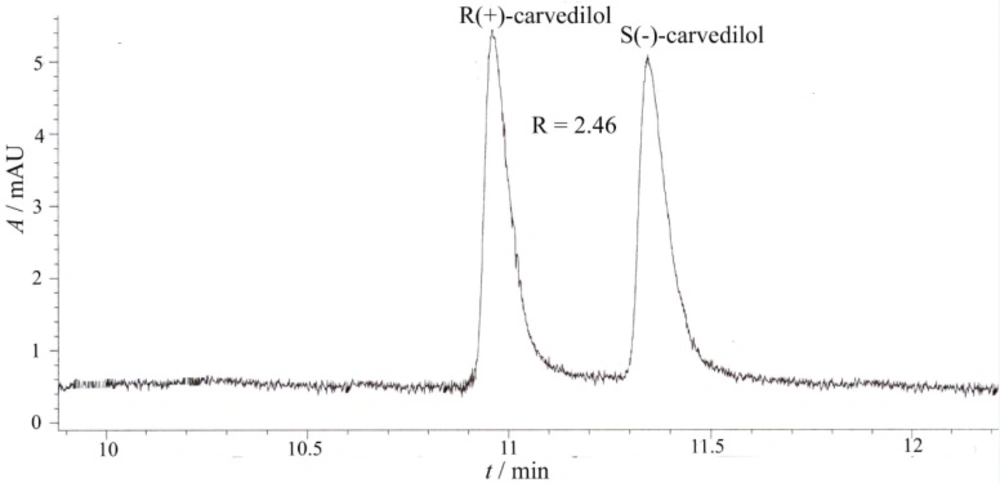
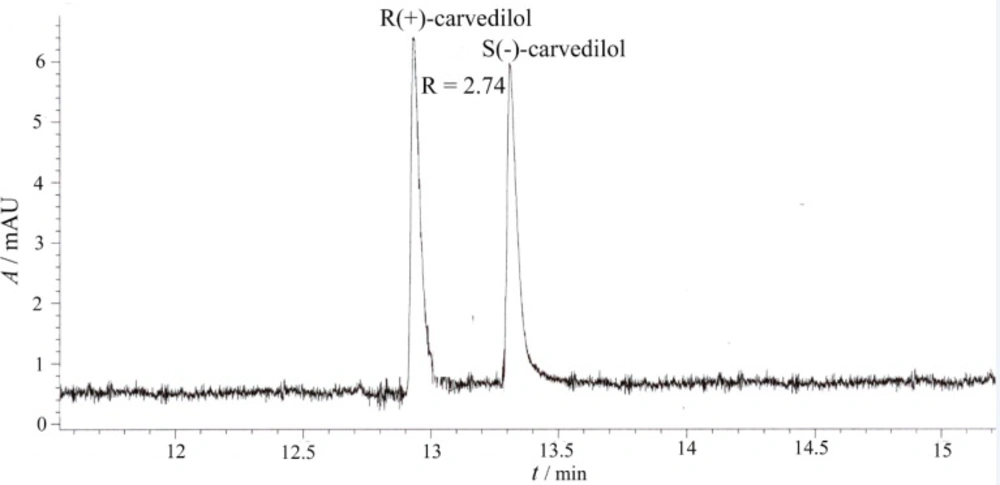
The electropherograms of the enantiosepartion using
β-CD and HP-β-CD as chiral selectors are presented in
Figure 3 and
Figure 4.
Capillary electrophoretic separation of carvedilol enantiomers using β-CD as chiral selector (experimental conditions: BGE 25 mM phosphoric acid, chiral selector 10 mM β-CD, pH = 2.5, voltage + 20 kV, temperature 15 0C, hydrodinamic injection 50 mbar/1 sec., sample concentration 10 μg/mL, UV detection 242 nm
Capillary electrophoretic separation of carvedilol enantiomers using HP-β-CD as chiral selector (experimental conditions: BGE 25 mM phosphoric acid, chiral selector 20 mM HP-β-CD, pH = 2.5, voltage + 20 kV, temperature 15 0C, hydrodinamic injection 50 mbar/1 sec., sample concentration 10 μg/mL, UV detection 242 nm)
Analytical parameters
The pure enantiomer of another β-blocker, S-propranolol was used as an internal standard (IS); its migration time being faster than the one of R(+)-carvedilol. Quantification was accomplished on the basis of carvedilol enantiomer to IS peak-area ratios (peak area of carvedilol enantiomer/peak area of IS).
Calibration plots were constructed by preparing standard solutions (n = 3) at six concentrations in a specific concentration range (concentration range: 2.5 - 50 µgmL
-1), and showed good linearity (
Table 2). High correlation coefficients were obtained and the intercepts of the plots were not significantly different from zero.
The limits of detection (LOD) and quantification (LOQ) were estimated as: standard deviation of regression equation/slope of the regression equation multiplied by 3.3 and 10, respectively (
Table 2).
| Enantiomer | Regression equation | Correlation coefficient | LOD/µgmL-1 | LOQ/µgmL-1 |
|---|
| R(+) carvedilol | y = 0.4625x + 0.8491 | 0.992 | 1.13 | 3.43 |
| S(-) carvedilol | y = 0.4465x + 0.8177 | 0.997 | 1.18 | 3.57 |
The precision of the method was determined by measurement of repeatability (intra-day) and intermediate precision (inter-day), expressed as RSD (relative standard deviation) % for a series of measurements.
Standard solutions of carvedilol and internal standard were prepared in methanol and injected on three consecutive days, six times a day (
Table 3).
| Enantiomer | Day 1 n=6 | Repeatabilityday 2 n=6RSD / % | Day 3 n=6 | Intermediateprecission n=6, k=3 |
|---|
| R(+) carvedilol | 1.14 | 1.68 | 1.96 | 1.98 |
| S(-) carvedilol | 1.18 | 1.88 | 2.04 | 2.02 |
A concentration of 10 µgmL-1 was used to evaluate precision as degree of repeatability by performing six replicate analyses and calculating the coefficient of variation, the RSD values were 1.35% for R(+) carvedilol and 1.36% for S(-) carvedilol, respectively; these results showing that the method is sufficiently precise.
±±