Introduction
Essential oils have long been used as flavoring agents and ingredients for several commercial products as well as folk medicine (1). These compounds are a complex mixture of chemicals with considerable activities.
The importance of essential oils is due to the increasing demand for food, cosmetics and pharmaceutical industries, so it is necessary to study yields, chemical profiles and biological activities of essential oils.
The genus Teucrium (Labiatae) includes about 300 species worldwide. This genus is distributed mainly throughout the Northern Hemisphere, in Central and South America, Southeast Asia, and the Mediterranean region (2, 3). T. persicum, an endemic plant in Iran, is distributed in Fars Province, around Lar Mountains (4). Natives named the plant marv e talkh and used it to treat headaches and abdominal pains such as colitis. In some communities, Teucrium has been used to treat diseases such as diabetes, obesity, hyperlipidemia, inflammation, and rheumatoid (5-7). The properties of this genus, such as antibacterial, antinociceptive, antioxidant, anticancer, tonic, and diaphoretic effects have been considered (2, 3, 5, 7-11). Many studies have been conducted to find an effective natural source of antioxidant compounds because of the complications from oxidative agents, such as autoimmune diseases, inflammation, cardiovascular disorders, arthritis, liver diseases, arthrosclerosis, cancer, and aging (7, 12).
In this context, several studies were carried out on the chemical composition and antioxidant properties of the essential oils of Teucrium species. Many of these oils showed effective antioxidant activity (4, 13-17). Hydrolats were used for their organoleptic, biological, and allelopathic properties in foods, cosmetics and agricultural products. Orange and rose aromatic water have been traditionally used in the Mediterranean region for skin care and the preparation of cakes and beverages (18). In Iranian folk medicine, the hydrolat which is called Arak0\æræq\ has been used in traditional medicine.
This study evaluates the chemical composition, antioxidant activity and yield of essential oils and Arak of T. persicum. As far as we know, this work is the first report on the chemical composition of Arak and the antioxidant activities of this species.
Experimental
Plant material
Aerial parts of the plant were collected in September 2009 at an altitude of 1,200 meters on Lar Mountain near Barak Village in Iran. Plants were dried in the shade at room temperature. A voucher specimen (No. 397) has been deposited at the Central Herbarium of Medicinal Plants (ACECR) in Iran.
Essential oil isolation
The air-dried aerial parts of the plant were subjected to steam distillation for 3 h using a Clevenger apparatus. The oil was dried in anhydrous sodium sulphate and stored at 4°C in tightly-closed dark container.
Aromatic water extraction procedure
Herbal Water (aromatic water) which is called Arak in some countries such as Iran, Afghanistan, and Arabic countries is steam distilled from Plants. Arak contains the essential oil of the plant in a natural water base.
Aromatic water, come out from Clevenger apparatus, was decanted three times with diethyl ether and then the diethyl ether was evaporated at room temperature. It was dried by anhydrous sodium sulphate and stored at 4°C until GC/MS analyses process.
Gas chromatography-mass spectrometry analysis
GC–MS analyses were performed using a Hewlett-Packard 5973–6890 system operating in EI mode (70 ev) equipped with a HP-5MS column (30 m × 0.25 mm, film thickness of 0.25 μm) and a split injector (290°C). The split ratio was 1:10. The column temperature program was 50°C (5 min) to 240°C at a rate of 3°C/min. The injection volume was one µL and the detector temperature was 290°C. The flow rate of helium as a carrier gas was 0.8 mL/min.
The identification of the constituents of the oils was performed through the comparison of their retention indices with the NIST database and literature data, as well as using the comparison of their mass spectra with the Wiley7n.l Mass spectral database and those described by Adams (19, 20).
Quantitative data was calculated using electronic integration from the FID area data without the use of correction factors.
Antioxidant activity
Antioxidant power was measured through three in-vitro methods including: 2, 2-Diphenyl-1-picrylhydrazyl (DPPH) assay; ferric reducing antioxidant power (FRAP); and reducing power (RP).
DPPH assay
The DPPH antioxidant assay is based on the spectrophotometric method according to Tofighi etal. (2009). In this test, the sample was reacted in dark at the room temperature for 30 min, with a certain concentration of methanolic DPPH. The difference in the absorbance between the initial purple-colored stable radical DPPH and the terminal yellow-colored DPPHH, at 517 nm, was determined to be antioxidant activity.
The scavenging percentage of the DPPH radical was calculated through the following formula (21-23): DPPH scavenging activity (%) = 100 × (1- (Abs sample/Abs initial DPPH)). IC50 (concentration of samples providing 50% scavenging) were calculated from the curve scavenging percentage against the oil concentration. The lower IC50 value means a higher antioxidant power. Butyl hydroxyanisol (BHA) and α-tocopherol were used as controls.
Ferric reducing antioxidant power assay (FRAP)
The FRAP assay is based on the ability of a sample to reduce Fe3+ in a Tripyridyltriazine (TPTZ) solution to Fe2+ and create the blue-colored complex Fe2+ – TPTZ.
Increased concentrations of the above complex means an increased FRAP value. The ability of the reducing power of the test sample was determined by using a spectrophotometer at 593 nm. This assay was done according to Benzie and Strain (1996) (24, 25).
Reducing power assay
The reducing power of the oils was measured according to the method used by Hinneburg et al. (2006). This method is based on the abilities of a sample to reduce ferricyanide to ferrocyanide and produce a Prussian blue-colored complex (Fe3+)4[Fe2+ (CN-) 6]3 that is detectable. Its absorbance was measured at 700 nm. Increased absorbance of the reaction mixture interprets as an increase in reducing the power of sample. BHA was the control (22, 26, 27).
Total phenolic content (TPC)
The TPC of oils was determined according to the method using by Ghafar et al. (2010). This method is set up for the oxidation of phenolics using a molybdotungstate in a Folin-Ciocalteu reagent yielding a green-colored product with λmax 745-750 nm. This assay lacks specifics for phenols and its reagents may react with disturbed compounds such as sugars, organic acids and aromatic amines and therefore, providing a concentration higher than real TPC (28). The recommended method for the determination of TPC is based on the spectrophotometric method (22, 28). Gallic acid was used as the standard for the calibration curve (20-200 mg/L, y = 0.003 x - 0.027, R2 = 0.991). TPC was expressed as mg Gallic acid equivalents (GAE) per g of DW.
Statistical analysis
Data was expressed as mean ± SD and all tests were repeated three times. Statistical analyses such as plots, student’s t-test, and p-value were done using Excel 2007.
Results and Discussion
Productivity and physical properties
All oils of the aerial part of T. persicum were fragrant and yellow, but the essential oil (EO) was more fragrant and Arak (AR) was dark yellow.
The values of densities for EO and AR were 0.97 g cm-3 and 1.09 g cm-3, respectively. No previous studies were reported in this parameter with which a comparison could be made with the results of our present analysis.
The amount of essential oil isolated from the aerial parts of T. persicum through the steam distillation was 1.00 g/100 g dry-weight plant (DW) and the productivity of AR was 0.55 g/100 g DW.
Although there are no reports about the productivity of the Arak of T. persicum, previous studies have shown that Teucriums are generally rich in essential oils, for example, the oil yields of T. montanum and T. marum were calculated as 0.47% DW and 0.59% (v/w), respectively (29, 30) and the productivity of T. ramosissimum Desf. was 0.14% (w/w) (8).
Table1
The composition of the essential oils (EO) and Arak (AR) of the aerial parts of Teucrium persicum.
| Compounds | RI | Composition% | |
|---|---|---|---|
| AR | EO | ||
| α-Thujene | 922 | - | 0.1 |
| α-Pinene | 928 | - | 0.3 |
| Octane,4-ethyl- | 951 | 0.2 | - |
| Nonane,5-methyl- | 956 | 0.3 | - |
| Nonane,3-methyl- | 968 | 0.3 | - |
| Sabinene | 969 | - | 0.1 |
| β-Pinene | 971 | - | 0.4 |
| β-Myrcene | 990 | 0.2 | 1.6 |
| Herboxide | 1005 | 0.1 | 0.2 |
| α-Terpinene | 1013 | 0.1 | 0.1 |
| ρ-Cymene | 1023 | T | 0.2 |
| 1,8-Cineole | 1032 | 4.1 | 5.7 |
| β-Ocimene | 1037 | - | 0.3 |
| Ocimene | 1048 | 0.1 | 0.5 |
| γ-Terpenine | 1056 | - | 0.1 |
| Linalool oxide | 1073 | 3.5 | 1.2 |
| α-Terpinolene | 1086 | 0.1 | 0.3 |
| Linalool | 1109 | 10.4 | 7.6 |
| Oct-1-en-3-yl acetate | 1112 | 0.7 | 0.6 |
| 2-Menthenol | 1123 | 0.1 | 0.1 |
| 1,3,8-p-Menthatriene | 1130 | t | 0.2 |
| Sabinol | 1136 | 0.1 | 0.1 |
| trans-Pinocarveol | 1139 | 0.1 | t |
| Nerol oxide | 1156 | 0.4 | 0.4 |
| Borneol | 1169 | 0.8 | 0.6 |
| Terpinene-4-ol | 1178 | 0.5 | 0.3 |
| γ-Terpineol | 1198 | 7.3 | 4.4 |
| Myrtenol | 1200 | - | 0.1 |
| 3,7-Octadiene-2,6-diol,2,6-dimetyl- | 1207 | 0.1 | - |
| 3,5,7-Octatriene-2-ol,2,6-dimetyl- | 1213 | - | 0.1 |
| trans-Carveol | 1215 | 0.3 | 0.2 |
| cis-Carveol | 1225 | 0.3 | 0.4 |
| 2-Oxabicyclo[2.2.2]octan-6-ol, 1,3,3-trimethyl- | 1228 | 0.1 | - |
| Nerol | 1235 | 0.7 | 0.6 |
| Linalyl acetate | 1262 | 5.6 | 7.7 |
| Caprinic alcohol | 1278 | 0.4 | 0.6 |
| Carvacrol | 1326 | t | 0.3 |
| γ-Elemene | 1337 | 0.5 | 0.9 |
| Piperitenone | 1345 | - | 0.1 |
| α-Terpinyl acetate | 1356 | 6.7 | 7.9 |
| Carvyl acetate | 1367 | 0.9 | 1.1 |
| α-Copaene | 1377 | - | 0.1 |
| Geranyl acetate | 1388 | 4.6 | 2.4 |
| β-Elemene | 1393 | 0.4 | - |
| α-Elemene | 1394 | 0.2 | 1.2 |
| α-Gurjunene | 1409 | 0.3 | 0.5 |
| β-Caryophyllene | 1420 | 0.2 | 0.5 |
| Aromadendrene | 1442 | 1.0 | 1.4 |
| 4(14),5-Muuroladiene | 1447 | t | 0.2 |
| α-Humulene | 1453 | t | 0.2 |
| γ-Gurjunene (5,11-Guaiadiene) | 1459 | 0.3 | 0.6 |
| Dodecyl alcohol | 1473 | 0.3 | - |
| Cadina-1(6),4-diene | 1473 | - | 0.2 |
| Germacrene-D | 1481 | 0.2 | 0.7 |
| β-Selinene | 1487 | 0.3 | 0.7 |
| δ-Cadinene | 1492 | 0.2 | 0.3 |
| Bcyclogermacrene | 1499 | 1.2 | 2.3 |
| α-Murrolene | 1502 | 0.8 | 1.1 |
| γ- Cadinene | 1517 | 0.6 | 1.2 |
| Phenol, 2,4-bis(1,1-dimethylethyl)- | 1519 | 0.5 | 0.4 |
| 1,4-Cadinadiene | 1532 | 6.5 | 9.2 |
| α-Cadinene | 1535 | 7.5 | 9.7 |
| Cadina-1(2),4-diene | 1537 | - | 0.3 |
| Calamenene | 1541 | 0.1 | 0.2 |
| α-Calacorene | 1545 | 0.2 | 0.1 |
| Palustrol | 1570 | - | 0.1 |
| Viridiflorol | 1592 | 0.3 | 0.4 |
| Caryophyllene oxide | 1595 | - | 0.1 |
| Ledol | 1607 | t | 0.2 |
| β-Oplopenone | 1611 | t | 0.1 |
| 1,10-di-epi-Cubenol | 1619 | t | 0.2 |
| γ-Eudesmol | 1623 | 0.5 | 0.7 |
| α-Cadinol | 1650 | 4.4 | 2.9 |
| β-Eudesmol | 1661 | 1.7 | 2.1 |
| Cadinol | 1669 | 6.3 | 6.2 |
| Buchariol | 1683 | - | t |
| α-Bisabolol | 1684 | 0.2 | 0.3 |
| Acorenone B | 1703 | 2.1 | 2.5 |
| Aromadendrene oxide | 1748 | - | 0.1 |
| Spathulenol | 1784 | 1.8 | 0.3 |
| Hexadecanol | 1882 | - | 0.2 |
| Phytol | 1951 | t | 0.1 |
| Manoyl oxide | 2011 | t | 0.2 |
| Octadecanal | 2038 | t | t |
| Geranyl 3-phenylpropanoate | 2135 | t | t |
| Geranyl linalool | 2192 | t | t |
| Grouped compounds: | |||
| Monoterpene hydrocarbons | 1.2 | 3.9 | |
| Oxygen-containing monoterpenes | 48.4 | 42.9 | |
| Sesquiterpene hydrocarbons | 20.4 | 31.8 | |
| Oxygen-containing sesquiterpenes | 17.2 | 16.2 | |
| Miscellaneous | 0.7 | 0.9 | |
| Total identified compounds | 88.5 | 95.8 | |
Chemical composition of essential oil and Arak
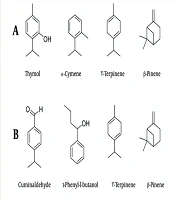
In total, 88 components were identified in the essential oil and Arak of T. persicum. Most of these compounds have already been reported in the essential oils of Teucrium species (6, 29, 31-36). Table 1 shows the components, retention indices and percentage of composition. They are listed in the order of their elution from a HP-5MS column. Seventy-nine compounds were identified in EO representing 95.8% of total oils. As shown in Table 1, the principal components of EO were α-cadinene (9.7%), 1,4-cadinadiene (9.2%), α-terpinyl acetate (7.9%), linalyl acetate (7.7%), and linalool (7.4%). The major parts of EO were sesquiterpenes (48.0%). In this fraction, sesquiterpene hydrocarbons (31.8%) were prevailing. Monoterpenes determined 46.9% of the oil, with a prevalence of oxygen-containing monoterpenes (43.0%).
In AR, 70 compounds were identified as representing 88.54% of the oil. The major constituents in the AR were determined to be linalool (10.4%), α-cadinene (7.5%), γ-terpineol (7.3%), α-terpinyl acetate (6.6%), 1,4-cadinadiene (6.5%), cadinol (6.3%), and linalyl acetate (5.6%). Monoterpenes formed the most abundant portion of AR (49.6%), with a predominance of oxygen-monoterpenes (48.4%), while monoterpene hydrocarbon was only 1.1%. Overall, 37.6% of the oil consisted of sesquiterpenes, of which oxygen-containing sesquiterpenes were 17.2%.
As shown in Table 1, most compounds identified from different oils were almost the same, but the amounts of corresponding components were different. According to data, the main groups of component in the EO are cadinane-sesquiterpenes, especially α-cadinene and 1, 4-cadinadiene, but in AR, the major constituents are acyclic monoterpenes, mainly linalool.
So far, more than 200 cadinane-type sesquiterpenes are known. They show various biological activities, such as wood preservative, fungicide, anti-malaria and anti-HIV (36, 37, 40). In all oils, there are small amounts of diterpenoids such as geranyl linalool, manoyl oxide, and phytol. Hydrolat volatile compositions have been the subject of limited research and there are no earlier studies about the chemical components of Arak with which to compare our results. The major components in hydrolat usually had the same corresponding essential oil ingredients (18).
When the chemical profile of the essential oil was compared with earlier studies, the results were somewhat different. Masoudi et al. (2009) identified 31 constituents corresponding to 95.9% of the total in the oil and also reported epi-α-cadinol (23.2%) as the major component (37). In addition, Javidnia et al. (2007) reported 81 compounds, representing 93.5% of the total oil, and the major compounds were caryophyllene oxide (10.6%), α-pinene (9.4%), geranyl linalool (7.8%), γ-cadinene (7.4%), elemol (6.9%), and α-cadinol (5.5%).
Differences in oil compounds may be influenced with geographical differences, time of plant harvesting and preparation process (4, 30, 37).
In contrast to our study, earlier investigations indicated that sesquiterpenes were the major compounds in the essential oil of Teucriums. For example, 57 components were recognized in the oil of T. alopecurus and predominant compounds were sesquiterpene hydrocarbons (61.3%) and oxygenated sesquiterpenes (26.9%) (8). Vukovic et al. (2007) studied the essential oil of T. montanum and recognized 45 compounds, representing 97.95% of the total; the main constituents of the oil were mono and sesquiterpenes hydrocarbons (30). Saroglou et al. (2007) studied the oil of T. royleanum and reported that the sesquiterpene hydrocarbons formed the main part (42.2%) of the oil (32), but in T. persicum, the prevailing compounds were oxygenated monoterpenes (45.7% ± 3.8%) followed by sesquiterpene hydrocarbons (26.1% ± 8.08%).
In the phytochemical investigation of T. persicum, buchariol, a sesquiterpenoid guaiane skeleton type (4,10-epoxy-6 α-hydroxyguaiane), was obtained. Its structure was elucidated with the help of Mass, IR and NMR spectroscopy including 1D and 2D experiments. It was confirmed to compare with articles (38, 39).
The obtained mass spectrum was compared to GC/MS chromatogram. The relevant peak was found as trace. To the best of our knowledge, this is the first time that this compound is introduced in the essential oil.
Its Kovats index was 1683, in HP-5MS column and the above mentioned temperature program. The mass fragmentation (EIMS) was: m/z 238.4 (8.3%), 221.4 (5.6%), 203 (6.7%), 195 (7.4%), 43 (100%).
Total phenolic content
Phenolic components are one of the secondary metabolites in plants that, due to their redox properties, are considered as the antioxidants (22, 28). As shown in Table 2, The EO revealed a higher content of total phenolics than the AR (1.71 ± 0.12 mg GAE/g DW and 1.36 ± 0.11 mg GAE/g DW, respectively). The phenolic content of the samples that we analyzed is less than the values found for polar and non-polar extracts of T. chamaedrys (97.12 ± 1.28 and 69.75 ± 2.62 μg GAE/mg, respectively). However, EO and AR showed relatively lower levels of phenolic content compared with T. arduini flowers (30.49 ± 1.00 mg GAE/g DW) and leaves (23.39 ± 3.60 mg GAE/g DW) (2, 40).
Antioxidant activity
Ferric reducing antioxidant power assay (FRAP assay)
The reducing power of the oils of T. persicum measured under the FRAP assay and an aqueous solution of ferrous sulphate (50-500 µmol/mL, y = 0.002x - 0.025, R² = 0.993) was used as a calibration curve. The results were expressed as µmol Fe2+ equivalent per g of dry-weight plant (DW). In Table 2, the FRAP value points to a considerably higher reducing power of EO (220 ± 7.2 µmol Fe2+/g DW) compared with that of AR (113 ± 5.4 µmol Fe2+/g DW). The results of our study compared with the work of Šamec et al. (2010) indicate that the reducing powers of EO and AR are greater than the reducing power of the average FRAP value for the leaf (75.81 ± 34.99 µmol Fe2+/g DW) and flower (97.65 ± 54.38 µmol Fe2+/g DW) infusions of T. arduini (2). The results are compatible with those of TPC.
DPPH radical scavenging activity
In the DPPH assay, the radical scavenging activity of the samples was compared to BHA and α-tocopherol as the standards. EO exhibited higher radical scavenging potential (IC50= 0.29 mg/mL) than AR (IC50= 4.19 mg/mL). These samples were less effective than BHA (IC50= 0.016 mg/mL) and α-tocopherol (IC50=0.015 mg/mL).
Kadifkova Panovsk et al. (2005) reported that the extract of T. polium, T. chamaedrys and T. montanum possessed DPPH radical scavenging activities with IC50 of 10, 11, and 10 mg/mL, respectively. They compared these results to the standard components, silymarin, quercetin, and luteolin, with IC50: 1.96, 0.06, and 0.08 mg/mL, respectively , and found the Teucrium extracts to be less effective than standards (41).
These results show that Teucrium is a good antioxidant agent, but the oils of T. persicum are more effective than the extracts of T. polium, T. chamaedrys, and T. montanum. The present assay confirms the values obtained from TPC and FRAP.
Table 2
Antioxidant activity and Total phenolic content (TPC) of essential oil (EO) and Arak (AR) of aerial part of Teucrium persicum
| TPC | RP assay*** | FRAP assay** | DPPH assay* | |
|---|---|---|---|---|
| 1.36 ± 0.11 | 34.1 ± 2.7 | 113 ± 5.4 | 4.19 | AR |
| 1.71 ± 0.12 | 51.7 ± 4.3 | 220 ± 7.2 | 0.29 | EO |
Reducing power
BHA was used as the standard calibration curve (5- 60 µg/mL, y = 0.006x + 0.058, R² = 0.997). The reducing power of EO (51.7 ± 4.3 µg BHA/g DW) was higher than that of AR (34.1 ± 2.7 µg BHA/g DW). The results of FRAP, DPPH, and TPC are compatible with the reducing power values.
Finally, the results show that the oils analyzed in our study revealed good antioxidant activity and high yields, so they could be suggested for use as natural antioxidants in food and cosmetic products.