


1. Background
2. Objectives
3. Methods
3.1. Chemicals and Reagents
3.2. Apparatus
3.3. Blank and Real Honey Samples
3.4. Standard Solutions Preparation
3.5. Sample Preparation
3.6. Multi-array Biochip System
3.7. Processing of the Data
3.8. Validation Procedure
| Compounds | MRPL (EU) (ppb) | Calibration Range (ppb) Regarding Dilution Factor = 2 | Chosen Spike Level (ppb) |
|---|---|---|---|
| AOZ | 1 | 0 - 8.6 | 0.5 |
| AMOZ | 1 | 0 - 12.2 | 0.5 |
| ADH | 1 | 0 - 9.4 | 0.5 |
| SEC | 1 | 0 - 22.0 | 0.9 |
Abbreviations: EU, European Union; AOZ, 3-amino-2-oxazolidone, AMOZ, 3-amino-5-morpholinomethyl-2-oxazolidinone; ADH, 1-aminohydantoin hydrochloride; SEC, semicarbazide.
3.9. Practicability
3.10. Applicability
3.11. Stability
3.12. Application of This Method on Real Samples
4. Results
4.1. Detection Capabilities
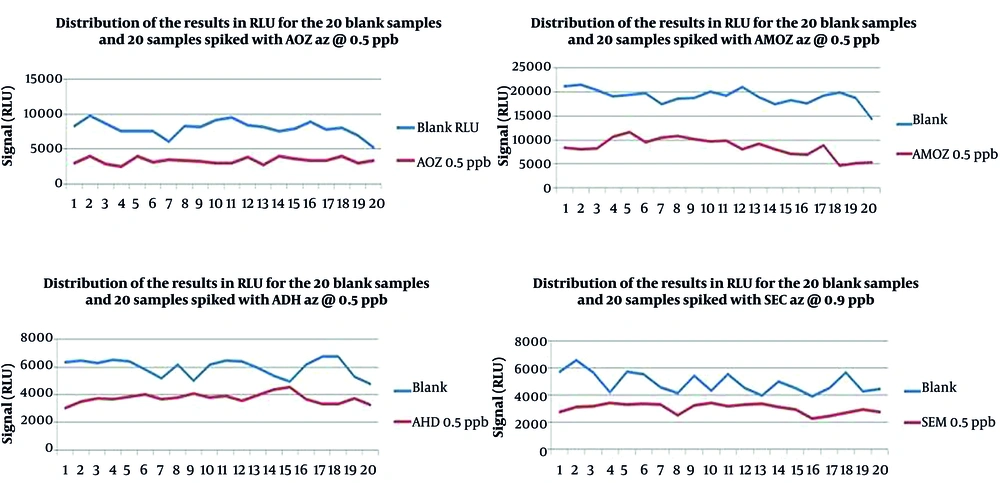
Distribution of RLU results in 20 blank and 20 spiked samples for four nitrofuran metabolites.
| Parameters | AOZ | AMOZ | ADH | SEC |
|---|---|---|---|---|
| Concentration (ppb) | 0.5 | 0.5 | 0.5 | 0.9 |
| T value (RLU) | 6202.45 | 17359.41 | 4930.10 | 3676.25 |
| Fm value (RLU) | 4045.95 | 11726.47 | 4357.74 | 3593.63 |
| T > Fm | Yes | Yes | Yes | Yes |
| Number of FP | 0 | 0 | 0 | 0 |
| FP rate % | 0 | 0 | 0 | 0 |
| Number of FN | 0 | 0 | 2 | 0 |
| FN rate % | 0 | 0 | 10 | 0 |
Abbreviations: RLU, relative light unit; AOZ, 3-amino-2-oxazolidone; AMOZ, 3-amino-5-morpholinomethyl-2-oxazolidinone; ADH, 1-aminohydantoin hydrochloride; SEC, semicarbazide; FN, false-negative; FP, false-positive.
| Parameters | AOZ | AMOZ | ADH | SEC |
|---|---|---|---|---|
| LOD (ppb) (as per manufacturer) | 0.30 | 0.08 | 0.30 | 0.50 |
| Spike level used for validation (ppb) | 0.5 | 0.5 | 0.5 | 0.9 |
| CCβ (ppb) | 0.5 | 0.5 | 0.5 | 0.9 |
Abbreviations: AOZ, 3-amino-2-oxazolidone; AMOZ, 3-amino-5-morpholinomethyl-2-oxazolidinone; ADH, 1-aminohydantoin hydrochloride; SEC, semicarbazide; LOD, limit of detection.
4.2. Practicability
4.3. Specificity and False-Positive Rate
| Parameters | AOZ | AMOZ | ADH | SEC |
|---|---|---|---|---|
| T (n = 20) | 6202.45 | 17359.41 | 4930.10 | 3676.25 |
| Cut off = T (n = 20) | ||||
| False-positive | 2 | 1 | 1 | 0 |
| False-negative | 0 | 0 | 0 | 0 |
| Fm (n = 20) | 4045.953 | 11726.47 | 4357.742 | 3593.635 |
| Cut off = Fm (n = 20) | ||||
| False-positive | 0 | 0 | 0 | 0 |
| False-negative | 0 | 0 | 2 | 0 |
Abbreviations: RLU, relative light unit; AOZ, 3-amino-2-oxazolidone; AMOZ, 3-amino-5-morpholinomethyl-2-oxazolidinone; ADH, 1-aminohydantoin hydrochloride; SEC, semicarbazide.
4.4. Applicability
4.5. Stability of Antibiotic Residues
4.6. Screening of Real Honey Samples
| Parameters | AOZ | AMOZ | SEC |
|---|---|---|---|
| Number of samples | 35 | 35 | 35 |
| Cut-off (RLU) | 4045.953 | 11726.47 | 3593.635 |
| Number of presumptive positive samples | 3 | 2 | 13 |
| % Presumptive Positive sample | 8.57 | 5.71 | 37.14 |
Abbreviations: AOZ; 3-amino-2-oxazolidone; AMOZ, 3-amino-5-morpholinomethyl-2-oxazolidinone; SEC, semicarbazide.
| Parameters | AOZ | AMOZ | SEC |
|---|---|---|---|
| Number of samples | 15 | 15 | 15 |
| Cut-off (RLU) | 4045.953 | 11726.47 | 3593.635 |
| Number of presumptive positive samples | 1 | 2 | 5 |
| % Presumptive Positive sample | 6.66 | 13.33 | 33.33 |
Abbreviations: AOZ, 3-amino-2-oxazolidone; AMOZ, 3-amino-5-morpholinomethyl-2-oxazolidinone; SEC, semicarbazide.
| Parameters | AOZ | AMOZ | SEC |
|---|---|---|---|
| Number of samples | 20 | 20 | 20 |
| Cut-off (RLU) | 4045.953 | 11726.47 | 3593.635 |
| Number of presumptive positive samples | 2 | 0 | 8 |
| % Presumptive positive sample | 10 | 0 | 40.00 |
Abbreviations: AOZ, 3-amino-2-oxazolidone; AMOZ, 3-amino-5-morpholinomethyl-2-oxazolidinone; SEC, semicarbazide.
5. Discussion
| Principle of the Test (Type of Reaction) | LOD of AOZ (ppb) | LOD of AMOZ (ppb) | LOD of ADH (ppb) | LOD of SEC (ppb) | Number of Tested Antibiotic Residues | Time per Analysis (h) | References |
|---|---|---|---|---|---|---|---|
| Biochip-based immunoassays (biochip array technology) | 0.3 | 0.08 | 0.3 | 0.5 | 4 | Approx.2.5 h | As per manufacturer |
| High-throughput suspension array technology | 0.031 | 0.087 | 0.131 | 0.055 | 4 | Approx. 9 h | (17) |
| Visualized microarray sensing technique | 0.04 | 0.1 | 0.1 | 0.04 | 4 | Approx.6.5 h | (18) |
| Single liquid-liquid extraction LC-MS/MS | 0.097 | 0.062 | 0.059 | 0.060 | 6 | Approx.17 h | (19) |
| Multispot nanoarray for antibiotic screening | 0.26 | 0.09 | 6.9 | 45.8 | 5 | Approx.1.5 h | (20) |
| LC-MS/MS assay | 0.06 | 0.04 | 0.06 | 0.08 | 4 | Approx.18 h | (21) |
| LC-MS/MS assay | 0.2 | 0.15 | 0.6 | 0.2 | 4 | Approx.17 h | (22) |


