
1. Background
Human poisoning involves a wide spectrum of pathophysiological processes related to the interaction between a chemical/biological agent and the body (1). According to the World Health Organization (WHO), poisoning is a serious public health concern worldwide (2). Annually, over one million children die globally due to preventable incidents such as traffic accidents, burns, drowning, and poisoning, with poisoning accounting for 15% of all deaths (3). According to WHO statistics, in 2012, 350,000 people died of poisoning, 45,000 of whom were younger than 20 years. This rate was 0.5 per 100,000 population in developed countries and 2 per 100,000 in developing countries (4).
Clinically, poisoning can be acute, sub-acute, chronic, or sub chronic (5). Meanwhile, acute poisoning is the most common type in the emergency departments worldwide and is classified into unintentional or intentional categories (6). According to the National Health Commission of China, poisoning and injuries are the top five causes of mortality in this country, accounting for 10.7% of all deaths (7). Based on statistics, over 100,000 people with acute poisoning visit the emergency departments of the UK annually (8). The Toxbase database in this country reports that drugs are the most common cause of acute poisoning, with antidepressants, hypnotics, antipsychotics, and analgesics bring among the most commonly used drugs (9).
Acute drug poisoning is the second leading cause of mortality caused by human poisoning. Years of potential life lost due to drug poisoning also inflict serious socioeconomic damages to the public (10). Drug poisoning seriously impacts the rate of morbidity and mortality and is the leading cause of poisoning in Brazil (11). According to some studies, the mortality rate due to drug poisoning in the US is on the rise (12, 13). Drug poisoning due to drug abuse and overdose is prevalent not only in the US but also in many parts of the world, including Europe, South Africa, and South Asia (14). Epidemiological data have demonstrated that the risk of drug poisoning due to improper use of drugs is extremely high, which has raised public health concerns (15).
Due to the increasing availability of drugs, especially over-the-counter (OTC) ones, drugs have become the most common cause of poisoning, with drug poisoning being the second leading cause of mortality in Iran (16). Although drug poisoning in Iran can pose risks at all ages, these risks can be more pronounced in children and the elderly (17). Intentional drug poisoning, such as self-poisoning or suicide, is also observed in adolescence and youth (18). Due to the high incidence of drug poisoning and its irreversible side effects, it is essential to take management measures in the form of registries (19). As an efficient system for information management, registers play a key role in solving health-related problems (20).
Registers are supportive information systems that are critical to organizing patient data, providing regular care, and tracking patient health outcomes (21). These systems help provide better healthcare services to patients, assist managers in decision-making and planning, and facilitate health research (22). Various studies worldwide have emphasized the effective role of registry systems in alleviating and preventing poisoning (23, 24).
Poisoning information systems and registries have a special place in developed countries for the prevention, treatment, and follow-up of patients. They have also become newly emerging tools for the management and support of healthcare data in developing countries.
For instance, the NPDS registry was developed in 1983 in the US. Its main objective was to manage toxicity cases, accurately gather data, and respond to the ongoing needs of public as well as professional education about toxicity. This registry uses a standard dataset to gather and report poisoning cases (25, 26).
Another US registry is the Toxicology Investigators Consortium (ToxIC), which is a unique database. In this registry, the information is entirely inputted by medical toxicologists, which indicates the best professional judgment of specialist physicians (27). The TOXBASE database for poisoning case management is available in the UK (28), and there is a Web-based system called DATATOX in Brazil. In South Korea, a Web-based poisoning database (poisoning information database (PIDB) has been developed to provide emergency therapeutic information about poisoned patients (29). Moreover, for the prevention and clinical management of poisoning cases, the World Health Organization has provided international guidelines titled IPCS INTOX (30).
A national drug poisoning registry system is a suitable means for better management, evaluation of patients' characteristics and risk factors, awareness of the extent of the problem plus the variations of the disease over time, and decision-making on control and prevention (31). Thu, designing and developing a national drug poisoning registry system in an integrated and efficient manner seems necessary.
2. Objectives
The researchers aimed to design a national drug poisoning registry model for Iran based on the experiences of developed countries in addressing this problem.
3. Methods
This was an applied descriptive study conducted in Iran in 2020 in two phases.
3.1. The First Phase: A Review of the Literature and Development of the Proposed Model
In this phase, the relevant studies were reviewed through a systematic study (32) and a scoping review (33) to identify registries and their mechanism of activity in pioneering countries to establish a drug poisoning registry. The content of this phase of the study was then analyzed considering the aim of the study.
3.2. The Second Phase: Validation and Presentation of the Final Model
The model was validated using the modified Delphi technique (decision type) conducted in two rounds to reach experts’ consensus. Dalkey and Helmer used the Delphi technique originally in 1963. The Delphi technique is a multistage (seven stages or more) process, and more stages may be exhausting for the participants (34).
A researcher-made questionnaire was developed for this purpose. Its content validity was confirmed, and its reliability was approved with a Cronbach's alpha of 93%. The questionnaire consisted of seven sections, where the responses to each question were “agree” (a positive score) or “disagree” (a negative score). A blank space was also provided beside each question for experts to express their reasons and/or suggest modifications.
Using the expert sampling method (35), the questionnaire was given to 25 experts with at least 5 years of experience (health information management and medical informatics experts (n = 5), drug poisoning program experts and managers affiliated with the Food and Drug Organization and Deputies for Health (n = 5), clinical toxicologists (n = 5), pharmacists (n = 5), and emergency medicine specialists (n = 5).
In each stage of the Delphi technique, the questionnaires were distributed among the participants in person.
A member of researcher team (A.S.) attended at the participants’ office, explained the objectives of the study, and distributed the questionnaires and after 10 days, she returned for collecting the completed questionnaires. In case these were not completed, with a gentle reminder, the subsequent visit was made in 10 days to collect the completed questionnaires. All participants took part in the study.
After collecting the questionnaires, the findings were analyzed using descriptive statistics. The criterion for accepting or rejecting each component was as follows: If the expert agreement was < 50%, the component would be removed; if it was 50% - 75%, it would enter the second Delphi stage; and if it was > 75%, it would be approved.
This study obtained a favorable ethical opinion of the ethics committee of the Shahid Beheshti University of Medical Sciences (IR.SBMU.RETECH.REC.1401.143).
An official letter was issued by the Shahid Beheshti University of Medical Sciences to organizations such as the Iranian Ministry of Health and Medical Education, toxicology research centers of universities of medical sciences, toxicology clinics, and hospitals. The experts' identities and responses were kept confidential during the population-based drug poisoning registry model validation. Moreover, their participation in the validation stages was voluntary, and they were free to withdraw from the study at any stage. Their suggestions and comments, in cases of agreement and disagreement, were kept without any partiality.
4. Results
4.1. Results of the Review of the Literature and Proposing the Model
Based on a systematic review study aiming to identify the minimum dataset of the poisoning registry, initially, 6208 papers were retrieved from four databases. After removing the duplicates and irrelevant cases based on title, abstract, and full-text checks, 34 papers were finally selected.
The data elements extracted from the sources were divided into two categories: Administrative data and clinical data. In the administrative data category, 98 data elements were subdivided into three sections: General, admission, and discharge data. In the clinical data category, 131 data elements were subdivided into five sections: Clinical observation, clinical assessment, past medical history, diagnosis, and treatment plan data.
Moreover, a scoping review was conducted on four databases to review and compare the features and processes of poisoning registries in pioneering countries in order to identify the experiences, main features and processes of such registries. A total of four registries were retrieved.
The main goal of the examined registries was the timely collection of information on exposure cases for early diagnosis and better management of the disease, timely monitoring of exposure cases, and monitoring of the patients' outcomes and health status. Several key features of registries were the confidentiality of patients' data and being equipped with different technologies, e.g., warning systems, GIS, and search and text retrieval tools to better manage the exposure cases. The most common sources of case finding included self-reported contacts by people and healthcare professionals to poison control centers. The most important data collection tool was electronic forms. Furthermore, the most important data quality indices were accuracy, completeness, and consistency of data. Follow-ups were usually handled by phone calls.
Based on the findings of this phase, the proposed model of the national drug poisoning registry was presented with seven main components: goals, data sources, registry system structure, data set, standards, features and capabilities, and registry processes (Tables 1 and 2). The findings related to the validation of the proposed model are presented in Table 3 based on expert opinions.
Table 1.
The Main Components and Sub-components of the National Drug Poisoning Registry
| Variables | Items |
|---|---|
| Goals | Epidemiological data collection on incidence, severity, and course of poisoning |
| Public and professional education on toxicity and research | |
| Presenting information about poisoning prevention, implementing preventive programs, and evaluating their effectiveness | |
| Timely monitoring of poison exposure cases for several activities such as new drug reactions, syndromic surveillance of new diseases, new drugs, chemical/biological terrorism, and cases of abuse | |
| Promoting the safety and quality of patient care | |
| Determining the geographical distribution to identify the high-risk population | |
| Reducing costs and preventing unnecessary visits | |
| Data sources | Toxicology departments of hospitals and poisoning clinics (medical records), research centers, drug and poison information centers, toxicologists and pharmacists, general practitioners, laboratories, Iran Society of Toxicology, Iran Legal Medicine Organization (autopsy reports and death certificates), drug prescriptions |
| Structure | |
| Responding organization | Drug and Poison Information Center, Food and Drug Organization |
| Committees | A steering committee to examine the drug poisoning registry at the national level, with epidemiologists, toxicologists, pharmacists, managers, and registry experts |
| Registration geographical area | |
| Hospital | Hospitals and clinics |
| Regional | Drug and Poison Information Center, Deputy for Food and Drug of universities of medical sciences |
| Central | Drug and Poison Information Center, Food and Drug Organization of the Ministry of Health and Medical Education (MoHME) |
| Cooperating organizations | Organizations affiliated with the Ministry of Health and Medical Education (MoHME) |
| Other cooperating organizations |
Table 2.
Dataset
| Dataset | ||
|---|---|---|
| Pre-hospital data | ||
| Hospital data | Demographic data | |
| Admission data | ||
| Discharge data | ||
| Clinical observation data | Signs and symptoms | |
| Vital signs | ||
| Clinical evaluation data | Exposure data | |
| Para clinical results data | ||
| Patient medical history data | ||
| Diagnostic data | ||
| Treatment plan data | ||
| Registration criterion | Acceptance criterion (Codes T36-T50 are mandatory, and it is essential to code the cause of poisoning.) | |
| Standard | Terminology and classification system | |
| Nomenclature | ||
| Data exchange and messaging | ||
| Features | Registry capabilities | |
| Registry processes | Case finding method | |
| Data gathering and abstracting | Data gathering instrument | |
| The official in charge of gathering and abstracting data | ||
| Quality control | Quality control criterion | |
| Quality control methods | ||
| Supervisory organization | ||
| Processing | Data processing types | |
| Reporting | Reporting method | |
| Report users | ||
| Types of reports | ||
| Patient follow-up | Follow-up period | |
| Follow-up methods | ||
Table 3.
Expert Opinions Regarding the Proposed National Drug Poisoning Registry Model
| Data Sections | Number of Items | First Round of Delphi | Second Round of Delphi | ||||||||
|---|---|---|---|---|---|---|---|---|---|---|---|
| < 50% | 50 - 75% | > 75% | Rejected Data Elements | Suggested Data Elements or Data Section | < 50% | 50 - 75% | > 75% | Rejected Data Elements | Final Number of Data Elements | ||
| Goals | 11 | 0 | 2 | 9 | None | None | 2 | 0 | 9 | 2 | 9 |
| Data sources | 10 | 1 | 2 | 7 | 1 | None | 0 | 0 | 9 | 0 | 9 |
| Structure | 143 | 22 | 15 | 106 | 22 | Health information management and medical informatics experts must join the steering committee. | 12 | 0 | 110 | 12 | 110 |
| Minimum data set | 93 | 3 | 6 | 84 | 3 | Demographic data: Patients’ national ID number; Clinical evaluation data: Drug data (drug’s generic name, drug dosage form, drug category (ATC), drug interactions, adverse drug reactions) | 3 | 0 | 93 | 3 | 93 |
| Standards | 11 | 0 | 0 | 0 | 0 | None | 0 | 0 | 11 | 0 | 11 |
| Features | 8 | 0 | 0 | 0 | 0 | None | 0 | 0 | 8 | 0 | 8 |
| Process | 58 | 0 | 0 | 0 | 0 | Data processing: Ratio of intentional to unintentional poisoning | 0 | 0 | 0 | 59 | 59 |
4.2. The Final National Drug Poisoning Registry Model in Iran
The final national drug poisoning registry model in Iran comprises nine components (goals, registry processes, data sources, cooperating organizations, minimum dataset, registry committees, standards used in the registry, data flow, and registry features) as displayed in Figure 1. This model has been adapted from a study entitled "Designing a National Eye Injury Registry Model in Iran" (36).
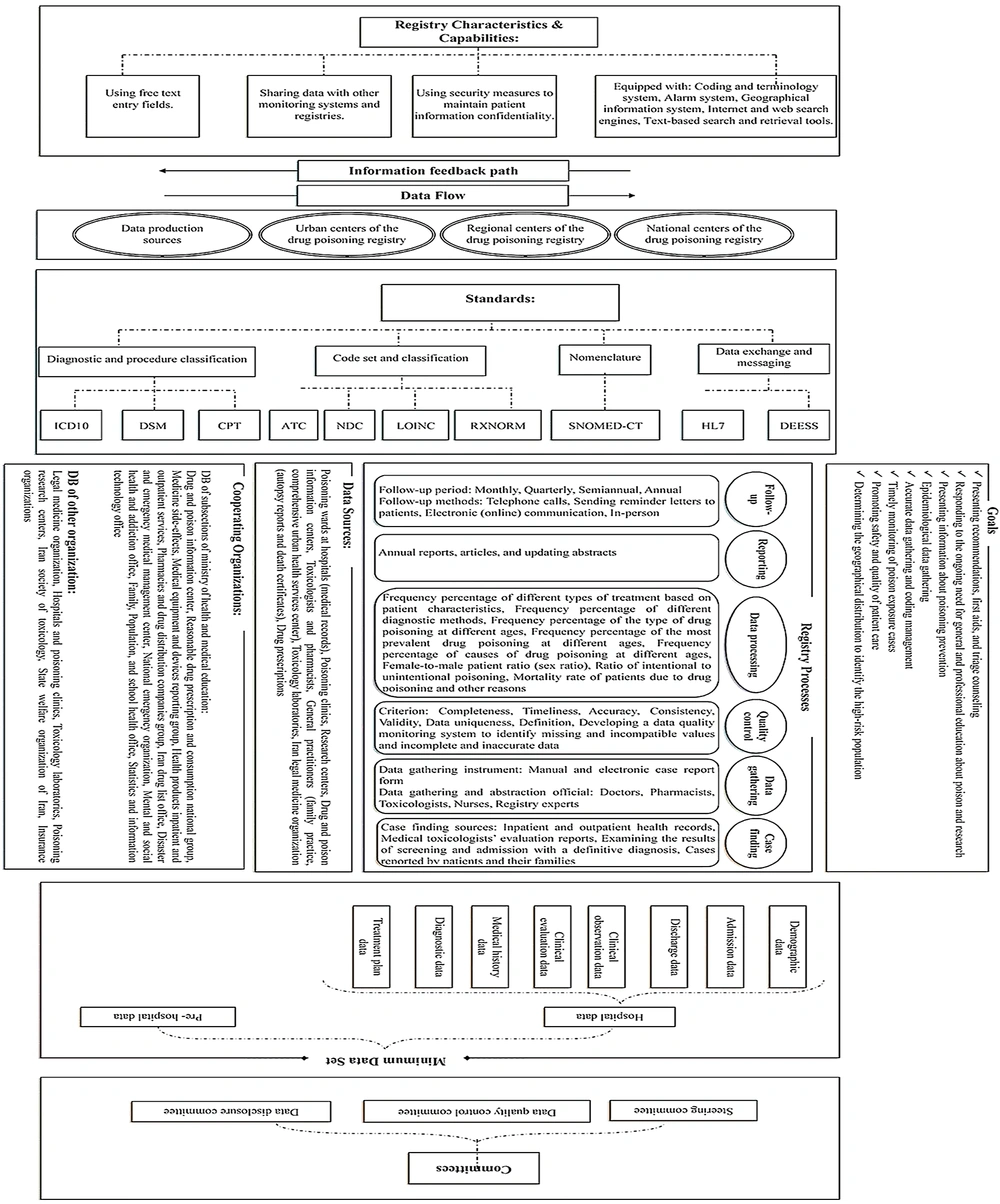
Figure 1.
National drug poisoning registry model in Iran
5. Discussion
The main goal of poisoning registries is to collect exposure information promptly for early diagnosis and better management of poisoning, timely monitoring of exposure cases, and monitoring of patient’s health status and outcomes. The management of healthcare costs and resources has also been pursued by some registries, including the poisoning registry of Israel. Furthermore, the mission of some registries is to provide the infrastructure to share data with other sources and to form research networks (27, 37, 38). Establishing a national information network and integration with other data sources are missions pursued by many healthcare systems and registries. Ideally, the registry should be part of an electronic network that makes real-time data available to all primary and secondary healthcare providers (39). In the model proposed for Iran, the goals of the registry include education and consultation, research, prevention, monitoring, security, quality of patient care, data registration, and information integrity. The goals of cost reduction and prevention of unnecessary visits did not reach expert consensus. This could be because, in the long run, such a system could have high cost-effectiveness despite its initially heavy costs and barriers (40).
Further, there are diverse data sources for the national drug poisoning registry. Some of these sources mainly receive clinical and treatment data from hospitals, poisoning clinics, drug and poison information centers, toxicologists, pharmacists, and general practitioners. Some sources also receive data from research centers, toxicology laboratories, the Iran Society of Toxicology, Legal Medicine Organization, and drug prescriptions, thereby complementing the information in the national drug poisoning registry (27, 38, 41, 42). These diverse sources are similar in most studies across countries; thus, in the model proposed for Iran, all sources (except for those related to the Iran Society of Toxicology) were deemed necessary. In all studied countries, poison control centers have been in charge of the national drug poisoning registry (27, 37, 38). Registers are supportive information systems that are critical to organizing patient data, providing regular care, and tracking patient health outcomes (21).
In the model proposed for Iran, the Drug and Poison Information Center of the Food and Drug Organization (the Ministry of Health and Medical Education) achieved expert consensus as the responding organization of the registry. Furthermore, due to their role in designing and evaluating registry systems as well as determining the required infrastructure and standards for providing healthcare services, health information management and medical informatics experts were approved by experts as members of the registry steering committee. In the model proposed for Iran, both categories of management and executive organizations as well as their communication and cooperation achieved expert consensus to better monitor patients, data communication, support poison control centers in data transfer, and assist researchers who use the data for comprehensive studies.
The minimal dataset is a standard tool for data collection that guarantees access to accurate and precise health data (43), improves the use of high-quality data, and is very useful for planning, developing, monitoring, managing, and evaluating performance, as well as controlling diseases and reducing costs. The development of a minimum dataset for the poisoning registry can contribute to high-quality care and improve registration plus efficiency in hospitals and clinical centers (44). The data elements in the TOXIC registry of the US are classified into patient demographics, exposure information, clinical signs and findings, vital signs, physical examination findings, laboratory test results, treatment plan, and medical outcomes (24). The data elements in the NPDS registry resemble those of the TOXIC registry, differing in the inclusion of vital signs (38). The data elements in the IPIC database of Israel are classified into patient demographics, exposure information, clinical exposure severity, laboratory test results, treatment plan, and medical outcomes (37). Registers are supportive information systems that are crucial to patient data organization, regular care provision, and patient health outcome tracking (21). The MDS classification in the current study greatly resembles the classification of information elements in the mentioned registries. The following data elements were deemed unnecessary by the experts and removed: Race in demographic data due to the lack of racial distribution in Iran; the patient status upon arrival in the admission data owing to non-compliance with registry goals; and poisoning risk assessment and exposure severity in exposure data because of the presence of other data elements (e.g., the type of exposure, the reason for exposure, route and duration of exposure) that could fulfill the information needs of experts in this category. The data element of activity during exposure (in exposure data) was not included in any of the mentioned registries. Meanwhile, this data element can be useful in planning and policy-making to prevent poisoning (45) and, as such, was included in the current study. In clinical evaluation, besides exposure data and paraclinical results, drug data was approved by the experts due to compliance with the registry goals. Contrary to other registries, HAST contains the patient history data element (46). In the current study, the experts agreed upon this data element and its sub-items. A coherent and comprehensive information system can connect scattered research and treatment centers, combine and analyze the resulting data using interoperability standards, and share research findings. The lack of such a system prevents poisoning research and treatment efforts from achieving desirable results (47).
Among terminology and coding systems, LOINC, SNOMED CT, DEDSS, and HL7C-CDA have greater coverage for data exchange between the emergency department and poison control centers (26, 48). There are security and confidentiality measures in the TOXIC registry in accordance with the health insurance portability and accountability act (27). Although easy access to the registry is essential, data privacy must be protected, the data need to be stored securely and not shared without proper sharing permissions (49).
Other features of the reviewed registries were being equipped with various tools and technologies, e.g., geographical information system (GIS), warning systems, text search and retrieval tools that help identify high-risk areas, drug interactions, and searchability in free text entry fields (27, 38). All of these features were agreed upon by the experts in the current study.
Case finding is the process whereby all eligible cases are identified, added to the registry, and summarized (50). It is one of the most important registry activities, and to complete it, all treatment departments and resources must be examined to ensure that all possible cases are identified (46). In the TOXIC registry, case finding was performed through patient evaluation by medical toxicologists in the clinical setting (24). In other registries, cases were identified through self-reports by patients, their families, and healthcare specialists, but this case finding method led to limitations, e.g., incomplete verification of each report by poison control centers. Some differences between the TOXIC and NPDS registries lie in case finding and reporting exposure cases, which can directly impact data quality (51). In the present study, in line with other studies, active case finding achieved consensus.
Gathering and storing data in the registry means the collection and maintenance of patient information, including demographics, treatment, follow-up, and history. Since extensive information is kept in the storage stage, a brief summary of patient information, disease process, the extent of the disease, diagnosis, treatment, and outcomes should be selected through abstraction and coding (52). Gathering and focusing on data integrity are among the goals emphasized by many registries. Attention to the accurate collection of data is a pillar of data management, and emphasizing it as a major goal of registries facilitates other registry steps and processes (53). In the model proposed for Iran, electronic and manual case report forms were agreed upon for data collection and summarization. The use of manual case finding methods increases the likelihood of losing eligible cases; as such, both manual and automated methods should be used when possible (54).
Data quality control is a key component of clinical registries and serves as an ongoing process to guarantee the accuracy of treatment outcomes (55). Registry’s data quality control requires further attention from registry designers and developers since collection and analysis of poor-quality data only waste resources without achieving registry goals (56); it is therefore suggested that standard tools and indicators be developed for this purpose. In the proposed model, continuous quality control processes are included to ensure accuracy, completeness, consistency, and integrity. Furthermore, the calculation and use of processing indicators will play an effective role in achieving the goals of registries; hence, appropriate indicators for the registry should be determined based on the goals, and the registry should be expandable in terms of the development of indicators (57).
In the poisoning registry systems of the studied countries, data analysis was performed using statistical indices, including descriptive statistics (frequency and percentage) to analyze demographics, as well as mean and standard deviation to analyze diagnostic evaluations plus the correlation between variables. In the proposed model, data processing indicators were classified into eight categories that were agreed upon by experts. The processing index of the percentage of intentional to unintentional poisonings was also proposed, which was neglected by all available studies.
Reporting in the registry refers to any type of report published from the registry. The data should be gathered and reported as needed, and registry users should be able to retrieve data and present them as reports (58). The important point in reporting information is paying attention to the type of organization or individual who will use the information (59). In general, reports should be based on the goals, activities, and needs of organizations as well as within the framework of the collected data and processed indicators. To improve the processing ability of registries, principal indicators should be considered by identifying the data requirements of key stakeholders (60).
Patient follow-up is a systematic process and monitoring of patients' health status for providing medical care over their lifetime (54). According to Gliklich, a key application of registries is the ongoing monitoring of patients, which makes registry users aware of the effectiveness of treatment methods or prescribed drugs (39). Doctors and patients can be reminded of patient follow-up or tests by sending scheduled letters to them (61). In the model proposed for Iran, the monthly, quarterly, biannual, and annual follow-up periods, as well as telephone calls, reminder letters, electronic communication (online), and in-person follow-up methods were agreed upon by experts. Although electronic communication is expanding, due to the lack of access of all patients to the Internet, other methods of follow-up have also attracted the attention of experts.
5.1. Conclusions
Given the significance of a national drug poisoning registry in gathering, storing, analyzing, and reporting the data of patients, it is essential to provide a framework for evaluating and controlling drug poisoning as well as for generating valuable data for decision-making. A priority of the Deputy for Research and Technology (MoHME) is to establish a registry system. With respect to the high prevalence of drug poisoning in Iran and the need for designing as well as developing such a system, the model proposed in the current study can provide a proper information infrastructure for the design and implementation of a national drug poisoning registry system.