Our study findings highlighted important aspects of pulmonary complications in pediatric patients undergoing cardiac surgery. The preoperative NLR was significantly higher in patients who developed complications (1.62 vs. 1.08; P = 0.012), suggesting that an elevated inflammatory state before surgery may predispose patients to adverse outcomes. This aligns with previous research which identified NLR as a prognostic marker for poor surgical outcomes, particularly when measured postoperatively (
7). Our results extend this understanding by emphasizing the predictive value of preoperative NLR, which could serve as an early warning sign for clinicians to implement targeted interventions.
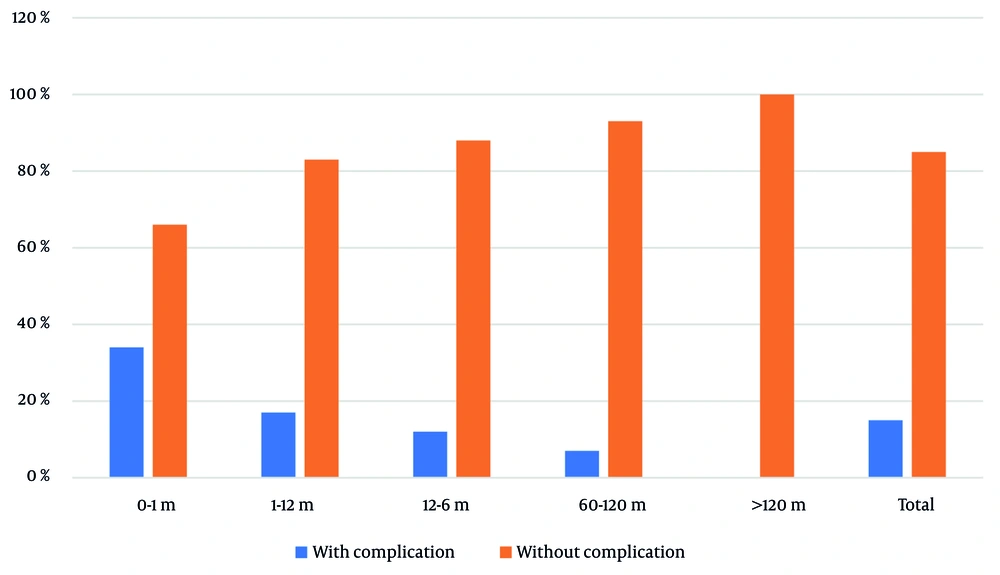
The study also revealed that pulmonary complications were most prevalent in infants under one month of age (34%), underscoring the vulnerability of this age group. This finding has significant clinical implications, as it suggests that neonates undergoing cardiac surgery require heightened monitoring and tailored respiratory support to mitigate risks. Furthermore, the duration of hospitalization and mechanical ventilation was significantly longer in patients with complications (13 days vs. 6 days and 49 hours vs. 15 hours, respectively; P < 0.001), reinforcing the need for strategies to reduce postoperative pulmonary complications and improve recovery times.
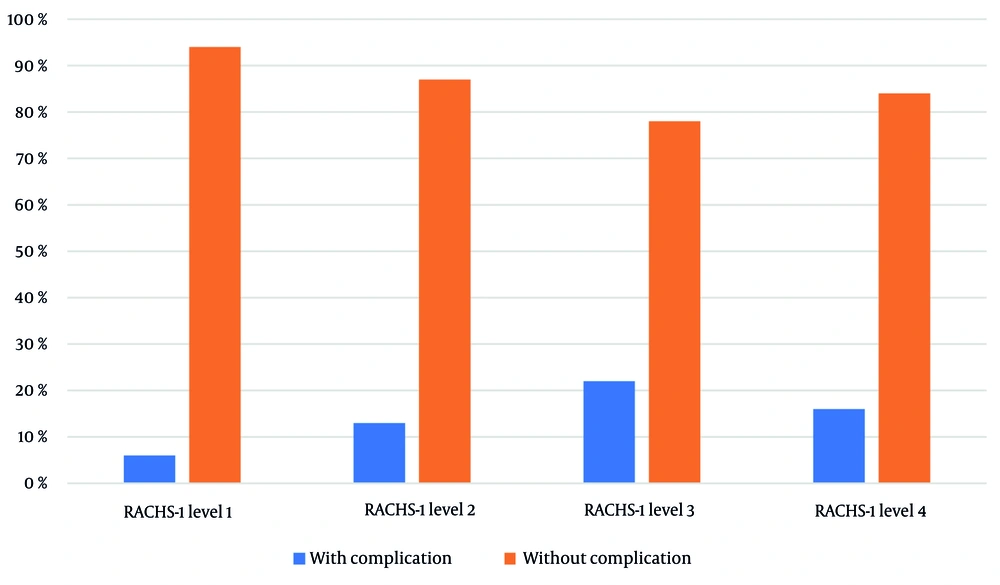
While the RACHS-1 scoring system did not show a statistically significant association with pulmonary complications in our study, this may reflect variations in surgical expertise or patient management rather than a limitation of the scoring system itself. For instance, patients in higher RACHS-1 categories (e.g., category 4) had a higher incidence of complications (22%), but this trend did not reach statistical significance (P = 0.150). This contrasts with some other studies which found a strong correlation between RACHS-1 scores and mortality (
8). The discrepancy may be attributed to differences in surgical skill or institutional protocols, highlighting the importance of standardized practices and continuous training for surgical teams.
The role of CPB time in postoperative outcomes remains a critical area of investigation. Although our study did not find a statistically significant difference in CPB duration between patients with and without complications (146 minutes vs. 118 minutes; P = 0.071), the trend toward longer CPB times in complicated cases aligns with findings from other studies (
6,
9). Prolonged CPB is known to exacerbate systemic inflammation and disrupt hemostasis, which may contribute to postoperative complications. Future research should explore strategies to minimize CPB duration and mitigate its inflammatory effects.
The clinical implications of our findings are twofold. First, preoperative NLR measurement could be integrated into risk assessment protocols to identify high-risk patients early. Second, targeted interventions, such as enhanced respiratory care and inflammatory modulation, could be prioritized for neonates and patients with elevated NLR to reduce complications and improve outcomes. These measures, combined with standardized surgical practices and continuous monitoring, could significantly enhance the quality of care for pediatric cardiac surgery patients.
Additionally, the findings reveal that longer CPB time, extended hospitalization, and prolonged mechanical ventilation are significant predictors of adverse outcomes, consistent with previous literature. For instance, studies have shown that prolonged mechanical ventilation and extended hospital stays are strongly associated with increased morbidity and mortality in children undergoing cardiac surgery, likely due to the heightened inflammatory response and physiological stress imposed by these factors (
7). The WBC count before surgery was also found to be a significant predictor, which aligns with existing evidence suggesting that preoperative inflammation or infection can exacerbate postoperative complications (
6,
10).
However, the lack of significant predictive value for WBC counts on the first and second postoperative days, as well as for NLR at any time point, contrasts with some studies that have highlighted NLR as a useful marker of systemic inflammation and predictor of complications in cardiac surgery patients (
8,
11). This discrepancy may be attributed to differences in patient populations, surgical techniques, or timing of NLR measurements. For example, some studies have reported that NLR is more predictive when measured at later postoperative stages or in specific patient subgroups (
9).
The AUC values for length of hospitalization (0.79) and duration of mechanical ventilation (0.80) indicate good predictive accuracy, reinforcing their utility as clinical indicators of pulmonary complications. However, the relatively low AUC values for WBC and NLR suggest that these markers may have limited standalone predictive value in this context. This finding underscores the importance of integrating multiple clinical and laboratory parameters to improve risk stratification and postoperative management.
In conclusion, while this study highlights the significance of CPB time, hospitalization duration, and mechanical ventilation as predictors of pulmonary complications, the role of NLR and WBC counts remains less clear and warrants further investigation. Future studies with larger sample sizes and standardized measurement protocols are needed to clarify the predictive utility of inflammatory markers like NLR in pediatric cardiac surgery patients.
5.1. Conclusions
The study found that the average age of patients was 25.84 months, with a balanced gender distribution (49% male, 51% female). The survival rate was high (97%), but 15% experienced pulmonary complications, particularly infants under one month. A significantly higher preoperative NLR in patients with complications suggests a pre-existing inflammatory state. These findings highlight the importance of preoperative NLR as a predictive marker and the need for targeted care in high-risk groups, such as neonates, to improve outcomes in pediatric cardiac surgery.
5.2. Limitations
This study has several limitations. Due to its retrospective design, there was limited control over confounding variables, which affects the ability to establish causality. The single-center nature of the study further limits the generalizability of the findings. Additionally, the small sample size for complications, involving only 68 patients, may reduce the statistical power of the study. The absence of long-term follow-up data precludes insights into long-term outcomes. Furthermore, the incomplete analysis of confounding factors, such as comorbidities and surgical techniques, may have impacted the comprehensiveness of the findings. Technical issues also restricted access to certain data, preventing the performance of regression analyses and receiver operating characteristic (ROC) curve analyses.
5.3. Recommendations
Future studies should consider adopting a prospective design and involve multi-center collaboration to enhance generalizability and increase sample size. Incorporating long-term follow-up, subgroup analysis, dynamic NLR monitoring, additional biomarkers such as C-reactive protein (CRP), and standardized NLR measurement methods would provide stronger evidence and deeper insights.