
1. Background
Nowadays, the spread of chronic diseases is considered a major challenge for global health (1). One of the most common of these diseases is cardiovascular disease. Depending on the type, severity, and progression of the disease, different treatment methods are used to treat patients. However, the most common treatment method for advanced coronary artery disease is open-heart surgery (2-5). The surgery is classified as a stressful event (6). Accordingly, many researchers and professionals believe that successful recovery after open-heart surgery and adaptation to the situation depend on positive support from the spouse. A patient's spouse is key to reducing the psychosocial distress associated with heart surgery and plays a very important role in their recovery, individual rehabilitation, and quality of life together (7, 8).
Therefore, although the process of coping with illness is unique and internal, it does not develop in a vacuum; rather, it is shaped by living with others and gaining experience (7). Accordingly, researchers have usually emphasized two major strategies for coping with stress, which include individual coping and dyadic coping. Dyadic coping has received more attention as a fundamental factor behind a good marital relationship. Dyadic coping is considered a response to couple stress and refers to the ways in which each partner deals with individual and couple stressors. It aims to support both the relationship and the couple in an intimate relationship and can reduce the impact of chronic external stress on chronic internal stress, thereby preventing stress from overflowing (9, 10).
The systemic interaction model also states in this context that dyadic coping usually occurs in a chain cycle of spouses' perceptions and reactions to each other's stress symptoms and the actions resulting from it (11). Randall and Bodenmann also compared positive and negative forms of dyadic coping in their study. The results of their study showed that both types of coping were effective on relationship outcomes. However, positive dyadic coping showed greater effects at the individual and relationship levels (9, 12).
The results of various studies have also shown that supportive dyadic coping has a greater impact on women than on men. For example, Khojasteh Mehr et al. concluded in their study of 150 couples in Iran that dyadic coping has a greater impact on women's marital satisfaction than on men's, because the support that women receive from their husbands in stressful situations has a significant impact on the quality of their marital life (13). The study by Falconier and Kuhn also showed that there is a relationship between dyadic coping and positive individual indicators in patients and their spouses (11). Vaske et al. also showed in their study that dyadic coping in couples with chronic pulmonary diseases causes less psychological distress and a higher quality of life in them (14). Similarly, studies on relationship outcomes have consistently suggested the benefits of dyadic coping. For example, Gouin et al. showed that dyadic coping was associated with increased relationship satisfaction in Western couples (15).
For this reason, considering all the above explanations and the fact that in Iran, the family and marriage center are more important than in Western countries due to specific cultural and value issues, the family is the cornerstone of support during health crises such as open-heart surgery. This coping style relies on strengths such as spirituality-based approaches and strong emotional support but is accompanied by challenges such as protective buffering and extensive collective decision-making that may hinder open communication. Therefore, assessing positive couple coping in Iran requires a definition that takes advantage of cultural benefits while being sensitive to potential barriers. Considering these dimensions, this study examines how Iranian couples use these cultural mechanisms to cope with the consequences of open-heart surgery. For this reason, and considering that qualitative research leads to participants describing the concept in terms of their conversations and feelings, conducting such research is necessary and valuable to explore important concepts in the field of nursing. As Ganong and Coleman emphasize, qualitative research is the best way to examine family dynamics and relationships, providing much richer data than a quantitative approach, and going beyond the quantitative approach in terms of achieving some of the research goals. Because in a qualitative approach, phenomena are not considered objective and fixed, but vary according to their context (16).
2. Objectives
It is necessary to use a qualitative approach (content analysis) to investigate mental and human phenomena such as positive dyadic coping in couples after open-heart surgery. This approach leads to a better understanding of the couple's conditions and concerns by examining the experiences related to the couples' social and cultural context.
3. Methods
The present study was conducted in a qualitative manner using a content analysis approach in 2024 - 2025. The participants of this study were spouses and patients who had undergone open-heart surgery. A total of 18 participants with an average age of 52 years were interviewed over 6 months. After obtaining the necessary permits by visiting the hospitals and cardiovascular clinics affiliated with Zahedan University of Medical Sciences in person and by studying the patients' records, patients with a history of open-heart surgery were selected. The researcher was well aware that coping is a changing and evolving process. For this reason, after the acute phase of the disease passed and when the patients and their spouses returned for continued treatment and annual check-ups, the researcher asked them to participate in this study if they were willing.
These individuals were selected from those who had the ability to communicate verbally, had at least 6 months passed since one of the couples had undergone open-heart surgery, were over 18 years of age, were married, and were living with their spouses at the time of the study. Sampling was purposive and continued until data saturation was reached, that is, until all codes and categories were completed, and new interviews did not add any new data to the previous data. Interviews were conducted individually and with couples in one or more sessions, depending on the time, patience, and willingness of the participants. Interview times varied from 45 to 90 minutes. All interviews were recorded after obtaining written and oral consent and then transcribed verbatim on paper within 24 hours. MAXQDA2020 software was used to store, manage, and reconstruct data.
Simultaneously with the interviews, data analysis was performed in five stages based on the method proposed by Graneheim and Lundman (17). These stages were: (1) Writing down the entire interview, (2) reading the entire interview text to gain a general understanding of its content, (3) determining meaning units and primary codes, (4) classifying similar primary codes into more comprehensive categories, and (5) determining the content latent in the data (17). In this study, the text was handwritten and typed word for word immediately after each interview, and then the written texts were read several times and the primary codes were extracted. After that, the primary codes that were related to each other were merged and formed categories based on similarities, which ultimately extracted the concepts latent in the data.
In order to verify the accuracy and validity of the research data, four validity indices of Guba and Lincoln, including validity, reliability, conformability, and transferability, were used (18). Researchers employed specific qualitative research methods such as ongoing involvement with the subject and data, the use of integration in the research, the review of observers, the search for conflicting evidence, and the review by participants (member check) to ensure data credibility. For dependability, the opinions of an external observer were used; all the codes and contents of the present study were provided to other instructors (external check, peer check) for further investigation. This allowed any existing contradictions and defects to be reviewed and revised to reach a final consensus. For conformability, all activities were recorded, and a report of the research process was prepared. Finally, for transferability, the results were shared with two patients and spouses outside of the study, who confirmed the data. In addition, the confidentiality of all interviews was observed.
4. Results
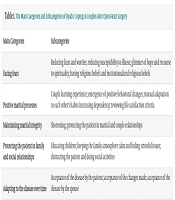
Five hundred initial codes were extracted from the participants' descriptions. After several reviews, the codes were summarized and classified based on similarity and relevance. They were finally placed into 5 main categories and 18 subcategories, which are described below (Table 1).
Table 1.
The Main Categories and Subcategories of Dyadic Coping in Couples After Open-Heart Surgery
| Main Categories | Subcategories |
|---|---|
| Facing fears | Reducing fears and worries; reducing susceptibility to illness; glimmer of hope and recourse to spirituality; having religious beliefs and institutionalized religious beliefs |
| Positive marital processes | Couple learning experience; emergence of positive behavioral changes; mutual adaptation to each other's habits Increasing dependency; reviewing life satisfaction criteria |
| Maintaining marital integrity | Shortening; protecting the patient in marital and couple relationships |
| Protecting the patient in family and social relationships | Educating children; keeping the family atmosphere calm and hiding stressful issues; distracting the patient and doing social activities |
| Adapting to the disease over time | Acceptance of the disease by the patient; acceptance of the changes made; acceptance of the disease by the spouse |
4.1. Facing Fears
Going through the acute phase of the illness and watching the patient recover provided an opportunity for the couple to face their fears and anxieties. At this stage, the couples made every effort to prevent negative thoughts from entering their minds and not to give importance to these thoughts if they did. One of the participants stated in this regard: “… I tried not to think or fantasize, and if any thoughts or fantasies came to my mind, I would keep my head warm…” (Patient 2, a 67-year-old male patient). Turning to spirituality and having religious beliefs, as well as institutionalized religious beliefs, were also factors that helped couples face their fears. In this regard, one participant stated: “I say, ‘God, you gave me the pain, I will give thanks for whatever pleases you.’” (Patient 1, a 54-year-old male patient). These beliefs also helped couples accept death as an inevitable reality.
4.2. Positive Marital Processes
Positive marital processes observed among couples after open-heart surgery included learning and the experiences that came from it. These experiences were sometimes rooted in the past and sometimes gained through learning from themselves and others. Participant number six spoke about his learning experience: "One meets and stands up with different people, learns how to behave, how to react, and as the saying goes, one becomes wise and no longer reacts to exacerbate the problem. We also had fights and conflicts. After all, differences of taste and opinion always exist and will continue to exist, but how we resolve these differences of taste and opinion is important." (Patient 8, patient’s 66-year-old husband). The passage of several years of living together had also caused the couples to become more familiar with each other's temperament, character, and habits, leading to a stronger attachment to each other. For example, participant number seven spoke about his wife's excessive discipline before her illness: "You get used to it, I became sensitive about these issues. I tried to make sure everything was in order before he came. After his heart surgery, when he was mostly at home and was recovering, I was generally careful to make sure everything went smoothly and according to routine so that he wouldn't get stressed or have problems." (Patient 6, patient’s 41-year-old wife). The possibility of the spouse's death also caused the couple to become emotionally closer to each other. Participant number seven stated in this regard: "After the open-heart surgery, my dependence became much greater. I became very dependent. Now why do I come in the morning? I stay here until night. When I am with him, I feel at ease." (Patient 7, patient’s 54-year-old wife). The stressful experience of heart surgery also caused the couple to review their criteria for life satisfaction. For this reason, after the surgery, they tried to consider the positive aspects of their lives, such as having a family and children, and to be grateful for having such blessings by their side. In this context, one of the participants said: “What can I say, what can I say if I am not satisfied? At that time, everyone who told me that, I would say no, I am not satisfied with my life, but now, after he got sick, the feeling that he may not be there anymore has made me appreciate my home and family more.” (Patient 5, patient’s 50-year-old wife)
4.3. Maintaining Marital Integrity
The patient's spouse, as the primary caregiver, plays a very important role in protecting themselves and the patient in marital interactions. One of the most important of these interactions is sexual intercourse. It is worth noting that protecting the patient was not only dependent on the marital relationship but also involved other emotional relationships between the couple. The strategies that couples used to maintain their marital relationship despite the illness were specific and unique, depending on the type of relationship between the couple. In this regard, one of the participants stated: "...but I tried to shorten the relationship myself..." (Patient 11, patient’s 50-year-old wife). When the interview transcripts were examined, it became clear that the root of this thinking was the fear couples had of losing the patient and his death. One of the strategies that the couples used was to yield to the patient in the event of any disagreement or conflict. Participant number nine stated in this regard: "Now, if there are shortcomings in life, I have to ignore them, I have to be humble, I have to lower my expectations. If you live with one person for 37 years under the same roof, you are not two people, you become one person. He is the same. Even now that he is sick, he tries not to have any shortcomings in this regard for me. This is because this 37-year life is stable." (Patient 9, patient’s 62-year-old husband)
4.4. Protecting the Patient in Family and Social Relationships
After open-heart surgery, couples implemented strategies to protect the patient from family and social risk factors. One of the strategies that couples used was to educate their children, keep the family atmosphere calm, and hide stressful issues. In this regard, participant number four stated: “My wife is very careful not to stress me out, so she always teaches the children not to tell me things that cause anxiety or to tell me every piece of news.” (Patient 4, a 57-year-old male patient). Participant number five also stated, "Because I know his morals, I don't tell him about some sensitive issues, both because of the heart problem he has and because I don't want to cause resentment." (Patient 5, patient’s 50-year-old wife). In addition to hiding issues, couples also used other strategies such as distraction and social activities. In this regard, participant number three stated: “I tried to pay attention to him, we even went on a pilgrimage to Mashhad. This trip helped him a lot mentally and emotionally.” (Patient 3, patient’s 47-year-old wife)
4.5. Adapting to the Disease Over Time
In order to adapt to the disease, couples began to accept the disease and the changes it caused. In this regard, one of the participants said: "Well, this disease will be with us until we die, as the old saying goes, and we should tolerate it, not fight it." (Patient 6, a 41-year-old female patient). Another participant stated: “I told myself, look, from this moment on, your husband is no longer a healthy person and this illness is not for one or two days, it is forever, so deal with it.” (Patient 5, patient’s 50-year-old wife)
5. Discussion
The results of the present qualitative study were divided into five main categories, which are described in detail. The passage of time, the follow-up of treatments, and the improvement of the patients' condition caused the couple's fears and concerns to subside. The results of this part of the present study are in line with the findings of Momennasab et al. They stated in their study that the participants' fears and concerns gradually decreased after undergoing treatment and as their physical conditions improved (19). Raofie Kalachayeh et al. also showed in their study that although a heart attack causes negative feelings and worries in couples, the use of "self-induction" reduced the patients' fears and worries (20). The findings of this part of the present study are also in line with the findings of Abbasi et al., who also referred to "removing worries and mental concerns" in their study (21). In fact, obtaining more information about the disease reduced the incidence of ineffective, immature, and excited reactions to the disease and its consequences.
The results of this part of the present study also showed that resorting to spirituality and having religious beliefs plays an important role in improving couples' relationships after open-heart surgery. A study conducted by Jalali et al. in this field showed that many patients considered their illness to be the will of their God and stated that they could continue their lives by trusting in their God. Thus, they considered the illness as an excuse to strengthen spirituality and have a greater connection with their God (22). Dahdest and Bagheri also stated in this context that "finding meaning in problems" plays an important role in the individual's adaptation process (23). Strategies for finding meaning in problems, along with other strategies such as patience, communication with God, satisfaction, and submission, gave couples additional strength to accept and understand the situation (7). In explaining this finding, it can be stated that when families face difficult situations such as health problems of members, religious beliefs and practices can help them cope with feelings of helplessness and despair, restore meaning and order to their lives, and gain a sense of mastery over the situation (10). The results of this part of the present study also showed that open-heart surgery can create positive behavioral changes among couples. This process leads to positive changes in self, relationships, well-being, and also reduces disease recurrence (7). In this regard, Derakhsh and Karaei in their study referred to the concept of getting along and adapting and stated it as one of the components of a successful marriage (24). Although that study was conducted on couples who were not facing a disease crisis and, in this respect, it is different from the present study, it clearly shows that couples adapt well to each other's habits over time and accept each other as they are.
The results of this part of the present study also showed that open-heart surgery can increase the emotional dependence of couples on each other over time. In this regard, the theory of interdependence states that sometimes in relationships it is necessary for people to give up some of their preferences in favor of the relationship they have with each other (25). According to this theory, when a person does not act solely based on their own interests and also cares about the needs of their spouse, a kind of motivational transfer occurs in relationships. In this situation, they make sacrifices for their spouse, which aligns with the results of this part of the present study (7). The results of the present study also showed that couples had changed their life's satisfaction criteria after open-heart surgery. In fact, having a heart attack, due to a sudden change in health status and transition from a healthy person to a sick person, causes a change in the individual's perspective on themselves and life (7). Derakhsh and Karaei also showed in their study that the result of trying to maintain a marital relationship is satisfaction with life, which includes satisfaction with oneself, one's spouse, and satisfaction with having children, confirming the results of the present study (24). Based on the definitions presented, marital satisfaction can be defined and identified in two domains: Intrapersonal and interpersonal. In the intrapersonal context, it includes the perception and evaluation of the individual alone, and in the interpersonal context, it includes the state of couple interactions (7). Therefore, marital satisfaction is a multifactorial and multifaceted phenomenon that can be composed of numerous factors (26).
Various perspectives have been proposed to explain the revision of life satisfaction criteria after chronic illness, including response displacement. According to this perspective, people with chronic illness try to achieve an acceptable level of quality of life despite the limitations caused by the illness by changing internal standards, values, and revising goals and expectations (5). Existing evidence also shows that people with chronic illnesses prioritize their goals and expectations to achieve a satisfactory level of life (10). The results of various studies in this field also show that after open-heart surgery, one of the most frequently used adaptation strategies is positive reappraisal (7). The results of the present study also showed that after open-heart surgery, couples made every effort to maintain their marital relationship. In this regard, the results of the research by Hashemi-Golmehr and Salari Zare et al. also showed that the individual and couple outcomes of a successful marriage include having a clear and unambiguous marital relationship, satisfaction with the marital relationship, realizing common marital goals, and a sense of peace (27, 28). The results of this part of the present study also showed that after open-heart surgery, healthy couples make every effort to protect the patient in their marital and couple relationships. The findings of this section of the present study are consistent with the findings of Safaei and Salimi and Pirsaghi et al. They also pointed out in their studies the importance of healthy and appropriate communication between couples (27, 29, 30).
The results of the present study also showed that after open-heart surgery, spouses try to protect the patient from stress. In this regard, Gullick et al. (2017) also mentioned this issue in their study under the category of "self-protection" and stated that caregivers used strategies aimed at protecting themselves and their partners from greater stress and danger (31). The results of the present study also showed that healthy couples provide their children with education to protect and support the patient. In this regard, Derakhsh and Karaei showed in their study that parents provide their children with age-appropriate education that leads to the formation of skills in children (24). Distracting the patient and engaging in social activities were also other strategies used by couples. Sarhadi et al. also showed in their research that when spouses focus on household and real-life tasks, they are less able to understand the seriousness of the situation and are better able to deal with their emotions. Another strategy that couples used was accepting the disease as part of their life together (10). Accepting the disease caused the couples to accept the complications of the disease and the changes that followed it, and after accepting them, they adopted appropriate strategies. Khansari et al. also referred to the concept of accepting the disease in their study and stated that time can be an effective factor in adapting to the disease (32).
In this regard, Naseri and Moeeni also showed in their research that when a patient accepts failure, acceptance replaces denial and the disease is accepted (33). In explaining this finding, it can be stated that adaptation to chronic diseases is a dynamic process, and the patient can achieve self-control by increasing their level of physical and cognitive adaptation, which is considered the ultimate goal in the management of chronic diseases (34).
This qualitative study, while providing valuable insights, faced several important limitations. First, the purposive sampling method and limited sample size reduce the extensive generalizability of the results to the wider population. Second, the focus on participants from specific medical centers makes the influence of contextual and geographical characteristics on the findings probable. Furthermore, given the reliance on interviews, the possibility of reporting bias (such as the tendency to present a more favorable image) and the inherent influence of the researcher's presence in the data collection and interpretation process are noteworthy. Finally, it should be emphasized that the primary goal of qualitative research, such as the present study, is not statistical generalization, but rather achieving a deep and contextually grounded understanding of the phenomenon under investigation.
5.1. Conclusions
The results of this qualitative study demonstrated that positive dyadic coping is an active and reconstructive process that facilitates adaptation to illness. Couples following open-heart surgery use different approaches individually and as couples to cope with the stress that occurs. The key insight of this research is its emphasis on "preserving dyadic integrity" as the core of this process, whereby couples transform the crisis of illness into an opportunity to strengthen their shared identity. From a clinical implications perspective, these findings reveal the necessity of integrating the assessment of couple relationships into nursing care programs and designing cardiac rehabilitation interventions based on enhancing active couple participation. Therefore, it is suggested that nurses and doctors help reduce couples' anxiety by providing information about surgery, subsequent care, the recovery period, etc. Hospitals should definitely pay attention to couples' coping approaches in their educational, counseling, and rehabilitation programs, and design and implement effective psychological interventions as standard protocols for use at the hospital and cardiac rehabilitation centers level. For future research, the design of structured interventions based on these findings and a longitudinal investigation of the sustainability of these patterns are suggested.