
1. Background
The global prevalence of overweight and obesity is steadily increasing, with projections suggesting that up to 57.8% of the world population may be affected (1). This trend is primarily driven by rapid urbanization, sedentary behaviors, and reduced physical activity, making childhood obesity a major global public health concern. Notably, the prevalence of obesity among children has increased by approximately 23% in developed countries and 14% in developing regions, highlighting the global scope of the problem (2). In Iran, obesity represents a substantial health burden and contributes to nearly 70% of deaths related to chronic diseases, particularly cardiovascular conditions.
Given the multifaceted nature of obesity, several anthropometric indices have been developed for its assessment. Body Mass Index (BMI) remains the most widely used measure in clinical and research settings; however, it does not adequately reflect body fat distribution or the extent of adipose tissue accumulation associated with vascular toxicity (3). Despite this limitation, elevated BMI has been linked to alterations in vascular function, suggesting a potential role in vascular adaptive or defensive responses rather than direct injury (3).
Waist circumference (WC) has gained importance as an indicator of central obesity and metabolic syndrome, although it does not consistently capture visceral fat accumulation with precision (4). To address these limitations, additional indices, such as the waist-to-height ratio (WHtR) and A Body Shape Index (ABSI), have been introduced to better characterize body fat distribution and have shown modest correlations with BMI (5). More recently, the Body Roundness Index (BRI) has been proposed as a novel anthropometric measure that estimates total and visceral adipose tissue by modeling body shape as an oval, potentially providing enhanced insight into obesity-related health risks (6).
Although the association between excess body weight and cardiovascular disease (CVD) is well established (7), the relationship between obesity and arterial stiffness (AS) remains controversial. Cardiovascular risk varies substantially by fat distribution, with visceral adiposity conferring a higher risk than subcutaneous fat (8). Arterial stiffness reflects progressive vascular aging and loss of arterial elasticity and is recognized as an early marker and strong predictor of CVD (5, 6). Vascular stiffening increases with advancing age and in the presence of metabolic abnormalities, such as dyslipidemia, ultimately becoming a hallmark of cardiovascular pathology (9). Importantly, AS has been shown to predict future cardiovascular events in both clinical and general populations, independent of traditional cardiovascular risk factors (10). Although magnetic resonance imaging provides accurate measurement of aortic stiffness through pulse wave velocity (PWV), its high cost and limited availability restrict routine clinical use (11). Consequently, echocardiographic assessment using systolic and diastolic blood pressure in combination with aortic diameter is commonly used to calculate aortic elasticity indices, including the aortic stiffness beta index, aortic distensibility, and the pressure strain elastic modulus.
2. Objectives
This study aimed to comprehensively examine the associations between conventional obesity indices (BMI, WC, and WHtR) and novel obesity indices (ABSI, BRI, and CI) and detailed aortic elasticity parameters in children. By adopting a multidimensional approach, this investigation sought to provide a more nuanced understanding of obesity-related vascular alterations in the pediatric population.
3. Methods
3.1. Study Design and Participants
This cross-sectional comparative study was conducted among children referred to Ali Asghar Pediatric Hospital, affiliated with Zahedan University of Medical Sciences, Zahedan, Iran, for routine check-ups in 2022. Children were enrolled based on BMI status, categorized according to the CDC Growth Charts for children and adolescents aged 2 - 19 years. BMI classifications included underweight (less than the 5th percentile), healthy weight (5th to less than the 85th percentile), overweight (85th to less than the 95th percentile), and obese (95th percentile or greater). Underweight children were excluded, and only overweight/obese children and normal-weight children were included in the two study groups. A total of 130 children aged 4 - 16 years were included, with equal numbers of overweight/obese and normal-weight children. Children with diabetes mellitus, hypertension, dyslipidemia, autoimmune diseases, infections, liver disease, renal disease, lung disease, smoking exposure, or metabolic syndrome were excluded. Children receiving antihypertensive or lipid-lowering medications and those with a family history of dyslipidemia were also excluded.
3.2. Measurements and Threshold Measures
Height, weight, and WC were measured. Weight was recorded using a calibrated medical electronic scale (Seca 770, Birmingham, UK) with a precision of 100 mg, and height was measured using a height rod (Seca 222, Birmingham, UK). WC was measured in the standing position above the hip bone during exhalation (12). All measurements were performed twice by an experienced nurse, and the mean was recorded. The anthropometric indices CI, WHtR, ABSI, and BRI were then calculated using the appropriate formulas. Cutoff values for WC, WHtR, ABSI, BRI, and CI were selected based on previously published pediatric and population-based studies to ensure consistency and comparability with the existing literature. WC cutoffs were based on a study by Mederico et al. (13), with mean values of 76.65 cm for girls and 77.95 cm for boys. WHtR was calculated as WC divided by height, with a cutoff value of 0.6, as reported by Shrestha et al. (14). ABSI was calculated using the appropriate formula, with a cutoff value of 0.08 based on Xu et al. (6). BRI was calculated using a formula developed by Chang et al. (15), with a cutoff of 5.00. CI was calculated using the appropriate formula, with a cutoff value of 1.18 based on Mangla et al. (16).
3.3. Echocardiographic and Blood Pressure Assessment
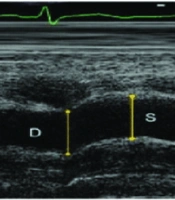
All children underwent medical history evaluation, physical examination, chest X-ray, and echocardiography using My Lab 60 transducers 3 and 8 (Italy). Echocardiography was performed without respiratory control, and measurements were repeated over three cycles, with the mean recorded. Conventional echocardiographic parameters included aortic systolic diameter (AOS) and aortic diastolic diameter (AOD), measured 3 cm above the aortic valve (17, 18).
Blood pressure was measured in the brachial artery after 5 minutes of rest, with three readings obtained at least 2 minutes apart. The mean was recorded, with systolic and diastolic blood pressure corresponding to Korotkoff phases I and V, respectively.
3.4. Ethical Approval
The study was approved by the Ethics Committee of Zahedan University of Medical Sciences (IR.ZAUMS.REC.1400.095).
3.5. Statistical Analysis
SPSS version 18 was used to analyze the data. Numerical data were summarized as means and standard deviations, and categorical data as frequencies and percentages. Non-parametric statistical tests were applied because several continuous variables were not normally distributed. Receiver operating characteristic (ROC) curve analysis was performed to assess the discriminatory ability of each anthropometric index to identify altered aortic elasticity parameters. The Mann-Whitney U test was used to compare the overweight/obese and normal-weight groups. Pearson and Spearman correlations were used for normally and non-normally distributed data, respectively. The AUC-ROC test was used to evaluate the diagnostic ability of obesity for each anthropometric measurement. AUC scores ranged from 0.5, indicating no discrimination, to more than 0.9, indicating outstanding discrimination. A P value of less than 0.05 was considered statistically significant.
4. Results
Based on BMI classification, participants were evenly distributed between the overweight/obese and normal-weight groups. Overall, 39% of the children were girls; among girls, 40% were classified as overweight/obese, compared with 56.3% of boys. The mean age of overweight/obese children was 10.79 ± 2.53 years, whereas normal-weight children had a mean age of 10.44 ± 1.28 years. The median ages were 10.76 and 10 years, respectively, with no statistically significant difference between groups (P = 0.320). ROC curve analysis was used to assess the ability of anthropometric indices to discriminate between overweight/obese and normal-weight children. The AUC reflects the degree of separation between the two groups rather than diagnostic performance. The ABSI (AUC = 0.419, P = 0.136) and CI (AUC = 0.540, P = 0.430) showed limited discrimination. In contrast, WC (AUC = 0.827, P < 0.001), WHtR (AUC = 0.773, P < 0.001), and BRI (AUC = 0.773, P < 0.001) demonstrated greater separation between overweight/obese and normal-weight children (Table 1).
Table 1.
Area Under the ROC Curve Values for Anthropometric Parameters
| Anthropometric Parameters | Area Under the ROC Curve (AUC) | Standard Deviation (SD) | P-Value | 95% CI Lower Bound | 95% CI Upper Bound |
|---|---|---|---|---|---|
| Waist circumference (WC) | 0.83 | 0.035 | < 0.001 | 0.76 | 0.90 |
| Waist-to-height ratio (WHtR) | 0.78 | 0.044 | < 0.001 | 0.69 | 0.86 |
| Body Roundness Index (BRI) | 0.78 | 0.044 | < 0.001 | 0.69 | 0.86 |
| A Body Shape Index (ABSI) | 0.42 | 0.054 | 0.136 | 0.31 | 0.52 |
| Conicity Index (CI) | 0.54 | 0.053 | 0.43 | 0.46 | 0.62 |
Using the identified cutoff values (Figure 1), the proportion of children classified as overweight/obese varied across indices: 41% according to WHtR, 68% for WC, 80% for ABSI, 46% for BRI, and 77% for CI.
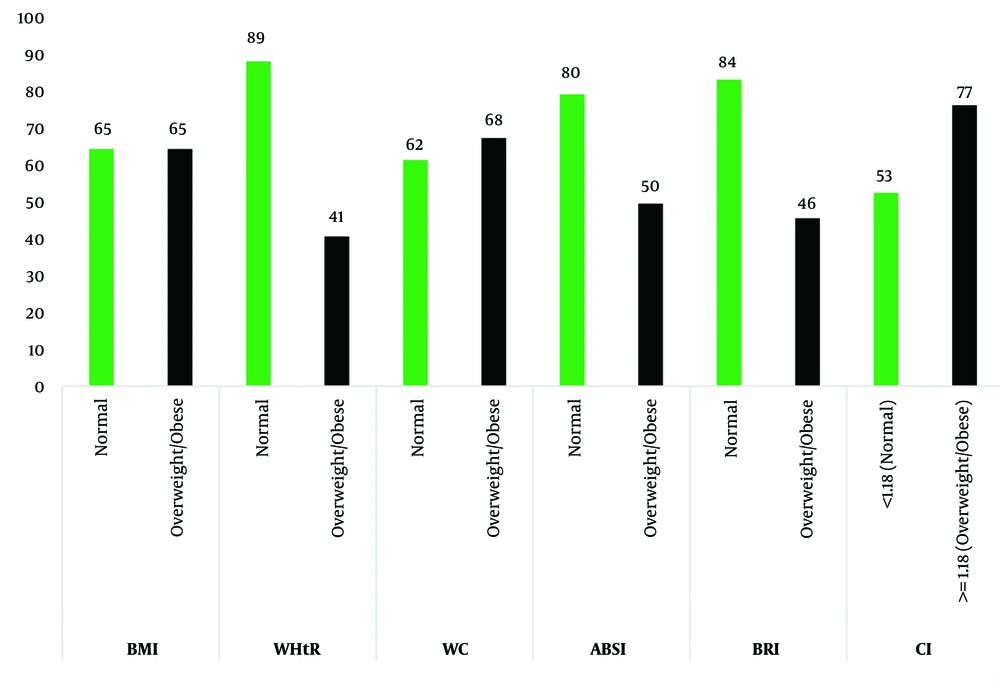
Figure 1.
Frequency of Overweight/Obesity According to Different Indicators in the Study Population
Associations between clinical variables and vascular stiffness parameters are summarized in Table 2. Systolic blood pressure (SBP) was inversely associated with AS and AD, with statistical significance observed for AD (P = 0.005). SBP was positively associated with ASβI (P = 0.035) and PSEM (P = 0.046). Diastolic blood pressure (DBP) showed weaker, non-significant associations with vascular stiffness indices. AOS and AOD exhibited patterns similar to those observed for SBP, with statistically significant relationships observed for most stiffness parameters, except PSEM.
Table 2.
Correlations Between Arterial Stiffness Parameters and Clinical Parameters a
| Clinical Parameters and Statistics | AS | ASβI | AD | PSEM |
|---|---|---|---|---|
| SBP | ||||
| Pearson value | -0.071 | 0.185 | -0.243 | 0.175 |
| P value | 0.422 | 0.035 | 0.005 | 0.046 |
| DBP | ||||
| Pearson value | 0.040 | -0.171 | 0.116 | -0.076 |
| P value | 0.648 | 0.051 | 0.189 | 0.387 |
| AOD | ||||
| Pearson value | -0.277 | 0.348 | -0.400 | 0.025 |
| P value | 0.001 | < 0.001 | < 0.001 | 0.779 |
| AOS | ||||
| Pearson value | -0.21 | 0.262 | -0.290 | -0.088 |
| P value | 0.015 | 0.003 | 0.001 | 0.320 |
| Total | 130 | 130 | 130 | 130 |
a Abbreviations: SBP, systolic blood pressure; DBP, diastolic blood pressure; AOS, aortic diameter in systole; AOD, aortic diameter in diastole; AS, aortic strain; ASβI, aortic stiffness beta index; AD, aortic distensibility; PSEM, pressure strain elastic modulus.
Mean values of vascular stiffness parameters across overweight/obese and normal-weight groups, as defined by different anthropometric indices, are presented in Table 3, and cardiac parameters are shown in Table 4. When obesity status was defined by BMI, significant differences were observed between groups for SBP, AOS, AOD, AS, ASβI, AD, and PSEM (all P < 0.001). Using CI-based classification, overweight/obese children exhibited lower AD (P = 0.016) and higher PSEM (P = 0.031). No significant differences in cardiac or vascular parameters were observed when obesity was defined using ABSI.
Table 3.
Mean and Standard Deviation of Heart Parameters in Obese and Non-Obese Children According to Different Body Indices a
| Heart Parameters; Body Indices and Statistics | Values (Mean ± SD) |
|---|---|
| SBP | |
| BMI | |
| Normal | 108.31 ± 10.48 |
| Overweight/Obese | 118.07 ± 14.61 |
| CI | |
| Normal | 108.68 ± 12.18 |
| Overweight/Obese | 113.51 ± 12.93 |
| ABSI | |
| Normal | 112 ± 12.73 |
| Overweight/Obese | 111.25 ± 12.92 |
| BRI | |
| Normal | 108.98 ± 11.52 |
| Overweight/Obese | 116.22 ± 13.8 |
| WC | |
| Normal | 105.1 ± 7.74 |
| Overweight/Obese | 117.41 ± 13.7 |
| WHtR | |
| Normal | 109.54 ± 11.59 |
| Overweight/Obese | 115.88 ± 14.32 |
| DBP | |
| BMI | |
| Normal | 69.48 ± 7.74 |
| Overweight/Obese | 70.49 ± 12.06 |
| CI | |
| Normal | 68.23 ± 7.33 |
| Overweight/Obese | 70.91 ± 10.43 |
| ABSI | |
| Normal | 70.84 ± 9.19 |
| Overweight/Obese | 69.18 ± 9.46 |
| BRI | |
| Normal | 69.31 ± 7.81 |
| Overweight/Obese | 70.74 ± 11.71 |
| WC | |
| Normal | 68.27 ± 6.37 |
| Overweight/Obese | 71.22 ± 11.29 |
| WHtR | |
| Normal | 69.27 ± 7.72 |
| Overweight/Obese | 71 ± 12.21 |
| AOS | |
| BMI | |
| Normal | 2.14 ± 0.3 |
| Overweight/Obese | 2.38 ± 0.37 |
| CI | |
| Normal | 2.23 ± 0.35 |
| Overweight/Obese | 2.21 ± 0.34 |
| ABSI | |
| Normal | 2.18 ± 0.35 |
| Overweight/Obese | 2.25 ± 0.33 |
| BRI | |
| Normal | 2.18 ± 0.35 |
| Overweight/Obese | 2.29 ± 0.32 |
| WC | |
| Normal | 2.09 ± 0.33 |
| Overweight/Obese | 2.34 ± 0.32 |
| WHtR | |
| Normal | 2.19 ± 0.34 |
| Overweight/Obese | 2.29 ± 0.33 |
| AOD | |
| BMI | |
| Normal | 1.99 ± PSEM |
| Overweight/Obese | 2.26 ± 0.35 |
| CI | |
| Normal | 2.07 ± 0.33 |
| Overweight/Obese | 2.08 ± 0.33 |
| ABSI | |
| Normal | 2.03 ± 0.34 |
| Overweight/Obese | 2.11 ± 0.32 |
| BRI | |
| Normal | 2.03 ± 0.34 |
| Overweight/Obese | 2.16 ± 0.3 |
| WC | |
| Normal | 1.92 ± 0.3 |
| Overweight/Obese | 2.22 ± 0.29 |
| WHtR | |
| Normal | 2.04 ± 0.34 |
| Obese | 2.16 ± 0.31 |
| AS | |
| BMI | 7.87 ± 5.36 |
| Normal | 5.44 ± 5.15 |
| Overweight/Obese | |
| CI | 7.92 ± 5.1 |
| Normal | 6.48 ± 5.55 |
| Overweight/Obese | |
| ABSI | 7.2 ± 6.16 |
| Normal | 6.99 ± 4.9 |
| Overweight/Obese | |
| BRI | 7.63 ± 4.73 |
| Normal | 6.04 ± 6.37 |
| Overweight/Obese | |
| WC | 8.96 ± 4.47 |
| Normal | 5.34 ± 5.62 |
| Overweight/Obese | |
| WHtR | 7.55 ± 4.68 |
| Normal | 6.02 ± 6.64 |
| Overweight/Obese | |
| ASβI | |
| BMI | 12.31 ± 22.69 |
| Normal | 18.33 ± 17.46 |
| Overweight/Obese | |
| CI | 11.45 ± 15.74 |
| Normal | 16.26 ± 24.2 |
| Overweight/Obese | |
| ABSI | 18.1 ± 28.89 |
| Normal | 11.92 ± 14.25 |
| Overweight/Obese | |
| BRI | 11.84 ± 21.54 |
| Normal | 18.8 ± 20.09 |
| Overweight/Obese | |
| WC | 6.67 ± 5.77 |
| Normal | 21.25 ± 27.09 |
| Overweight/Obese | |
| WHtR | 11.85 ± 20.98 |
| Normal | 19.63 ± 21.03 |
| Overweight/Obese | |
| AD | |
| BMI | 0.0044 ± 0.0031 |
| Normal | 0.0023 ± 0.0024 |
| Overweight/Obese | |
| CI | 0.0044 ± 0.0032 |
| Normal | 0.0032 ± 0.0028 |
| Overweight/Obese | |
| ABSI | 0.0037 ± 0.0032 |
| Normal | 0.0037 ± 0.0030 |
| Overweight/Obese | |
| BRI | 0.0042 ± 0.0029 |
| Normal | 0.0027 ± 0.0031 |
| Overweight/Obese | |
| WC | 0.0051 ± 0.0027 |
| Normal | 0.0024 ± 0.0027 |
| Overweight/Obese | |
| WHtR | 0.0041 ± 0.0029 |
| Normal | 0.0027 ± 0.0032 |
| Overweight/Obese | |
| PSEM | |
| BMI | 25.83 ± 43.16 |
| Normal | 35.24 ± 38.37 |
| Overweight/Obese | |
| CI | 22.42 ± 29.37 |
| Normal | 33.43 ± 48.12 |
| Overweight/Obese | |
| ABSI | 36.35 ± 54.51 |
| Normal | 36.35 ± 54.51 |
| Overweight/Obese | |
| BRI | 24.57 ± 42.75 |
| Normal | 36.92 ± 38.99 |
| Overweight/Obese | |
| WC | 16.46 ± 21.38 |
| Normal | 40.32 ± 51.58 |
| Overweight/Obese | |
| WHtR | 24.53 ± 41.66 |
| Normal | 38.52 ± 40.75 |
| Obese |
a Abbreviations: SBP, systolic blood pressure; DBP, diastolic blood pressure; AOS, aortic diameter in systole; AOD, aortic diameter in diastole; AS, aortic strain; ASβI, aortic stiffness beta index; AD, aortic distensibility; PSEM, pressure strain elastic modulus.
Table 4.
Comparison of Cardiac Parameters Between Overweight/Obese and Normal-Weight Participants Based on Different Anthropometric Indices a
| Obesity Indicator; Cardiac Parameters and Body Status | Median | Mann-Whitney U | P Value |
|---|---|---|---|
| BMI | |||
| SBP | 1221 | < 0.001 | |
| Normal weight | 110 | ||
| Overweight/Obese | 120 | ||
| DBP | 2051.5 | 0.768 | |
| Normal weight | 70 | ||
| Overweight/Obese | 70 | ||
| AOS | 1240.5 | < 0.001 | |
| Normal weight | 2.06 | ||
| Overweight/Obese | 2.35 | ||
| AOD | 1060 | < 0.001 | |
| Normal weight | 1.91 | ||
| Overweight/Obese | 2.18 | ||
| AS | 1179 | < 0.001 | |
| Normal weight | 7.96 | ||
| Overweight/Obese | 4.59 | ||
| ASβI | 914 | < 0.001 | |
| Normal weight | 5.094 | ||
| Overweight/Obese | 11.51 | ||
| AD | 896.5 | < 0.001 | |
| Normal weight | 0.0064 | ||
| Overweight/Obese | 0.0017 | ||
| PSEM | 1185.5 | < 0.001 | |
| Normal weight | 12.32 | ||
| Overweight/Obese | 23.39 | ||
| CI | |||
| SBP | 1560.5 | 0.019 | |
| Normal weight | 100.00 | ||
| Overweight/Obese | 110.00 | ||
| DBP | 1792.5 | 0.223 | |
| Normal weight | 70.00 | ||
| Overweight/Obese | 70.00 | ||
| AOS | 2035 | 0.979 | |
| Normal weight | 2.18 | ||
| Overweight/Obese | 2.18 | ||
| AOD | 1913.5 | 0.547 | |
| Normal weight | 2 | ||
| Overweight/Obese | 2.05 | ||
| AS | 1642.5 | 0.059 | |
| Normal weight | 7.14 | ||
| Overweight/Obese | 5.55 | ||
| ASβI | 1661.5 | 0.073 | |
| Normal weight | 6.14 | ||
| Overweight/Obese | 9.80 | ||
| AD | 1532.5 | 0.016 | |
| Normal weight | 0.0038 | ||
| Overweight/Obese | 0.0024 | ||
| PSEM | 1586 | 0.031 | |
| Normal weight | 13.90 | ||
| Overweight/Obese | 18.35 | ||
| ABSI | |||
| SBP | 1883 | 0.565 | |
| Normal weight | 109 | ||
| Overweight/Obese | 110 | ||
| DBP | 1808.5 | 0.341 | |
| Normal weight | 70 | ||
| Overweight/Obese | 70 | ||
| AOS | 1721.5 | 0.182 | |
| Normal weight | 2.14 | ||
| Overweight/Obese | 2.25 | ||
| AOD | 1743 | 0.219 | |
| Normal weight | 2 | ||
| Overweight/Obese | 2.11 | ||
| AS | 1957.5 | 0.839 | |
| Normal weight | 6.6 | ||
| Overweight/Obese | 6.65 | ||
| ASβI | 1925.5 | 0.721 | |
| Normal weight | 7.48 | ||
| Overweight/Obese | 7.31 | ||
| AD | 1959 | 0.844 | |
| Normal weight | 0.0028 | ||
| Overweight/Obese | 0.00227 | ||
| PSEM | 1763 | 0.257 | |
| Normal weight | 16.42 | ||
| Overweight/Obese | 15.61 | ||
| BRI | |||
| SBP | 1361 | 0.004 | |
| Normal weight | 105 | ||
| Overweight/Obese | 116.1 | ||
| DBP | 1884.5 | 0.81 | |
| Normal weight | 70 | ||
| Overweight/Obese | 70 | ||
| AOS | 1564 | 0.073 | |
| Normal weight | 2.14 | ||
| Overweight/Obese | 2.25 | ||
| AOD | 1466.5 | 0.023 | |
| Normal weight | 2 | ||
| Overweight/Obese | 2.11 | ||
| AS | 1311 | 0.002 | |
| Normal weight | 7.3 | ||
| Overweight/Obese | 4.56 | ||
| ASβI | 1154 | < 0.001 | |
| Normal weight | 6 | ||
| Overweight/Obese | 11.51 | ||
| AD | 1111.5 | < 0.001 | |
| Normal weight | 0.0038 | ||
| Overweight/Obese | 0.0018 | ||
| PSEM | 1202 | < 0.001 | |
| Normal weight | 13.89 | ||
| Overweight/Obese | 24.41 | ||
| WC | |||
| SBP | 1031.5 | < 0.001 | |
| Normal weight | 100 | ||
| Overweight/Obese | 120 | ||
| DBP | 1834.5 | 0.186 | |
| Normal weight | 70 | ||
| Overweight/Obese | 70 | ||
| AOS | 1214 | < 0.001 | |
| Normal weight | 2.055 | ||
| Overweight/Obese | 2.31 | ||
| AOD | 959.5 | < 0.001 | |
| Normal weight | 1.9 | ||
| Overweight/Obese | 2.18 | ||
| AS | 955.5 | < 0.001 | |
| Normal weight | 8.15 | ||
| Overweight/Obese | 4.35 | ||
| ASβI | 884 | < 0.001 | |
| Normal weight | 5 | ||
| Overweight/Obese | 11.67 | ||
| AD | 714 | < 0.001 | |
| Normal weight | 0.005 | ||
| Overweight/Obese | 0.0017 | ||
| PSEM | 1139.5 | < 0.001 | |
| Normal weight | 12.41 | ||
| Overweight/Obese | 23.41 | ||
| WHtR | |||
| SBP | 1382 | 0.023 | |
| Normal weight | 105 | ||
| Overweight/Obese | 120 | ||
| DBP | 1762.5 | 0.747 | |
| Normal weight | 70.00 | ||
| Overweight/Obese | 70.00 | ||
| AOS | 1524 | 0.132 | |
| Normal weight | 2.15 | ||
| Overweight/Obese | 2.28 | ||
| AOD | 1431 | 0.049 | |
| Normal weight | 2.00 | ||
| Overweight/Obese | 2.13 | ||
| AS | 1225.5 | 0.003 | |
| Normal weight | 7.27 | ||
| Overweight/Obese | 4.17 | ||
| ASβI | 1098 | < 0.001 | |
| Normal weight | 6.13 | ||
| Overweight/Obese | 11.83 | ||
| AD | 1064.5 | < 0.001 | |
| Normal weight | 0.0037 | ||
| Overweight/Obese | 0.0018 | ||
| PSEM | 1136 | 0.001 | |
| Normal weight | 13.96 | ||
| Overweight/Obese | 26.42 |
a Abbreviations: SBP, systolic blood pressure; DBP, diastolic blood pressure; AOS, aortic diameter in systole; AOD, aortic diameter in diastole; AS, aortic strain; ASβI, aortic stiffness beta index; AD, aortic distensibility; PSEM, pressure strain elastic modulus.
5. Discussion
With improvements in living standards, excess body weight has emerged as a major global public health problem. Anthropometric indicators used to assess obesity are commonly classified into traditional measures, including BMI, WC, and WHtR, and newer indices, such as ABSI, BRI, and CI (19). Visceral adiposity is closely linked to metabolic disturbances, including dyslipidemia, insulin resistance, diabetes, and hypertension, all of which substantially increase cardiovascular risk (20). Aortic stiffness is an established surrogate marker of cardiovascular risk and has been shown to be more strongly associated with abdominal obesity than with BMI alone (20).
In this study, we investigated the relationships between conventional and novel anthropometric indices and echocardiographic markers of aortic stiffness in children. Overall, indices reflecting general and central adiposity, particularly BMI, WC, WHtR, and BRI, showed more consistent associations with aortic elasticity parameters than CI and ABSI. Obesity defined by BMI, WC, WHtR, and BRI was associated with reduced aortic strain and aortic distensibility, along with increased aortic stiffness index and pressure strain elastic modulus. In contrast, ABSI-based obesity classification did not reveal significant differences in vascular or cardiac stiffness parameters.
The lack of significant associations for ABSI may be attributable to limitations inherent in its conceptual framework and target population. ABSI was originally developed and validated in adult populations, in whom body proportions are relatively stable. Childhood, however, is characterized by rapid growth and age-dependent changes in height, weight, and fat distribution. These developmental dynamics may reduce the sensitivity of ABSI to detect obesity-related vascular alterations in pediatric populations, thereby limiting its applicability for identifying differences in aortic stiffness observed with other indices.
Although PWV is widely used to measure arterial stiffness in research settings, its routine use in pediatric clinical practice is limited by technical and logistical challenges. Previous studies, including those by Lentferink et al. (21) and Bittencourt et al. (22), have reported increased PWV in obese individuals compared with normal-weight controls. Associations between PWV and anthropometric indices, such as BMI, WC, and WHtR, have also been described, although results have varied across studies. Chao et al. (23) reported significant associations with BMI, WC, and WHtR, whereas Gómez-Sánchez et al. (24) found no association with BMI but identified correlations with WHtR and BRI.
Several pediatric studies have also demonstrated relationships between arterial stiffness and adiposity measures (25-31). Consistent with the present findings, Khadilkar et al. (25) reported a relationship between WHtR and arterial stiffness in children, although the direction of the association differed across studies. Tang et al. (8) and Kim et al. (9) observed positive correlations, and Kim et al. (9) noting that WC correlated more strongly with arterial stiffness than BMI, particularly in younger children, in whom obesity may be underestimated. Khadilkar et al. (25) also identified positive correlations between arterial stiffness and BMI, WC, and body fat, findings that are consistent with those reported by Dangardt et al. (26), Hu et al. (27), and Liu et al. (28). Zachariah et al. (29) further confirmed that obese children exhibit significantly greater arterial stiffness.
Some studies have suggested that replacing WC with ABSI may improve the prediction of cardiovascular risk and future renal function decline in the general population (32-34). However, other evidence indicates that ABSI contributes minimally to improving CVD risk assessment (35), which aligns with the results of the present study.
The primary aim of the present study was to apply arterial stiffness parameters comparable to PWV, including aortic stiffness, ASβI, AD, and PSEM. These measures have been used in studies assessing aortic elasticity in various conditions, including celiac disease (35), asthma (36), obesity (37), diabetes (38), end-stage renal disease, and thalassemia (39). Across these conditions, ASβI and PSEM consistently increased, whereas aortic strain and distensibility decreased in affected patients.
Dangardt et al. (40) demonstrated that obesity significantly alters arterial stiffness parameters in adolescents aged 14 - 19 years compared with non-obese controls. Both the degree and duration of obesity appear to influence cardiovascular changes, particularly arterial stiffness, which serves as an early biomarker of vascular dysfunction (28). Adiposity itself may contribute directly to vascular remodeling and hypertension, whereas traditional cardiovascular risk markers may fluctuate during adolescence (40). Hudson et al. (41) reported that arterial stiffness parameters vary primarily with age rather than pubertal stage, and Haraguchi et al. (42) also identified a significant association between obesity and arterial stiffness. Furthermore, increased arterial stiffness may contribute to the development of cardiac hypertrophy in obese individuals (43). Variability across studies likely reflects differences in the anthropometric indices used, as distinct patterns of adiposity may exert differential effects on various organs.
5.1. Limitations
This study has several limitations that should be considered when interpreting the findings. First, the cross-sectional design precludes causal inference between adiposity indices and arterial stiffness parameters. Second, the relatively small sample size and single-center setting limit generalizability to broader pediatric populations. Third, arterial stiffness was assessed using echocardiography-derived surrogate markers rather than PWV, the gold-standard method. Fourth, obesity classification relied on cutoff values derived from heterogeneous populations, as pediatric- and ethnicity-specific reference values for newer indices, such as ABSI and CI, remain limited. In addition, important confounding factors, including physical activity, dietary patterns, pubertal stage, and family history of CVD, were not systematically assessed. Finally, anthropometric and echocardiographic measurements are operator-dependent, and potential measurement variability cannot be excluded.
5.2. Conclusions
This cross-sectional study demonstrates that anthropometric indices reflecting general and abdominal adiposity, particularly BMI, WC, WHtR, and BRI, are more consistently associated with echocardiographic markers of aortic stiffness in children than are CI and ABSI. Obesity defined by these indices was associated with reduced aortic strain and distensibility and increased stiffness indices, suggesting early vascular alterations. In contrast, ABSI did not show meaningful associations with arterial stiffness parameters, likely reflecting its limited applicability in pediatric populations undergoing rapid growth. Although these findings highlight the potential utility of simple anthropometric measures for early cardiovascular risk stratification, larger longitudinal studies incorporating multivariable adjustment and standardized pediatric cutoff values are needed to determine their predictive value for future cardiovascular outcomes.