Dear Editor
Heart failure (HF) is a major public health concern that substantially contributes to morbidity, mortality, and healthcare costs. Patients with HF, particularly those from socioeconomically disadvantaged backgrounds, face multiple barriers to medication adherence (1). These challenges may lead to serious consequences, including HF exacerbation and increased mortality, which are important determinants of adverse health outcomes (2). Nonadherence to prescribed regimens is common, especially among socioeconomically disadvantaged populations, because of structural and intermediary determinants such as low health literacy, financial barriers, and limited social support.
Medication Adherence in Heart Failure as a Health Equity Issue
Addressing these barriers requires targeted interventions aligned with the World Health Organization (WHO) Commission on Social Determinants of Health (CSDH) framework. This letter examines 2 causal pathways—structural determinants focused on socioeconomic status (SES) and intermediary determinants focused on health literacy (HL)—and proposes actionable program and policy responses to improve medication adherence and reduce disparities in HF outcomes. This letter highlights medication nonadherence in HF as a health equity issue by examining the roles of SES and HL as key structural and intermediary determinants and calls for integrated policy and programmatic responses to improve adherence and outcomes.
Socioeconomic Determinants and Structural Barriers to Adherence
Socioeconomic status is a critical structural determinant that profoundly influences health behaviors and outcomes. Patients with HF and lower SES face major challenges, including high medication costs, limited pharmacy access, and inadequate insurance coverage (2). Financial constraints often require these individuals to prioritize basic needs, such as housing and food, over medications, resulting in inconsistent adherence or treatment discontinuation (3). These barriers are particularly pronounced in underserved communities, where systemic inequities limit healthcare resources and support systems. For example, patients with HF and lower incomes frequently struggle to afford regular prescriptions, leading to treatment gaps (1). Those with insufficient or no insurance coverage face high out-of-pocket costs, which further discourages medication adherence (4). Moreover, limited transportation options and fewer pharmacies in low-income areas exacerbate difficulties in accessing essential medications (5). These structural barriers cascade into intermediary determinants, including increased psychological stress and reduced HL, compounding medication nonadherence and contributing to poorer outcomes among patients with HF.
Research has highlighted the critical role of SES in medication adherence. One study found that patients with HF residing in lower-SES neighborhoods had higher rates of medication nonadherence because of financial hardship and restricted pharmacy access (1). Similarly, Browder and Rosamond (2) reported that individuals in the lowest SES brackets were significantly less likely to fill HF prescriptions than those in higher-income groups. These disparities underscore the profound impact of socioeconomic factors on medication adherence and health outcomes.
Addressing structural determinants, such as low SES and financial constraints, is essential for improving medication adherence among patients with HF. By implementing targeted policy changes and community-based programs, a comprehensive initiative inspired by the Community Outreach and Cardiovascular Health (COACH) study could effectively mitigate these structural barriers, ensuring equitable medication access and improved outcomes for patients with HF (6). This initiative emphasizes complex, collaborative, and culturally relevant interventions to alleviate financial constraints and enhance medication access. A central component of this approach involves recruiting and training community health workers (CHWs) to provide personalized support (6). These CHWs, selected from the local community, help patients navigate healthcare systems, access financial assistance programs, and understand medication regimens through culturally sensitive and linguistically appropriate education (6). Their involvement fosters trust and enhances patient engagement, ultimately supporting higher adherence rates.
A collaborative care model uses multidisciplinary teams, including CHWs, nurse practitioners, pharmacists, and social workers, to deliver coordinated, patient-centered care (6). This approach addresses medical and socioeconomic factors affecting adherence through regular team meetings and individualized care-plan adjustments. Culturally tailored educational programs can empower patients with knowledge about medication adherence and available resources. Advocacy should target systemic barriers by promoting policies that improve medication affordability, including expanded insurance coverage and reduced copayments. Together, these efforts aim to improve HF outcomes by creating a supportive ecosystem.
Health Literacy and Self-Management as Intermediary Determinants
Addressing medication adherence in patients with HF requires attention to intermediary determinants, particularly HL and self-management capabilities. The SAFE HEART study is designed to enhance these factors and thereby improve adherence and health outcomes. The causal pathway illustrates how low HL and inadequate self-management skills can lead to poor medication adherence and adverse HF outcomes; implementing SAFE HEART aims to disrupt this pathway by improving HL and self-management.
In HF management, patients must understand complex medication regimens and identify symptoms that require medical attention. Low HL significantly hinders comprehension of treatment plans, whereas inadequate self-management skills adversely affect daily adherence to prescribed therapies (7). Consequently, patients may miss doses or administer medications incorrectly, leading to disease progression and increased hospitalizations. Based on the literature review, low HL is associated with decreased adherence to HF therapy, resulting in higher hospitalization and mortality rates (8). Furthermore, effective self-management is associated with improved medication adherence and reduced HF-related hospitalizations (9).
To address these intermediary determinants of health, the implementation of SAFE HEART, a mobile application designed to enhance medication adherence through improved HL and self-management support, is proposed (10). Key features of this intervention include personalized medication reminders tailored to individual schedules, accessible information on HF management to foster understanding and engagement, and symptom-tracking tools to monitor health status, enabling proactive management and timely medical consultation (10).
Successful program implementation requires collaboration with healthcare providers to integrate SAFE HEART into patient care plans and ensure seamless support and training for both patients and providers (10). Training sessions can facilitate effective use of the application and its incorporation into daily routines. This program has the potential to enhance medication adherence by providing timely reminders and educational support, ultimately improving adherence rates among patients with HF and supporting better health outcomes, including reduced hospitalizations and improved quality of life (10).
By focusing on intermediary determinants such as HL and self-management and by leveraging technology through the SAFE HEART application, this program seeks to disrupt the causal pathway contributing to poor HF management outcomes (10). Moreover, improving neighborhood infrastructure and enhancing HL are important components of promoting physical activity and improving quality of life for patients with HF.
Integrating Structural and Intermediary Responses
Future policy and public health initiatives should integrate structural and intermediary determinants to address barriers to medication adherence among patients with HF. Emphasis should be placed on improving socioeconomic conditions by enhancing access to affordable medications and insurance coverage and reducing financial burdens through subsidies. Programs such as SAFE HEART and COACH should leverage technology and community-based approaches to address HL and self-management skills (Figure 1). Research should evaluate the effectiveness of personalized reminders, patient education, and culturally tailored support across diverse populations. Collaborative efforts with CHWs and healthcare providers are essential to ensure equitable access to care. By addressing both structural and intermediary factors, sustainable solutions can improve adherence and health outcomes in underserved HF populations.
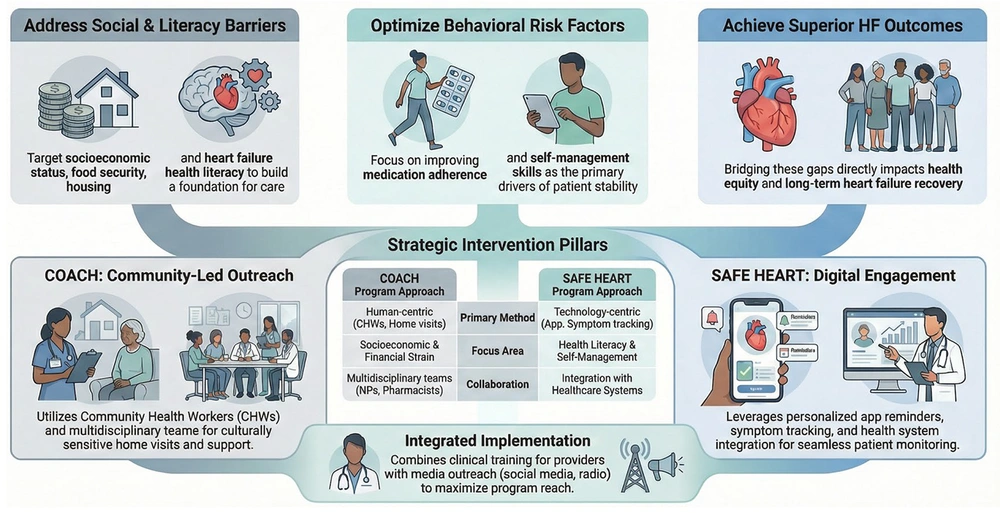
Figure 1.
Integrated Models for Heart Failure Care: Bridging Social Barriers to Improve Outcomes
Conclusion
Medication nonadherence in HF reflects broader structural and intermediary determinants, including socioeconomic barriers and limited HL. Integrating policy actions to improve medication access with community- and technology-based strategies to enhance self-management is essential for improving outcomes and advancing health equity among vulnerable HF populations.