
1. Background
End stage renal disease (ESRD) patients who undergo hemodialysis treatment suffer from immune system disorders, including the innate immune system and adaptive (acquired) or specific immune system (1, 2).
Defects in phagocytosis, as well as defects in the function of the complement system, have been reported in the innate immune system of ESRD patients (3, 4).
One of the disorders of the acquired immune system in ESRD patients is the imbalance of Th1 and Th2 cells, which leads to disorders in cellular immune response and humoral immune response (1, 5).
These immune system disorders in ESRD patients progress with the duration of kidney disease and dialysis treatment and have a significant positive statistical relationship with the prevalence of infectious diseases in these patients. Permanent chronic inflammation in these patients causes malnutrition and cachexia, which increases the severity of immune system defects in these patients (2).
The defect in the immune system of ESRD patients undergoing hemodialysis (1) makes them prone to infectious diseases (4, 5). These patients’ most important infectious pathogens are encapsulated bacteria, including Haemophilus influenzae (6, 7).
Haemophilus influenzae are Gram-negative bacilli, first described in an influenza epidemic in 1892 by Richard Pfeiffer. This bacterium was mistakenly considered the cause of influenza until 1933 when the viral agent of influenza was discovered (8). Haemophilus influenzae can be seen in two forms: capsulated and non-capsulated. Capsulated strains are divided into six groups, a, b, c, d, e, and f, based on capsular antigens (9).
Strains with serotype b capsule or H. influenzae type b (Hib) are among the most important disease-causing strains (10, 11) in children and adults, especially those with immune system defects (6). Antibiotic resistance to Hib is increasing, and its treatment has become difficult (12).
The global annual prevalence of Hib infection is 1.7 cases per 100,000 people, and this prevalence is 6.3 per 100,000 people aged 65 and over. Of these cases, 14.5% have resulted in death, and this mortality rate has increased by 20% in people aged 65 years and above (13). Thus, vaccination of at-risk individuals such as hemodialysis patients is recommended to prevent infections with this bacterium (6, 7).
Effective vaccines against Hib have been available since the early 1990s (14). The prevalence of Hib infection decreased significantly with the start of vaccination, indicating the vaccine’s effectiveness (15).
Similar to other developing countries, to reduce the cases of Hib infection and its complications, the Ministry of Health of Iran also started to use the five vaccines, including hepatitis B, diphtheria, tetanus, pertussis, and Hib type b (DTwP-Hib-HepB) from On September 19, 2014, it entered the national vaccination basket. This vaccination program has 99% national coverage (16).
In Iran, Hib vaccination is only for children and adults, and even immunocompromised adults, such as hemodialysis patients, are not vaccinated against Hib (16).
Given that “Hib is more threatening to the elderly and immunocompromised patients, such as those undergoing hemodialysis,” vaccination of hemodialysis patients against Hib seems essential. However, ESRD patients undergoing hemodialysis in Iran are not vaccinated against Hib.
2. Objectives
The purpose of this research was to investigate the prevalence of naturally acquired immunity against Hib and its relationship with the duration of dialysis treatment and the age and gender of patients in hemodialysis patients referred to Jahrom Hemodialysis Center.
3. Methods
3.1. Ethics Statement
Before starting the research, all the patients in the study completed and signed an informed consent form. The protocol used in this research was approved by the Research Ethics Committee of Jahrom University of Medical Sciences (IR.JUMS.REC.1400.095).
3.2. Participants
In this cross-sectional and descriptive research, which was conducted from June to August 2022, the research population consisted of patients with chronic kidney disease and undergoing hemodialysis treatment, referred to the Jahrom Hemodialysis Center. In this study, sampling was done by the census, and all patients (88 patients) were enrolled.
3.3. Demographic Data
Demographic data of the patients, such as sex, age, duration of hemodialysis treatment, and the number of hemodialysis sessions per week, were extracted from the patient’s medical records. None of the patients had primary or secondary immunodeficiency syndrome, and all patients had a negative Human Immunodeficiency Virus (HIV) test.
The agreement of the patients to participate in the research was the criteria for their entry into the study. Incomplete medical records of the patients, presence of primary or secondary immunodeficiency disease, positively acquired immunodeficiency syndrome (AIDS) test, receiving immunosuppressive drugs in the past month, and the history of Hib vaccination in the patients was among the exclusion criteria of this study.
3.4. Blood Sampling and Laboratory Test
In order to start the research, 3 cc of blood were taken from the patients, and the isolated patients’ sera were used to detect the qualitative amount of serum antibody against Hib polyribose-ribitol phosphate (anti-Hib PRP) to determine anti-Hib immunity. Patients’ sera were kept at -20°C until the laboratory test.
In order to evaluate immunity to Hib in the patients, the qualitative level of anti-Hib PRP antibodies in the patient’s sera was determined by the ELISA method using a specialized and commercial kit manufactured by IBL, Germany, according to the instructions in the kit. Briefly, the results of the ELISA test were interpreted as follows:
An anti-Hib PRP serum concentration under 0.15 μg/mL shows no protection against Hib. An anti-Hib PRP serum concentration equal to or more than 0.15 μg/mL and less than 1.0 μg/mL indicate short-term immunity to Hib, and patients with serum concentration of anti-Hib PRP equal to or more than 1.0 μg/mL, indicate long-term immunity to Hib (17).
3.5. Statistical Analysis
The collected data were entered by SPSS software version 21. Descriptive statistics (frequency, percentages, mean, and standard deviation) were used to present the data. Chi-square and independent t-tests were used for the comparison of anti-Hib immunity and study variables. Then, multivariable linear regression by ENTER technique was also used to investigate the association between the amount of anti-Hib PRP IgG and the study variable. A significance level of 0.05 was considered.
4. Results
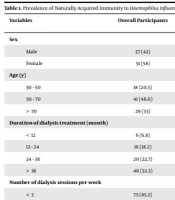
A total of 88 participants that 51 (58%) female and the rest male, were studied. The mean age of hemodialysis patients was 61.63 ± 13.26 years. Forty-six patients (52.2%) received dialysis treatment for more than 36 months, and 75 (85.2%) received dialysis less than three times per week.
The prevalence of naturally acquired immunity against Hib in participants was 26.13% (95% CI: 17.88 - 36.49%). This prevalence was 34.14% (95% CI: 21.08 - 50.14) in age groups 50 - 70 years and 33.33% (95% CI: 7.05 - 76.76) in patients who underwent hemodialysis treatment for less than 12 months (Table 1).
Table 1.
Prevalence of Naturally Acquired Immunity to Haemophilus influenzae Type-B in Hemodialysis Patients According to Demographic Variables a
| Variables | Overall Participants | Number of Immune Patients | Anti-Haemophilus influenzae Type-B Immunity (95% CI) | P-Value b |
|---|---|---|---|---|
| Sex | ||||
| Male | 37 (42) | 9 | 24.32 (12.93 - 41.0) | 0.742 |
| Female | 51 (58) | 14 | 27.54 (16.77 - 41.53) | |
| Age (y) | ||||
| 30 - 50 | 18 (20.5) | 4 | 22.22 (8.22 - 47.67) | 0.260 |
| 50 - 70 | 41 (46.6) | 14 | 34.14 (21.08 - 50.14) | |
| > 70 | 29 (33) | 5 | 17.24 (7.15 - 36.02) | |
| Duration of dialysis treatment (mo) | ||||
| < 12 | 6 (6.8) | 2 | 33.33 (7.05 - 76.76) | 0.541 |
| 12 - 24 | 16 (18.2) | 2 | 12.5 (29.02 - 40.27) | |
| 24 - 36 | 20 (22.7) | 5 | 25 (10.41 - 48.86) | |
| > 36 | 46 (52.3) | 14 | 30.43 (18.68 - 45.44) | |
| Number of dialysis sessions per week | ||||
| < 3 | 75 (85.2) | 11 | 14.66 (8.21 - 24.82) | <0.001 |
| ≥ 3 | 13 (14.8) | 12 | 9.23 (58.21 - 99.04) |
a Values are expressed as No. (%).
b Chi-square test, significant level < 0.05
Among the immune patients, nine people (10.22%, 95% CI: 5.33 - 18.71) had short-term immunity to Hib, and 14 people (15.91%, 95% CI: 9.55 - 25.30) had long-term immunity to Hib.
The prevalence of long-term immunity in patients with a history of dialysis treatment for more than 36 months and the number of dialysis sessions three times and more per week were 23.91 (95% CI: 13.56 - 38.63) and 84.61 (95% CI: 52.85 - 96.42), respectively (Table 2).
Table 2.
Prevalence of Naturally Acquired Immunity to Hib in Hemodialysis Patients According to Immunity Type
| Variables | Immunity Type % (95% CI) | P-Value* | ||
|---|---|---|---|---|
| Non-immune | Short-term Immunity | Long-term Immunity | ||
| Duration of dialysis (mo) | ||||
| < 12 | 66.66 (23.28 - 92.94) | 33.33 (7.05 - 76.71) | 0 | 0.163 |
| 12 - 24 | 87.5 (59.72 - 97.06) | 6.25 (0.79 - 35.71) | 6.25 (0.07 - 35.71) | |
| 24 - 36 | 7 5(51.11 - 89.58) | 15 (4.06 - 38.75) | 10 (2.27 - 33.67) | |
| > 36 | 69.56 (54.55 - 84.31) | 6.52 (2.05 - 18.80) | 23.91(13.56 - 38.63) | |
| Number of dialysis sessions per week | ||||
| < 3 | 85.33 (75.17 - 91.78) | 10.66 (5.03 - 20.15) | 4 (1.02 - 11.93) | < 0.001 |
| ≥ 3 | 7.69 (0.09 - 41.17) | 7.69 (0.09 - 41.17) | 84.61 (52.85 - 96.42) | |
a Chi-square test, significant level < 0.05
Furthermore, the number of dialysis sessions per week in the short-term and long-term Immune groups was 2.55 ± 1.01 vs. 3.92 ± 0.61 (P = 0.001). The mean duration of dialysis treatment in the short-term Immune and long-term Immune groups were 12.67 ± 12.69 vs. 44.07 ± 14.79 (P = 0.006).
The results of multivariable linear regression showed that for one unit of change in the number of dialysis sessions per week, the average serum level of anti-Hib PRP IgG increased by 0.562 μg/mL (P < 0.001). In addition, age, sex, and duration of dialysis treatment had no association with the serum level of anti-Hib PRP IgG (Table 3).
Table 3.
Factors Affecting Serum Level of anti-Haemophilus influenzae Type-B PRP IgG (μg/mL) Using the Multivariable Linear Regression Modela
| Variables b | Category | B | SE | Standardized Coefficients Beta | P-Value c |
|---|---|---|---|---|---|
| Age (y) | NA | -0.004 | 0.004 | -0.085 | 0.334 |
| Duration of dialysis treatment (mo) | NA | 0.005 | 0.005 | 0.097 | 0.304 |
| Number of dialysis sessions per week | NA | 0.420 | 0.069 | 0.562 | < 0.001 |
| Sex | 0.631 | ||||
| Male | -0.057 | 0.119 | 0.042 | ||
| Female | Ref | NA | NA |
Abbreviations: NA, Not applicable; Ref, reference group.
a Model-based on 87 Observations, Adjusted R-squared = 34.6%, P < 0.001
b Variables entered in the model: Age (year), duration of dialysis (month), and the number of dialysis sessions per week as quantitative variables and sex as qualitatively variable.
c Significant level < 0.05
5. Discussion
Immunodeficiency is the most common problem in hemodialysis patients (1, 2), which worsens with the increasing duration of kidney disease and dialysis treatment (1). Immunodeficiency in hemodialysis patients makes them susceptible to various infections (4, 5). For the first time in Iran, this research determined the prevalence of naturally acquired immunity to Hib and the factors affecting it in hemodialysis patients.
The prevalence of naturally acquired immunity to Hib in hemodialysis patients was 26.13% (10.22% short-term immunity to Hib and 15.91% long-term immunity to Hib), including 24.32 % of men and 27.54 % of women. Also, this prevalence was 34.14% in the age group 50 - 70 years and 33.33% in patients who underwent hemodialysis treatment for less than 12 months.
This research was conducted for the first time in Iran, and there is no information about the prevalence of naturally acquired immunity against Hib in Iranian hemodialysis patients to compare their results with the results of the present study, but there are some studies about the prevalence of naturally acquired immunity against Hib in hemodialysis patients, which were done in other countries, and there are some studies about the prevalence of Hib in Iran (but not in hemodialysis patients), which shows the importance of the issue.
A study by Nix et al. showed that 29% of hemodialysis patients and 3% of healthy people had acquired natural immunity against Hib, which indicates that Hib is one of the infectious agents in these hemodialysis patients (6).
Gaultier et al. reported that 100% of hemodialysis patients had natural anti-Hib antibodies (without vaccination) in their serum and concluded that Hib is one of the infectious agents in these patients (18).
Pormohammad et al. reported 60% of the bacterial causes of meningitis in children in Tehran Hib (19).
In 2013, Emaneini’s research in Yasouj reported Hib as 5% of children’s tonsils and middle ear infections (20).
Berangi et al. reported Hib to be 12.78% of the agent causing meningitis in children before vaccination in Iran (21), and in the report by Heidari et al., the involvement of Hib in children’s meningitis decreased to 3.6% after vaccination in Iran (16).
The results of the present study are consistent with the results of research works which have been done by Nix et al. (6) and Gaultier et al. (18) that ESRD patients undergoing hemodialysis are at high risk of Hib infection and suggested Hib vaccination in these patients.
We found a significant relationship between the prevalence of long-term immunity in patients and the number of dialysis sessions three times per week (P < 0.001). This finding is consistent with the results of previous research that this factor is associated with the severity of kidney disease and subsequently with the severity of immune system deficiency (1, 4, 5). As in Iran, adults and even immunocompromised adults such as hemodialysis patients are not vaccinated against Hib (16). So, if antibodies against the polysaccharide capsule of this bacterium are found in the serum of these people, it indicates their previous infection with Hib (22). According to previous studies, “Short-term immunity is obtained from incomplete vaccination or after one Hib infection, and long-term immunity is obtained from complete vaccination or after two or more Hib infections” (23, 24). Patients with a greater number of dialysis sessions per week have more history of Hib infections and have long-term immunity to Hib.
In this present research, we found that age and duration of dialysis treatment were predictors of acquired immunity to Hib in hemodialysis patients. This finding is not parallel with the results of previous studies that reported these factors are associated with the severity of renal failure and subsequently with the severity of immunodeficiency (1, 4, 5). This inconsistency may be due to the small number of patients studied in the present study.
The limitations of this research can be mentioned in the small number of studied patients, as well as the lack of determination of serum levels of factors affecting the immune system, such as vitamins and trace elements (25) and their association with naturally acquired immunity to Hib in these patients. In this research, only the immunological tool, i.e., an antibody against this bacterium, was used as an indicator of the history of the previous infection with this bacterium in patients, and clinical findings were not used. Also, it would be better if this research was done on healthy people as well. But due to a lack of funds, this was not possible.
5.1. Conclusions
In conclusion, the result of the present study showed that the prevalence of naturally acquired immunity against Hib is 26.13% (10.22% short-term immunity to Hib and 15.91% long-term immunity).
Considering that ESRD patients with maintenance hemodialysis therapy are not vaccinated against Hib in Iran, it can be concluded that 26.13% of the hemodialysis patients studied in this research had a history of Hib infection (10.22% had at least one history of Hib infection and 15.91% had two or more histories of Hib infection). Considering the predisposition of ESRD patients to Hib infection and as this infection is preventable with vaccination, it is recommended to conduct case-control research with a high sample size on hemodialysis patients to accurately determine the prevalence of Hib and to decide on the implementation of the Hib vaccination program in these patients.