
1. Background
More than 670000 deaths worldwide were attributed to breast cancer in 2022. It is estimated that by 2050, the number of breast cancer cases will increase by 38%, and deaths will increase by 68%. Breast cancer has a greater impact in low- and middle-income countries (1, 2).
Triple-negative breast cancer (TNBC) is a difficult-to-treat subtype that accounts for approximately 15% - 20% of all breast cancer cases and remains a major challenge in cancer treatment. It is characterized by the absence of estrogen receptors, progesterone receptors, and human epidermal growth factor receptor 2; therefore, it does not respond to hormone or HER2-targeted therapies. The 5-year survival rate is less than 77%, and treatment largely relies on chemotherapy, which can cause adverse effects and resistance (3, 4).
Epidermal growth factor receptor (EGFR), a tyrosine kinase receptor located in the plasma membrane and a member of the ErbB family, regulates cell growth, invasion, and metastasis through pathways such as phosphoinositide 3-kinase/protein kinase B and the mitogen-activated protein kinase pathway. Because EGFR is overexpressed in up to 60% of TNBC tumors, it is considered an important therapeutic target (5, 6).
The MDA-MB-231 cell line, which is derived from pleural effusion, is commonly used as a TNBC model because of its rapid growth, high invasiveness, and strong EGFR expression (7).
Phoenix dactylifera is a date palm species that grows mainly in the Canary Islands, North Africa, the Middle East, Pakistan, India, and California (8). Phoenix dactylifera leaf extract is being investigated in nutraceutical and traditional medicine research for its potential anticancer properties, particularly in therapies targeting EGFR. This extract is rich in polyphenols, flavonoids, and ferulic acid derivatives and has low toxicity and multifaceted biological effects. Its therapeutic effectiveness may even exceed that of synthetic EGFR inhibitors, such as gefitinib, which are often associated with drug resistance (9, 10).
Previous studies have reported that seed-derived fractions of the Khalas variety decreased EGFR and extracellular signal-regulated kinase 1/2 expression in MDA-MB-231 cells without affecting AKT signaling, highlighting the key role of the MAPK pathway (11). In addition, Khalas leaf extracts inhibit prostate and pancreatic cancer cell growth by increasing EGFR dephosphorylation and triggering apoptosis (12).
2. Objectives
Although fruit- and seed-derived compounds inhibit EGFR through the MAPK pathway, research on date palm leaves in TNBC has largely been limited to general antiproliferative effects, and little is known about dose–time relationships or underlying mechanisms. Given the limited availability of targeted treatments for TNBC metastasis, this study aimed to integrate plant-based compounds and genomic data to identify safe and effective nutraceuticals to address treatment gaps by investigating the concentration- and time-dependent effects of Phoenix dactylifera leaf extract on EGFR expression in MDA-MB-231 cells.
3. Methods
3.1. Preparation of Phoenix Dactylifera Leaf Extract
The leaf extract was prepared using standard procedures for isolating bioactive compounds, with slight modifications for this study. Phoenix dactylifera leaves and fibers were treated with sodium hydroxide and hydrogen peroxide at neutral pH to remove lignin. The delignified material was dried, powdered, and suspended in 2% acetic acid.
Cellulase was added at 1 g/kg substrate, and the mixture was mixed thoroughly. Hydrolysis was performed under anaerobic and dark conditions for 40 days to extract the bioactive components. After acetic acid was removed by vacuum distillation, 100 g of dry extract was obtained from 10 kg of leaves, yielding 1%. The yield was calculated using the following formula:
3.2. Alamar Blue Assay
The extract was dissolved in phosphate-buffered saline (PBS; Bio-idea, Iran) and sterilized using a 0.22-μm filter. MDA-MB-231 cells (Pasteur Institute Cell Bank, Iran) were seeded at 50000 cells per well in 24-well plates containing 1.5 mL of RPMI-1640 medium (Bio-idea, Iran) supplemented with 10% fetal bovine serum (Bio-idea, Iran) and 1% penicillin-streptomycin (Bio-idea, Iran). The cells were incubated at 37°C with 5% CO2 for 24 hours to allow attachment.
Cells were treated with sterile extract at concentrations of 10, 50, and 250 μg/mL. The control group was treated with PBS. After incubation, 10% (v/v) Alamar Blue (Thermo Fisher, USA) was added, and the plates were incubated for 2 - 4 hours. Absorbance was then measured at 570 nm, with 600 nm as the reference wavelength, using a microplate reader (BioTek Epoch, USA). Cell viability was calculated using the following formula:
Cell viability (%) = (absorbance of treated sample / absorbance of control) × 100
3.3. Treatment of the MDA-MB-231 Cell Line With Phoenix Dactylifera Leaf Extract
Cells were cultured in RPMI-1640 medium supplemented with serum and antibiotics at 37°C. After trypsinization, cells were counted using a hemocytometer, and 50000 cells were seeded in 1.5 mL of medium per well. Cells were then treated with sterile extract at 10, 50, and 250 μg/mL or with PBS for 24 hours.
3.4. RNA Extraction and cDNA Synthesis
RNA purification was performed using RNX-Plus solution (SinaClon, Iran). RNA concentration and quality were determined at 260/280 nm using a NanoDrop spectrophotometer (BioTek, USA). RNA integrity was confirmed by 1% agarose gel electrophoresis and observation of the 18S and 28S ribosomal RNA bands. Complementary DNA (cDNA) was synthesized using a commercial kit (SinaClon, Iran) and a thermal cycler (ABI Veriti, USA) and stored at -20°C.
3.5. Evaluation of EGFR Gene Expression by Real-time PCR
Reverse transcription polymerase chain reaction was performed using Real-Time Master Mix (Ampliqon, Denmark). The following primers were used: forward 5’-GTGAGCAGATCGCAAAGG-3’ and reverse 5’-CTTTGATCTTGACATGCTGC-3’ for the EGFR gene, and forward 5’-GAGCATCCCCCAAAGTTCACA-3’ and reverse 5’-GGGACTTCCTGTAACAACGCA-3’ for the β-actin gene. Amplification was performed using a real-time PCR system (ABI StepOne, USA). Threshold cycle values were determined, and EGFR expression levels were normalized to the housekeeping gene β-actin using the ΔCt method. Fold change in gene expression was calculated using the 2-ΔΔCt formula:
The quantitative PCR temperature program began with initial denaturation at 95°C for 15 minutes, followed by 40 cycles of denaturation at 95°C for 30 seconds, annealing at 59°C for 30 seconds, and extension at 72°C for 30 seconds.
3.6. Statistical Analysis
Quantitative reverse transcription polymerase chain reaction results were analyzed using the 2-ΔΔCt method for relative quantification (RQ), normalized to β-actin. The ΔCt was determined using the equation ΔCt = Ct(EGFR) - Ct(β-actin), and ΔΔCt was calculated as ΔCt(treatment) - mean ΔCt(control). Relative quantification was then computed as RQ = 2-ΔΔCt.
Descriptive statistics were used to calculate the mean and standard deviation. One-way analysis of variance was used to assess variation in the RQ variable among different doses (10, 50, and 250 μg/mL) and the control group. The Bonferroni multiple-comparison test was used to compare each pair of doses, and the Dunnett test was used to compare each dose with the control group. All data analyses were performed using SPSS version 25 (Chicago, IL, USA). P values less than 0.05 were considered statistically significant.
4. Results
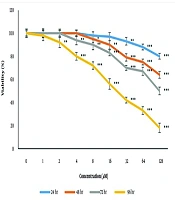
The Alamar Blue assay showed no change in the percentage of cell viability in the treated samples compared with the control group.
In this study, one-way analysis of variance was used to evaluate the effects of different treatments on EGFR gene expression in the MDA-MB-231 cell line. The Dunnett T3 method, which is appropriate under conditions of unequal variance, was used for post hoc comparisons.
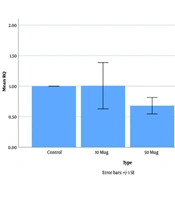
Analysis of variance indicated that the difference in EGFR gene expression across the groups was close to significance (P = 0.013). The Dunnett T3 post hoc test showed a significant difference between the control group and the 250 μg/mL group (P = 0.010), whereas the other comparisons were not significant. Overall, these findings suggest that increasing the treatment concentration to 250 μg/mL resulted in a significant decrease in EGFR gene expression in the TNBC MDA-MB-231 cell line compared with the control group (Table 1 and Figure 1).
Table 1.
Effects of Different Doses on Relative Quantification
| Group | Mean RQ ± SD | P-Value (vs Control) |
|---|---|---|
| Control | 0.000 ± 1.000 | - |
| 10 μg/mL | 0.65516 ± 1.0067 | 1.000 |
| 50 μg/mL | 0.268 ± 0.680 | 0.407 |
| 250 μg/mL | 0.167 ± 0.160 | 0.010 a |
a P < 0.05 was considered statistically significant.
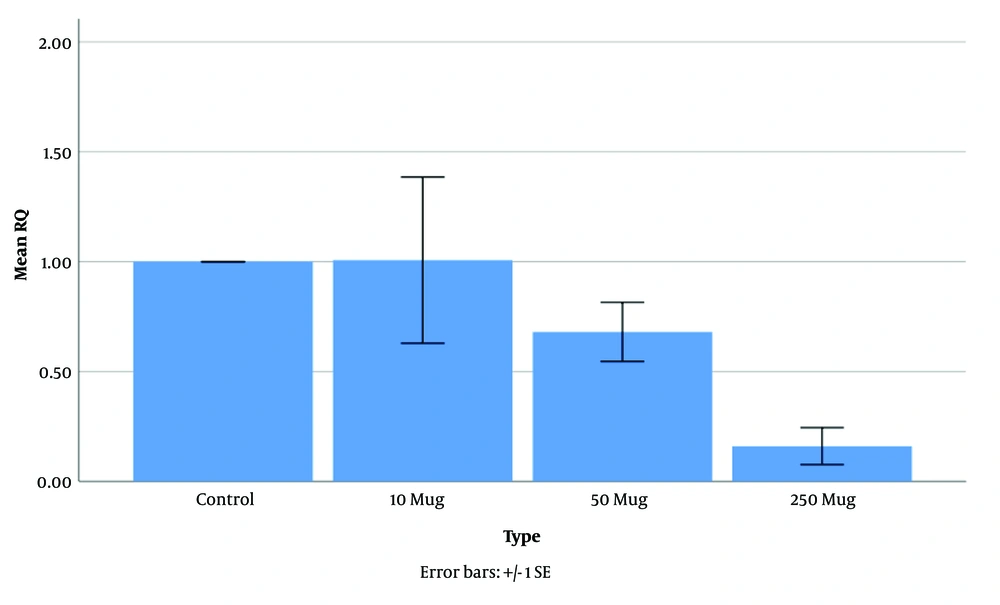
Figure 1.
Comparison of gene expression between groups
5. Discussion
Triple-negative breast cancer is one of the most aggressive subtypes of breast cancer and is associated with a poor prognosis, high recurrence rates, and early metastasis. In recent years, many studies have focused on identifying molecular markers involved in the growth and progression of TNBC. Among these markers, EGFR is a key target. The EGFR overexpression or uncontrolled activation has been observed in patients with TNBC and is correlated with more aggressive tumor behavior, drug resistance, and poorer overall survival. Therefore, EGFR is a potential prognostic marker and therapeutic target in TNBC.
Bioactive compounds derived from Phoenix dactylifera, including polyphenols, flavonoids, tannins, and anthocyanins, have notable antioxidant and anti-inflammatory properties. Studies have shown that these compounds may contribute to the prevention and suppression of breast cancer cell growth by scavenging free radicals, reducing lipid peroxidation, and modulating cellular signaling pathways. Various parts of the date palm, particularly the leaves, have demonstrated significant anticancer potential, with concentration-dependent cytotoxic effects and the ability to inhibit the proliferation of human cancer cell lines such as AMJ13 and MCF7. In addition, leaf extracts have shown inhibitory effects on glioblastoma and breast cancer cells by inducing mechanisms that reduce cell adhesion, migration, and invasion through interference with integrin receptors, thereby directly contributing to decreased tumor metastatic potential.
The leaf extract of P. dactylifera showed a concentration-dependent regulatory effect on EGFR gene expression in the MDA-MB-231 cell line. A concentration of 250 μg/mL caused a significant reduction in EGFR gene expression after 24 hours of treatment. This marked decrease may inhibit EGFR activity by interfering with key pathways involved in cell proliferation and survival. These results are consistent with previous studies demonstrating the anticancer properties of P. dactylifera. However, most earlier research focused on fruit and seed extracts, which suppressed the growth of MDA-MB-231 cells mainly through mechanisms involving apoptosis induction and modulation of the PI3K/AKT signaling pathway (13). The reduction observed in EGFR expression at 250 μg/mL also aligns with the effects reported for other phytochemicals, such as curcumin, which suppresses TNBC cell proliferation by targeting similar signaling pathways. For instance, a recent study showed that curcumin complexes, even at lower doses, can inhibit MDA-MB-231 cell proliferation after 48 hours of exposure (14).
5.1. Conclusions
Further investigation is needed to identify the bioactive compounds and enable more precise inference of their mechanisms of action. Therefore, future studies should focus on compound fractionation using high-performance liquid chromatography, testing the effects of these compounds in vivo models, and conducting protein validation assays to explore their functional roles.