




1. Background
2. Objectives
3. Methods
3.1. Training Protocol
3.2. Statistical Analysis
4. Results
| Variables | Control; Pre-test, Post-test | Training; Pre-test, Post-test |
|---|---|---|
| Weight (kg) | 77.6 ± 6.5, 78 ± 6.7 | 77.3 ± 12.3, 76 ± 12 a, b |
| BMI (kg.m-2) | 25 ± 1.4, 25.1 ± 1.3 | 24.4 ± 2.6, 24.5 ± 2.7 |
| HDL (mg.dL-1) | 41.7 ± 7.6, 42 ± 8.7 | 42.8 ± 8, 45.6 ± 7 b |
| LDL (mg.dL-1) | 112 ± 30, 115 ± 30 | 117 ± 37, 95 ± 35 a, b |
| TC (mg.dL-1) | 198 ± 36, 199 ± 37 | 200 ± 50, 165 ± 36 a, b |
| TG (mg.dL-1) | 162 ± 16, 163 ± 16 | 144 ± 69,130 ± 57 a, b |
| Glucose (mg.dL-1) | 96 ± 12, 98 ± 13 | 95 ± 14, 92 ± 11 a, b |
| AST (U.L-1) | 18.9 ± 5, 19.7 ± 5.5 a | 20.2 ± 4.7, 17.5 ± 4.3 a, b |
| ALT (U.L-1) | 16.2 ± 2, 17.2 ± 2 a | 18.1 ± 5, 15.7 ± 4.5 a, b |
| IL-6 (pg.mL-1) | 13.6 ± 2.7, 14 ± 2.8 | 14.1 ± 2.5, 7.3 ± 3 a, b |
| Hs-CRP(mg.L-1) | 3 ± 0.9 , 3.06 ± 0.9 | 4.1 ± 2.8,1.6 ± 1.2 a, b |
a Significant difference with pre-test.
b Significant differences with changes (∆) in the control group.
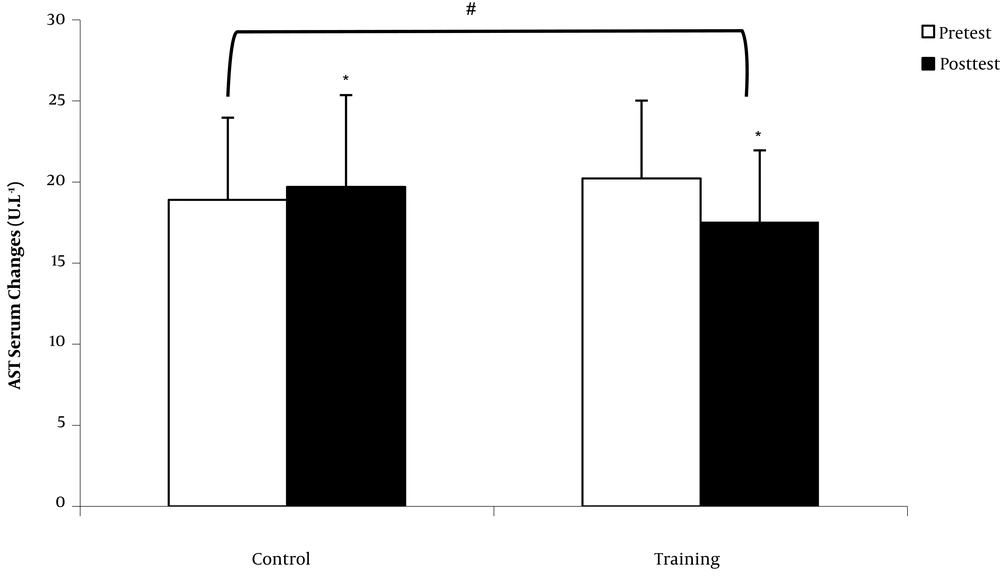
Serum changes in liver aspartate transaminase of the studied groups. * Significant difference with pre-test (P < 0.05); # Significant differences with (∆) the control group (P < 0.05).
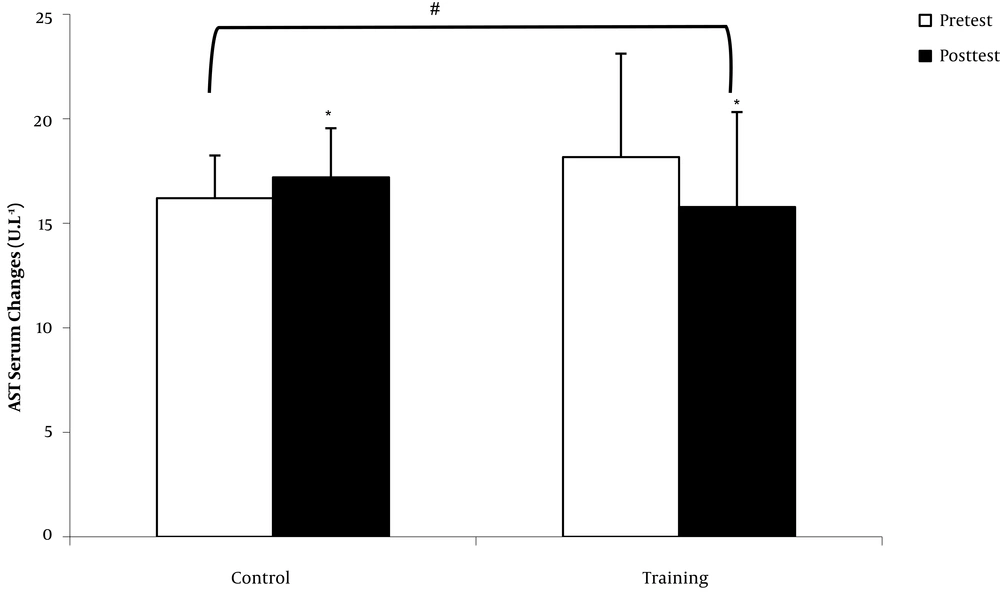
Serum changes in liver alanine transaminase of the studied groups. * Significant difference with pre-test (P < 0.05); # Significant differences with (∆) the control group (P < 0.05).
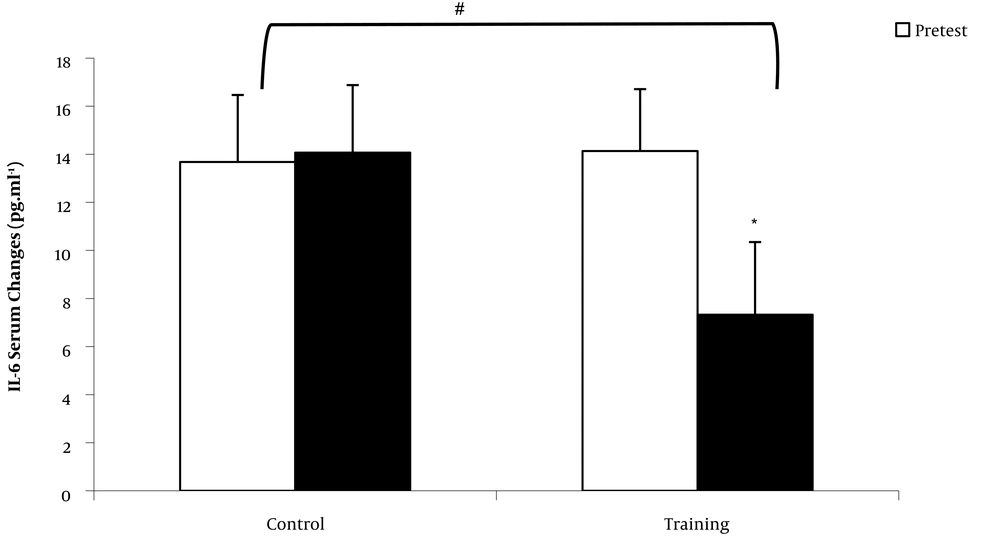
Serum changes in IL-6 of the studied groups. * Significant difference with pre-test (P < 0.05); # Significant differences with (∆) the control group (P < 0.05).
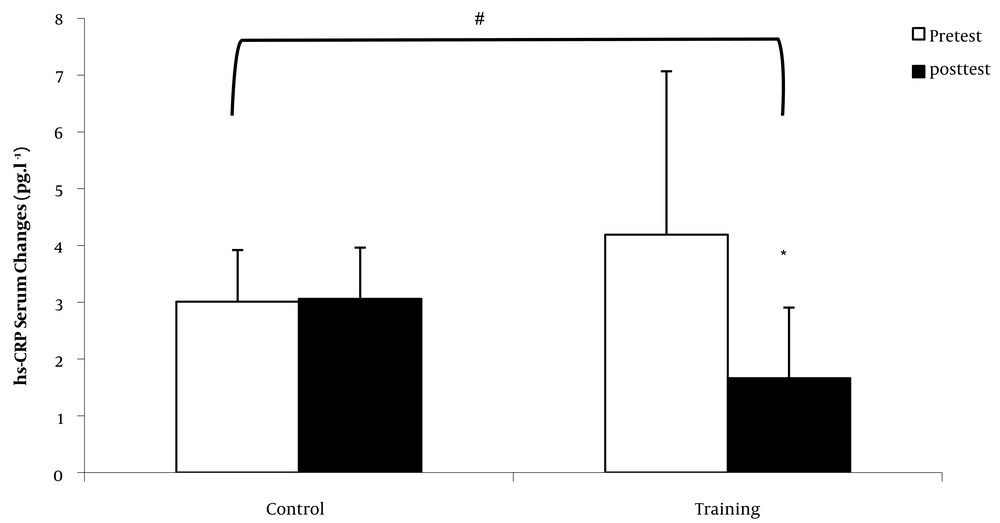
Serum changes in high-sensitivity CRP of the studied groups. * Significant difference with pre-test (P < 0.05); # Significant differences with (∆) the control group (P < 0.05).
