J Arch Mil Med

Image Credit:J Arch Mil Med

Phytochemical Profiling and Antibacterial Potential of Terminalia chebula from Southern Iran Against β-Lactam-Resistant Gastrointestinal and Nosocomial Pathogens

Author(s):
Mohammad KordkatouliMohammad KordkatouliMohammad Kordkatouli ORCID1, 2, Aryan SateeiAryan SateeiAryan Sateei ORCID3, 2,*, Hadi KoohsariHadi KoohsariHadi Koohsari ORCID4,**
1Department of Genetics, Faculty of Advanced Sciences and Technology, TeMS.C, Islamic Azad University, Tehran, Iran
2Medicinal Plants Research Center, Go.C, Islamic Azad University, Gorgan, Iran
3Department of Plant Sciences, Faculty of Sciences, Go.C, Islamic Azad University, Gorgan, Iran
4Department of Microbiology, Az.C, Islamic Azad University, Azadshahr, Iran
Corresponding Authors:

Journal of Archives in Military Medicine:Vol. 13, issue 4; e166321
Published online:Dec 31, 2025
Article type:Research Article
Received:Sep 14, 2025
Accepted:Dec 20, 2025
How to Cite:Kordkatouli M, Sateei A, Koohsari H. Phytochemical Profiling and Antibacterial Potential of Terminalia chebula from Southern Iran Against β-Lactam-Resistant Gastrointestinal and Nosocomial Pathogens. J Arch Mil Med. 2025;13(4):e166321. doi: https://doi.org/10.69107/jamm-166321

Abstract

Background:

The global rise of β-lactam-resistant bacteria significantly threatens public health, limiting treatment options and increasing morbidity and mortality. Nosocomial and gastrointestinal pathogens are particularly concerning in high-density environments such as military settings. Natural products, including Terminalia chebula, have shown antimicrobial, and antioxidant properties, making them promising alternatives or adjuncts to conventional antibiotics.

Objectives:

This study aimed to investigate the phytochemical composition, antibacterial activity, β-lactamase inhibition, and antioxidant potential of T. chebula extracts against β-lactam-resistant gastrointestinal and nosocomial pathogens.

Methods:

Fruits of T. chebula were collected from Minab County, Iran, dried, powdered, and extracted using ethanol and propanol. Gas chromatography-mass spectrometry (GC-MS) analysis was performed to identify bioactive compounds. Antioxidant activity was evaluated via 2,2-diphenyl-1-picrylhydrazyl (DPPH) assay. Antibiotic susceptibility of Staphylococcus aureus, Pseudomonas aeruginosa, Shigella dysenteriae, and Enterococcus faecalis was assessed by disk diffusion. β-lactamase activity was measured using the iodometric assay. Antibacterial effects were tested via well diffusion, minimum inhibitory concentration (MIC), and minimum bactericidal concentration (MBC) assays. Statistical analyses included analysis of variance (ANOVA) and post-hoc tests.

Results:

The GC-MS analysis was performed on the ethanolic extract, identifying major compounds including 1,2,3-benzenetriol, phenol, benzoic acid, hexadecanoic acid, and D-limonene, accounting for over 80% of the extract. While the antioxidant activity was evaluated using the methanolic extract (IC50 = 0.1996 ± 0.017 mg), antibacterial activity, including disk diffusion, MIC, and MBC assays, was assessed using the ethanolic extract. The ethanolic extract exhibited dose-dependent antibacterial effects, with the highest activity against S. aureus (inhibition zone: 37.50 ± 2.64 mm; MIC: 1.56 mg/mL; MBC: 3.12 mg/mL). β-lactamase activity was highest in S. aureus and lowest in P. aeruginosa. Overall, the ethanolic extract demonstrated stronger antibacterial activity than the propanolic extract.

Conclusions:

Terminalia chebula contains bioactive compounds with significant antibacterial, β-lactamase inhibitory, and antioxidant properties. The results support its potential as a natural alternative or adjunct therapy for β-lactam-resistant infections. Further in vivo studies and clinical trials are recommended to explore practical applications in clinical and high-risk environments.

1. Background

The emergence and rapid spread of antibiotic-resistant pathogenic bacteria, particularly strains resistant to β-lactam antibiotics, represent a major threat to global public health, clinical care quality, and patient safety. According to the World Health Organization (WHO), antimicrobial resistance (AMR) accounts for at least 700,000 deaths annually, a number that could rise to 10 million by 2050 if effective measures are not implemented. Resistance to β-lactam antibiotics — including penicillins, cephalosporins, and carbapenems — has markedly reduced the efficacy of frontline therapies, limiting treatment options and contributing to increased morbidity, mortality, and healthcare costs (1-3).

Nosocomial and gastrointestinal pathogens are among the leading causes of infections in both civilian and military settings. High-density and high-risk environments such as military hospitals, field clinics, barracks, and operational deployments amplify the risk of rapid pathogen transmission due to close contact among personnel, operational stress, limited hygiene and sterilization facilities, and restricted access to medical resources. Many of these pathogens produce β-lactamase enzymes, which hydrolyze β-lactam antibiotics and render them ineffective, further complicating infection control and treatment, particularly during wartime or military operations where standard medical care is often limited (1, 3-5).

Natural products, especially medicinal plants, have long been recognized as valuable sources of antimicrobial and antioxidant compounds. Terminalia chebula is traditionally used for its antimicrobial, antioxidant, and anti-inflammatory properties. Previous studies have shown that its bioactive compounds can inhibit the growth of various bacterial strains, including antibiotic-resistant pathogens, and reduce oxidative stress, which is commonly elevated during infection and inflammation. These characteristics make T. chebula a promising candidate for alternative or adjunctive therapies, particularly in resource-limited or high-risk environments such as military healthcare settings (1, 2).

By investigating the phytochemical composition, antibacterial activity, and antioxidant potential of T. chebula extract, as well as evaluating β-lactamase activity levels in gastrointestinal and nosocomial β-lactam-resistant pathogens, this study provides insights into the potential application of natural plant extracts for controlling resistant infections, mitigating oxidative damage, and supporting the health and operational readiness of personnel in both clinical and military contexts (1 - 5).

2. Objectives

The main objective of this study was to evaluate the potential of T. chebula extract as a natural therapeutic agent against β-lactam-resistant gastrointestinal and nosocomial pathogens. Specifically, the study aimed to:

1. Analyze the phytochemical composition of T. chebula extract and identify its bioactive compounds.

2. Assess its antibacterial activity against selected β-lactam-resistant bacterial strains using well diffusion, minimum inhibitory concentration (MIC), and minimum bactericidal concentration (MBC) assays.

3. Evaluate its antioxidant potential to mitigate oxidative stress associated with infection.

The findings are intended to provide evidence for the use of T. chebula as an alternative or adjunctive therapy to control resistant infections and improve health outcomes in both clinical and military environments.

3. Methods

3.1. Study Area and Climatic Description

The present study was conducted in Minab County, located in the southeastern part of Hormozgan Province, Iran, approximately 90 km east of Bandar Abbas, the provincial capital. The geographical coordinates of the Minab synoptic meteorological station are 27.107°N latitude and 57.089°E longitude, with an elevation of 29.6 meters above sea level (Station ID: 40876).

This region exhibits a hot semi-arid (steppe) climate, characterized by long, extremely hot summers and mild winters, accompanied by low and irregular precipitation. Comprehensive climatic data for the year 2024 were obtained from the Islamic Republic of Iran Meteorological Organization based on observations recorded at the Minab synoptic station.

The maximum daily temperatures ranged from 26.8°C in January to 49.7°C in June, while minimum daily temperatures varied between 6.5°C in December and 30.1°C in July. The highest mean monthly temperature was recorded in August (~36.9°C), whereas the lowest averages occurred in January and February (14.3 - 14.6°C). Relative humidity levels peaked during the winter months, reaching 100% in January, February, and December, but dropped significantly in the pre-summer and summer months, with the lowest average humidity recorded in May and June (32.8%).

Annual precipitation was extremely low, with measurable rainfall occurring only in January (1.11 mm), February (~54 mm), March (~14 mm), and December (~3.1 mm), amounting to a total annual precipitation of less than 75 mm, classifying the area as arid. Global solar radiation (radglo24) values remained consistently high throughout the year, ranging from 217 W/m² in March to 345.5 W/m² in May, indicating intense solar exposure. The predominant wind direction was from the southwest (225°), with average wind speeds ranging from 1.4 to 3.2 m/s, and maximum wind gusts reaching up to 14.2 m/s in June.

These extreme environmental parameters — including high ambient temperatures, solar radiation, seasonal drought, and fluctuating humidity — are considered significant abiotic stressors that may influence the biosynthesis, composition, and accumulation of secondary metabolites in medicinal plant species such as T. chebula.

3.2. Plant Identification and Collection

Over the course of one year, from 2024 to 2025, field operations were conducted to identify and collect the natural habitats of medicinal plant species in the Minab region. These operations included visiting various areas and collecting plant samples from their natural habitats. The samples were accurately identified and confirmed by experts from the Herbarium of Islamic Azad University, Gorgan Branch. Then, the required plant for experiments and extract preparation was stored under appropriate conditions. These conditions included a dark, cool, and dry environment to ensure complete removal of moisture from the plants. After drying, the fruits of T. chebula were carefully ground using a Panasonic MJ-J176P device from Japan and uniformly powdered to prepare them for the extraction stage. The powder was then stored in airtight containers under cool and dry conditions to maintain its quality and prevent potential contamination (1 , 2).

3.3. Preparation of the Terminalia chebula Extracts

Extraction of phytoconstituents from T. chebula fruit powder was performed using the cold maceration technique. Precisely 5.0 g of powdered dried fruit material was immersed in 50 mL of 70% ethanol (Merck, Germany) and maintained at 4°C for 14 days in a sealed container, protected from light to prevent photodegradation. Upon completion of the maceration period, the mixture was centrifuged at 4000 rpm for 20 minutes using a laboratory centrifuge (Behdad BH-1200, Iran), and the resulting supernatant was carefully decanted (1 , 2).

The solvent was subsequently removed by vacuum distillation using a rotary evaporator (Heidolph Hei-VAP Expert, Germany) operating under reduced pressure. The obtained crude extract was further air-dried at ambient temperature for 48 hours to ensure complete solvent removal. This process yielded approximately 1.50 g of dried ethanolic extract from the original 5 g of plant powder (1).

Following removal of the ethanolic fraction, the residual plant material was subjected to a secondary extraction under identical maceration conditions using 50 mL of 96% n-propanol (Merck, Germany) at 4°C for an additional 14 days. Post-extraction, the mixture was centrifuged, and the propanolic phase was similarly concentrated and dried, resulting in approximately 0.7 g of dried propanolic extract. Both the ethanolic and propanolic extracts were transferred into airtight amber glass containers and stored at 4°C until further phytochemical and biological analyses (1).

3.4. Gas Chromatography-Mass Spectrometry Analysis of Extracts of Terminalia chebula

The phytochemical constituents of T. chebula extracts were identified and characterized using gas chromatography-mass spectrometry (GC-MS). Analyses were conducted on an Agilent 6890 Series gas chromatograph coupled with an Agilent 5973 Network mass selective detector (Agilent Technologies, USA) (1).

Separation of volatile components was carried out using an HP-5MS capillary column (30 m × 0.25 mm internal diameter, 1.00 μm film thickness). High-purity helium (99.999%) served as the carrier gas, maintained at a constant flow rate of 1.0 mL/min. Sample injection was performed in split mode with a 1:5 split ratio, and the injector temperature was set at 280°C.

The GC oven was programmed as follows: The initial temperature was held at 60°C for 2 minutes, followed by a linear ramp of 5°C/min until reaching 280°C, which was maintained for 20 minutes. The total runtime of the analysis was 66 minutes.

Mass spectrometric detection was carried out using electron impact ionization (EI) at 70 eV. The quadrupole mass analyzer was operated in full scan mode, with a mass range of m/z 40 - 500. The ion source and quadrupole temperatures were maintained at 230°C and 150°C, respectively. A solvent delay of 3 minutes was applied to prevent solvent interference.

Identification of the chemical compounds was performed by comparing the obtained mass spectra and retention indices with reference spectra available in the National Institute of Stabdards and Technology (NIST) and Wiley Mass Spectral Libraries, as well as corroborative data from previously published literature (1 , 2).

3.5. Antioxidant Activity

Determination of antioxidant activity using the via 2,2-diphenyl-1-picrylhydrazyl (DPPH) assay was based on the reduction in absorbance at 517 nm due to the scavenging of the stable free radical DPPH. In the presence of antioxidants, the deep violet color of DPPH fades to yellow as it gets reduced, resulting in a measurable decrease in absorbance (6). Initially, Extract of T. chebula were prepared in 80% methanol (Merck, Germany) at a concentration of 50 mg/mL. In some cases, the samples were diluted with a dilution factor of 2. For the assay, 0.25 mL of the appropriately diluted extract (to ensure absorbance was within the range of 0.200 - 0.800) was mixed with 3.0 mL of a 0.09 mg/mL methanolic solution of DPPH. The reaction mixture was incubated in the dark for 20 minutes, after which the absorbance was measured at 517 nm using a Cary UV-Vis 4000 spectrophotometer. The percentage of DPPH radical scavenging activity was calculated using the following formula:

To generate the calibration curve and calculate IC50 values, ascorbic acid (vitamin C) of analytical grade from Sigma-Aldrich (UK) was used in the concentration range of 0.150–0.275 mg/mL. Results were expressed as percentage inhibition and IC50 values in mg/mL and µg/mL.

3.6. Bacterial Strain

The bacterial strains employed in this study included Staphylococcus aureus (PTCC 1431), Pseudomonas aeruginosa (PTCC 1430), Shigella dysenteriae (PTCC 1188), and Enterococcus faecalis (PTCC 1778). All strains were obtained in lyophilized form from the Iranian Research Organization for Science and Technology (IROST, Iran).

The lyophilized cultures were revived under aseptic conditions in the microbiology laboratory of Islamic Azad University, Gorgan Branch. Each strain was initially cultured in Brain Heart Infusion (BHI) broth (Merck, Germany) and incubated at 37°C for 24 hours using a laboratory incubator (Memmert, Germany).

Subsequently, isolated colonies from each 24-hour culture were transferred into Nutrient Broth (Himedia, India) and further incubated at 37°C for 1 - 2 hours until the turbidity of the suspension reached 0.5 McFarland standard, corresponding to approximately 1.5 × 10⁸ CFU/mL, as previously described (1).

3.7. Screening of Pathogenic Bacteria for Sensitivity and Resistance to Selected β-Lactam Antibiotics

To evaluate the sensitivity and resistance of the tested pathogenic bacteria against β-Lactam antibiotics, the disk diffusion method was employed. A bacterial suspension equivalent to 0.5 McFarland standard (approximately 1.5 × 10⁸ CFU/mL) was prepared and uniformly spread over the surface of Mueller-Hinton Agar (Ibresco, Italy). Standard antibiotic disks including Penicillin G (10 U), Ampicillin (10 µg), Penicillin V (10 U), Ceftriaxone (30 µg), Cefotaxime (30 µg), Ceftazidime (30 µg), and Cefixime (10 µg) (Padtan Teb Company, Iran) were placed on the agar surface. The plates were then incubated at 37°C for 24 to 48 hours. After incubation, the inhibition zones were measured, and bacterial sensitivity or resistance to each antibiotic was determined accordingly (1, 2, 7, 8).

Following incubation, bacterial sensitivity or resistance was assessed by measuring the diameter of the inhibition zones surrounding each disk. The findings were then interpreted in accordance with the recommendations provided by the Clinical and Laboratory Standards Institute 2021 (CLSI).

3.8. Determination of β-Lactamase Activity

To evaluate the enzymatic activity of β-lactamase, the necessary reagents for the iodometric assay were prepared. A solution of penicillin (Daana Pharma co, Iran) was prepared in 10 mL of phosphate buffer saline (pH 7.4) (DACell, Iran). Hydrolyzed starch solution (0.2% w/v) was obtained by dissolving starch in phosphate buffer and heating it gently to boiling for 2 - 3 minutes. The iodine solution was prepared by dissolving 1 g of iodine and 2 g of potassium iodide in 100 mL of distilled water. The iodine-starch complex was then prepared by adding 0.03 mL of the iodine solution to 20 mL of the hydrolyzed starch solution.

For the assay, 1 mL of the iodine-starch complex, 1 mL of the penicillin solution, and 0.9 mL of phosphate buffer were added to each cuvette to reach a final volume of 3 mL. Then, 0.1 mL of the bacterial suspension was directly added to each cuvette. The cuvettes were placed inside the spectrophotometer (APEL PD-303S, Japan) set at 37°C, and the OD at 620 nm was monitored over a period of 20 minutes to observe decolorization, which was considered indicative of β-lactamase activity. A negative control containing all assay components except the bacterial suspension (which was replaced with sterile BHI culture medium) was used for comparison (9).

3.9. Determination of Minimum Inhibitory Concentration and Minimum Bactericidal Concentration

A stock solution of the pure T. chebula extract was prepared at a concentration of 100 mg/mL in dimethyl sulfoxide (DMSO 10%) (Sigma-Aldrich, Germany). Serial dilutions of this stock solution were then prepared in nutrient broth to achieve various working concentrations of the extract. A volume of 100 µL from each dilution was added to the wells of a sterile 96-well microplate (Costar®, Cat. No. 3599, Corning Inc., NY, USA). Subsequently, bacterial suspensions were added to each well to reach a final inoculum density of approximately 5 × 10⁵ CFU/mL.

The microplates were incubated at 37°C for 24 hours. Each assay included positive control wells (containing bacteria without extract) and negative control wells (containing broth only). After incubation, wells were inspected for visible turbidity. The lowest concentration of the extract at which no turbidity was observed was recorded as the MIC.

To determine the MBC, aliquots of 10 µL from wells showing no turbidity (i.e., MIC and higher concentrations) were subcultured onto Mueller-Hinton agar plates. Following incubation at 37°C for 24 hours, the lowest concentration at which no bacterial colonies grew was recorded as the MBC. All experiments were performed in triplicate, and the results were reported as mean values (1 , 2).

3.10. Antibacterial Activity by Well Diffusion Method

Based on the MIC and MBC findings, the extract exhibiting the strongest antibacterial inhibitory activity was selected for further evaluation using the agar well diffusion method. The antibacterial activity of the plant extract was evaluated using the diffusion in agar and by the well method. A bacterial suspension equivalent to 0.5 McFarland standard (1.5 × 10⁸ CFU/mL) was prepared and evenly spread on the surface of Mueller-Hinton Agar (Ibresco, Italy) plates using a sterile swab. A sterile cork borer was used to aseptically punch wells into the agar that were 6 mm in diameter. 100 µl of various plant extracts were then cautiously pipetted into every well. After that, the plates were incubated for 24 to 48 hours at 37°C. To evaluate the antibacterial activity following incubation, the diameter of the inhibition zones surrounding the wells was measured in mm. To guarantee reproducibility, each test was run in triplicate. The following was the interpretation of the results: Resistance was defined as inhibition zones < 9 mm, moderate sensitivity as 9 - 12 mm, and sensitivity as > 12 mm (1).

3.11. Statistical Analysis

Statistical analyses were performed using SPSS software version 26 (IBM Corp., Armonk, NY, USA). Data were expressed as mean ± Standard Error (SE) or mean ± Standard Deviation (SD) from three independent experiments. To determine the significance of differences among multiple groups, one-way analysis of variance (ANOVA) was conducted, followed by Scheffe post or Tukey’s post-hoc test for pairwise comparisons. In addition, independent t-tests were applied where appropriate. A P-value less than 0.05 was considered statistically significant. Graphs were drawn using Microsoft Excel 2022 (1).

4. Results

4.1. Analysis of Essential Phytoconstituents in Terminalia chebula by Gas Chromatography-Mass Spectrometry Technique
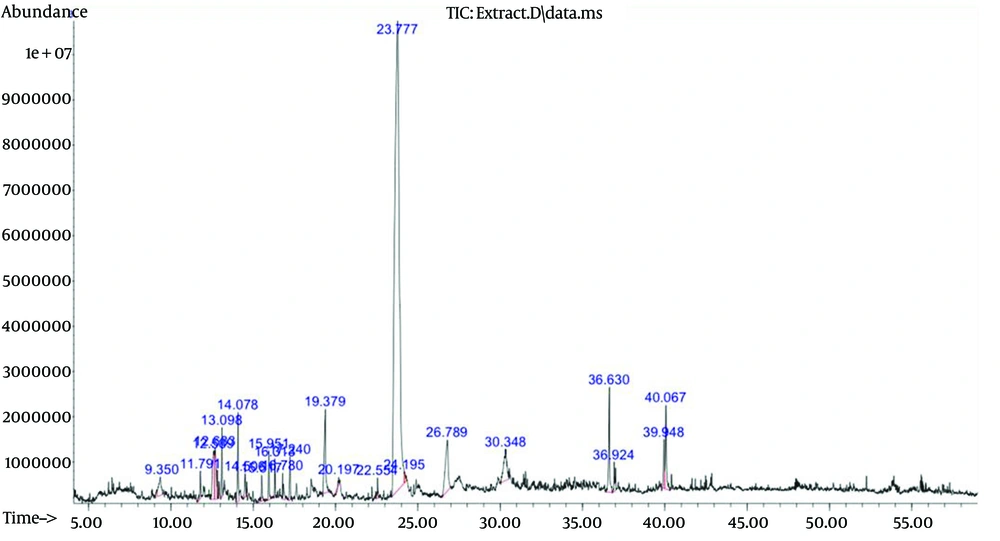
The GC-MS analysis of the ethanol extract of T. chebula identified major bioactive compounds such as 1,2,3-Benzenetriol, Phenol, and Benzoic acid, collectively accounting for 86.89% of the total components, indicating a profile rich in phenolics, aldehydes, fatty acids, and alkaloids (Figure 1).

Gas chromatography-mass spectrometry (GC-MS) chromatogram showing retention times and chemical profiles of major bioactive compounds in the ethanol extract of <i>Terminalia chebula</i>
Figure 1.

Gas chromatography-mass spectrometry (GC-MS) chromatogram showing retention times and chemical profiles of major bioactive compounds in the ethanol extract of Terminalia chebula
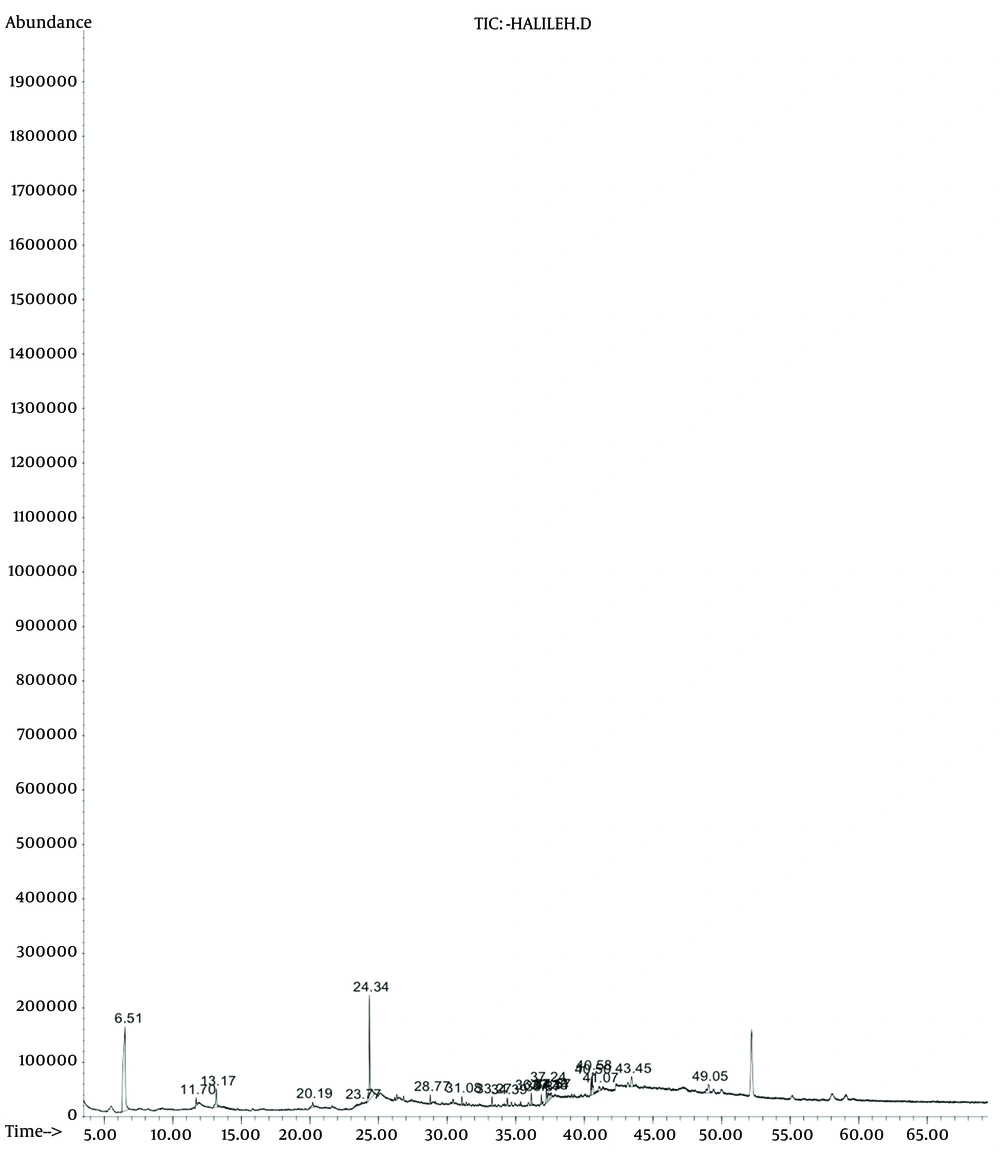
Similarly, the propanol extract revealed compounds like Propanoic acid, Hexadecanoic acid, and D-limonene, making up 83.35% of the extract. This extract showed a diverse profile including fatty acids, terpenes, alkynes, heterocycles, and sulfur-containing compounds (Figure 2) (Table 1).

Gas chromatography-mass spectrometry (GC-MS) chromatogram showing retention times and chemical profiles of major bioactive compounds in the propanol extract of <i>Terminalia chebula</i>
Figure 2.

Gas chromatography-mass spectrometry (GC-MS) chromatogram showing retention times and chemical profiles of major bioactive compounds in the propanol extract of Terminalia chebula

Table 1.GC-MS Identified Compounds in Ethanolic and Propanolic Extracts of Terminalia chebula, Showing Relative Abundance (Area %), CAS Numbers, and Identification Quality Scores
Extract Type and Compound NameArea (%)CAS NoQual
Ethanol Extract
1,2,3-Benzenetriol64.19000087-66-195
Phenol5.15000108-95-291
Benzoic acid4.43000099-06-997
2-Furancarboxaldehyde, 5-3.84000067-47-087
Hexadecanoic acid3.53000057-10-399
9,17-Octadecadienal2.88056554-35-095
IMPERIALINE2.87999206-18-674
Propanol Extract
Propanoic acid40.46000106-36-578
4,4-Dimethyl-2-(3-phenyl-2-thienyl)oxazoline20.61128608-98-083
Hexadecanoic acid4.8000628-97-789
D-limonene4.28005989-27-597
6-Octadecenoic acid3.85000593-39-595
Thiosulfuric acid (S-(2-aminoethyl) ester)3.16002937-53-350
7-Pentadecyne2.87999206-18-693
9,10-dihydro-7-methoxy-4a-methyl-2(4aH)-phenanthrenone1.93036126-09-778
6,8-dimethylbenzocyclooctene1.39099027-75-578

4.2. Results of Antioxidant Activity

The antioxidant activity of the sample, extracted using 80% methanol (Merck, Germany), was evaluated by the DPPH radical scavenging assay. At the concentration of 0.75 mg, the percentage of radical inhibition ranged from 79.12% to 88.34%, with an average of approximately 84.7%. The assay was conducted in triplicate, and the calculated IC50 value of the extract was 0.1996 ± 0.017 mg. Values are presented as mean ± SE. The relatively low IC50 value indicates that the methanolic extract possesses strong antioxidant activity and is capable of effectively neutralizing free radicals even at low concentrations.

4.3. Antibiotic Susceptibility Testing of Bacterial Strain

Antibiotic susceptibility tests were performed using the disk diffusion method for S. aureus, P. aeruginosa, S. dysenteriae, and E. faecalis. In S. aureus, P. aeruginosa, S. dysenteriae, and E. faecalis. According to the interpretive criteria of the CLSI 2021 guidelines, all tested isolates were categorized within the resistant (R) range for the evaluated antibiotics (Table 2).

Table 2.Results of the Antibiotic Disk Diffusion Test a
AntibioticsStaphylococcus aureusPseudomonas aeruginosaShigella dysenteriaeEnterococcus faecalis
AmpicillinRRRR
CeftriaxoneRRRR
Penicillin GRRRR
CefotaximeRRRR
CeftazidimeRRRR
PenicillinRRRR
CefiximeRRRR

a The symbol "R" indicates resistance, meaning no detectable inhibition zone was observed for the respective antibiotic against the tested bacterium.

4.4. Results of Determination of β-Lactamase Activity
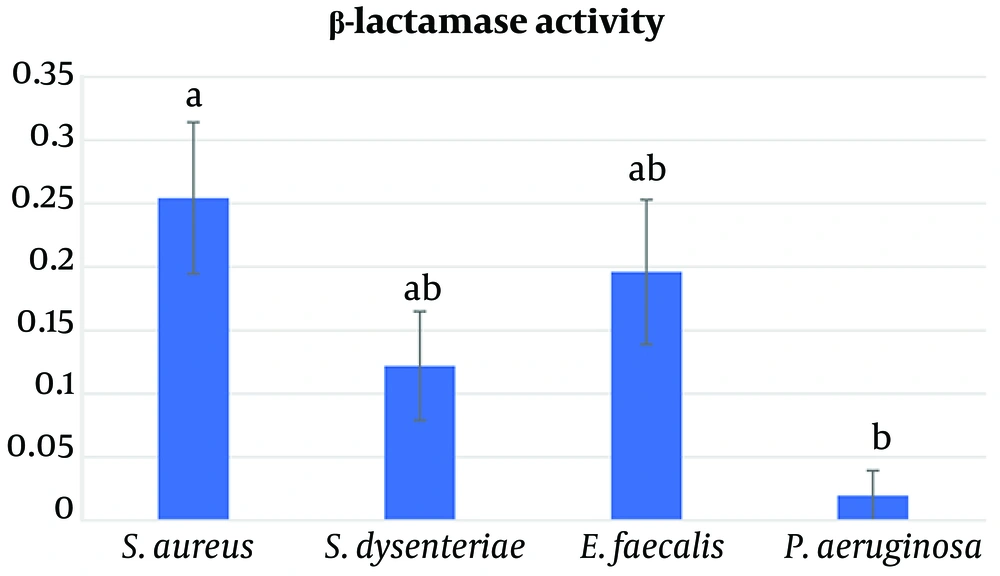
Values are presented as mean ± SE. The β-lactamase activity of the four bacterial strains was measured using the iodometric assay. S. aureus exhibited the highest enzymatic activity (0.25433 ± 0.059834), followed by E. faecalis (0.196 ± 0.057), S. dysenteriae (0.122 ± 0.043016), and P. aeruginosa (0.01967 ± 0.019667). Statistical analysis using one-way ANOVA followed by Tukey’s post-hoc test revealed a significant difference in β-lactamase activity among all bacterial strains (P = 0.039). The negative control showed no change in absorbance, confirming that the observed decolorization was due to β-lactamase activity. Overall, these results indicate that S. aureus produces the highest β-lactamase levels, whereas P. aeruginosa exhibits the lowest activity among all tested strains (Figure 3).

Mean ± SE from three independent replicates is used to express values. Analysis of variance (ANOVA), Tukey’s post-hoc test were used for statistical analysis. Shared letters signify no significant difference, while different letters imply statistically significant differences (P &lt; 0.05).
Figure 3.

Mean ± SE from three independent replicates is used to express values. Analysis of variance (ANOVA), Tukey’s post-hoc test were used for statistical analysis. Shared letters signify no significant difference, while different letters imply statistically significant differences (P < 0.05).

4.5. Results of Minimum Inhibitory Concentration and Minimum Bactericidal Concentration of Ethanolic and Propanolic Extracts

The MIC and MBC values of ethanolic and propanolic extracts of T. chebula against S. aureus, P. aeruginosa, E. faecalis, and S. dysenteriae are presented in Table 3. The ethanolic extract showed the lowest MIC against S. aureus (1.56 mg/mL), while the MIC for the other tested bacteria was 6.25 mg/mL. The corresponding MBC values for the ethanolic extract were 3.12 mg/mL for S. aureus and 12.5 mg/mL for the remaining strains. In the case of the propanolic extract, MIC values ranged from 3.12 mg/mL for S. dysenteriae to 6.25 mg/mL for the other bacterial strains. The MBC values were 6.25 mg/mL for S. dysenteriae and 12.5 mg/mL for the rest.

Table 3.The Values Represent the Minimum Inhibitory Concentration Minimum Bactericidal Concentration of Ethanolic and Propanolic Extracts of Terminalia chebula (mg/mL) Against Staphylococcus aureus, Pseudomonas aeruginosa, Enterococcus faecalis, and Shigella dysenteriae
Terminalia chebula ExtractsMIC/MBC (mg/mL)Staphylococcus aureusPseudomonas aeruginosaEnterococcus faecalisShigella dysenteriae
EthanolicMIC1.566.256.256.25
EthanolicMBC3.1212.512.512.5
PropanolicMIC6.256.256.253.12
PropanolicMBC12.512.512.56.25

Abbreviations: MIC, minimum inhibitory concentration; MBC, minimum bactericidal concentration.

Overall, these findings indicate that the ethanolic extract exhibited stronger antibacterial activity than the propanolic extract, particularly against S. aureus, while both extracts showed moderate activity against P. aeruginosa and E. faecalis.

4.6. Assessment of the Antibacterial Activity of the Ethanolic Extract of Terminalia chebula via Agar Well Diffusion Assay

Using the well diffusion method, the antibacterial activity of the T. chebula extract was evaluated against S. aureus, S. dysenteriae, E. faecalis, and P. aeruginosa at different concentrations. The extract exhibited a clear dose-dependent inhibitory effect against S. aureus, as shown in the table, with the inhibition zone diameter decreasing from 37.50 ± 2.64 mm at 100 mg/mL to 12.17 ± 0.29 mm at 0.78 mg/mL. Statistical analysis using one-way ANOVA followed by Scheffe post-hoc test revealed significant differences (P < 0.05) between most concentration groups, as indicated by the different letters (a - f) in the statistical grouping column. These results suggest that the extract had a strong antibacterial effect on S. aureus, particularly at higher concentrations.

For S. dysenteriae, the inhibition zones ranged from 26.00 ± 0.86 mm at 100 mg/mL to 13.17 ± 0.76 mm at 1.56 mg/mL, with significant differences between several concentration groups (P < 0.05). In the case of E. faecalis, the extract produced inhibition zones of 22.67 ± 1.26 mm at 100 mg/mL, but the activity markedly declined at lower concentrations, reaching only 8.33 ± 1.15 mm at 6.25 mg/mL. Similarly, P. aeruginosa showed inhibition zones of 22.67 ± 2.25 mm at 100 mg/mL, decreasing to 8.50 ± 0.87 mm at 6.25 mg/mL, with statistically significant differences across most groups (P < 0.05).

Overall, the findings indicate that the extract demonstrated concentration-dependent antibacterial activity against all tested bacteria, with the strongest effect observed against S. aureus compared to the other strains (Table 4).

Table 4.Staphylococcus aureus Compared to the Other Strains a, b, c
Bacterial StrainExtract Concentration (mg/mL)Inhibition Zone Diameter (mm)Statistical Grouping
Staphylococcus aureus10037.500 ± 2.6458A
S. aureus5033.167 ± 0.7638AB
S. aureus2529.500 ± 1.5000BC
S. aureus12.526.333 ± 1.7559CD
S. aureus6.2521.500 ± 2.5000DE
S. aureus3.12519.500 ± 1.3229E
S. aureus1.5617.333 ± 0.5774EF
S. aureus0.7812.167 ± 0.2887F
Shigella dysenteriae10026.000 ± 0.8660A
S. dysenteriae5024.167 ± 1.0408AB
S. dysenteriae2521.500 ± 1.5000BC
S. dysenteriae12.518.833 ± 1.5275CD
S. dysenteriae6.2516.333 ± 1.8930DE
S. dysenteriae3.12515.333 ± 1.2583DE
S. dysenteriae1.5613.167 ± 0.7638E
Enterococcus faecalis10022.667 ± 1.2583A
E. faecalis5021.833 ± 4.7522AB
E. faecalis2514.667 ± 1.2583BC
E. faecalis12.59.500 ± 1.3229C
E. faecalis6.258.333 ± 1.1547C
Pseudomonas aeruginosa10022.667 ± 2.2546A
P. aeruginosa5019.333 ± 1.8930AB
P. aeruginosa2514.333 ± 0.7638BC
P. aeruginosa12.59.500 ± 2.1794CD
P. aeruginosa6.258.500 ± 0.8660D

a Mean ± SD from three independent replicates is used to express values.

b Analysis of variance (ANOVA), Scheffe post-hoc test were used for statistical analysis.

c The same capital letters indicated no significant differences, while different capital letters indicated statistically significant differences (P < 0.05).

5. Discussion

The rapid emergence and spread of antibiotic-resistant bacteria, particularly β-lactam-resistant strains, pose a serious threat to global health, clinical outcomes, and operational readiness in high-risk settings such as military environments. In this context, the search for natural alternatives with antibacterial, β-lactamase inhibitory, and antioxidant properties has gained significant importance. The medicinal plant T. chebula, long used in traditional medicine for its antimicrobial and antioxidant activities, was investigated in this study for its efficacy against gastrointestinal and nosocomial β-lactam-resistant pathogens (1, 5).

The findings revealed that all tested bacterial strains — S. aureus, P. aeruginosa, S. dysenteriae, and E. faecalis — were completely resistant to the tested β-lactam antibiotics. This aligns with the global trend of increasing multidrug-resistant (MDR) bacteria and underscores the need for alternative therapeutic strategies (1, 2).

β-lactamase activity varied among the strains, with S. aureus exhibiting the highest enzyme production (0.25433 ± 0.059834) and P. aeruginosa showing the lowest activity (0.01967 ± 0.019667). Activity in E. faecalis and S. dysenteriae was 0.196 ± 0.057 and 0.122 ± 0.043016, respectively. These differences highlight the significant role of β-lactamase in resistance to β-lactam antibiotics and the necessity of alternative approaches for infection control.

The biological activities of plant extracts are largely attributed to their chemically diverse and naturally occurring bioactive constituents, which can act individually or synergistically (10). T. chebula was selected due to its high tannin content (approximately 30 - 40%) and rich phytochemical profile (10, 11). Tannins possess strong antibacterial properties, primarily by penetrating bacterial cell walls, disrupting key metabolic processes, and damaging internal cellular structures (12, 13). In addition to tannins, the extract contains several other major constituents, including various forms of chebulic acid, gallic acid, ellagic acid, amino acids, and flavonoids, which are associated with diverse pharmacological activities such as antioxidant, antimicrobial, and anticancer effects.

The ethanolic extract of T. chebula exhibited strong and dose-dependent antibacterial activity against all tested strains. S. aureus was the most susceptible, with an inhibition zone diameter of 37.50 ± 2.64 mm at 100 mg/mL. The lowest MIC and MBC values for this strain were 1.56 mg/mL and 3.12 mg/mL, respectively. P. aeruginosa and E. faecalis showed moderate sensitivity, while S. dysenteriae displayed relatively high sensitivity, particularly at higher concentrations. Overall, the ethanolic extract exhibited stronger antibacterial activity than the propanolic extract, likely due to differences in solubility and concentration of active compounds. These results highlight the potential of T. chebula as a broad-spectrum antibacterial agent against resistant pathogens.

The GC-MS analysis revealed that 1,2,3-benzenetriol (pyrogallol) was the predominant compound in the ethanolic extract, comprising over 64% of the total content. This concentration is higher than the 21 - 43% reported by Thoithoisana Devi et al. in extracts from the Manipur region of India. Their study linked pyrogallol to strong antioxidant activity and caspase-dependent apoptosis induction in HCT-116 colon cancer cells, indicating its potential anticancer properties. Therefore, the higher concentration in our extract may suggest enhanced therapeutic efficacy, particularly in anticancer applications (14).

The multifunctional bioactivity of pyrogallol is further supported by Jie Wang et al., who demonstrated its role in inducing oxidative stress, upregulating DNA repair genes, and enhancing antioxidant enzyme activities (15). Additionally, Patel et al. reported that chebulinic acid, a key compound in T. chebula, exhibits strong affinity for the DNA gyrase enzyme of Mycobacterium tuberculosis, including quinolone-resistant strains, by displacing the Tyr129 residue and inhibiting DNA binding (16). This underscores the importance of T. chebula phytochemicals in combating antimicrobial resistance.

The propanolic extract contained compounds such as propanoic acid, 4,4-dimethyl-2-(3-phenyl-2-thienyl)oxazoline, hexadecanoic acid, and D-limonene. Han et al. reported that limonene exhibits strong antimicrobial activity, particularly against food-borne pathogens, by damaging the cell membrane and wall, increasing membrane permeability, and disrupting bacterial energy metabolism via inhibition of ATP synthesis and respiratory enzymes, making it an effective natural antimicrobial agent (17).

Recent studies by Mahmood Janlou et al. demonstrated that both ethanolic and propanolic extracts of T. chebula exhibit significant antibacterial activity against β-lactam-resistant gastrointestinal pathogens, with key compounds such as 1,2,3-benzenetriol (pyrogallol) and propanoic acid likely acting by disrupting bacterial cell walls and metabolic functions. These findings further support the antibacterial potential of T. chebula and align with our observations, reinforcing its role as a promising natural therapeutic agent (1).

In addition to antibacterial effects, the antioxidant activity of T. chebula extracts has been well documented. Sheng et al. and Parveen et al. investigated DPPH radical scavenging activity in various extracts of Terminalia chebula using solvents such as water, hexane, acetone, methanol, ethyl acetate, and ethanol, reporting 77 - 85% inhibition (18, 19). Similarly, Shaikh et al. observed 80 - 85% inhibition in water, ethanol, and acetone extracts of T. chebula (20).

Consistent with these reports, our study demonstrated strong antioxidant activity of the ethanolic extract. At a concentration of 0.75 mg, the percentage of radical inhibition ranged from 79.12% to 88.34%, with an average of approximately 84.7%. The calculated IC50 value was 0.1996 ± 0.017 mg, indicating that the extract effectively neutralizes free radicals even at low concentrations. The DPPH results from our study are in agreement with previous reports (18-20) and confirm that T. chebula, in addition to its antibacterial activity, possesses strong antioxidant properties, highlighting its multifunctional therapeutic potential.

5.1. Conclusions

The present study demonstrated that T. chebula extract contains significant bioactive compounds with notable antibacterial and antioxidant properties. 1,2,3-Benzenetriol (pyrogallol) was the predominant compound in the ethanolic extract, while D-limonene was the major constituent in the propanolic extract. Other key components, including phenol, benzoic acid, and hexadecanoic acid, collectively accounted for over 80% of the identified compounds.

The extract exhibited strong antibacterial activity against β-lactam antibiotic-resistant bacteria, including S. aureus, P. aeruginosa, S. dysenteriae, and E. faecalis, with the most pronounced effect observed against S. aureus. Additionally, the extract showed inhibitory effects on β-lactamase enzyme activity and demonstrated significant antioxidant potential, which may help mitigate oxidative stress associated with infections.

These findings highlight the potential of T. chebula as a natural source for combating β-lactam-resistant bacterial infections and suggest its promise as an alternative or complementary agent to conventional antibiotics. Future research should focus on in vivo studies and clinical trials to evaluate the practical application of these compounds in clinical settings and fully explore their potential in addressing antimicrobial resistance.

Footnotes

References

  • 1.
    Mahmood Janlou MA, Kordkatouli M, Sateei A, Koohsari H. Gc-Ms-based phytochemical profiling and antibacterial efficacy of terminalia chebula extract against gastrointestinal pathogens resistant to β-lactam antibiotics. Journal of Patient Safety & Quality Improvement. 2025;13(3):169-78. https://doi.org/10.22038/psj.2025.89635.1477.
  • 2.
    Koohsari H, Kordkatouli M, Sateei A, Janlou MA. GC-MS Analysis and Antibacterial Activity of Terminalia chebula Against β-lactam-resistant Kelebsiella pneumoniae. Immunoregulation. 2024;7(1). https://doi.org/10.32598/Immunoregulation.7.13.
  • 3.
    Selvarajan R, Obize C, Sibanda T, Abia ALK, Long H. Evolution and Emergence of Antibiotic Resistance in Given Ecosystems: Possible Strategies for Addressing the Challenge of Antibiotic Resistance. Antibiotics (Basel). 2022;12(1). [PubMed ID: 36671228]. [PubMed Central ID: PMC9855083]. https://doi.org/10.3390/antibiotics12010028.
  • 4.
    Chopra M, Deswal G, Chopra B, Kriplani P, Dass R, Grewal. A. S, et al. Therapeutic and Health Promoting Potential of Terminalia chebula: An Exploratory Literature Review. Current Traditional Med. 2024;10(7):65-77. https://doi.org/10.2174/2215083810666230815142547.
  • 5.
    Teymourzadeh E, Bahadori M, Fattahi H, Rahdar HA, Mirzaei Moghadam S, Shokri A. Prevalence and Predictive Factors for Nosocomial Infection in the Military Hospitals: A Systematic Review and Meta-Analysis. Iran J Public Health. 2021;50(1):58-68. [PubMed ID: 34178764]. [PubMed Central ID: PMC8213630]. https://doi.org/10.18502/ijph.v50i1.5072.
  • 6.
    Khalil E, Sultan MT, Khalid W, Khalid MZ, Rahim MA, Saleem SR, et al. Evaluation of different Terminalia chebula varieties and development of functional muffins. Frontiers in Sustainable Food Systems. 2023;7:1227851. https://doi.org/10.3389/fsufs.2023.1227851.
  • 7.
    Notashfard A, Nojavan Asghari M. Inhibitory and Bactericidal Effect of Aqueous Pepper Extract (Capsicum annum L.), Capsaicin, and Capsaicin Combination with Amoxicillin against Streptococcus pyogenes. J Med Microbiol Infect Dis. 2021;12(4):259-69. [PubMed ID: 34178764]. [PubMed Central ID: PMC8213630]. https://doi.org/10.61186/JoMMID.12.4.259.
  • 8.
    Yazdani A, Koohsari H, Sadegh Shesh Poli M. [Antibacterial Activity of Honey and Bee Pollen Collected from Bee Hives from Three Climatic Regions of Golestan Province Against some Clinical Isolates with High Antibiotic Resistance]. Res Innovat Food Sci Technol. 2025;14(1):19-28. FA.
  • 9.
    Sawai T, Takahashi I, Yamagishi S. Iodometric assay method for beta-lactamase with various beta-lactam antibiotics as substrates. Antimicrobial Agents Chemother. 1978;13(6):910-3. [PubMed ID: 677858]. [PubMed Central ID: PMC352361]. https://doi.org/10.1128/AAC.13.6.910.
  • 10.
    Al-Musawi MH, Ibrahim KM, Albukhaty S. In vitro study of antioxidant, antibacterial, and cytotoxicity properties of Cordia myxa fruit extract. Iran J Microbiol. 2022;14(1):97-103. [PubMed ID: 35664718]. [PubMed Central ID: PMC9085551]. https://doi.org/10.18502/ijm.v14i1.8810.
  • 11.
    Afzal M, Khan AS, Zeshan B, Riaz M, Ejaz U, Saleem A, et al. Characterization of Bioactive Compounds and Novel Proteins Derived from Promising Source Citrullus colocynthis along with In-Vitro and In-Vivo Activities. Molecules. 2023;28(4). [PubMed ID: 36838731]. [PubMed Central ID: PMC9960351]. https://doi.org/10.3390/molecules28041743.
  • 12.
    Nayak SS, Ankola AV, Metgud SC, Bolmal UK. An in vitro study to determine the effect of Terminalia chebula extract and its formulation on Streptococcus mutans. J Contemp Dent Pract. 2014;15(3):278-82. [PubMed ID: 25307806]. https://doi.org/10.5005/jp-journals-10024-1528.
  • 13.
    Raval A, S. Yadav N, Narwani S, Somkuwar K, Verma V, Almubarak H, et al. Antibacterial Efficacy and Surface Characteristics of Boron Nitride Coated Dental Implant: An In-Vitro Study. J Funct Biomater. 2023;14(4). [PubMed ID: 37103292]. [PubMed Central ID: PMC10145549]. https://doi.org/10.3390/jfb14040201.
  • 14.
    Thoithoisana Devi S, Devika Chanu K, Singh NB, Chaudhary SK, Keithellakpam OS, Singh KB, et al. Chemical Profiling and Therapeutic Evaluation of Standardized Hydroalcoholic Extracts of Terminalia chebula Fruits Collected from Different Locations in Manipur against Colorectal Cancer. Molecules. 2023;28(7). [PubMed ID: 37049666]. [PubMed Central ID: PMC10096451]. https://doi.org/10.3390/molecules28072901.
  • 15.
    Wang J, Liu Q, Feng J, Lv JP, Xie SL. Effect of high-doses pyrogallol on oxidative damage, transcriptional responses and microcystins synthesis in Microcystis aeruginosa TY001 (Cyanobacteria). Ecotoxicol Environ Saf. 2016;134p1:273-9. [PubMed ID: 27643987]. https://doi.org/10.1016/j.ecoenv.2016.09.010.
  • 16.
    Patel K, Tyagi C, Goyal S, Jamal S, Wahi D, Jain R, et al. Identification of chebulinic acid as potent natural inhibitor of M. tuberculosis DNA gyrase and molecular insights into its binding mode of action. Comput Biol Chem. 2015;59 Pt A:37-47. [PubMed ID: 26410242]. https://doi.org/10.1016/j.compbiolchem.2015.09.006.
  • 17.
    Han Y, Sun Z, Chen W. Antimicrobial Susceptibility and Antibacterial Mechanism of Limonene against Listeria monocytogenes. Molecules. 2019;25(1). [PubMed ID: 31861877]. [PubMed Central ID: PMC6982812]. https://doi.org/10.3390/molecules25010033.
  • 18.
    Sheng Z, Zhao J, Muhammad I, Zhang Y. Optimization of total phenolic content from Terminalia chebula Retz. fruits using response surface methodology and evaluation of their antioxidant activities. PLoS One. 2018;13(8). e0202368. [PubMed ID: 30106980]. [PubMed Central ID: PMC6091980]. https://doi.org/10.1371/journal.pone.0202368.
  • 19.
    Parveen R, Shamsi TN, Singh G, Athar T, Fatima S. Phytochemical analysis and in-vitro biochemical characterization of aqueous and methanolic extract of Triphala, a conventional herbal remedy. Biotech Rep. 2018;(17):126-36. [PubMed ID: 29619331]. [PubMed Central ID: PMC5881245]. https://doi.org/10.1016/j.btre.2018.02.003.
  • 20.
    Shaikh RU, Pund MM, Gacche RN. Evaluation of anti-inflammatory activity of selected medicinal plants used in Indian traditional medication system in vitro as well as in vivo. J Tradit Complement Med. 2016;6(4):355-61. [PubMed ID: 27774419]. [PubMed Central ID: PMC5067865]. https://doi.org/10.1016/j.jtcme.2015.07.001.

Crossmark
Crossmark
Checking
Share on
Cited by
Metrics

Purchasing Reprints

  • Copyright Clearance Center (CCC) handles bulk orders for article reprints for Brieflands. To place an order for reprints, please click here (   https://www.copyright.com/landing/reprintsinquiryform/ ). Clicking this link will bring you to a CCC request form where you can provide the details of your order. Once complete, please click the ‘Submit Request’ button and CCC’s Reprints Services team will generate a quote for your review.
Search Relations

Author(s):

Related Articles