1. Background
Antibacterial activity is the ability of a substance to inhibit or kill bacterial cells. Different types of antibiotics and chemotherapeutic agents are being used in the treatment of one form of disease or the other. Most of these antibiotics were originally derived from micro-organisms while the chemotherapeutic agents are from plants. However, nowadays these antibiotics and chemotherapeutic agents are obtained by various synthetic processes [1]. Diseases caused by bacteria are widespread worldwide. The treatment of these infections is mainly based on the use of antibiotics. In recent years, a number of antibiotics have lost their effectiveness due to the development of resistant strains, mostly through the expression of resistance genes [2]. In addition to this problem, antibiotics are sometimes associated with adverse effects including hypersensitivity, immune-suppression and allergic reactions [3]. Therefore, there is a need to develop alternative antibacterial drugs for the treatment of infectious diseases from various sources such as medicinal plants. Undoubtedly, medicinal plants are the prime source of drugs in both developing and developed nations, as drugs or herbal extracts for various chemotherapeutic purposes. There are about 2000 plant species known to possess medicinal value in the traditional Asian system of medicine [4].
In herbal medicine, crude plant extracts in the form of infusion, decoction, tincture, or herbal extract are traditionally used by the population for the treatment of diseases, including infectious diseases. Although their efficacy and mechanisms of action have not been tested scientifically in most cases, these simple medicinal preparations often mediate beneficial responses due to their active chemical constituents [5]. Plant derived products contain a great diversity of phytochemicals such as phenolic acids, flavonoids, tannins, lignin, and other small compounds. These compounds possess numerous health-related effects such as antibacterial, antimutagenic, anticarcinogenic, antithrombotic, and vasodilatory activities [6].
The use of plant compounds to treat infections is an age-old practice in a large part of the world, especially in developing countries, where there is dependence on traditional medicine for a variety of diseases [7, 8]. Interest in plants with antimicrobial properties has revived as a result of current problems associated with the use of antibiotics [9, 10].
S. bachtiarica Bunge, a member of Lamiaceae family, is an endemic plant that is greatly distributed in southern regions in Iran. It is well known for its medical uses in folk medicine. S. bachtiarica has a relatively wide distribution in Iran and has been collected from West, Central, and Southwest provinces of Iran. There are about 30 species of Satureja in the world that S. bachtiarica is an endemic species of this genus in Iran. Satureja is carminative and tonic and it is effective to boost sexual power. It is used to relieve dental pain and if is taken with the water of fig is beneficial for cough and shortness of breath and brilliant of the face. A Satureja treat the diarrhea. It is very useful. The Satureja can be used to removal of state weakness and gastric torsion. It can also be used to exploit digestive and intestinal fermentation and flatulence.
2. Objectives
The aim of this study was evaluation of S. bachtiarica antimicrobial effect on S. pyogenes, P. aeruginosa and S. epidermidis.
3. Materials and Methods
This experimental study was carried out from November, 2011 to September, 2012 in the laboratory of industrial microbiology and novel technologies of collage of agriculture, Ferdowsi university of Mashhad, Mashhad, Iran.
Preparation plant: Satureja bachtiarica was collected from Shahrekord (Chaharmahal va Bakhtiari, Iran). Taxonomic identification was performed by the faculty of science Herbarium, Ferdowsi university of Mashhad, Iran. Aqueous, ethanol and methanol extracts of the samples were obtained by the following procedure. The extract was prepared by maceration 1 g sample was extracted with 50 mL ethanol 96% or methanol 96% for 20 hours. The mixture was filtered through Whatman No.1 (Camlab, UK) and the filtrate was evaporated to dryness under vacuum at 40°C. The dry extract was weighed and the yield was calculated. Twenty percent glycerin solution has been used as a solvent. Fifty grams of fine powder of the leaves was added to 200 mL of prepared glycerin solvent and heated for 20 minutes. The extract was then filtered using paper filters and then centrifuged in 9000 gravity for 15 minutes [2].
Source of microorganisms: Three strains were chosen for investigation of which one was reference bacteria: Gram positive (S. pyogenes PTCC 1447, S. epidermidis PTCC 1435) and Gram-negative (P. aeruginosa PTCC 1310) all organisms were stored at -70°C in glycerol Mueller Hinton broth (Merck, Germany). Fresh subcultures were used for each experiment.
Preparation of microbial suspension: To preparing microbial suspensions, requires 24 hours culture from each microorganism. So, 24 hours before experiments, microorganisms were inoculated from storage medium to nutrient agar medium slope. After 24 hours, the cultures were washed by Ringer (Merck, Germany), solution and microbial suspensions were prepared. Then some of the bacterial suspension was poured in sterile tubes containing Ringer solution and its turbidity, was measured by spectrophotometer at 530 nm wavelength. It was diluted by Ringer solution until the solution turbidity equalizes with 0.5 McFarland standard solutions. Suspension should have contains 1.5 × 10⁸ CFU/mL [11].
Evaluation of antimicrobial activity: Adding extracts to the culture medium according of the method of Collins et al. [12] and disk agar diffusion method were done and to evaluated the antimicrobial effects of aqueous and alcoholic S. bachtiarica extracts. Then 0.2 g of aqueous and ethanol extract, were added to 5 mL of sterile distilled water. Then it was stirred with vortex system to assist being steady. Then 1 mL of this solution was added to sterile plates. The final concentration of the extract was 2 mg/mL [3]. In the next step, Mueller Hinton agar (Merck, Germany) medium were sterile and used for bacteria, were added to the plates, and placed at room temperature, so the medium was prepared. One loop of each standard strain culture media was cultured inoculums on these medium. The plates were incubated for 48 hours at 37°C. The culture with extract and without bacteria was used as control. The disk agar diffusion method, at first a loop of each standard strain culture media was cultured on the plates, and then paper discs (from Whatman filter with 6 mm diameter) placed on Mueller Hinton (Merck, Germany), plates were saturated with 100 μL of the test compound allowed to dry and was introduced on the upper layer of the seeded agar plate with 10, 20, 30 and 40 mg/mL concentrations, were prepared in distilled water and was treated with S. bachtiarica extract and placed in culture medium by Sterile loop. Then it was fixed on the media with a light little pressure. After incubation time, the diameter of free zone was measured exactly by using a ruler in millimeters. All experiments were performed with 3 replicates [4].
Statistical analysis: All the assays were carried out in triplicates. The experimental results were expressed as mean ± SD. The data were analysis using one way analysis of variance (ANOVA) using SPSS 18 (USA، Il، Chicago، SPSS Inc).
4. Results
The results of the antimicrobial effects of extracts, by using the method of screening antimicrobial activity were show on in Table 1.
Table 1.
Antimicrobial Effects of 2 mg/mL S. bachtiarica Extracts Concentrations, on S. pyogenes, P. aeruginosa and S. epidermidis
| Microorganism | ||||
|---|---|---|---|---|
| Ethanolic Extract | Aqueous Extract | Methanolic Extract | Glycerin Extract | |
| - | - | - | - | |
| ++ | + | ++ | + | |
| + | + | + | + | |
a The growth of bacteria on culture and the lack of antibacterial activity of Satureja bachtiarica extracts.
b No bacterial growth on culture and strong antibacterial activity of Satureja bachtiarica extracts.
c No bacterial growth on culture and antibacterial activity of Satureja bachtiarica extracts.
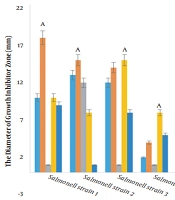
The results of the antimicrobial effects of extracts, by the agar diffusion method were presented in Tables 2 - 5. The results showed that aqueous, ethanol 96%, methanol 96% and 20% glycerin extracts were quite effective in 2 mg/mL concentration on S. pyogenes and S. epidermidis and were prevented from growth them on medium, while extracts have no certain antimicrobial effect on P. aeruginosa.
Table 2.
Average Diameter (Mm) of Microbial Free Zone Area of Aqueous Satureja Bachtiarica Extract, on Streptococcus Pyogenes, Pseudomonas Aeruginosa and Staphylococcus Epidermidis (Disk Agar Diffusion Method) a
| 10 | 20 | 30 | 40 | |
| - | - | - | 6.2 ± 0.52 | |
| 11.4 ± 0.57 | 13.5 ± 0.50 | 15 ± 0.25 | 18.3 ± 0.25 | |
| 10.2 ± 0.57 | 11.9 ± 0.57 | 13.6 ± 0.52 | 15.8 ± 0.28 | |
a Values are as means ± SD, n = 3.
b No inhibitory effects was shown.
Table 3.
Average Diameter (Mm) of Microbial Free Zone Area of Ethanolic Satureja Bachtiarica Extract, on Streptococcus Pyogenes, Pseudomonas Aeruginosa and Staphylococcus Epidermidis (Disk Agar Diffusion Method) a
| 10 | 20 | 30 | 40 | |
| - | - | 6.7 ± 0.57 | 8.8 ± 0.28 | |
| 15 ± 0.76 | 17.9 ± 0.50 | 19.6 ± 0.50 | 21.9 ± 0.57 | |
| 13.8 ± 0.28 | 14.9 ± 0.50 | 16.6 ± 0.76 | 19.1 ± 0.57 | |
a Values are as means ± SD, n = 3.
b No inhibitory effects was shown.
Table 4.
Average Diameter (Mm) of Microbial Free Zone Area of Methanolic Satureja Bachtiarica Extract, on Streptococcus Pyogenes, Pseudomonas Aeruginosa and Staphylococcus Epidermidis (Disk Agar Diffusion Method) a
| 10 | 20 | 30 | 40 | |
| - | - | 6.4 ± 0.50 | 7.2 ± 0.50 | |
| 13.3 ± 0.57 | 15.3 ± 0.50 | 17 ± 0.28 | 19.4 ± 0.28 | |
| 12.2 ± 0.57 | 13.8 ± 0.57 | 14.6 ± 0.50 | 16.6 ± 0.28 | |
a Values are as means ± SD, n = 3.
b No inhibitory effects was shown.
Table 5.
Average Diameter (Mm) of Microbial Free Zone Area of Glycerin Satureja bachtiarica Extract, on Streptococcus pyogenes, Pseudomonas Aeruginosa and Staphylococcus Epidermidis (Disk Agar Diffusion Method)
| 10 | 20 | 30 | 40 | |
| - | - | 6.3 ± 0.52 | 6.9 ± 0.52 | |
| 12.3 ± 0.57 | 14.1 ± 0.50 | 16 ± 0.28 | 18.9 ± 0.28 | |
| 10.9 ± 0.57 | 12.5 ± 0.57 | 13.9 ± 0.50 | 15.9 ± 0.28 | |
a Values are as means ± SD, n = 3.
b No inhibitory effects was shown.
5. Discussion
The results showed that the solvent type, the extract concentration and their interaction significantly changed the inhibition zone diameter in each 3 bacteria. Theoretically, inhibition zone diameter reflects the concentration of antimicrobial compound of S. bachtiarica extract. According to the results, increasing the concentration of S. bachtiarica extract led to the inhibition zone diameter increase significantly. Generally, the antimicrobial effects of each extraction treatment varied depending on the kind of bacteria. While Gram positive bacteria (S. epidermidis PTCC 1435 and S. pyogenes PTCC 1447) were more sensitive, Gram negative bacteria (P. aeruginosa PTCC 1310) were more resistance (Table 1), this may have been because of the structure of the cell wall in Gram positive and negative bacteria. Boroujeni et al. reported that the extracts from S. bachtiarica exhibited inhibitory effect on fungal growth, suggesting that the studied plant extracts are potentially a safe and natural source of antifungal agents. Some of these plants were more effective than traditional antimicrobial to combat the pathogenic microorganisms [13]. Sefidkon et al. showed the high antimicrobial effect of these S. bachtiarica oils. It seems the presence of thymol, carvacrol, P-cymene and gamma-terpinene in these oils caused the strong anti-microbial effect of them [14]. Several mechanisms are discussed to explain the antimicrobial effect. Several studies have been performed concerning the antimicrobial activity of essential oils or extracts of other Satureja species. Many of the previous studies demonstrated that the members of the genus Satureja show a high antimicrobial activity due to the presence of thymol, carvacrol, and their precursors Adiguzel et al. [15]. They are grouped as alkaloids, glycosides, corticosteroids, coumarin, flavonoids, and essential oils. Over 50% of all modern clinical drugs are of natural origin and play an important role in development of drugs [16].
Many herbs have been used for treating disease caused by microorganisms such as cholera, diarrhea, dysentery, typhoid, and bacterial enteritis. Moreover, huge economy is invested in the imports of drugs especially antibiotics from different parts of the world. Therefore, antibacterial activity of local medicinal plants should be studied to provide alternative antibacterial regimens. The results showed that aqueous, ethanol 96%, methanol 96% and 20% glycerin extracts were quite effective in 2 mg/mL concentration on S. pyogenes and S. epidermidis and were prevented from growth them on medium, while extracts have no certain antimicrobial effect on P. aeruginosa. Based on the results ethanolic extract of S. bachtiarica in this study have significant antimicrobial activity on the studied microorganisms. The results show that S. bachtiarica aqueous, ethanol 96%, methanol 96% and 20% glycerin extracted at all concentrations (10, 20, 30 and 40 mg/mL) had the inhibitory effect on S. pyogenes and S. epidermidis. The results show that S. bachtiarica ethanol 96%, methanol 96% and 20% glycerin extracted at concentrations (30 and 40%) had the inhibitory effect on P. aeruginosa. However, 10 and 20% concentration extracts, have no significant antimicrobial effect on P. aeruginosa and it is not able to prevent the growth of bacteria on culture. Gram positive bacteria are more sensitive than Gram negative bacteria to S. bachtiarica extract, due to differences in cell structure of Gram negative and Gram positive bacteria, because Gram positive bacteria have more mucopeptide in their cell wall composition while Gram negative bacteria have only a thin layer of mucopeptide and most of their cell structure is lipoprotein and lipo-polysaccharides. Thus, Gram negative bacteria are more resistant [17, 18]. These points were consistent with the results obtained in this study. Alizadeh-Behbahani et al. report that, ethanol extract compared to the aqueous extract was more effective and have a greater deterrent. The reason of these phenomena may be extracting more effective materials extracted by ethanol from Avicennia marina[19]. These points were consistent with the results obtained in this study. The results of a study showed that the ethanol extract of Vinca minor leaves exhibited strong antibacterial activity against L. garvieae in comparison with other alcoholic and aqueous extracts from 21 species of herbs from Bolu (Turkey) [20].
Ghasemi et al. reported that essential oils of Myrtus communis L., Thymus daenensis and S. bachtiarica exhibited antimicrobial activities against Bacillus cereus, E. coli O157:H7, Candida albicans and Listeria monocytogenes [21].
The use of plant derived natural compounds used as alternative sources of medicine continues to play major roles in the general wellness of people all over the world. The curative properties of medicinal plants are due to the presence of various complex chemical substances of different composition which occur as secondary metabolites [22, 23]. In conclusion, it can suggest that S. bachtiarica extract “in vitro” have considerable antimicrobial ability over the studied strains. In addition, more studies are needed “in Situ” be done, to identifying the effective dose of the extract on the microorganisms, and finally introduce the extract as a natural and novel antimicrobial compound.