
1. Background
Cardiopulmonary resuscitation (CPR) is a critical and life-saving intervention to restore blood circulation and spontaneous breathing among patients with cardiorespiratory arrest (1, 2). If CPR is performed accurately and promptly by an expert and trained professional, it significantly reduces mortality rates and improves survival chances associated with cardiovascular diseases (3). Given that nursing students often have limited opportunities to practice CPR in real clinical settings, innovative teaching methods are needed to bridge the gap between theoretical learning and competent clinical performance (4-9). Constraints in clinical education (e.g., limited time, fear of mistakes, and unpredictable conditions) restrict opportunities for deliberate practice of critical skills such as CPR (10-13).
As a contemporary educational approach, self-regulated learning (SRL), initially proposed by Bandura, emphasizes self-management and self-regulation skills, empowering students to adapt and take responsibility for their learning (14). The SRL strategies are typically classified into cognitive, metacognitive, resource management, and motivational domains (15).
In parallel, simulation-based education provides students with a safe and controlled environment to develop knowledge, clinical decision-making, and psychomotor skills without the risks of real patient care (16-19).
However, evidence on electronic or simulation-based CPR training remains inconsistent. For instance, Jang et al. showed that self-directed video feedback enhanced knowledge, self-efficacy, and performance (20). Similarly, Elendu et al. emphasized that simulation improves therapeutic skills but cannot fully replace real experiences (21). Bowling and Underwood also highlighted the need for cost-effective strategies with clear learning benefits (22). Notably, most prior studies examined SRL or simulation in isolation, focused on a single outcome, or had short-term follow-up, leading to inconsistent findings (20-24).
2. Objectives
The present protocol seeks to evaluate the combined effect of SRL strategies and CPR simulation on undergraduate nursing students. Specifically, this study will test whether embedding SRL into CPR simulation improves psychomotor performance, knowledge, and self-efficacy compared with standard instruction. The primary outcome is improvement in psychomotor performance of CPR skills, while the secondary outcomes are knowledge acquisition and retention, and CPR-related self-efficacy.
3. Methods and Results
3.1. Design
This study follows a protocol developed in 2024. It is designed to investigate the integration of SRL using a CPR simulation among undergraduate nursing students over two semesters in 2025 - 2026. This study has been registered and approved by the Ethics Committee of Lorestan University of Medical Sciences under reference code IR.LUMS.REC.1403.204.
3.2. Participants and Sampling
The study population will consist of all eighth-semester undergraduate nursing students in the Lorestan University of Medical Sciences, Iran, specifically those enrolled in the Khorramabad Nursing and Midwifery School and the Aligudarz Nursing School. One of the schools will be randomly selected as the control group, while the other will serve as the intervention group. Subsequently, all students from each school will be included in the study using a census sampling method. Since both faculties are part of the same university, they will adhere to the same educational policies and frameworks despite being in different cities.
Due to the fixed academic schedules, random allocation at the individual level is not feasible. Implementing the intervention for only a subset of students within a single school is also impractical, as students attend fixed, group-based sessions. Therefore, a cluster randomized design is employed, whereby the two schools are randomly assigned to the intervention and control groups. Subsequently, all eligible students in each school are included in the study. This approach allows for institutional-level randomization while maintaining the integrity of the educational scheduling.
A formal power analysis was not conducted due to census sampling of all eligible final-semester students across the two schools. While this design ensures inclusion of the entire accessible population (~100 students), it limits our ability to determine in advance whether the sample size is sufficient to detect small-to-moderate effect sizes. This limitation will be acknowledged when interpreting null findings, and effect sizes with confidence intervals will be reported alongside P-values to improve interpretability.
To reduce the risk of baseline imbalance, demographic and academic characteristics [e.g., grade point average (GPA), prior CPR experience, emergency course grades] will be compared between the intervention and control schools at baseline. If significant differences are detected, these variables will be included as covariates in the adjusted analyses. Although stratification or matching was not feasible due to the limited number of clusters, this approach provides a strategy for addressing potential baseline nonequivalence.
Completing the theoretical and practical courses in emergency nursing is an inclusion criterion. Exclusion criteria include unwillingness to continue participating in the study, participation in a similar research project, and work experience with a nursing assistant certificate.
3.3. Intervention Implementation
The intervention will be implemented in four stages (Figure 1).
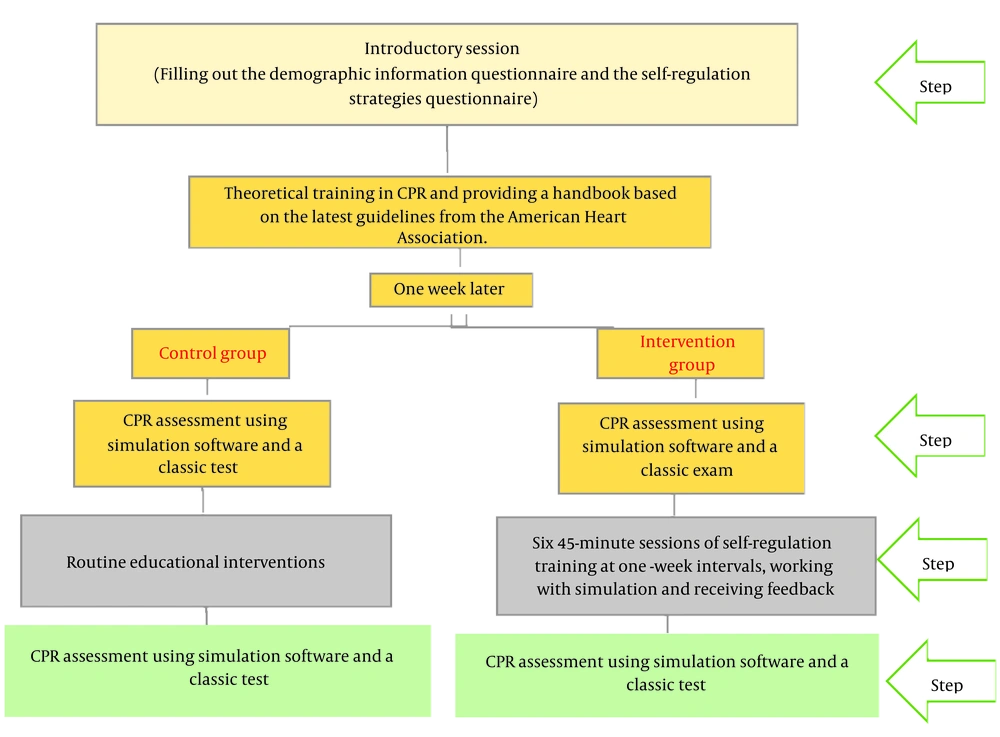
Figure 1.
Study implementation process
3.3.1. Step One
The study objectives will be explained to participants as a group. Following an overview of the procedures, students will complete a socio-demographic questionnaire, which includes variables such as age, gender, marital status, place of residence, GPA over the past seven semesters, the final score of the emergency nursing course (a required course in the Iranian undergraduate nursing curriculum that includes CPR training), and any prior CPR experience will be recorded. Faculty-related variables, including academic rank and teaching experience, will also be documented and considered covariates during the data analysis phase to adjust for baseline differences between groups.
To control for potential confounding variables such as prior knowledge and to ensure group homogeneity, both groups will receive the same standardized theoretical and practical CPR training session delivered by the same instructor. The training content and CPR booklet are developed based on the 2020 American Heart Association (AHA) guidelines for CPR and emergency cardiovascular care, covering standardized protocols for basic and advanced life support (25). Students will be instructed to review the booklet within one week of distribution. This AHA-based training is distinct from the standard emergency nursing and medical emergencies courses included in the curriculum. It has been specifically designed for this study to ensure consistency across both groups. One week after the training, all participants will undergo baseline CPR knowledge and performance assessments using a simulation-based evaluation and a traditional written test.
3.3.2. Step Two
For this study, six basic and advanced CPR scenarios will be initially drafted, with their content validity evaluated and approved by six faculty members of Lorestan University of Medical Sciences. These scenarios will then be converted into virtual simulations integrated into mobile-based applications developed by professional developers. Due to the lack of in-house technical infrastructure, we will collaborate with an external knowledge-based company specializing in educational simulation software for the technical development of the app. However, all educational content — including CPR scenarios, instructional goals, feedback structures, and assessment criteria — has been developed entirely by the research team based on the 2020 AHA guidelines and reviewed by an expert panel of nursing faculty. The app will be designed exclusively for this research project, but we plan to develop and expand its functionality further in future initiatives.
Each simulated scenario will undergo review and approval by faculty members, addressing any identified weaknesses. The virtual simulation will animate scenarios accompanied by audio guidance, presenting users with various options for subsequent actions. The simulation software will provide feedback and scores based on users’ choices, guiding them through all simulation stages. Ultimately, the software will assign an overall score and indicate whether users’ actions are correct or incorrect, suggesting the proper alternative in cases of error. The scoring system will range from zero to two for each action, with criteria established by an expert panel. Once the software development is finalized, it will be reviewed again by the expert panel and a group of non-involved students to assess its feasibility.
The CPR written multiple-choice question (MCQ) will be developed using 20 MCQs based on the Millman checklist (26), with scores ranging from 0 to 20. A panel of ten experts in the field, including academic staff from Lorestan University of Medical Sciences, will contribute to designing the test blueprint. This assessment will be administered to both groups before the intervention and repeated at the end of the eight-week intervention period. The duplicate test content, structure, and evaluation criteria will be used in both the pre-test and post-test to ensure consistency and validity.
In addition to content validity, the concurrent criterion-related validity of the simulated CPR test will be examined by developing this standardized CPR written MCQ. This standardized test will be created using credible sources such as scientific articles, textbooks, and current clinical guidelines, with input from nursing faculty members. Concurrent criterion validity will be determined by comparing the scores of the simulated CPR test with those of the standardized written MCQ administered simultaneously. A high correlation between the two sets of scores will indicate strong validity (27).
The intervention will be designed to teach SRL strategies and support their development through active and structured feedback. Feedback will be delivered via two main channels: (1) The CPR simulation app, which provides immediate, automated feedback on student performance, including errors and corrective guidance, and (2) the instructor, who observes and reinforces self-regulatory behaviors during training sessions. This feedback-driven approach ensures that self-regulation will be taught, practiced, and refined in context.
Appendix 1 in Supplementary File summarizes the educational content covered in the CPR booklet and simulation scenarios, including the basic and advanced components. While the training emphasizes basic life support skills suitable for undergraduate nursing students, select advanced cardiac life support topics are included for observational learning and enhanced clinical reasoning.
3.3.3. Step Three
The intervention group will receive educational content focused on self-regulation strategies during six 45-minute sessions at one-week intervals. The researcher leading these sessions has completed relevant training programs in self-regulation and studied pertinent literature. Furthermore, one of the faculty members will record and analyze the self-regulation classes.
The intervention consists of three complementary components: (1) Standardized CPR training based on AHA guidelines, (2) scenario-based mobile CPR simulations, and (3) structured instruction in SRL strategies. Each component serves a distinct pedagogical function, and their integration is designed to enhance technical skills and autonomous learning capacities.
Following each session, students will be provided with new simulated scenarios and instructed to engage with them and receive the relevant feedback from the software. During the sessions, students’ self-regulation activities will be reinforced and guided through participation in simulated CPR settings with varying scenarios, accompanied by consistent feedback to support their development. The scenarios are sequenced from basic to more advanced, and each includes immediate feedback through the app, helping students build confidence and competence step-by-step. Additionally, the instructor provides tailored support during sessions and remains available for guidance throughout the week, reducing the risk of learner frustration and promoting effective assimilation.
In the control group, no additional CPR-specific training is planned, as students in both groups are completing their 8th-semester clinical internships, during which no structured CPR education is included in the curriculum. However, both groups can access similar clinical settings, skill labs, and educational resources. Only the intervention group will receive the structured CPR simulation and self-regulation training.
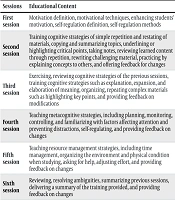
The educational content based on SRL strategies was developed using relevant literature and under the supervision of experts (Table 1). It includes training on motivational, cognitive, metacognitive, and resource management strategies. The sessions conducted for the SRL strategies program will be designed based on Pintrich's model and other relevant literature (27-29).
Table 1.
Self-regulated Learning Strategy-Based Educational Content for the Intervention Group
| Sessions | Educational Content |
|---|---|
| First session | Motivation definition, motivational techniques, enhancing students' motivation, self-regulation definition, self-regulation methods |
| Second session | Training cognitive strategies of simple repetition and restating of materials, copying and summarizing topics, underlining or highlighting critical points, taking notes, reviewing learned content through repetition, rewriting challenging material, practicing by explaining concepts to others, and offering feedback for changes |
| Third session | Exercising, reviewing cognitive strategies of the previous sessions, training cognitive strategies such as explanation, expansion, and elaboration of meaning, organizing, repeating complex materials such as highlighting key points, and providing feedback on modifications |
| Fourth session | Teaching metacognitive strategies, including planning, monitoring, controlling, and familiarizing with factors affecting attention and preventing distractions, self-regulating, and providing feedback on changes |
| Fifth session | Teaching resource management strategies, including time management, organizing the environment and physical condition when studying, asking for help, adjusting effort, and providing feedback on changes |
| Sixth session | Reviewing, resolving ambiguities, summarizing previous sessions, delivering a summary of the training provided, and providing feedback on changes |
3.3.4. Step Four
During the eighth week, all students in the study groups will be asked to participate in a simulated and a CPR written MCQ. The scores obtained in both assessments will be recorded and documented accordingly. Table 2 summarizes the overall structure of the study, outlining the training, assessment, and intervention phases across the 8-week timeline.
Table 2.
Study Timeline
| Weeks | Activity | Groups Involved |
|---|---|---|
| Week 1 | Standard CPR training session delivered by the same instructor + distribution of CPR booklet | Both intervention and control groups |
| Week 2 | Baseline assessment (simulation-based and written MCQ) | Both groups |
| Week 2 | Start of SRL intervention (first of 6 sessions) | Intervention group only |
| Weeks 3 - 7 | Continuation of SRL intervention (total of 6 weekly sessions, 45 minutes each) | Intervention group only |
| Week 8 | Post-intervention assessment (simulation-based and written MCQ) | Both groups |
Abbreviations: CPR, cardiopulmonary resuscitation; MCQ, multiple-choice question; SRL, self-regulated learning.
Although the intervention spans six weeks, opportunities for students to apply SRL strategies outside the classroom sessions have been incorporated. Each week, participants receive new simulation scenarios through the mobile app and are instructed to practice independently, with performance feedback automatically generated by the software. This allows for continuous application and reinforcement of learned strategies between sessions.
3.4. Blinding
To reduce the risk of assessment bias, all pre- and post-intervention evaluations — including both the simulated and CPR written MCQ — will be conducted by an independent third-party assessor who is not part of the research team and is blinded to group assignment. Additionally, the data analyst responsible for statistical analysis will remain blinded to the group allocation to minimize potential analytical bias.
3.5. Outcomes
The primary outcome will be the improvement in students’ psychomotor performance of CPR, assessed using a validated simulation-based CPR performance checklist developed in accordance with the 2020 AHA guidelines. Each skill item will be rated on a 3-point scale (0 = not performed, 1 = partially correct, 2 = correct), with a total possible score ranging from 0 to 40. A minimum score of 80% (≥ 32/40) will be considered the threshold for adequate competence. The blinded evaluator will rate performance, and inter-rater reliability will be calculated using Cohen’s kappa.
The secondary outcomes will include:
1. The CPR knowledge acquisition and retention, measured by a 20-item multiple-choice exam based on the Millman criteria and AHA guidelines. Each item will be scored as 0 (incorrect) or 1 (correct), with a maximum score of 20. A threshold of ≥ 16/20 (80%) will be considered acceptable knowledge competency.
2. The CPR-related self-efficacy, measured using the standardized CPR Self-efficacy Scale (Likert 1 - 5 per item; higher scores indicate greater self-efficacy). A mean score ≥ 4.0 will be considered high self-efficacy.
Assessments will be conducted at baseline (week 2) and post-intervention (week 8) in both groups.
3.6. Data Analysis
All analyses will be performed at the student level, with clustering by school taken into account. Descriptive statistics (means, standard deviations, frequencies, and percentages) will summarize baseline characteristics. Group equivalence at baseline will be assessed using independent-sample t-tests or chi-square tests as appropriate, and any significant imbalances (e.g., GPA, prior CPR experience, emergency nursing course scores, or instructor-related factors) will be entered as covariates.
Because only two schools are randomized, traditional multilevel modeling or estimation of intra-cluster correlation coefficients is statistically unstable. Therefore, the primary analytic approach will use analysis of covariance (ANCOVA) models with the school entered as a fixed effect, baseline scores as covariates, and cluster-robust standard errors (Huber-White adjustment) to account for non-independence of observations. This method provides valid inference with a small number of clusters when combined with robust standard errors.
For continuous outcomes (e.g., CPR performance score, knowledge score, self-efficacy score), adjusted mean differences between intervention and control groups will be estimated, reported with 95% confidence intervals and effect sizes (Cohen’s d). For categorical variables, chi-square or Fisher’s exact tests will be used as appropriate, with robust variance estimation.
To strengthen internal validity, randomization inference using permutation tests and wild-cluster bootstrap procedures will be conducted as sensitivity analyses to confirm the robustness of the main findings. These approaches are particularly recommended when the number of clusters is small.
All analyses will follow the intention-to-treat principle, including all eligible students as randomized, with missing data handled using multiple imputation if rates exceed 5%. A P-value < 0.05 will be considered statistically significant. Table 3 presents a dummy table outlining the planned structure for results reporting.
Table 3.
Planned Structure for Results Reporting
| Variables | Group | Pre-intervention | Post-intervention | Statistical Test/Analysis |
|---|---|---|---|---|
| Age (y) | Intervention/control | Mean ± SD | - | Independent t-test (baseline equivalence) |
| Gender (male/female) | Intervention/control | No (%) | - | Chi-square test or Fisher’s exact test (baseline equivalence) |
| GPA (cumulative, 7 semesters) | Intervention/control | Mean ± SD | - | Independent t-test (baseline equivalence); adjust as covariate if imbalanced |
| Prior CPR training experience (yes/no) | Intervention/control | No (%) | - | Chi-square test or Fisher’s exact test (baseline equivalence); adjust as covariate if imbalanced |
| Emergency nursing course | Intervention/control | Mean ± SD | - | Independent t-test (baseline equivalence); adjust as covariate if imbalanced |
| Simulated CPR score | Intervention/control | Mean ± SD | Mean ± SD | ANCOVA with baseline score as covariate, school as fixed effect, cluster-robust SE; effect size (Cohen’s d) |
| CPR written MCQ | Intervention/control | Mean ± SD | Mean ± SD | ANCOVA with baseline score as covariate, school as fixed effect, cluster-robust SE; effect size (Cohen’s d) |
Abbreviations: GPA, grade point average; CPR, cardiopulmonary resuscitation; ANCOVA, analysis of covariance; MCQ, multiple-choice question.
This study has not received any financial support from any institution or university. The intervention will be conducted between September 2025 and June 2026, followed by data analysis, with the final report expected later that year. Approximately 100 participants are expected to enroll.
4. Discussion
This protocol is developed to enhance CPR skills by integrating modern educational methods, with SRL being the most crucial. The SRL, especially in nursing education, is significant and enables nursing students to monitor their learning process independently, set specific goals, and achieve them using appropriate strategies. The ability to self-regulate allows students to effectively manage academic and clinical challenges and improve the quality of nursing care (30).
Designing an educational package based on self-regulation strategies can significantly enhance learning. Teaching motivational, cognitive, metacognitive, and resource management strategies enables users to improve their skills independently and systematically (31). Furthermore, mobile-based virtual simulation, animated scenarios, and voice integration allow for subsequent behavior choices and provide users with a realistic experience akin to real-world situations (32). This approach strengthens technical skills and enables users to identify mistakes and benefit from the feedback and scores provided (22, 33, 34). Virtual simulations enhance decision-making and performance in critical situations (33). Providing immediate feedback and performance-based scoring empowers users to recognize their strengths and weaknesses, improve their skills, and achieve continuous improvement (35).
Faridian et al. conducted a semi-experimental study on 30 individuals employing a pretest-posttest design and control group. Participants were selected through the convenience sampling method and randomly divided into the intervention (n = 15) and control (n = 15) groups. The intervention group received eight 90-minute sessions of educational content on self-regulation strategies over two months. The data were collected using the Self-directed Learning Questionnaire and the E-Learning Readiness Questionnaire. The results demonstrated that self-regulation strategy training significantly enhanced self-directed learning and e-learning readiness among students participating in virtual education programs (31).
Similarly, Kassabry conducted a pretest-posttest single-group study on 60 fourth-year nursing students. Self-efficacy, attitudes, and anxiety levels were measured the day before the intervention. Over two consecutive days, participants attended six-hour sessions on advanced CPR, adhering to the AHA guidelines. The training program covered cardiac arrest recognition and management, airway management, pharmacological interventions and defibrillation treatment, and post-resuscitation care. The course materials included instructional videos, lectures, case scenarios, and simulation tools. The students were organized into ten groups of six, each receiving advanced resuscitation training with simulation. Based on the AHA checklist, their performance was evaluated at the end of the two-day sessions. The results highlighted the effectiveness of simulation-based learning as an educational strategy for patient safety care in the future, offering a realistic learning environment for students and consequently improving patient care outcomes (32).
It is important to note that instructor interaction, feedback, and personalized guidance were intentionally embedded to support SRL. Thus, the intervention represents a bundled educational model that integrates content-based training with instructional support. Although this limits the ability to isolate the independent effect of self-regulation, it reflects authentic educational settings.
Pre-post comparisons within the intervention group will still provide insight into the effectiveness of this integrated strategy in enhancing CPR-related knowledge, skills, and motivation. This protocol also aims to guide educational planners in adopting SRL-based methods and innovative tools such as virtual simulations, highlighting their practical applicability for improving students’ academic performance and fostering student-centered learning.
The main strength of this study lies in its intervention design, which enhances causal inference and supports the shift from teacher-centered to student-centered approaches by integrating self-regulation and simulation-based strategies.
4.1. Limitations
This study will have several anticipated limitations. The absence of individual-level randomization is a key constraint; instead, a cluster randomized design will be used, with schools as units of allocation. While this preserves academic integrity, it may introduce clustering effects and site-related confounding. Although both schools follow the same curriculum, unmeasured differences such as faculty experience, teaching style, or demographics could affect outcomes. To reduce these risks, standardized CPR training and booklets will be provided, and baseline covariates (e.g., GPA, emergency nursing course scores, instructor characteristics) will be statistically adjusted.
Another limitation concerns the limited infrastructure for developing simulation scenarios. Collaboration with external developers will ensure feasibility, though further refinements and validation may be needed. Additionally, the short interval (one week) between the intervention and post-test may restrict assessment of long-term retention; future studies should include longer follow-up. Despite these constraints, the use of a control group, blinded assessment, and cluster-adjusted analysis will strengthen internal validity.
Although the intervention combines CPR training, simulation, and SRL, its bundled design prevents isolation of the independent contribution of self-regulation. This limitation is acknowledged, although the integrated model reflects authentic educational contexts; future factorial trials may better disentangle effects. Internal validity may also be influenced by instructor variability and informal contamination between groups, which could shape exposure to CPR. While standardized training and blinded evaluation reduce bias, these factors cannot be entirely eliminated. Finally, short training-assessment intervals may constrain real-world application, and institutional differences may act as uncontrolled confounders. These issues are recognized and will be carefully considered when interpreting results.
4.2. Ethical Considerations
This study is derived from a master's thesis in nursing, and ethical approval and permission were obtained from the Ethics Committee of Lorestan University of Medical Sciences (IR.LUMS.REC.1403.204). Participants will enter the study after receiving adequate information regarding the research project and its significance, and providing an informed consent form. They will be assured that the study results will not affect their exam scores. Participation involves minimal risk, limited to the time required for assessments and potential minor discomfort from the performance evaluation. No physical or psychological harm is anticipated. Confidentiality will be ensured by assigning anonymized codes to all participants, with data stored on secure, password-protected servers accessible only to the research team. Students will be explicitly informed that participation is voluntary, that they may withdraw at any stage without penalty, and that their decision will not influence academic evaluation or grades.
This protocol has not been prospectively registered in a trial registry because it is an educational study without patient or clinical outcomes. The findings of this study will be published in reputable journals and presented at national and international conferences. The SPIRIT 2013 checklist was followed in preparing this protocol, and the completed checklist is available as Appendix 1 in Supplementary File (36).