Fulltext
The body of the article can be found in the PDF file.
Journal of Medical Education for Future Demands
Former Title: Journal of Medical Education | The Official Journal of School of Medical Education and Learning Technologies
Image Credit:J Med Edu
Authors
Purpose: The present study aims at comparing the impact of two teaching/learning approaches self- directed/paced learning and lecture/demonstration-based instruction - on mastering psychomotor skills among nursing students.Material & Method: Thirty nursing students were selected for the study. They filled out questionnaires indicating the demographic factors, and mean exam scores achieved in the previous academic years. They were then randomly divided into two groups and assigned to the following groups: self directed/paced learning group and lecture/demonstration based instruction group.The selection of the students was based on the following criteria: their successful completion of the physiology and anatomy courses, a pre-test score of less than40/100 assessing their competence in performing cardio-pulmonary resuscitation (CPR).The self-directed/paced learning group had no formal instruction. They received two sets of handouts and one video tape each. The first set of handouts indicated what the learning aims were. The second set demonstrated step by step instructions for performing CPR and the video tape was a complete demonstration of CPR. The students had access to a practice room to practice on a manikin. The lecture/demonstration centered group received two sessions of instruction, each lasting two hours. The lectures were on the objective of the course and the basic concepts of CPR. The lecturer gave a step by step demonstration of CPR. The students practised on the manikin and a tutor monitored their progress.Finding: The findings of the study indicated that there were no significantdifferences between the two groups. All students in both groups performed significantly better in the post-tests. There was a positive correlation between age and the post-test scores of the self directed/paced learning group. There was also a positive correlation between the previous mean exam scores and the post test results of the lecture/demonstration based instruction group.Conclusion: Both methods were successful in changing students' psychomotor skills in performing CPR. However, there is evidence that self directed learning is effective with more students, unlike the lecture demonstration method which seems to work better with good learners. Based on the lack of correlation between past exam scores and post-test results, the performance of the students in self directed/paced learning indicates that they were probably more motivated than the other group. The older students also gained from this method of learning.
© 2001, Author(s). This open-access article is available under the Creative Commons Attribution 4.0 (CC BY 4.0) International License (https://creativecommons.org/licenses/by/4.0/), which allows for unrestricted use, distribution, and reproduction in any medium, provided that the original work is properly cited.
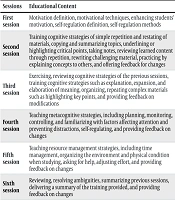
Khosrozadh M, Kordestani Moghadam P, Shahidi Delshad E, Mohammadi R, Mohammadi S, et al. Integrating Self-regulated Learning and the Use of a Cardiopulmonary Resuscitation Simulation Among Undergraduate Nursing Students: A Study Protocol. J Arch Mil Med. 2026;14(1):e168702. doi: https://doi.org/10.69107/jamm-168702
Nikandish R, Askaree A, Karamad T. Comparison Of Basic Life Support (BLS) Video Self-Instructional System And Traditional BLS Training In First Year Nursing Students. J Med Edu. 2005;7(1):e105173. doi: https://doi.org/10.22037/jme.v7i1.847
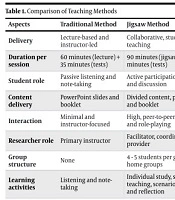
Dahmardeh H. The Effect of Jigsaw Teaching Method on Perception of Educational Environment Among Nursing and Emergency Medicine Students: An Interventional Study. J Nurs Midwifery Sci. 2025;12(4):e164386. doi: https://doi.org/10.5812/jnms-164386
Rahmati H, Yaghoubinia F, Zare Mehrabady R. Comparing the Effect of Lecture-Based Training and Basic Life Support Training Package on Cardiopulmonary Resuscitation Knowledge and Skill of Teachers. Health Scope. 2017;6(3):e15165. doi: https://doi.org/10.5812/jhealthscope.15165
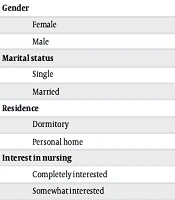
Rafi A, Heidari M, Masharafi A, Darabiyan P, Neshati A, et al. The Effect of Case-Based Learning on Self-directed Learning Among Undergraduate Nursing Students: A Quasi-Experimental Study. J Nurs Midwifery Sci. 2026;13(3):e169796. doi: https://doi.org/10.5812/jnms-169796
Last Update: 3 weeks ago
Last Update: 3 weeks ago
Last Update: 3 weeks ago
Last Update: 6 days ago
Last Update: 8 hours ago
Last Update: 4 days ago