


1. Background
Postural anomalies refer to the adverse changing which deform the skeletal structure and natural height, these anomalies appear due to the environmental reasons, improper muscular function and physical movements and its recovery depends on the removing of related factors. Totally, we can dissect the causative factors leading to bringing about these anomalies, which are related to the person’s condition and the environment of conditions. One of the important aims of the corrective exercise is to recognize the physical weaknesses and postural abnormalities using the simple and available methods. On time, recognition of physical weaknesses is considered as one of the major steps of the preventive measures (1). The studies showed that the frequency of postural abnormalities is high in Iran (2-5).
According to the evidence, most of these abnormal forms resulted from the muscular weaknesses and improper physical activities. Due to the skeletal deformities, some muscles will be shortened and do not allow the person to move the joint through its full range of motion so the muscles stop moving before reaching to this point. On the other hand, some muscles will be weakened, so the person gets tired early during the physical activity and his muscles stop doing more physical activities and after some activities, muscles get tired (6). The effects of these factors are observed during the period of youth, since the stages of body grow and develop duing this period. Thus, in case of deformation of a person’s body during the childhood, adolescence and youth, the person will certainly face mental and physical difficulties for the rest of his life. Getting enough information about the postural abnormalities is necessary for each person. Due to the lack of cognition and enough training and also the reduction of physical activity in lower age group, postural abnormalities are prevalent among young people. As the soldiers are worthwhile in the country and every kind of physical weakness would result in negative effects on the physical and mental states and consequently their behaviors, thus being aware of their physical state and doing the proper exercises and movements to remove these disorders are so important. Presenting the favorable viewpoint about the prevalence of postural deformation in soldiers paves the way to scientifically develop the educational and corrective plans and use the facilities efficiently.
2. Objectives
In order to recognize the causes and factors that have effects on the prevalence of these disorders in different working conditions and also the relationship between different habits and physical fitness plans in military training, it is essential to perform further investigations. So the aim of this study was to investigate the frequency of postural anomalies and the effects of military training courses and the corrective plans.
3. Materials and Methods
In this cross sectional study that was performed in October 2011, fifty new coming soldiers from training center of military force of Sanandaj were randomly selected. Maximum education degree of participants was diploma and they weren’t exempt from combat duty (mean age: 18-21 years old, mean weight: 55-65 kg, mean height: 165-180 cm) also they didn’t have any history of spine injury. Their postural anomalies were evaluated two months before and after the military training course, using the Ridko form and cross board. The scores were analyzed using the descriptive statistics and t-test.
3.1. The Measurement Tools and Anomaly Detection
To measure the anomalies, the Ridko form including 12 rows and 8 columns was used, which in five rows, the anomalies are visible from the backside of the other five rows, the anomalies are visible from the side of cross board. The first row indicates the scoring and the last row indicates the total score. For assessing the anomalies, three scores such as good (score 10), average (5) and weak (0) were regarded. The Sum of scores is considered as total score which presented in the last row.
3.2. Data Collection Method
The subjects were asked to stand motionless behind the cross board without dressings and shoes in order to measure their height be measured by a tester standing two meters away from the other side of the cross board, and so the abnormalities can be detected, the tester should enter the scores by observing the person from the backside of cross board and comparing his height with regard to three Ridko scores.
The normality of data distribution was investigated using the Kolmogorov-Smirnov test. In this investigation, the significant P value was less than 0.05. For statistical analysis, SPSS software was used.
4. Results
In this research, three scores of 0, 5 and 10, which mean severe anomaly, moderate anomaly and good condition, respectively were regarded for evaluating the indexes. The results of this study showed that before the military training course, round back disorder was in unfavorable condition with the mean score of 5.6 and the neck flexion and belly falling unfavorable condition with mean score of 8.1 compared to the other anomalies and after two months, uneven shoulder disorder was the unfavorable condition with mean score of 2.8 and belly falling disorder was in favorable condition with mean score of 8.6. The results of this research have shown that anomalies like uneven shoulder, neck flexion, round back and lordosis in soldiers were compared before and after the military training period and the differences were statistically significant (P = 0.000, P = 0.021, P = 0.000, P = 0.000).
According to the findings of this research, the anomalies like lateral deviation of head, lateral deviation of spine, lateral deviation of pelvis, deviation of ankle; backward body and belly falling were not significant in soldiers before and after the training. The results of t- test for determining the difference between the frequency of anomalies before and after the two-month training period have shown that round back anomaly was intensified before the training period and decreased afterwards and the frequency of anomalies like uneven shoulder disorder, neck flexion, and lordosis was high at the end of the training period and considerably intensified (Table 1) (Figures 1 and 2).
Table 1.The Results From the Pretest and Posttest Investigation of Postural Anomalies Among Soldiers in Military Training
| Anomalies | Pre Test | Post Test | Observed | P value |
|---|---|---|---|---|
| Lateral deviation of head | 7.1 | 6.5 | 0.771 | 0.444 |
| Uneven shoulder | 6.42 | 2.8 | 6.125 | 0.000 |
| Lateral deviation of spine | 6.6 | 5.5 | 1.753 | 0.086 |
| Lateral deviation of pelvic | 6.9 | 5.9 | 1.565 | 0.124 |
| Outward deviation of ankle | 8 | 8 | 0 | 1 |
| Neck flexion | 8.1 | 6.3 | 2.391 | 0.021 |
| Round back | 5.6 | 8.2 | -4.149 | 0 |
| Backward body | 7.4 | 7.3 | 0.151 | 0.881 |
| Belly falling | 8.1 | 8.6 | -0.81 | 0.471 |
| Lordosis | 6.9 | 4 | 4.773 | 0 |
| Postural anomalies | 70.9 | 62.5 | 2.515 | 0.015 |
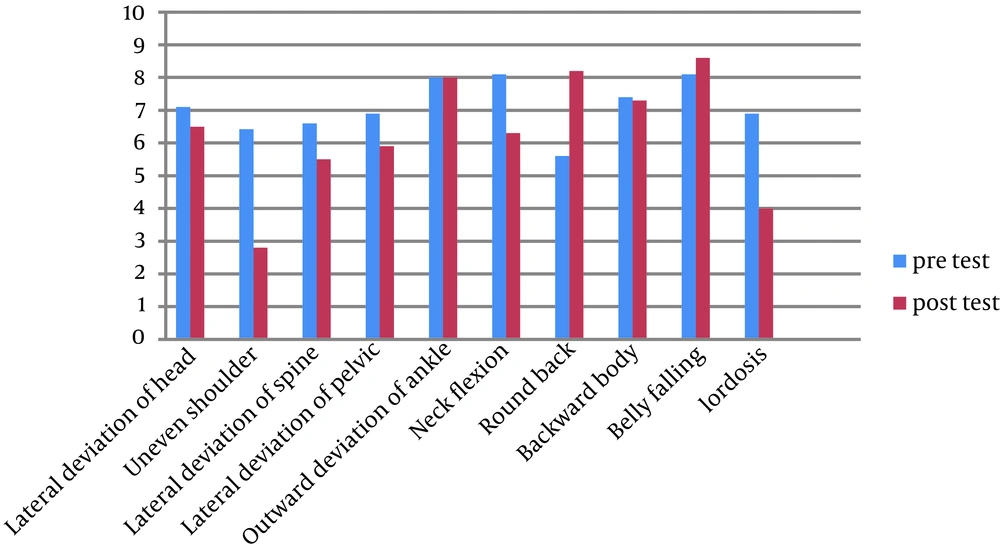
Figure 1.
The Postural Anomaly Condition in Soldiers During the Military Training (Separately)
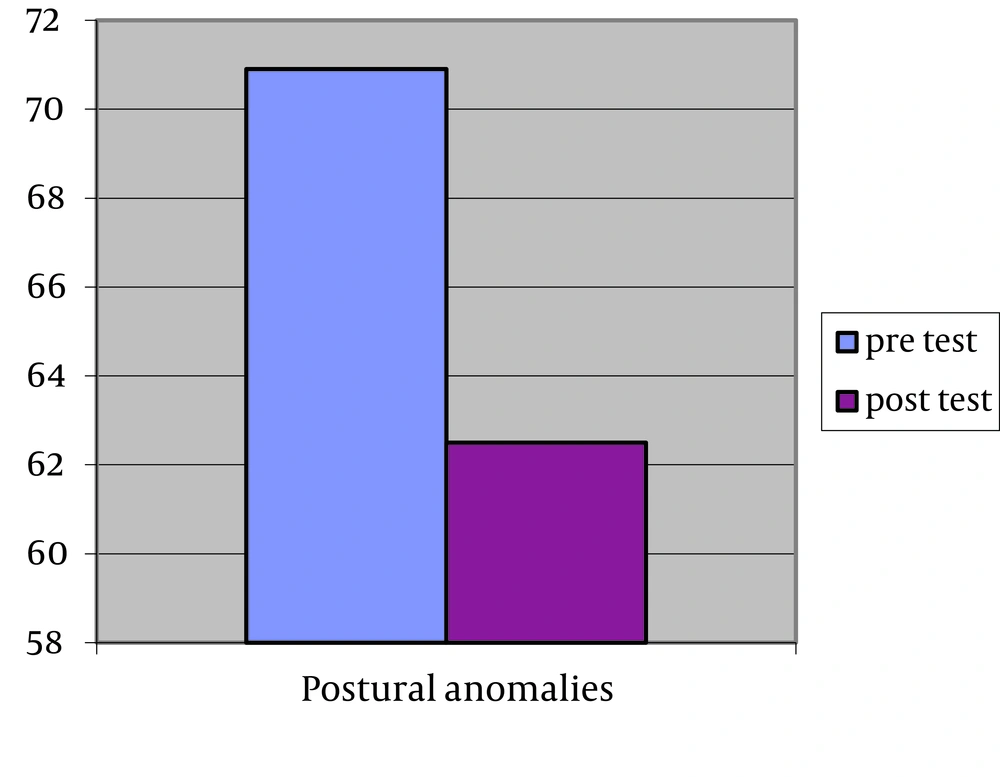
Figure 2.
The Postural Anomaly Condition in Soldiers During the Military Training
5. Discussion
The results of this research show that the round neck anomalies have been significantly recovered after the two-month training course while the uneven shoulder, neck flexion, and lordosis anomalies were considerably intensified after the two-month training course. The anomalies of the upper part of the body are related to the spine, which is the main part of the body structure. As the spine is sensitive, it brings in the proper space for the spinal cord which is vulnerable and has an important role for keeping body structure fit. The lordosis leading to the resistance against the vertical forces (body and things weight) provides forces which impresses on body during the physical activity (7). The above mentioned issues suggest the significant role of the spine. Anomalies in spine may result from different factors such as structural and functional default. The functional default can be recovered by on time detection and proper training. The functional factors leading to anomalies in the body structure include the wrong manner of sitting, resting, carrying, and doing physical exercises, occupations and lack of movement (8). The subjects of this research were soldiers who had no jobs. The researches showed that occupation is one of the factors affecting on the structure of body and it is expected that the technical jobs increase the anomalies (9, 10). The postural anomalies intensified after the two-month training course, were uneven shoulder, neck flexion and lordosis. As the wrong manners in long walking or doing one way activities and using one hand carrying the heavy things are the main factors of uneven shoulder anomalies, it is probable that the main causes of intensifying these anomalies in soldiers was to carry the gun with one hand in long walking; for instance walking from the training center to shooting center and the manner of taking the gun in military parade. Also the wrong habit of sitting while studying, standing, walking and doing exercise, sight weakness in nearsighted people and using the high pillows when sleeping are the factors of neck flexion, it is likely that the causes of intensifying these anomalies in soldiers are related to the wrong state of body such as standing for a long time and feeling fatigue in neck muscles. On the other hand, the shortness of hip flexor muscles and the muscles of spine in waist and sciatic muscle, belly and hamstring stretch are the main factors of lordosis and the causes of intensifying these anomalies in soldiers maybe resulted from the mass exercises, military parade without warming up, doing the stretchy movements for hip flexor muscles, lack of reinforcing the sciatic muscles, hamstring in physical activity programs, using the inconvenient bed and wrong state of body in sitting and standing. On the other hand, the round back anomalies were recovered significantly after the training course. In 1996, Sinaki et al. found that the stronger the muscles of the back of body are, the less likely is the occurrence of round back, also the research by Ham et al. in 1994 has shown that there is a negative relationship between the frequency of round back anomaly and respiratory capacity, and lateral expansion of the chest. In this regard, it is probable that the round back anomaly in soldiers recovered due to increasing the capacity, especially respiratory capacity which increases by doing the aerobics and physical fitness activities (1). In 1990, in recognition of congenital kyphosis Bvkhn student Germany study entitled "Leibniz Czech" and "Hyadnbrand" The study was conducted among 2075 students aged 10 to 17 years old who were randomly selected from five schools were tested, in terms of abnormal thoracic kyphosis. The most important results of the research were: A) Students who have had thoracic kyphosis, exercised less and their families’ orthopedic disease is more frequent with back pain. B) The degree of kyphosis in students was measured and recorded. The degree of kyphosis was 12 in girls and boys 3/10 degrees in boys (11).
Jrygl Morris et al. study has determined the prevalence of postural abnormalities in neck, shoulders and chest in two age groups of healthy subjects (age group of 21 to 35 years with a mean of 25 and the age group of 36 to 50 years with a mean of 47). 3.87% had anomaly in right shoulder, 66% had the anomaly in the left shoulder, 55% had malformations of the head to the front and 38% had kyphosis. In this study no relationship was found between the severity of deformity and pain (12).
Conclusions: With regard to these findings, it can be concluded that during the two-month training course, it is essential to emphasis on making the soldiers familiar with the proper physical condition of sitting, walking, sleeping and carrying the things specially carrying the gun and devoting the activities to the upper parts of body while carrying the things and doing other daily physical activities, keeping the range of neck and head movement to all directions, controlling the sight of soldiers and strengthening the sciatic muscle, belly and hamstring and stretching the hip flexors and straightening the spine of waist. As the recovery of postural anomalies is easier in the lower age group due to the flexibility of muscles and joints, it is essential to adopt corrective measures, by including the comments of this research, we can provide the proper backgrounds for prevention and treatment during the military training course.


