


1. Background
Lower limb amputation is a permanent disability, which results in lower life quality, limited mobility, and engagement of the person in social activities (1). Lower-limb amputation can occur in the battlefield or surgically at a hospital (2). Lower-limb loss has a higher occurrence rate compared to upper-limb loss, as a study of amputees in Iran-Iraq war showed that from each 200 amputees in the war, only 25 had upper body limb loss while the rest had limb loss in their lower body parts (3). Other studies have shown that the most widespread lower body limb loss is the below-knee limb loss (4) and the rehabilitation process for these individuals is accompanied by major difficulties (5). These peoples, due to difficulty in adapting to their situation, are stricken with psychological and social disorders, such as depression, desperation, lower confidence level, anxiety, and suicide attempts, and they develop other disorders, such as addiction to drugs, alcohol, psychedelics or decreased functionality in the society (6).In addition, quality of life in lower-limb amputees decreases due to their immobility issues (7, 8). Therefore, in the rehabilitation process of amputees, prosthesis usage can help with mobility dysfunctions and improve personal and social functionality (9). For this reason, one of the important factors in rehabilitation of lower-limb amputee people can be the prescription of a prosthesis, which can act as a substitute for the lost limb (10). Age, Gender, and scale and reason of amputation are also influential in prosthesis usage (11). Studies have shown that quality of life in unilateral trans-femoral amputee prosthesis users have been improved in psychosocial adjustments and athletic activity restrictions (12). Overall, what is prominent is that the quality of life in amputees is drastically reduced, and can be observed and monitored in forms of depression, scale of engagement in social activities, problems with prosthesis and mobility characteristics of prosthesis. However, many of these problems can be solved by prescribing a suitable prosthesis (3, 13, 14). Due to the importance of life quality in the amputee, many studies have been carried out in this regard. Sinha et al. by using the short form-36 (SF-36) and mental component summary (MCS), studied affecting factors regarding quality of life in lower-limb amputee and found that employment status, phantom-limb pain, use of assistive devices, and prosthesis have the most impact in determining quality of life in this population (14). In another study, Mousavi et al. assessed the quality of life in war-related bilateral lower limb amputees of Iranian disabled war veterans using SF-36 survey form and discovered that this group of patients had significantly lower quality of life. Out of different parameters, history of hospitalization and salary satisfaction were the key factors in quality of life in this group of patients. This study also revealed that improvement of supportive services and rehabilitation, including encouragement to exercise, leisure events, and control and treatment of amputation side-effects can increase quality of life in this group (3). Deans et al. investigated the relationship between physical activity and quality of life in lower-limb amputees to determine the important aspects of physical activity on quality of life factors in this group and found that implementing supportive changes in the environment can contribute to quality of life for this group (15). Asano et al. conducted a study to predict quality of life in individual lower limb amputees. They found that social activity in amputees has a very important effect on regaining and maintaining quality of life in this group (13). The goals of rehabilitation of amputees are improvement in mental, physical, social, and economic functioning and bringing back this group to the society (16). Therefore, to reduce disorders that result from amputation and increase adjustment of amputee with prosthesis, it should be emphasized that parts of prosthesis, such as ankle and knee parts, should have high degree of similarity and adjustment to the natural limb with ability of performing the same movements that a natural limb can perform to reduce problems, which are caused by amputation and prosthesis usage (17). In this regard, it seems that ankle transverse plane motion plays a major role. This motion can be beneficial in easing up performing actions, such as putting on socks and shoes (18). This motion can also assist the patient in cross-legged sitting and kneeling positions and also helps the patient maintain a more natural posture (19). For these reasons and the perceived necessities, an attempt was made to design a unit that can provide ankle motion in the transverse plane. Therefore, the aim of this study was to investigate of the effects of ankle turner unit on the quality of life of unilateral below knee amputees. Therefore, the aim of this study was to investigate the effects of ankle turner unit on the quality of life of unilateral below knee amputees.
2. Methods
This cross-sectional study evaluated the quality of life of amputees that use an ankle turner unit. For this purpose, twenty individuals with below-knee amputation were selected with randomized selection from Red Crescent rehabilitation center of Tehran, Iran during March to May 2016. Inclusion criteria for participating in this study were: (1) Unilateral below-knee amputation, (2) Prior experience in using prosthesis, (3) Having the modular type of prosthesis (because in this type of prosthesis, segments can be easily separated). The main purpose of ankle turner unit is creating ankle rotation in the transverse plane. Also, this unit allows the prosthesis to perform knee flexion easily when the foot rotates externally (Figure 1). In fact, turner unit that was used in this study works as a locker/unlocker unit. When the amputee want to turn ankle, they pull its cable and make the ankle unlocked, so the amputee can turn it by internal/external rotation of femur, and when they find an appropriate angle, they lock the ankle by unbuckling the cable of the ankle turner. When the amputee wants to flex their knee in close chain while their forefoot and knee are on the ground, turning the ankle can help the amputee flex their knee easily. In another position, when a person wants to sit cross legged, turning the ankle can be helpful for more knee flexion. In this study, for evaluation of the effect of the ankle turner unit on the quality of life of patients, the researchers used the trinity amputation and prosthesis experience scales (TAPES) method that was developed by Gallagher and McLachlan (11). In this scale, in addition to physical aspects, evaluation of the psychosocial aspects in people with lower-limb and upper-limb amputation is also performed. This survey was structured in three parts. In the first part, the adjustments of amputee with usage of prosthesis was performed. In the second section, restrictions, due to limb loss and usage of prosthesis by the amputee, were being analyzed. The third part analyzed the scale of satisfaction of the individual in different aspects of using the prosthesis. In many studies, the TAPES survey has been used in assessing objectives, such as quality of life, adjustment of individual to lower-limb prosthesis, and effects of limb-loss on amputee’s mental, emotional, and functional states (9, 20). This study was carried out with the following approach: At first, the participants, who qualified to enter the survey were asked to fill the TAPES, based on their experience with their own prosthesis and life conditions. Then ankle turner unit and the movements it makes were explained to the participants. The participants were asked to practice these movements so that they became familiar with the functionality of the unit and the possible increase in their movement by using this unit. A separate section of the survey evaluated the amount of pain the patient might have in the amputated limb (phantom-limb pain) (9, 11, 20). The minimum time spent on performing the recommended training was thirty minutes. Afterwards, the participants were asked to fill the survey again, respecting the experience they had with the ankle turner unit, and finally, both surveys were graded and compared. Statistical analysis: The normal distribution of all variables was assessed with the Kolmogrov-Smirnov test. The baseline mean scores for all subjects were analyzed using the paired-sample t test to determine whether there were any significant differences. Statistical analysis was performed with SPSS (version 19.0), and P values of less than 0.05 were considered statistically significant
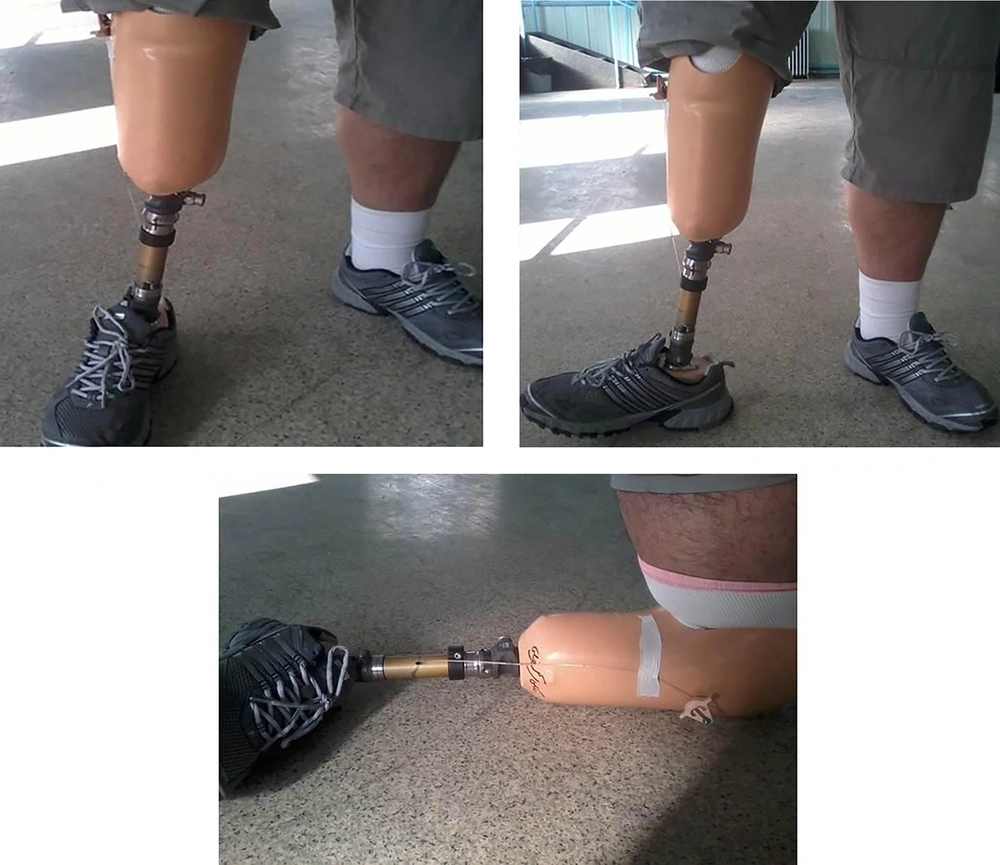
Figure 1.
Ankle turner unit was used in this study
3. Results
Twenty subjects with below knee amputation with mean age 47.7 years participated in this study. Also, the mean time since limb amputation was 96.9 months. Table 1 provides the other information about prosthesis of subjects. Based on the two sample t test results, quality of life of participants in the study showed a significant difference before and after using the ankle turner unit (P < 0.05). In the adjustment with restrictions section, mean quality of life in participants was significantly less compared to that after using the new unit (P < 0.05). So that the results showed a 12.63% increase in quality of life index after using the new unit. In the adjustment with movement limitations, quality of life index turned out to be lower prior to using the new prosthesis unit, which demonstrated a statistically significant difference (P = 0.006). The ankle turner unit improved quality of life index of subjects by 34.6%. In the adaptation with functional limits category, while the quality of life index increased in comparison with the survey before using the ankle turner unit, it was not statically significant (P = 0.287). Quality of life index in adjustment with social limitations significantly (P = 0.04) exhibited a relevant increase after using the ankle turner unit, and improved by 11.6% (Table 2).
Table 1.Demographic Properties of the Participants in the Survey
| Variable | Mean ± SD | Min - Max |
|---|---|---|
| Age | 47.7 ± 15.88 | 16 - 75 |
| Months since limb loss | 96.9 ± 99.1 | 14 - 324 |
| Months since using prosthesis | 67.8 ± 68.6 | 9 - 284 |
| Months since using their latest prosthesis | 46.1 ± 71.2 | 5 - 264 |
Table 2.The Mean Changes Compared Baseline and After Use of the Ankle Turner Unit
| Category | Baseline | After Use of Unit | Mean of Difference ± SD | P Value |
|---|---|---|---|---|
| TAPES | 101.8 | 105.50 | -3.7 ± 5.87 | 0.01 |
| Adaptation | 13.85 | 15.60 | -1.75 ± 3.71 | 0.04 |
| Athletic limitation | 2.45 | 3.30 | -0.85 ± 1.22 | 0.006 |
| Functional limitation | 4.85 | 5.10 | -0.25 ± 1.02 | 0.2 |
| Social limitation | 5.60 | 6.25 | -0.65 ± 1.34 | 0.04 |
4. Discussion
The overall aim of this study was investigation of the effect of the ankle turner unit on the quality of life subjects with below knee amputation. The main purpose of the ankle turner unit is creating ankle rotation in the transverse plane. Also, this unit allows the prosthesis to perform knee flexion easily when the foot rotates externally. The evaluation of quality of life factors were carried out according to the TAPES survey with special attention to four related items to satisfaction level. These items were: Adjustment with limits in daily life routines, adjustment with athletic restrictions, adjustment with functional limitations, and adjustment with social limits. In this study, these four categories involving satisfaction levels of individuals were evaluated according to TAPES survey standards and at the end analysis was performed and overall conclusions were made. Based on yielded results, the ankle turner unit has an overall positive effect on quality of life in participants and has improved quality of life in amputee. The results of this study are in the same direction as Sinha’s study, which has stated that prosthesis improves quality of life in amputee (14). Also, the overall result of this study was similar to the results obtained by Kamali and Adli's study, since they stated that facilitation of daily activities provided by prosthesis can increase quality of life in the individual (12). The questions discussed in the adjustment with restrictions section, which assessed existence of restrictions in performing tasks in the amputees, showed an effective increase in scores of this category after using the ankle turner unit and indicated that this unit can help improve abilities of the amputee in this category. The obtained results can be attributed to increase in range of motion provided by this unit. This was also in accordance with results of Kamali and Adli's study (12). In the adjustment with athletic restrictions, which assessed the restrictions in intense activities, such as running, lifting objects, heavy exercises, stair climbing, and other typical activities, such as general leisure, a significant decrease was observed (13). Therefore it could be concluded that this unit can increase mobility and ability of the amputee in performing intensive activities and exercise. The probable reason of this obtained result is the nature of motions made possible with this unit. According to the yielded results in this study, it is possible to come to functional objective of selection of appropriate target group for this unit. Based on the results, individuals with higher levels of activity can be better candidates for using the ankle turner unit. Adaptation with functional restrictions category, which assessed lighter activities, such as climbing stairs of single storey buildings or walking about one or two kilometers or less (11), have shown that the prosthesis unit used in this study resulted in effectively enhanced quality of life in the participants. Thus, it can be concluded that this unit will not provide a lot of benefits for individuals with lower activity levels. The reason might be that individuals with lower levels of activity and limited to in-home tasks, do not find any increase in the range of motion provided by this unit necessary. Social restrictions category, which assessed normal life activities, such as keeping relationships with friends, performing entertaining activities, and going to work (11), showed an increase in social performance of the users. Possible reasons for this result might be the help, which this unit provides in performing the movements in a more natural way, having a more natural posture as well as helping in activities, such as sitting, which can be effective in expanding relationships (18-21). The findings are consistent with the results obtained by Kamali and Adli, where in both studies, the participant group did not have significant differences in terms of athletic restrictions (12). In conclusion, based on the statistical result that we obtained from this study by TAPES questionnaire, it can be said that this unit has the ability of improving quality of life in the below-knee amputees. However, it seems this unit, in individuals with higher levels of activity, provides better desirable results compared to individuals with lower levels of activity because the effect of the turner on athletic activity level and social activity level was significant yet its effect on daily routine activities was not significant. However, it is clear that further studies are needed to support the results of this study.


