


1. Background
High education is one of the most important parts of each country with this in mind, it is not supervising to notice that different aspects of each country such as economic, social, and political status are significantly affected by its educational system. Thus, it is very important for different countries to determine their educational system status by utilizing educational services quality method. Actually, educational services quality can be accomplished by employing different methods such as the SERVQUAL model (Gap analysis model), which is one of the most renowned models for quality assessment. SERVQUAL model measures the gap between perceptions and expectations of services based on the customer’s viewpoint; the goal of this model is finding weak points in services quality and trying to reduce or eliminate these weak points.
Demands and expectations of customers are important elements for services quality assessment. Since quality is a function of costumer’s viewpoint, no one can repudiate the statement, which mentions that customers’ viewpoint is the most important scale in the definition of service quality. Parasuraman et al. devised one of the most important models for service quality assessment based on the mentioned idea (1). Initially, their model was based on ten different dimensions for the service quality assessment including; tangibles, reliability, responsiveness, competence, access, courtesy, communication, credibility, security and understanding (2). The modified model that contained only five dimensions including; “tangibles”, “reliability”, “responsiveness”, “assurance” and “empathy”, was published by the same authors on 1990 and this model is known as the SERVQUAL model. The SERVQUAL model was a not only a simple and applicable model in high dimensions, but also a highly reliable and valid model. Reliability and validity of this model have been confirmed in many studies such as Parasuraman et al. (1). The SERVQUAL model did not satisfy many researchers such as Khamis and Njau (3) and Dabholkar et al. (4), as it is criticized in the first few days. However, after the implementation of the SERQUAL model in various fields, researchers came to the conclusion that a specefic SERVQUAL model can be devised for each certain company or institute. In recent years, the SERVQUAL model has been used in various fields, including banking, stock market services, maintenance of buildings, services information, marketing, hospitality, health care, sales, and higher education to evaluate the quality of service.
The SERVQUAL model was used in health areas by Khamis and Njau (3) and Papanikolaou and Zygiaris (5). In addition, it applied to educational researchers by Mansori et al. (6), Zareinejad et al. (7), May and Viljoen (8), and van Schalkwyk and Steenkamp (2). Moreover, Panda and Kondasani (9) and Choudhury utilized this model in banking industries (10).
2. Objectives
In this study, we are going to assess educational services quality of the Aja University of Medical Science based on the SERVQUAL model. In the following sections, methods will be illustrated in the methods section. After that, results will be presented before discussing results and finally, conclusions will be offered in the last section.
3. Methods
This study has implemented on students and professors of the Aja University of Medical Sciences in 2017. The proportional stratified sampling method was used as a sampling strategy for choosing 317 students and 102 professors, among five university faculties, to answering the SERVQUAL model questionnaire. A 22-item SERVQUAL model, which coordinates tangibles [appearance of physical facilities, equipment, personnel, and communication materials] (4 questions), reliability [ability to perform the promised service dependably and accurately] (5 questions), responsiveness [willingness to help students and provide prompt service] (4 questions), assurance [knowledge and courtesy of employees and their ability to convey trust and confidence] (4 questions), and empathy [caring, individualized attention the university provides its students] (5 questions) was used for the study. Reliability and validity of the SERVQUAL questionnaire have been confirmed by Parasuraman et al. (1), Tan and Kek (11), and many other authors. In this research, the Cronbach coefficient alpha was used to present the reliability of the questionnaire and according to Table 1, the reliability of the questionnaire is confirmed (greater than 0.7).
Table 1.Reliability Coefficienta
| Dimension/Case Study | Alpha (Expectations) | Alpha (Perceptions) |
|---|---|---|
| Tangible | ||
| Students | 0.875 | 0.701 |
| Professors | 0.891 | 0.708 |
| Responsiveness | ||
| Students | 0.916 | 0.790 |
| Professors | 0.817 | 0.735 |
| Empathy | ||
| Students | 0.941 | 0.743 |
| Professors | 0.901 | 0.758 |
| Reliability | ||
| Students | 0.952 | 0.836 |
| Professors | 0.947 | 0.866 |
| Assurance | ||
| Students | 0.925 | 0.821 |
| Professors | 0.930 | 0.889 |
| Total | ||
| Students | 0.982 | 0.937 |
| Professors | 0.979 | 0.933 |
aCronbach alpha coefficient
4. Results
Finally, 274 (87%) students and 78 (77%) professors participated in the survey. All of the students were male while 61.04% of the professors were females. Distribution of students in faculties is as follow: faculty A: 10.69%, B: 23.28%, C: 29%, D: 9.54%, and E: 27.49% and distribution of professors is as follow: A: 15.79%, B: 34.21%, C: 18.42%, D: 15.79%, and E: 15.79%.
Some descriptive statistics and gap values between expectations and perceptions of students and professors are presented in Table 2. Obviously, all of SERVQUAL dimensions have negative gap values based on two viewpoints, which means there is not the only distance between expectations and perceptions; however, there are also more expectations of educational services quality than perceptions. Maximum gaps are related to empathy (-2.215) and tangible (-1.866) dimensions while the minimum gap is related to responsiveness (-2.109, -1.292), based on the viewpoint of students and professors, respectively.
Table 2.Gap Value Between Students and Professors’ Expectations and Perceptions
| Dimensions/Case Study | Perception Score, Mean ± SE | Expectation Score, Mean ± SE | Gap |
|---|---|---|---|
| Assurance | |||
| Students | 2.293 ± 1.012 | 4.441 ± 0.887 | -2.148 |
| Professors | 3.134 ± 0.907 | 506.4 ± 0.705 | -1.372 |
| Responsiveness | |||
| Students | 2.315 ± 0.939 | 4.425 ± 0.863 | -2.109 |
| Professors | 3.283 ± 0.734 | 4.488 ± 0.854 | -1.292 |
| Empathy | |||
| Students | 2.163 ± 0.809 | 4.378 ± 0.894 | -2.215 |
| Professors | 3.122 ± 0.811 | 4.431 ± 0.752 | -1.309 |
| Reliability | |||
| Students | 2.196 ± 0.891 | 4.377 ± 0.946 | -2.181 |
| Professors | 2.964 ± 0.946 | 4.488 ± 0.854 | -1.524 |
| Tangible | |||
| Students | 2.275 ± 0.823 | 4.431 ± 0.810 | -2.157 |
| Professors | 2.607 ± 0.562 | 4.474 ± 0.667 | -1.866 |
| Total | |||
| Students | 2.249 ± 0.776 | 4.411 ± 0.827 | -2.162 |
| Professors | 3.022 ± 0.677 | 4.494 ± 0.690 | -1.473 |
Based on the results of t-test in Table 3 and Figure 1, there is a significant difference between male and female professors’ viewpoint only on the tangible dimension but, in all other dimensions, there is no significant difference. However, based on P values of the t-test there is no significant difference between male and female professors’ viewpoint of educational services quality.
Table 3.Difference Between Professors’ Viewpoint Based on GENDER Levela
| Dimensions | Perception | Expectation | ||||
|---|---|---|---|---|---|---|
| t Value | df | P Value | t Value | df | P Value | |
| Assurance | -1.915 | 75 | 0.059 | -0.722 | 72.820 | 0.472 |
| Responsiveness | -1.329 | 38.852 | 0.192 | -1.265 | 74.642 | 0.210 |
| Empathy | -1.908 | 48.636 | 0.062 | -1.911 | 72.258 | 0.163 |
| Reliability | -0.121 | 75 | 0.904 | -0.150 | 75 | 0.881 |
| Tangible | -3.550 | 36.377 | 0.001 | -0.705 | 72.741 | 0.488 |
| Total | -1.032 | 75 | 0.305 | |||
at-test
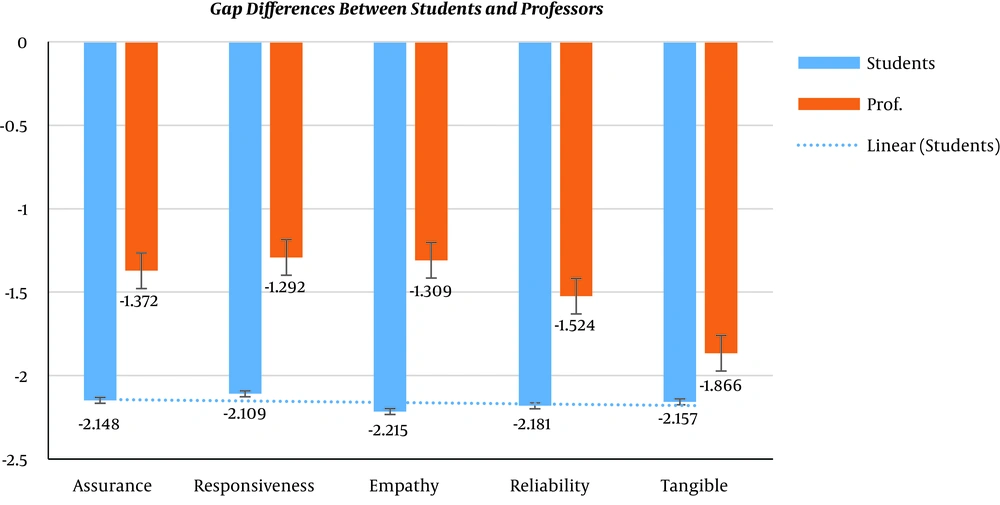
Figure 1.
Barchart of SERVQUAL Model
Based on results of One-way ANOVA test in Table 4, there is a significant difference among professors’ viewpoint in different faculties (5 faculties); however, there is no significant difference among students’ viewpoint of different faculties.
Table 4.Difference Between Five Faculties’ Professors and Students’ Viewpointa
| ANOVA | Sum of Squares | df | Mean Square | F Statistic | Sig. |
|---|---|---|---|---|---|
| Between groups | |||||
| Students | 4.165 | 4 | 1.041 | 0.946 | 0.438 |
| Professors | 7.674 | 4 | 1.918 | 4.144 | 0.004 |
| Within groups | |||||
| Students | 282.960 | 257 | |||
| Professors | 32.869 | 71 | |||
| Total | |||||
| Students | 287.126 | 261 | |||
| Professors | 40.543 | 75 |
aOne-way ANOVA
We introduce a categorical variable for the gap between expectations and perceptions such that categorical variable takes 1 if the gap value is greater than -1 and else takes 0. The binary logistic regression results are presented in Table 5. As you see covariates: age, time and gender cannot be good predictors for reported gap levels by professors while the age of students can be a good predictor for their viewpoints of educational services quality.
Table 5.Logistic Regressiona
| Parameter/Level | Coefficient | SE | P Value |
|---|---|---|---|
| Constant | |||
| Student | 8.306 | 4.396 | 0.059 |
| Professor | 4.749 | 5.331 | 0.373 |
| Age | |||
| Student | -0.472 | 0.001 | 0.031 |
| Professor | -0.094 | 0.109 | 0.388 |
| Time (elapsed at university) | |||
| Student | 0.001 | 0.001 | 0.392 |
| Professor | -0.281 | 0.412 | 0.495 |
| Gender | |||
| Student | All are male | - | - |
| Professor | -0.809 | 1.477 | 0.584 |
aRegression coefficients
5. Discussion
The SERVQUAL model is used for obtaining overall information about the customers’ viewpoint of services quality. The SERVQUAL model was very popular recently among researchers. Improving services quality needs, first, knowing about present services quality, this information can be obtained from the SERVQUAL model. According to this study, there is a negative gap in all dimensions of the SERVQUAL model based on the professors and students’ viewpoints. Empathy (-2.215) and tangible (-1.866) dimensions have maximum gap values while responsiveness (students: -2.198, professors: -1.292) has a minimum gap value, based on students and professors’ viewpoints, respectively. In many previous studies, a negative gap between customers’ expectations and perceptions was distinguished.
Kebriaei and Roudbari at Zahedan University of Medical Science (7), concluded a negative gap in all model dimensions based on students’ viewpoint by using the SERVQUAL model, and the responsiveness dimension was the maximum gap value in their model (this result is not in line with our study) and the minimum gap value was related to reliability dimension. Arbooni et al., obtained negative gap values for all dimensions of the SERVQUAL model in Zanjan University of Medical Science such that maximum gap value was related to the empathy dimension (this result is in line with our study) (12).
In this study, student-based total negative gap value is -2.162 while, the same value is equal to -1.473 for professors, which means, students and professors’ expectations are beyond their perceptions and also students have more expectations than professors.
Kebriaei and Roudbari concluded that students’ total negative gap value is equal to -1.49 (7).
The negative gap in tangible dimension means that physical attractiveness (building, classroom, chairs...), modern equipment, and material and facilities services are not suitable. Empathy negative gap means that the university has some weakness in cases such as professors’ respect to students and appropriate educational staff’s behavior with students. The negative gap in reliability dimension is because of problems in some areas such as performance of activities by professors and staff in due time and be on time. Presence of problems in some areas such as facility discussion between professors and students and sufficient resources to responsiveness and increasing the students’ knowledge will lead to a negative gap in assurance dimension. Allocated sufficient time for responsiveness to students by professor and staff, and loving to help students, are some areas that are determined by responsiveness dimension. The negative (positive) gap in different dimensions can affect each other, in a way that improvement in one dimension leads to improvement in the other one. Dimensions with greater negative gaps are a priority in improvement planning strategy as tangible and empathy dimensions are priorities in this research.
Authors presented the following suggestions for decreasing gap values and improving educational services quality:
-Appropriate allocation of resources and university budgets
-Update educational instruments and facilities
-Furnish university with the internet, new liberators and appropriate classrooms
-Considering a suitable mechanism for collecting students and professors’ viewpoints and pay attention to them
-Pay more attention to students and professors’ demands
This study and its results are related to the Aja University of Medical Science and cannot be generalized to other universities, because it is recommended that similar research should be performed in other educational institutes and other customer based institutes such as hospitals, schools, and banks, in order to increase services quality.
5.1. Conclusions
There is a negative gap in all dimensions of the SERVQUAL model in this study. Maximum gap value was related to empathy and tangible dimensions based on the students and professors’ viewpoint and minimum gap value was related to responsiveness dimension based on the both viewpoints. Students have more expectations than professors. There was no significant difference between the viewpoint of male and female professors. There was no significant difference between viewpoints of five faculties’ students while professors’ viewpoint was different in these levels. Based on the regression logistic variable age was an appropriate predictor for gap level based on the students’ viewpoint while there was no good predictor for professors’ viewpoint of quality. For improving educational services quality, some suggestions were presented and tangible and empathy dimensions are priorities.
