
1. Background
Laparoscopic cholecystectomy is the standard surgical treatment for symptomatic gallstone disease. This minimally invasive approach is associated with fewer postoperative complications than open surgery (1, 2). Despite these benefits, postoperative nausea and vomiting (PONV) remains one of the most common and distressing complications, with a prevalence ranging from 30% to 80% in different populations (3-5). PONV arises from multiple factors, including anesthetic techniques, patient comorbidities, and perioperative medications, making its prediction and prevention challenging for clinicians (4, 6, 7).
Recent research has focused on identifying reliable, cost-effective, and accessible biomarkers to assess the risk of PONV in surgical patients (8-10). The neutrophil-to-lymphocyte ratio (NLR) and platelet-to-lymphocyte ratio (PLR), derived from preoperative blood counts, are systemic inflammatory indices associated with prognosis in various diseases (8-10). These markers are appealing because of their simplicity and clinical applicability. The literature increasingly supports NLR and, to a lesser extent, PLR as predictors of perioperative complications, including PONV (8-10).
NLR serves as an indicator of systemic inflammation, reflecting the interplay between neutrophil-mediated innate immunity and lymphocyte-mediated adaptive immune responses. An elevated preoperative NLR is associated with more pronounced inflammatory states and may sensitize the central nervous system to emetogenic stimuli during anesthesia and surgery (8, 10, 11). For example, in a recent study of patients undergoing elective laparoscopic cholecystectomy, preoperative NLR was identified as an independent risk factor for PONV. Logistic regression analysis showed a statistically significant odds ratio, and a receiver operating characteristic (ROC) curve supported its discriminative value (14). Similar findings have been reported in maxillofacial, orthopedic, and esthetic surgery (10-13).
Most evidence pertains to NLR. Several studies have also evaluated PLR as a predictor of PONV. Platelets act as acute-phase reactants in hemostasis and inflammation; however, findings regarding the predictive value of PLR are inconsistent. Some studies have reported that PLR performed as well as, or better than, NLR, whereas others did not identify PLR as an independent predictor (10, 12). These discrepancies underscore the need for procedure-specific analyses and adequately powered studies.
The mechanisms linking elevated NLR and PLR to PONV are likely multifactorial. Systemic inflammation increases circulating cytokines and chemokines, which can sensitize central emetic pathways, such as the chemoreceptor trigger zone and the nucleus tractus solitarius (14-16). Platelets are the main reservoir of circulating serotonin and release it during surgical stress and tissue injury. This serotonin activates 5-HT3 receptors on vagal afferent fibers, contributing to the emetic response (15). Thus, higher NLR and PLR may reflect an inflammatory and neurohumoral state that predisposes patients to more severe PONV.
2. Objectives
Postoperative nausea and vomiting is common after laparoscopic cholecystectomy and is clinically significant. Identifying high-risk patients using routine blood indices is a practical necessity. This approach may help guide tailored prophylactic strategies and improve recovery, patient satisfaction, and resource use (1-3, 5). Therefore, this study aimed to assess the association of preoperative NLR and PLR with the incidence and severity of PONV.
3. Methods
3.1. Study Design and Setting
This prospective observational cohort study investigated the association between hematological indices and the incidence and severity of PONV after laparoscopic cholecystectomy. The study included patients admitted to Al-Zahra Hospital, affiliated with Isfahan University of Medical Sciences, in 2024.
3.2. Ethical Considerations
The study protocol was developed in accordance with the Declaration of Helsinki and was approved by the Ethics Committee of the Medical Faculty of Isfahan University of Medical Sciences (code: IR.MUI.MED.REC.1403.444). The reporting of the study findings adhered to the STROBE (Strengthening the Reporting of Observational Studies in Epidemiology) guidelines. Written informed consent was obtained from all participants before enrollment.
3.3. Patient Selection and Eligibility Criteria
Patients were selected using a convenience sampling method. All patients scheduled for elective laparoscopic cholecystectomy who were aged 18 to 65 years and classified as ASA physical status I or II were eligible for inclusion.
The exclusion criteria were Body Mass Index (BMI) greater than 30 kg/m2; a history of cardiovascular disease or hemodynamic instability; use of psychotropic or sedative medications; preoperative use of antiemetic drugs; a history of opioid or nonopioid substance abuse; a diagnosis of diabetes mellitus, hypothyroidism, depression, dementia, or psychiatric disorders; pregnancy or lactation; and recent antibiotic therapy. Patients were also excluded intraoperatively or postoperatively in cases of allergy to anesthetic agents, the need for cardiopulmonary resuscitation, mortality, difficult or prolonged tracheal intubation, or noncooperation.
3.4. Study Procedure
Patients were first informed about the study objectives and provided written consent. An anesthesiologist then performed a physical examination and obtained the medical history. Patients with low or moderate surgical risk were transferred to the operating room. All patients fasted for at least 6 hours before surgery.
Upon arrival in the operating room, the anesthesiologist re-evaluated each patient to confirm ASA classification and assess airway anatomy. Two intravenous lines were inserted using 18-gauge cannulas, one in each arm. An infusion of 10 mL/kg crystalloid solution was initiated through the right arm to prevent anesthesia-induced hypotension and reduce stress-related symptoms. Standard monitoring, including electrocardiography, pulse oximetry, and noninvasive blood pressure monitoring, was provided for all patients.
To reduce the influence of perioperative confounding on PONV risk, perioperative management was standardized as far as possible. All patients underwent elective laparoscopic cholecystectomy under general anesthesia with endotracheal intubation according to the institutional anesthesia protocol. Volatile-based maintenance anesthesia was used rather than total intravenous anesthesia. Preoperative antiemetic use was an exclusion criterion, and ondansetron was used as rescue antiemetic therapy after postoperative assessment. Operation duration was recorded for all patients. The anesthetic technique, intraoperative opioid exposure, antiemetic exposure, pneumoperitoneum protocol, and postoperative opioid-based analgesia were reviewed as potential PONV-related confounders and summarized descriptively when available.
Blood samples were collected in the ward before transfer to the operating room. Samples were placed in heparinized tubes and transported under appropriate temperature conditions to the laboratory for analysis. Before incision, 1 g of intravenous cefazolin was administered to all patients as prophylactic antibiotic therapy. Vital signs were monitored and recorded at 15-minute intervals throughout surgery.
After surgery, anesthetic reversal agents were administered. Patients were transferred to the post-anesthesia care unit and remained there until they were fully awake. Vital signs were recorded upon admission to the post-anesthesia care unit. After full consciousness was achieved, patients were transferred back to the surgical ward.
3.5. Assessment of Nausea and Intervention
The incidence and severity of nausea and vomiting were assessed during the first hour after surgery using the Rhodes Index of Nausea, Vomiting, and Retching. If a patient developed clinically significant nausea or vomiting or reported a nausea visual analog scale score greater than 4, a 4-mg dose of ondansetron was administered as rescue antiemetic therapy. The total cumulative dose of ondansetron received by each patient within the first 24 hours postoperatively was recorded.
3.6. Data Collection Tool
Data were collected using a structured checklist capturing demographic information and perioperative variables, including age, sex, ASA physical status, BMI eligibility status, smoking status when available, duration of surgery, anesthetic technique, anesthetic drug class, antiemetic exposure, pneumoperitoneum protocol, intraoperative opioid exposure, and postoperative opioid-based analgesic exposure. The checklist also captured key hematological indices, including neutrophil count, lymphocyte count, platelet count, and the derived NLR and PLR. Vital signs, specifically systolic and diastolic blood pressure, heart rate, and oxygen saturation, were recorded at multiple time points: preoperatively, every 15 minutes during the intraoperative period, upon admission to the post-anesthesia care unit, and on the first postoperative day. The primary outcome measures were the Rhodes Index score and the total 24-hour ondansetron dose.
3.7. Rhodes Index
The Rhodes Index, developed in 1999 by Rhodes and McDaniel, assesses the experience of nausea and vomiting across eight parameters: Frequency, amount, and distress of vomiting; duration, frequency, and distress of nausea; and frequency and distress of retching. Each parameter is scored from 0 to 4, with 0 indicating no symptoms and 4 indicating extreme severity. The total score ranges from 0 to 32, with higher scores indicating greater severity: 0, none; 1 - 8, mild; 9 - 16, moderate; 17 - 24, severe; and 25 - 32, very severe.
3.8. Statistical Analysis
Data were analyzed using SPSS software version 26. The normality of the continuous data distribution was assessed using the Kolmogorov-Smirnov test. Quantitative variables are expressed as mean ± standard deviation, and qualitative variables are presented as frequency and percentage. The Spearman rank correlation test was used to examine associations between NLR, PLR, Rhodes Index scores, and total ondansetron dose. Potential PONV-related confounders were addressed through protocol standardization when there was no meaningful between-patient variation and through descriptive or exploratory analyses when values were available. These variables included anesthetic technique, volatile anesthesia versus total intravenous anesthesia, intraoperative opioid exposure, antiemetic exposure, duration of surgery, pneumoperitoneum protocol, and postoperative opioid-based analgesia. Variables with complete data and sufficient variability were considered in exploratory analyses, whereas variables with no between-patient variability or insufficiently extractable individual-level data were reported descriptively and acknowledged as limitations. A 95% confidence interval was considered for all tests, with P < 0.05 considered statistically significant.
4. Results
A total of 180 patients were included in the final analysis. The cohort comprised 105 males (58.3%) and 75 females (41.7%), with a mean age of 46.98 ± 10.43 years. The mean duration of surgery was 85.45 ± 27.43 minutes. The mean lymphocyte, platelet, and neutrophil counts were 2.66 ± 0.87 × 10³/μL, 210.91 ± 77.41 × 10³/μL, and 9.95 ± 8.06 × 10³/μL, respectively. The mean NLR was 3.72 ± 2.42, and the mean PLR was 97.22 ± 66.54. The mean administered ondansetron dose was 13.09 ± 3.22 mg, and the mean Rhodes Index score was 11.11 ± 1.40. Expanded baseline and perioperative characteristics are presented in Table 1.
Table 1.
| Variables | Male (n = 105) | Female (n = 75) | P-Value |
|---|---|---|---|
| Age (y) | 47.22 ± 10.51 | 46.61 ± 10.37 | 0.612 |
| Operation duration (min) | 86.72 ± 28.05 | 83.92 ± 26.78 | 0.358 |
| Lymphocyte count (× 103/μL) | 2.71 ± 0.84 | 2.59 ± 0.91 | 0.274 |
| Platelet count (× 103/μL) | 209.13 ± 76.48 | 212.97 ± 78.66 | 0.741 |
| Neutrophil count (× 103/μL) | 10.02 ± 8.15 | 9.85 ± 7.94 | 0.882 |
| NLR | 3.76 ± 2.44 | 3.66 ± 2.41 | 0.739 |
| PLR | 95.88 ± 67.13 | 99.03 ± 66.01 | 0.661 |
| Ondansetron dose (mg) | 12.94 ± 3.28 | 13.29 ± 3.16 | 0.418 |
| Rhodes Index score | 11.02 ± 1.42 | 11.23 ± 1.39 | 0.304 |
a Values are expressed as mean ± SD.
b P values for continuous sex-based comparisons were calculated using the independent t-test. BMI > 30 kg/m2 was an exclusion criterion; individual BMI values were not imputed when they were not extractable from the available dataset.
Potential perioperative confounders were reviewed in relation to the study design and the available dataset. Operation duration was available for all patients and is reported in Table 1. Hemodynamic variables remained clinically stable throughout the perioperative period. The anesthetic technique, antiemetic approach, and surgical procedure were protocolized; therefore, these factors were primarily addressed through standardization and descriptive reporting. Variables with incomplete individual-level extractability, including smoking status, exact intraoperative opioid dose, exact pneumoperitoneum pressure, and detailed postoperative opioid dose, were not imputed and were instead acknowledged as residual limitations (Table 2).
Table 2.
Reporting and Handling of Perioperative PONV-Related Confounders a
| Potential Confounder | Reporting/Handling in the Revised Manuscript |
|---|---|
| Smoking status | Not systematically recorded in the extracted dataset; acknowledged as a residual limitation rather than imputed. |
| Anesthetic technique | Standardized general anesthesia with endotracheal intubation for all included patients. |
| Volatile anesthesia versus total intravenous anesthesia | Volatile-based maintenance anesthesia was used; total intravenous anesthesia was not used. |
| Antiemetic prophylaxis/exposure | Preoperative antiemetic use was an exclusion criterion; ondansetron was administered as rescue therapy, and total 24-hour dose was recorded. |
| Intraoperative opioid exposure | Reviewed as a potential confounder; exact individual doses were not consistently extractable and were not imputed. |
| Pneumoperitoneum protocol | Managed according to the institutional laparoscopic surgical protocol; exact individual pressure values were not consistently extractable. |
| Postoperative opioid-based analgesia | Reviewed as a potential confounder; detailed individual doses were not consistently extractable and were not imputed. |
a Variables with no between-patient variability or incompletely extractable individual-level values were reported descriptively and addressed in the limitations paragraph.
Analysis of hemodynamic parameters showed that the mean preoperative heart rate was 74.84 ± 10.50 beats/min. Heart rate exhibited minor fluctuations within the normal range during and after the procedure, with values of 81.73 ± 10.43 beats/min on admission to the recovery room and 72.68 ± 10.43 beats/min on the first postoperative day. Oxygen saturation remained stable throughout the perioperative period, with a preoperative mean of 96.71% ± 2.04%. The mean preoperative systolic and diastolic blood pressures were 120.94 ± 16.15 mmHg and 80.48 ± 9.78 mmHg, respectively. Both parameters showed minor, physiologically acceptable variations during and after surgery, measuring 125.53 ± 16.26 mmHg for systolic blood pressure and 84.39 ± 9.83 mmHg for diastolic blood pressure on the first postoperative day (Table 3).
| Variable and Time point | Mean ± SD | P-Value |
|---|---|---|
| Heart Rate (bpm) | 0.072 | |
| Before intervention | 74.84 ± 10.50 | |
| 15 min after surgery start | 77.82 ± 10.48 | |
| 30 min after surgery start | 80.53 ± 10.51 | |
| 45 min after surgery start | 82.78 ± 10.42 | |
| 60 min after surgery start | 85.54 ± 10.32 | |
| Upon recovery entry | 81.73 ± 10.43 | |
| First postoperative day | 72.68 ± 10.43 | |
| Oxygen Saturation (%) | 0.84 | |
| Before intervention | 96.71 ± 2.04 | |
| 15 min after surgery start | 96.73 ± 2.04 | |
| 30 min after surgery start | 96.73 ± 2.00 | |
| 45 min after surgery start | 96.72 ± 2.01 | |
| 60 min after surgery start | 96.73 ± 1.97 | |
| Upon recovery entry | 96.73 ± 2.01 | |
| First postoperative day | 96.76 ± 2.02 | |
| Systolic BP (mmHg) | 0.064 | |
| Before intervention | 120.94 ± 16.15 | |
| 15 min after surgery start | 115.49 ± 16.13 | |
| 30 min after surgery start | 113.57 ± 16.22 | |
| 45 min after surgery start | 111.48 ± 16.17 | |
| 60 min after surgery start | 109.46 ± 16.16 | |
| Upon recovery entry | 114.48 ± 16.13 | |
| First postoperative day | 125.53 ± 16.26 | |
| Diastolic BP (mmHg) | 0.081 | |
| Before intervention | 80.48 ± 9.78 | |
| 15 min after surgery start | 78.52 ± 9.82 | |
| 30 min after surgery start | 76.49 ± 9.75 | |
| 45 min after surgery start | 75.51 ± 9.70 | |
| 60 min after surgery start | 73.53 ± 9.75 | |
| Upon recovery entry | 77.49 ± 9.76 | |
| First postoperative day | 84.39 ± 9.83 |
a Values are expressed as mean ± SD.
b Repeated-measures ANOVA was used for normally distributed variables. No statistically significant repeated-measures change was observed for the monitored hemodynamic variables.
Correlation analysis demonstrated a statistically significant positive correlation between NLR and the Rhodes Index score (r = 0.480, P < 0.001). Similarly, PLR was positively correlated with the Rhodes Index score (r = 0.388, P < 0.001). NLR and PLR also showed significant positive correlations with the total 24-hour ondansetron dose (NLR: r = 0.489, P < 0.001; PLR: r = 0.465, P < 0.001), as shown in Table 4.
Table 4.
Correlation Between Inflammatory Indices and Postoperative Outcomes a
| Predictor | Outcome | Correlation Coefficient (r) | P Value |
|---|---|---|---|
| NLR | Rhodes Index score | 0.480 | < 0.001 |
| PLR | Rhodes Index score | 0.388 | < 0.001 |
| NLR | Total 24-hour ondansetron dose | 0.489 | < 0.001 |
| PLR | Total 24-hour ondansetron dose | 0.465 | < 0.001 |
a Spearman rank correlation test was used.
Receiver operating characteristic curve analysis suggested modest predictive value for preoperative inflammatory biomarkers. For NLR, the area under the curve was 0.63, with an optimal cutoff value of 2.05 (sensitivity, 58%; specificity, 57%). The platelet-to-lymphocyte ratio showed an area under the curve of 0.61, with a cutoff value of 110.7 (sensitivity, 60%; specificity, 61%). The ROC curves for NLR and PLR are shown in Figure 1.
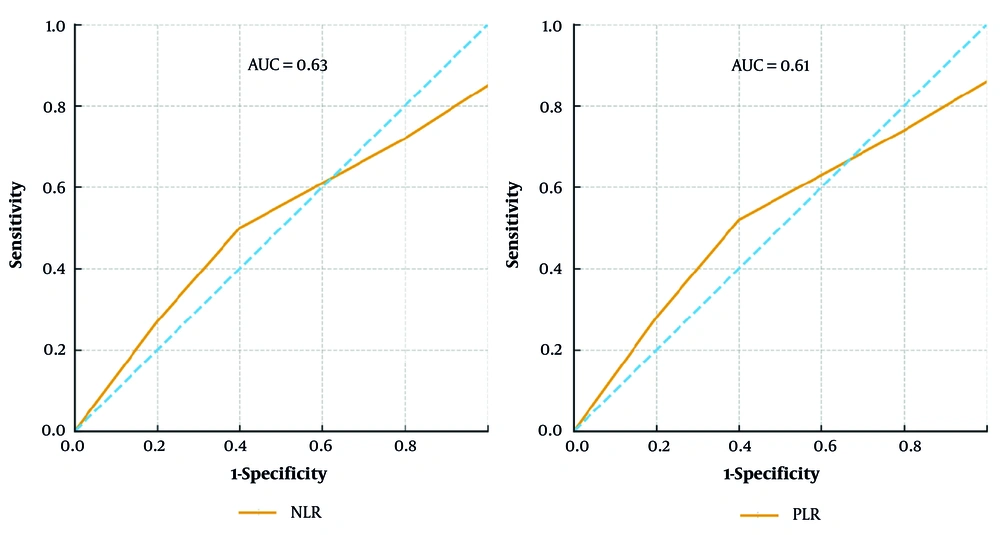
Figure 1.
ROC curves of NLR and PLR for prediction of postoperative nausea and vomiting (PONV)
5. Discussion
In this prospective cohort of patients undergoing laparoscopic cholecystectomy, higher preoperative NLR and PLR were significantly associated with greater PONV severity, as reflected by both Rhodes Index scores and total ondansetron requirements. These findings support the hypothesis that systemic inflammatory markers may serve as useful predictors of PONV in this surgical population.
The high prevalence and clinical impact of PONV after laparoscopic cholecystectomy have been well documented, with reported rates of up to 46% to 75% in the absence of prophylactic antiemetic therapy (1-5). Despite advances in anesthetic agents, surgical techniques, and enhanced recovery protocols, PONV remains a leading cause of patient discomfort, delayed discharge, and unplanned readmission (1-3, 5). This underscores the need for practical and reliable preoperative predictors to guide individualized antiemetic strategies.
Our findings regarding NLR are consistent with previous studies across multiple surgical settings. Chen et al. reported that elevated preoperative NLR was an independent predictor of PONV in patients undergoing laparoscopic sleeve gastrectomy and distal gastrectomy (8). Yildiz Altun et al. observed that NLR > 2 was associated with significantly higher rates of nausea, vomiting, and antiemetic use in patients undergoing septorhinoplasty (11). Arpaci et al. similarly demonstrated that elevated NLR predicted PONV in ambulatory maxillofacial surgery, with a markedly higher proportion of patients with high NLR requiring antiemetic therapy (13). Importantly, Gupta and Rajput specifically investigated laparoscopic cholecystectomy and found that NLR was an independent risk factor for PONV, with an odds ratio of 1.61 and a significant ROC curve cutoff value of approximately 2.05 (14). Feng et al. also confirmed the predictive ability of NLR for PONV in patients with hemophilia A undergoing orthopedic surgery (10).
The role of PLR is less well established but has been examined in several studies. Karaca and Dogan demonstrated that PLR, in conjunction with NLR, had acceptable sensitivity and specificity for predicting PONV in breast reduction surgery (12). Zengin et al. evaluated factors associated with postoperative nausea and vomiting following thoracoscopic wedge resection and also highlighted the contribution of inflammatory and perioperative factors to emetic risk (16). Although some investigations have failed to identify PLR as an independent predictor (10), our finding of a significant positive correlation between PLR and both Rhodes Index scores and ondansetron consumption suggests that PLR may capture additional dimensions of inflammatory status relevant to PONV.
The underlying pathophysiological mechanisms linking NLR and PLR to PONV are biologically plausible. Elevated NLR reflects a shift toward neutrophil predominance and relative lymphopenia, indicating systemic stress and inflammation. This state is associated with increased circulating cytokines, such as interleukin 6 and tumor necrosis factor alpha, which can sensitize central emetic structures, including the chemoreceptor trigger zone and the nucleus tractus solitarius (10, 14-16). Platelets, which store most circulating serotonin, are activated during surgical trauma and inflammatory responses. Subsequent serotonin release stimulates 5-HT3 receptors on vagal afferent fibers, a key pathway in triggering nausea and vomiting (15). Consequently, elevated PLR may indirectly reflect increased platelet activation and serotonin-mediated emetic susceptibility.
Several clinical studies have suggested threshold values for NLR in predicting PONV, typically around 2.0, which closely align with the mean values and correlation trends observed in our cohort (10 - 14). These convergent findings across different surgeries and populations suggest that NLR may be a robust biomarker for stratifying PONV risk. When combined with established clinical risk factors, such as female sex, non-smoking status, a history of motion sickness or PONV, and perioperative opioid exposure, the addition of NLR and PLR could enhance the accuracy of existing predictive models (4, 5, 14, 16).
From a practical standpoint, NLR and PLR are attractive because they are derived from routine complete blood counts and require no additional cost or specialized testing. This makes them feasible candidates for incorporation into standard preoperative evaluation pathways (2, 4, 6). Patients identified as high risk based on elevated NLR or PLR could receive more aggressive prophylaxis, such as multimodal antiemetic regimens or opioid-sparing anesthetic strategies, as supported by evolving perioperative protocols (1-3, 6, 7).
5.1. Limitations
This study has several limitations. First, it was a single-center study with a moderate sample size, which may limit external generalizability and the precision of estimated correlations and potential cutoff points. Second, although perioperative management was standardized where possible, residual confounding cannot be completely excluded. Important PONV-related factors, including smoking status, exact intraoperative opioid dose, exact pneumoperitoneum pressure, and detailed postoperative opioid dose, were not consistently available as complete individual-level variables in the extracted dataset and therefore could not be fully incorporated into adjusted models. Third, some established PONV risk factors, such as a prior history of PONV or motion sickness, were not systematically documented and thus could not be fully adjusted for in the analysis. Fourth, the Rhodes Index, although validated, is subject to patient self-reporting, which introduces inherent subjectivity. Finally, NLR and PLR were measured only once preoperatively; therefore, dynamic changes during and after surgery were not captured. Future multicenter studies with larger samples, standardized perioperative data collection, and mechanistic components, including cytokine measurements and direct assessment of serotonin pathways, are warranted to confirm and extend these findings (8, 10, 12, 16).
5.2. Conclusions
Higher preoperative NLR and PLR values were significantly associated with increased PONV severity and higher ondansetron requirements after laparoscopic cholecystectomy. These results are consistent with observations from other surgical populations and highlight the potential of these simple inflammatory indices as components of PONV risk stratification (10-14). In clinical practice, incorporating preoperative NLR and PLR into routine assessment may help identify high-risk patients and guide more targeted prophylactic strategies. To confirm and generalize these findings, future research should employ multicenter designs with larger and more diverse cohorts and investigate the underlying mechanisms of this association through objective measurement of inflammatory and neurohumoral mediators, such as cytokines and serotonin (8, 10, 12, 15, 16). Subsequent studies should also develop predictive models that integrate NLR and PLR with other clinical and biochemical markers to improve the prevention and management of PONV.