
Dear Editor,
Recent interruptions in the availability of injectable neostigmine, as reported to the authors by hospital pharmacies in Iran, raise perioperative patient-safety concerns beyond procurement alone. Because the geographic extent and duration of these interruptions have not been established through a publicly accessible national dataset, we do not characterize them as a formally documented nationwide shortage. Neostigmine remains on the 2025 World Health Organization Model List of Essential Medicines among peripherally acting muscle relaxants and cholinesterase inhibitors (1). Perioperative drug shortages can promote unfamiliar substitutions, dosing errors, procedural delays, and increased expenditure (2). A one-for-one substitution may therefore be neither feasible nor safe. We propose that a neuromuscular blocker be administered only after establishing a recovery plan tailored to the selected agent, anticipated depth of blockade, patient-specific factors, and locally available resources.
This principle reflects an important pharmacological asymmetry. By inhibiting acetylcholinesterase, neostigmine increases acetylcholine at the neuromuscular junction and can antagonize blockade produced by any competitive nondepolarizing agent once sufficient spontaneous recovery has occurred. Sugammadex, by contrast, encapsulates the aminosteroidal agents rocuronium and vecuronium and has no clinically useful reversal activity against atracurium or cisatracurium. Consequently, administering a benzylisoquinolinium agent and subsequently reaching for sugammadex is a foreseeable selection error. Current American and European guidelines support matching the reversal strategy to both the causative blocker and the objectively measured depth of blockade (3, 4). However, pharmacological suitability does not guarantee practical availability. Sugammadex should not be regarded as the default substitute: universal sugammadex use may be more costly than a selective, monitoring-guided reversal strategy (5), and local allocation or formulary restrictions may further limit access in resource-constrained hospitals. Accordingly, the approach proposed here is both monitoring- and resource-based.
For rocuronium- or vecuronium-induced blockade, sugammadex 2 mg/kg intravenously is appropriate after reappearance of the second train-of-four (TOF) twitch; 4 mg/kg is required for deep blockade when one or two post-tetanic counts (PTCs) are present without TOF responses. Immediate reversal approximately 3 minutes after rocuronium 1.2 mg/kg requires 16 mg/kg. Doses should be calculated using actual body weight and guided by quantitative monitoring (3, 4). Patients receiving sugammadex should be closely monitored during and after reversal for marked bradycardia, which may occur within minutes and has occasionally progressed to cardiac arrest, and for serious hypersensitivity, including anaphylaxis, with immediate treatment capability available.
During this shortage, the 16 mg/kg dose should be restricted to a true immediate-reversal airway emergency, such as a cannot-intubate, cannot-oxygenate (CICO) event after rocuronium, and the complete calculated dose must be immediately available. It should not be used merely to accelerate routine emergence, operating-room turnover, or an otherwise scheduled case. Even during CICO, sugammadex is an adjunct rather than an airway-rescue strategy, and its administration must not delay progression through the difficult-airway algorithm, including emergency invasive airway access when indicated. More generally, the Journal of Cellular & Molecular Anesthesia (JCMA) has previously reported successful rocuronium-sugammadex reversal in an urgent high-risk case, illustrating the clinical logic of a blocker-specific pathway rather than an indication for routine 16 mg/kg dosing (6).
Severe renal impairment requires a separate pathway. Regulatory labeling does not recommend sugammadex use when creatinine clearance is below 30 mL/min because clearance of both sugammadex and its complex is markedly reduced. Accordingly, these patients should not be routinely shifted to a rocuronium-sugammadex strategy. When clinically appropriate, cisatracurium with planned spontaneous recovery and preservation of any remaining neostigmine stock may provide a more rational approach. Quantitative ulnar-nerve monitoring at the adductor pollicis should continue throughout neuromuscular blockade and recovery, and a TOF ratio ≥ 0.9 must be confirmed before extubation (3, 4). If kinemyography is used, unrestricted thumb movement and correct sensor positioning should be ensured; electromyography may be preferred when these mechanical conditions cannot be reliably achieved (3).
Any remaining neostigmine should be prioritized for patients who have received atracurium or cisatracurium and for patients for whom sugammadex is unavailable or unsuitable. It should still be administered only after adequate spontaneous recovery and with appropriate antimuscarinic coadministration. Historical alternatives such as edrophonium or parenteral pyridostigmine should not be adopted through informal bedside substitution because contemporary evidence, availability, regulatory status, and clinician familiarity are limited. Their use, if considered at all, requires a pharmacy-verified and institutionally approved protocol.
When neither neostigmine nor sugammadex is available, waiting for spontaneous recovery should be managed as active, supported recovery rather than passive delay. No fixed waiting interval is reliable; the endpoint is objectively confirmed recovery. If only a short delay is anticipated and continued operating-room care is operationally feasible, the patient should preferably remain in the operating room with a secured tracheal tube; controlled or assisted ventilation; continuous ECG, pulse oximetry, and capnography; regular blood-pressure and temperature monitoring; titrated hypnosis and analgesia sufficient to prevent awareness; and serial quantitative ulnar-nerve monitoring at the adductor pollicis (3, 4, 7-9). Further neuromuscular-blocking doses and avoidable potentiating drugs should be withheld, and reversible contributors to prolonged blockade, including hypothermia and major acid-base or electrolyte disturbances, should be corrected. Extubation must not be attempted until a quantitative TOF ratio of at least 0.9 and the usual respiratory, hemodynamic, and neurologic criteria have been met.
If spontaneous recovery is likely to be prolonged or continued operating-room care is impractical, transfer should occur only to a postanesthesia care unit (PACU) or intensive care unit (ICU) equipped and staffed for ongoing mechanical ventilation and airway rescue. Ventilation and physiologic monitoring must continue without interruption during transport, followed by a structured handoff documenting the blocker, cumulative dose and timing, relevant organ function and interacting drugs, the latest TOF or PTC measurements, and the ventilation, sedation-analgesia, and reassessment plan (7, 8). Hypnosis and analgesia must be maintained until objective neuromuscular recovery permits safe emergence. Under these conditions, delayed emergence and extubation are ethically preferable to premature extubation or awake paralysis; operating-room throughput does not justify accepting these risks. When such a delay is foreseeable, it should be discussed during informed consent; when unexpected, it should be documented and subsequently explained to the patient and, when appropriate, the family (9).
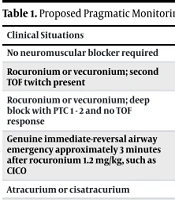
The pathway proposed in Table 1 is a pragmatic, resource-adapted expert strategy synthesized from established pharmacological principles and the 2023 American Society of Anesthesiologists (ASA) and European Society of Anaesthesiology and Intensive Care (ESAIC) recommendations (3, 4). It has not been prospectively validated as an algorithm and should not be interpreted as an independent evidence-based clinical guideline.
Table 1.
Proposed Pragmatic Monitoring- and Resource-Based Strategy for Neuromuscular Blockade During a Neostigmine Shortage
| Clinical Situations | Preferred Response |
|---|---|
| No neuromuscular blocker required | Use regional, neuraxial, local, or an appropriate general anesthetic technique without blockade. |
| Rocuronium or vecuronium; second TOF twitch present | Sugammadex 2 mg/kg IV using actual body weight. |
| Rocuronium or vecuronium; deep block with PTC 1 - 2 and no TOF response | Sugammadex 4 mg/kg IV using actual body weight. |
| Genuine immediate-reversal airway emergency approximately 3 minutes after rocuronium 1.2 mg/kg, such as CICO | Sugammadex 16 mg/kg IV only when the complete dose is immediately available. Do not use it to expedite routine emergence or operating-room turnover, and do not delay the difficult-airway rescue algorithm. |
| Atracurium or cisatracurium | Sugammadex is ineffective; allow monitored spontaneous recovery or use reserved neostigmine after adequate recovery. |
| Neither neostigmine nor sugammadex available | Do not attempt extubation. Maintain titrated hypnosis and analgesia, a secured tracheal airway, controlled or assisted ventilation, continuous physiologic and capnographic monitoring, and serial quantitative TOF monitoring at the adductor pollicis until a TOF ratio of at least 0.9 and the standard extubation criteria are met. Correct reversible factors that may prolong blockade. If recovery is prolonged, transfer only with uninterrupted ventilation and monitoring to an appropriately equipped and staffed PACU or ICU. |
| Creatinine clearance below 30 mL/min | Do not default to routine sugammadex; consider cisatracurium with planned spontaneous recovery and use quantitative ulnar-nerve monitoring at the adductor pollicis until a TOF ratio ≥ 0.9 is confirmed. |
| No quantitative monitor available | Avoid deep or repeated blockade when possible; maintain ventilation and recognize that clinical or qualitative tests cannot confirm a TOF ratio of at least 0.9. |
Whenever quantitative monitoring is available, extubation should occur only after a TOF ratio of at least 0.9 has been confirmed at the adductor pollicis. Head lift, grip strength, tidal volume, and the ability to follow commands cannot reliably exclude residual blockade (3, 4). The physiology of TOF fade has also been discussed in JCMA (10), although extubation thresholds should remain anchored in quantitative monitoring and current guidelines. When quantitative monitoring is unavailable, qualitative stimulation may help estimate block depth but cannot demonstrate a TOF ratio of 0.9. Deep or repeated blockade should therefore be avoided, and ventilation and airway protection should continue until sustained spontaneous recovery and the standard respiratory, hemodynamic, and neurologic extubation criteria are present, while recognizing that residual blockade cannot be excluded with the same confidence. Drug scarcity should not be used to justify premature extubation. A resource-based strategy should conserve reversal agents by reducing unnecessary block depth and maintenance dosing, not by empirical underdosing. Quantitative monitoring should guide every additional neuromuscular blocking agent (NMBA) dose and, whenever surgical conditions permit, allow the final dose to be withheld sufficiently early for spontaneous recovery. For rocuronium- or vecuronium-induced blockade, recovery from deep blockade to reappearance of the second TOF twitch reduces the indicated sugammadex dose from 4 to 2 mg/kg; if a TOF ratio of at least 0.9 is objectively confirmed, no pharmacological reversal is required (3-5). In a prospective monitoring-guided cohort, 17% of patients recovered without pharmacological reversal, and selective use of reversal agents reduced acquisition costs compared with universal sugammadex administration (5). A fixed "low-dose" sugammadex regimen should not be used solely to extend stock because administration below the recommended depth-based dose may result in recurrent neuromuscular blockade.
For short-to-intermediate procedures, the first planning question should be whether an NMBA is necessary at all. When tracheal intubation, ventilation, immobility, or surgical exposure does not require paralysis, neuraxial anesthesia, peripheral nerve or field blocks, local anesthesia, general anesthesia with a supraglottic airway when appropriate, or another suitable general anesthetic technique without an NMBA should be preferred. When an NMBA is necessary, an appropriate initial dose should be used for the airway and surgical indication, followed by avoidance of routine maintenance dosing and deep blockade near the end of surgery unless it remains surgically essential. Withholding an NMBA solely to conserve reversal agents must not compromise airway management or surgical conditions, and NMBA avoidance should not be achieved through unnecessarily deep anesthesia or excessive opioid administration.
Hospitals facing prolonged scarcity should consider activating a multidisciplinary pathway involving anesthesiologists, clinical pharmacists, surgeons, nurses, procurement teams, and medication-safety personnel. Iranian hospital experience has likewise shown that clinical pharmacists can identify medication-related problems involving drug selection and unavailable dosage forms, supporting their inclusion in institutional shortage governance (11). The pathway could include daily centralized inventory, explicit priority criteria for the remaining neostigmine, a compatibility card linking each blocker to feasible reversal options, depth-based sugammadex dosing, immediate access to quantitative monitors, and prospective review of documented TOF ratios, residual blockade, hypoxemia, reintubation, cancellations, and drug consumption. Broader implementation strategies have improved perioperative neuromuscular-blockade management (12).
A neostigmine shortage neither justifies indiscriminate sugammadex substitution, which may be financially or logistically impossible, nor requires abandonment of general anesthesia. It requires deliberate pairing of anesthetic technique, neuromuscular blocker, measured block depth, organ function, and a feasible recovery pathway based on locally available resources. When no reversal agent is available, that pathway is active, supported spontaneous recovery with continued hypnosis and analgesia, airway protection, mechanical ventilation, and quantitative monitoring until a TOF ratio of at least 0.9 is confirmed. In this setting, we propose a practical principle: neuromuscular blockade should be used only when a documented and locally feasible plan for safe recovery is available.