
1. Introduction
Sepsis is a leading cause of acute critical illness and mortality among patients with community-acquired and hospital-acquired infections (1, 2). It is defined as life-threatening organ dysfunction resulting from a dysregulated host response to infection. Sepsis can cause dysfunction of multiple organs and complications, including heart failure, acute respiratory distress syndrome, disseminated intravascular coagulation, and acute kidney injury (AKI) (3, 4).
Acute kidney injury is a clinical syndrome characterized by a rapid decline in renal function and is associated with an increased risk of chronic kidney disease (CKD) and end-stage kidney disease (5). Patients with AKI have a mortality risk approximately 5.5 times that of patients without AKI. Major causes include sepsis, obstruction, medications, radiologic contrast agents, and surgery; sepsis is among the most common etiologies (6-8). In intensive care units, sepsis-associated AKI (SA-AKI) accounts for nearly 44% of diagnosed cases and represents a major public health challenge because of its strong association with increased mortality and progression to CKD (9, 10).
Despite the clinical importance of SA-AKI, effective methods for early diagnosis and appropriate therapeutic strategies remain limited. Its molecular mechanisms are also incompletely understood. The development of SA-AKI is a complex pathological process. Unlike in other forms of AKI, renal blood perfusion in SA-AKI does not decrease and may increase; instead, an excessive systemic inflammatory response is the primary driver of injury (9, 11, 12).
Recent studies have investigated potential mechanisms contributing to SA-AKI, including the regulatory roles of noncoding RNAs (ncRNAs). These molecules participate in gene transcription, RNA processing, posttranscriptional regulation of translation, and epigenetic regulation of gene expression (13).
Among these molecules, microRNA-21 (miR-21) is one of the most extensively studied microRNAs (miRNAs) in SA-AKI. It is expressed in various organs, including the heart and kidneys, and is considered an important regulator of inflammation, energy metabolism, and cancer (14, 15). Evidence indicates that miR-21 is a critical regulatory molecule in SA-AKI, contributing to renal fibrosis and podocyte apoptosis (16, 17). Another microRNA of interest is miR-22, which is expressed at reduced levels in patients with SA-AKI. Overexpression of miR-22 can reduce inflammatory mediators, including interleukin (IL)-1β, IL-6, tumor necrosis factor α (TNF-α), and nitric oxide, and inhibit apoptosis through the PTEN/HMGB1 pathway. It also targets the TLR4/NF-κB pathway, thereby attenuating sepsis-associated kidney injury. Collectively, these findings suggest that miR-22 may be a therapeutic target for SA-AKI (18=20).
Several ncRNAs also contribute to SA-AKI by regulating apoptosis. For example, miR-152 - 3p and miR-128 - 3p exacerbate apoptosis and impair renal function in severe sepsis, whereas miR-590 - 3p, miR-20a, miR-133a, and miR-942 - 5p have antiapoptotic effects, and their overexpression can suppress apoptosis (21).
A miR-205 agonist has also been shown to reduce apoptosis and renal damage in animal models of sepsis-associated kidney injury. These findings suggest that miR-205 may be a therapeutic approach for SA-AKI (22). Accordingly, this systematic review aimed to assess and identify miRNAs that may serve as predictors of SA-AKI.
2. Methods
2.1. Ethical Approval
The study received ethical approval from the Research Ethics Committees of the Vice-Chancellor for Research Affairs, Shahid Beheshti University of Medical Sciences, under code IR.SBMU.RETECH.REC.1403.575. No financial support was received. The center provided scientific and administrative supervision for project registration only.
2.2. Study Design and Search Strategy
A systematic literature search was conducted in PubMed, Scopus, and Web of Science from database inception through July 2026. Studies published in English were considered. The complete search strategies for each database are provided in Table S1 of the Supplementary File.
2.3. Eligibility Criteria
Articles were selected according to inclusion and exclusion criteria established a priori. The included studies were predominantly preclinical and used animal and cell models; some clinical studies used human samples. Therefore, the Newcastle-Ottawa Scale (NOS) was selected as a general quality assessment tool. Given the predominance of preclinical studies, preclinical-specific tools such as SYRCLE could also be considered for future updates. Studies with an NOS score below 4 were excluded a priori according to the predefined eligibility criteria.
The inclusion criteria were as follows: 1) investigation of the role of miRNAs in predicting or characterizing SA-AKI; 2) clear and assessable methodology; and 3) publication in English. The exclusion criteria were as follows: 1) no focus on SA-AKI, sepsis, or AKI; 2) insufficiently transparent methodology or no predictive outcomes; 3) duplicate publications or overlapping datasets; and 4) review articles, editorials, commentaries, or other nonoriginal research reports.
2.4. Study Selection Process
Two reviewers independently screened the titles and abstracts of all identified records. The same reviewers then assessed the full texts of potentially eligible articles. Disagreements were resolved through discussion or, when necessary, consultation with a third reviewer.
2.5. Data Extraction and Outcome Measures
For each eligible study, data were extracted on the miRNAs investigated; sample sources, including blood, plasma, renal tissue, and bronchoalveolar or respiratory specimens; patient characteristics, including age, sex, clinical condition, and disease severity; and methodological features, strengths, and limitations.
2.6. Quality Assessment
Two reviewers independently assessed the methodological rigor and potential risk of bias of all selected studies. The NOS (23) was used to assess three domains: selection, comparability, and outcomes. Scores of 0 - 3 indicated low quality, 4 - 6 indicated moderate quality, and 7 - 9 indicated high quality. Studies scoring below 4 were excluded (Table 1). This threshold was applied during study selection, before data extraction and synthesis. Disagreements were resolved through discussion or consultation with a third reviewer.
Table 1.
Quality Evaluation of the Included Studies
| Authors | Selection | Comparability | Outcome/Exposure | Total Score |
|---|---|---|---|---|
| Xu et al. (24) | 3 | 2 | 3 | 8 |
| Fu et al. (25) | 4 | 2 | 3 | 9 |
| Wei et al. (26) | 3 | 2 | 3 | 8 |
| Lin et al. (27) | 3 | 1 | 3 | 7 |
| Wei et al. (28) | 4 | 2 | 3 | 9 |
| Zou et al. (29) | 4 | 2 | 3 | 9 |
| Zhang et al. (30) | 3 | 2 | 3 | 8 |
| Wang et al. (31) | 3 | 2 | 3 | 8 |
| Ye et al. (32) | 4 | 2 | 3 | 9 |
| Chen et al. (33) | 2 | 2 | 3 | 7 |
| Ha et al. (34) | 3 | 1 | 3 | 7 |
| Ding et al. (35) | 3 | 2 | 3 | 8 |
| Shen et al. (36) | 4 | 2 | 3 | 9 |
| Wang et al. (37) | 3 | 2 | 3 | 8 |
| Zhang et al. (38) | 3 | 2 | 3 | 8 |
| Shi et al. (39) | 4 | 2 | 3 | 9 |
| Ren et al. (40) | 2 | 2 | 2 | 6 |
| Lin et al. (41) | 3 | 1 | 3 | 7 |
| Sang et al. (42) | 4 | 2 | 3 | 9 |
| Guo et al. (43) | 2 | 2 | 2 | 6 |
| Zhang et al. (44) | 3 | 2 | 3 | 8 |
2.7. Synthesis of Findings
Findings from eligible studies were synthesized narratively, with particular attention to the predictive potential of miRNAs in SA-AKI, research gaps, and implications for future studies.
3. Results
3.1. Study Selection
The database search identified 867 records: 315 from PubMed, 436 from Scopus, and 116 from Web of Science. After 257 duplicates were removed, 610 records remained for title and abstract screening. During this phase, 189 records were excluded because they were not in English, their full text was unavailable, or their titles or abstracts were irrelevant, leaving 421 records for eligibility assessment. Of these, 266 were excluded because they did not meet the predefined inclusion criteria. The remaining 155 articles underwent full-text assessment, and 134 were excluded because of insufficient data, an unsuitable study design, or failure to report the target outcome. Finally, 21 studies met the eligibility criteria and were included in the review and analysis (Figure 1).
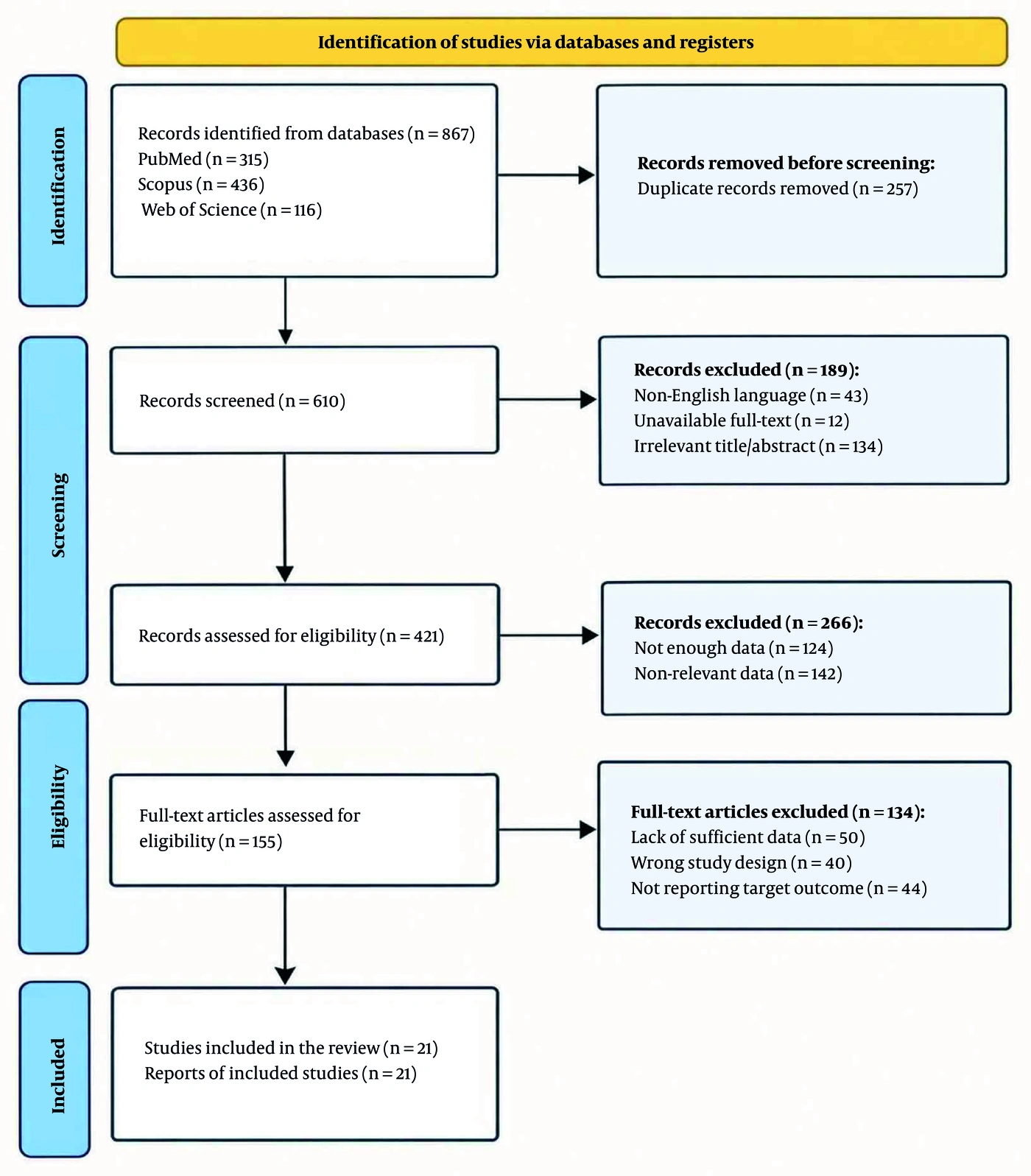
Figure 1.
Study selection process for inclusion of articles
3.2. Clinical Evidence
The included studies identified a wide range of miRNAs with potential as biomarkers and prognostic indicators in SA-AKI. Expression patterns were heterogeneous. Some miRNAs were upregulated, including miR-21, miR-155, and miR-214, whereas others were downregulated, including miR-22 - 3p, miR-15a-5p, and miR-150 - 5p. Members of the miR-21 family (miR-21, miR-21 - 3p, miR-21 - 5p, and miR-21a-3p) were consistently elevated. Increased circulating and tissue levels of miR-21a-3p suggest its potential as a systemic biomarker (29). Fu et al. reported protective effects of experimental miR-21 overexpression through PTEN/PI3K/AKT signaling in preclinical models (25). Although disease-associated miR-22 - 3p expression was reduced, its experimental restoration was associated with reduced tubular cell death and inflammation (30, 31). Expression of miR-23a-3p was reduced, whereas miR-26a-5p was increased (32, 33). Increased miR-106a and miR-107 were associated with apoptosis, inflammation, and elevated TNF-α (36, 37). MiR-205, miR-210, and miR-494 showed prognostic significance, with miR-205 identified as an independent risk factor for poorer survival. MiR-210 and miR-494 were increased, whereas miR-205 was decreased (41). Reduced miR-15a-5p may be an early biomarker of glomerular-specific injury (24). Reduced miR-29b-3p was associated with podocyte damage (34), and reduced miR-103a-3p with increased inflammatory injury in tubular cells (35). Table 2 summarizes expression patterns and functional effects.
Table 2.
Summary of Data Characteristics (Clinical Evidence & Preclinical/Mechanistic Evidence)
| First Author and Reference | Year | Model/Study Type | miRNA(s) | Expression Pattern | Target/Pathway | Functional/Prognostic Role |
|---|---|---|---|---|---|---|
| Xu G et al. (24) | 2019 | in vitro / Clinical + preclinical | miR-15a-5p | ↓ | XIST, CUL3 | Reduced expression is associated with inhibition of podocyte proliferation. |
| Fu D et al. (25) | 2017 | in vivo / in vitro / Preclinical | miR-21 | ↑ | PTEN/PI3K/AKT | Regulates signaling and suppresses apoptosis. |
| Wei W et al. (26) | 2020 | in vivo / in vitro / Preclinical | miR-21 | ↑ | CDK6 | MiR-21 inhibition protects against LPS-induced AKI and apoptosis; CDK6 is a target. |
| Lin Z et al. (27) | 2019 | in vivo / in vitro / Preclinical | miR-21 - 3p | ↑ | AKT/CDK2-FOXO1 | Induces apoptosis and cell-cycle arrest in renal tubular cells. |
| Wei W et al. (28) | 2021 | in vitro / Preclinical | miR-21 - 5p | ↑ | circ_0068888 | Protective effects through circRNA sponging. |
| Zou Z et al. (29) | 2020 | in vivo / in vitro / Preclinical | miR-21a-3p | ↑ | Ago2 (Nrp-1) | Increases plasma levels and enhances regulation in TECs. |
| Zhang P et al. (30) | 2020 | in vivo / in vitro / Clinical + preclinical | miR-22 - 3p | ↓ | AIFM1 (miR-22 - 3p is sponged by lncRNA TCONS_00016233) | Inhibits apoptosis and reduces caspase-3 accumulation. |
| Wang X et al. (31) | 2020 | in vivo / in vitro / Preclinical | miR-22 - 3p | ↓ | PTEN | Overexpression decreases inflammation and apoptosis. |
| Ye J et al. (32) | 2022 | in vitro / Clinical + preclinical | miR-23a-3p | ↓ | WNT5A (Wnt/beta-catenin) | Protects against sepsis-induced tubular epithelial cell injury. |
| Chen Y et al. (33) | 2022 | in vivo / in vitro / Preclinical | miR-26a-5p | ↑ | IL-6 axis | Reduces inflammation in septic AKI. |
| Ha ZL et al. (34) | 2021 | in vivo / in vitro / Preclinical | miR-29b-3p | ↓ | HDAC4 | Associated with podocyte injury. |
| Ding G et al. (35) | 2022 | in vitro / Preclinical | miR-103a-3p | ↓ | CXCL12 | Linked to pro-inflammatory gene expression. |
| Shen Y et al. (36) | 2019 | in vivo / in vitro / Preclinical + clinical | miR-106a | ↑ | THBS2 | Enhances inflammation and apoptosis. |
| Wang S et al. (37) | 2017 | in vivo / in vitro / Clinical + preclinical | miR-107 | ↑ | DUSP7 | Induces TNF-α secretion and tubular injury. |
| Zhang H et al. (38) | 2022 | in vitro / Clinical + preclinical | miR-124 - 3p.1 | ↓ | LPCAT3 | Regulates LPCAT3 and phospholipid metabolism; suppresses cell proliferation. |
| Shi L et al. (39) | 2021 | in vivo / in vitro / Clinical + preclinical | miR-150 - 5p | ↓ | MEKK3/JNK | Protects against apoptosis, inflammation, and oxidative stress. |
| Ren Y et al. (40) | 2017 | in vivo / Preclinical | miR-155 | ↑ | JAK/STAT | Inhibition of miR-155 alleviates LPS-induced kidney injury. |
| Lin Y et al. (41) | 2019 | Clinical | miR-210, miR-494, miR-205 | miR-210 ↑; miR-494 ↑; miR-205 ↓ | - | Prognostic biomarkers; miR-205 predicts survival. |
| Sang Z et al. (42) | 2021 | in vivo / Preclinical | miR-214 | ↑ | PTEN | Alleviates AKI via autophagy modulation. |
| Guo C et al. (43) | 2022 | in vivo / in vitro / Preclinical | miR-214 - 5p | ↑ | GLP-1R/AMPK | Increased expression aggravates inflammation and oxidative stress; inhibition is protective. |
| Zhang J et al. (44) | 2023 | in vivo / in vitro / Preclinical | miR-22 | ↓ | HMGB1/TLR4/NF-κB | Alleviates sepsis-induced AKI by targeting HMGB1/TLR4/NF-κB. |
3.3. Preclinical and Mechanistic Evidence
Mechanistic studies demonstrated protective, antiapoptotic effects of miR-21 through PTEN/PI3K/AKT (25), whereas miR-21 inhibition was protective in the study investigating CDK6 (26). MiR-21 - 3p induced cell-cycle arrest and exacerbated tubular injury (27). These antiapoptotic and proapoptotic effects show that expression direction does not necessarily indicate biological effect. Restoring miR-22 - 3p protected against apoptosis and inflammation through AIFM1 inhibition (30), PTEN inhibition (31), and inhibition of HMGB1/TLR4/NF-κB signaling (44). MiR-23a-3p prevented tubular epithelial cell apoptosis (32), whereas miR-26a-5p suppressed IL-6-mediated inflammation (33). MiR-106a enhanced apoptosis and inflammation through THBS2 (36), and increased miR-107 promoted TNF-α secretion (37). MiR-214 exerted protective effects via PTEN suppression and enhanced autophagy (42). In contrast, increased miR-214 - 5p aggravated inflammation and oxidative stress, whereas its inhibition was protective through GLP-1R/AMPK signaling (43). Table 3 summarizes the strengths and limitations of the included studies.
Table 3.
Strengths and Limitations of the Included Studies
| First Author and Reference | Year | miRNA(s) | Strengths | Limitations |
|---|---|---|---|---|
| Xu G et al. (24) | 2019 | miR-15a-5p | Microarray + in vivo/in vitro validation; identified miR–gene–lncRNA axes such as miR‑15a‑5p–XIST–CUL3. | Very small sample size; limited clinical data; further functional validation needed. |
| Fu D et al. (25) | 2017 | miR‑21 | Cell + animal models; diverse assays (MTT, flow cytometry, WB, TUNEL, IHC); PTEN/PI3K/AKT pathway. | Small animal sample size; no human data; no dose–response testing. |
| Wei W et al. (26) | 2020 | miR‑21 | Human + mouse + cell integration; strong molecular and histological validation. | Limited samples; incomplete reporting; complex design may reduce reproducibility. |
| Lin Z et al. (27) | 2019 | miR‑21‑3p | Multi-level (rats, TECs, HEK293, NRK52E); multiple assays (qPCR, WB, ELISA, luciferase, flow cytometry). | Highly complex methodology reduces reproducibility. |
| Wei W et al. (28) | 2021 | miR‑21‑5p | Clear HK‑2 cell model; multiple assays assessing viability, inflammation, oxidative stress, NF‑κB. | in vitro only; few replicates (n = 3). |
| Zou Z et al. (29) | 2020 | miR‑21a‑3p | Validated CLP rat model; multi‑time‑point sampling; strong molecular assays (qPCR, WB, IF, IP). | Single animal species; missing randomization/blinding. |
| Zhang P et al. (30) | 2020 | miR‑22‑3p | Human samples; qPCR validation; identified lncRNA–miRNA axis. | Small sample size; pooled samples; limited selection criteria details. |
| Wang X et al. (31) | 2020 | miR‑22‑3p | Well‑designed CLP model; biochemical + histological + molecular assessments. | Small sample size (n = 5); short follow‑up; PTEN-focused. |
| Ye J et al. (32) | 2022 | miR‑23a‑3p | Clear patient selection; HK‑2 validation; multi‑platform molecular analysis. | Small cohort; single-pathway focus; fixed LPS dose. |
| Chen Y et al. (33) | 2022 | miR‑26a‑5p | Animal + cell models; multilayer molecular, biochemical, histological analysis. | Small samples; no long‑term data; no sex/genetic diversity analysis. |
| Ha ZL et al. (34) | 2021 | miR‑29b‑3p | Multiple functional assays; agomir/mimic manipulation. | Small samples; 24 h follow‑up only; one pathway studied. |
| Ding G et al. (35) | 2022 | miR‑103a‑3p | Comprehensive assays (qPCR, WB, ELISA, CCK‑8, TUNEL, luciferase). | Small sample size; 24 h follow‑up; no sex-based analysis. |
| Shen Y et al. (36) | 2019 | miR‑106a | Human + animal samples; molecular and functional assays. | Small samples; limited pathway; only male animals; short follow‑up. |
| Wang S et al. (37) | 2017 | miR‑107 | Human + mouse models; endothelial cell isolation; conditioned‑medium experiments. | Small sample size; 20 h follow‑up. |
| Zhang H et al. (38) | 2022 | miR‑124‑3p.1 | Bioinformatics, an HK-2 LPS model, and patient serum samples. | Limited datasets; no in vivo validation. |
| Shi L et al. (39) | 2021 | miR‑150‑5p | Human + in vivo + in vitro integration; oxidative and inflammatory analysis. | LPS model limitations; small sample size. |
| Ren Y et al. (40) | 2017 | miR‑155 | Large animal cohort (190 mice); multi-phase dosing. | LPS model limits generalizability; no renal function outcomes. |
| Lin Y et al. (41) | 2019 | miR‑210, miR‑494, miR‑205 | Large sample (110 patients + 110 controls); validated criteria; extensive clinical data. | Unclear control matching; single‑center; excluded major comorbidities. |
| Sang Z et al. (42) | 2020 | miR‑214 | Robust CLP model; multiple comparative groups; PTEN mechanism validated. | Small sample size; incomplete reporting of blinding/randomization. |
| Guo C et al. (43) | 2022 | miR‑214‑5p | Clear intervention groups; in vivo + in vitro design. | Male‑only mice; unspecified group sizes; LPS model limitations. |
| Zhang J et al. (44) | 2023 | miR‑22 | Standard CLP model; multiple molecular assays. | Small sample size; 24 h follow‑up only. |
4. Discussion
This systematic review evaluated the role of miRNAs in SA-AKI. The included studies identified a wide range of miRNAs as promising candidate diagnostic and prognostic biomarkers, although their clinical reliability remains to be established.
A major finding was the presence of distinct miRNA expression patterns. Members of the miR-21 family, miR-26a-5p, miR-106a, miR-107, miR-210, miR-494, and miR-155 were frequently reported to be upregulated, whereas miR-22 - 3p, miR-23a-3p, miR-15a-5p, miR-150 - 5p, miR-29b-3p, miR-103a-3p, and miR-205 showed reduced expression. Restoring miR-22 - 3p and miR-214 was protective in preclinical models. This variability suggests that miRNAs may reflect the severity and nature of renal injury, as well as the different pathophysiological pathways underlying sepsis.
Comparison with studies of nonseptic AKI, such as drug-induced or ischemia-reperfusion AKI, indicates that some miRNAs, particularly miR-21 and miR-210, have also been reported in other forms of AKI. However, a recent validation study found limited diagnostic performance of plasma miRNAs in SA-AKI (45). Conversely, miR-214 and miR-22 - 3p appear to show changes that are more specific to SA-AKI and may therefore offer greater discriminatory value in this setting (22, 31).
The reviewed evidence suggests that combining multiple miRNAs might improve diagnostic and prognostic sensitivity and specificity, although this possibility requires further investigation. Validated molecular techniques, such as reverse transcription-quantitative polymerase chain reaction and microarray platforms, could improve the reliability of these findings (46). Common limitations included small sample sizes, short follow-up durations that were often limited to 24 - 48 hours, a focus on single molecular pathways, and extensive reliance on animal or in vitro models. These factors hinder translation to clinical practice. Human clinical samples were evaluated in only a limited number of studies (47).
Because miRNA expression can change early in disease, these molecules may alert clinicians to impending AKI before severe clinical manifestations develop. In addition, miR-22 - 3p and miR-214 may be therapeutic targets for modulating inflammatory and apoptotic pathways (14, 16, 17, 20, 22, 44).
Clinical implementation nevertheless requires larger, prospective, multicenter, and multinational studies. Combining miRNA panels with established clinical scoring systems, such as the Sequential Organ Failure Assessment (SOFA) and Acute Physiology and Chronic Health Evaluation II (APACHE II), may improve predictive accuracy. Emerging bioinformatics approaches and regulatory network analyses may also help identify miRNAs that are central to the pathophysiology of sepsis.
4.1. Conclusions
Current evidence suggests that miRNAs are promising candidate biomarkers for SA-AKI. This review synthesized findings on key miRNAs, including miR-21 and miR-22 - 3p, compared their expression in septic patients with and without AKI, and examined preclinical and clinical models. Further validation in well-designed, prospective, multicenter studies is essential to bridge the gap between experimental findings and clinical application.