SARS-CoV-2 infection can result in severe pulmonary disease, complications, and significant morbidity and mortality. Currently, there is no optimal therapy or effective medication for this potentially fatal lung condition. The host immune response to SARS-CoV-2 infection remains poorly understood, presenting challenges in the development of novel therapeutics. In many cases, viral infection triggers substantial changes in the host transcriptome, leading to abnormal host cell metabolism and a modulated immune response that supports viral replication (
16). Understanding the molecular pathways involved in viral replication within human cells is critical for developing effective pharmacological strategies and identifying innovative biomarkers (
17).
Biomarkers play a crucial role during the progression of this disease, particularly in classifying patients as mild, severe, or critical, thereby enabling earlier intervention for SARS-CoV-2 patients (
18,
19). In patients with severe SARS-CoV-2 infection, a pattern of hematologic, metabolic, inflammatory, and immune-biological anomalies has been reported compared to those with milder systemic illnesses (
17). Guterres et al. identified 34 miRNAs for positive-sense viral RNA and 45 miRNAs for negative-sense viral RNA that can strongly bind to key SARS-CoV-2 genes. These miRNAs hold significant potential in the immunopathogenesis and therapeutic approaches for SARS-CoV-2 disease (e.g., miR-18b, miR-193a, miR-367, and miR-668). According to their study, these miRNAs are also implicated in respiratory and cardiovascular diseases, such as lung cancer, asthma, pneumonia, and cardiac fibrosis (
20).
We investigated miR-26a and miR-125b as potential biomarkers for classifying patients with mild versus severe symptoms. MiR-26a is involved in cancer and inflammation. Recent studies have demonstrated its role in asthma by regulating inflammatory factors and cells (
11). MiR-26a also contributes to the GAS5-alleviated palmitic acid-induced myocardial inflammatory injury through the miR-26a/HMGB1/NF-κB axis (
21). Moreover, miR-26a regulates pro-inflammatory cytokine production in microglia (
9).
A study on influenza A virus (IAV) indicated that miR-26a expression significantly inhibits IAV replication by activating type I interferon (IFN) signaling pathways and promoting the expression of IFN-stimulated genes, thereby suppressing viral replication (
22). Similarly, in the context of porcine reproductive and respiratory syndrome virus (PRRSV) infection, overexpression of the miR-26 family strongly inhibited PRRSV replication (
23). Centa et al. observed that miR-26a, miR-29b, and miR-34a expression levels were significantly reduced in lung biopsies from COVID-19 patients compared to other lung diseases (
24). Zhang et al. demonstrated that miR-26a promotes STAT1 phosphorylation during FHV-1 infection, which upregulates IFN-β expression. They also revealed that miR-26a stimulates IFN-I antiviral signaling, controls, and inhibits FHV-1 infection by targeting SOCS5, a negative regulator of the JAK-STAT signaling pathway (
25).
NF-κB signaling regulates the expression of miR-125b, which inhibits the inflammatory response by targeting the TNF-α 3′UTR region gene (
26). Busch et al. reported that miR-125b directly targets and inhibits the expression of a gene encoding 5-lipoxygenase, an essential enzyme in the biosynthesis of leukotrienes required for innate immune responses and inflammatory processes (
15). In hepatitis B virus-infected cells, miR-125b expression was reduced, and ectopic expression of miR-125b inhibited HBV DNA intermediates, as well as HBsAg and HBeAg secretion. Additionally, miR-125b inhibited SCNN1A's mRNA and protein levels (
27).
The angiotensin-converting enzyme 2 (ACE2) transmembrane protein on host cells plays a critical role in SARS-CoV-2 infection by acting as a receptor for the viral spike glycoprotein (
28). Widiasta et al. revealed that miR-125b and miR-18 directly target the 3′UTR of ACE2 mRNA, suppressing ACE2 expression, which is crucial in the progression of COVID-19 infection (
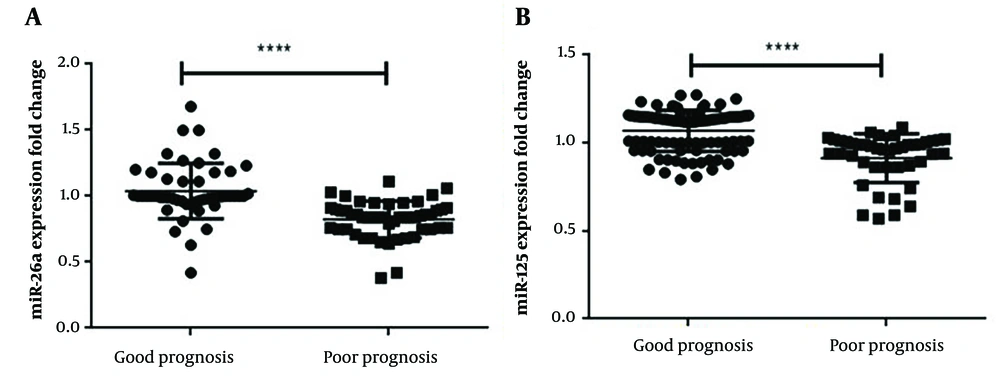
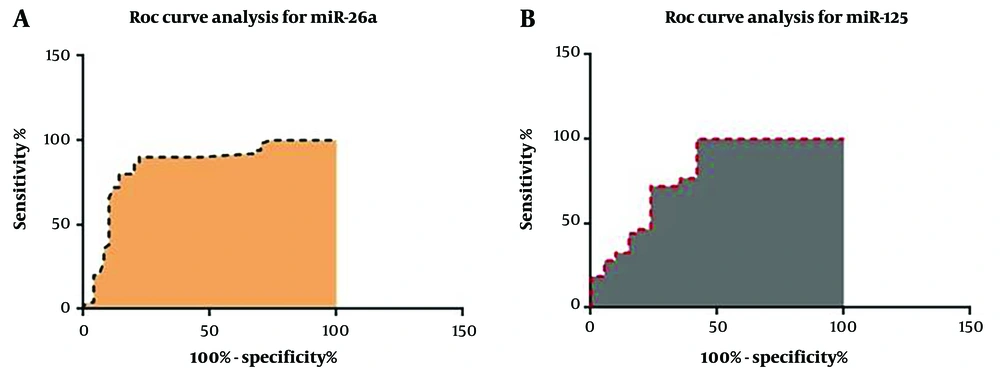
29). Our results show that the expression of both miR-26a and miR-125b is significantly decreased in patients with a poor prognosis compared to those with a good prognosis. These findings suggest that these miRNAs may serve as potential diagnostic markers for severe SARS-CoV-2 infections. Their association with specific clinicopathological features and roles in inflammation and immune response disorders, as evidenced by previous studies, further support their potential utility. However, additional research is necessary to confirm these findings.
One limitation of this study was the exclusive focus on miR-26a and miR-125b as biomarkers, without considering other microRNAs or clinical indicators, which could provide a more comprehensive diagnostic profile. Another limitation was the relatively small sample size (100 samples), which may affect the robustness and generalizability of the findings. Further studies with larger cohorts and an expanded range of biomarkers are needed to enhance the diagnostic and prognostic understanding of these miRNAs in SARS-CoV-2 infection.
5.1. Conclusions
Given the substantial global threat posed by SARS-CoV-2 as an ongoing pandemic, and the critical importance of biomarkers in guiding optimal treatment strategies, it is anticipated that future research into the interaction of SARS-CoV-2 with various human cells will pave the way for novel therapeutic, diagnostic, and prognostic approaches to prevent and manage this infectious disease. In summary, our findings suggest that the relative expression levels of miR-26a and miR-125b in SARS-CoV-2 infection can serve as valuable indicators of disease severity and as prognostic markers.