
1. Background
Low birth weight among preterm neonates is a crucial public health problem worldwide, and it has an increasing rate in almost all countries. Furthermore, preterm birth occurs more often in lower-income countries (1).
Preterm delivery before 37 weeks of pregnancy causes more than half of the morbidity and mortality of the infancy period. Moreover, the preterm care strategy has a more significant role in saving premature babies (2, 3).
Despite improvements in the quality of care provided to premature infants in recent decades, proper weight gain is still a main concern for their health and survival.
Thermal care, skin-to-skin contact (SSC), Kangaroo mother care (KMC), and proper nutrition have been introduced for weight gain improvement in premature babies. Bathing with or without a skin-cleaning agent is safe in neonates’ care (4-6).
In addition, some researchers have demonstrated that touch or massage therapy has positive effects on heart rate, respiratory rate, sleep time, growth and neurodevelopment index, skin health, immune system, bone density, vagal activity, gastric motility, insulin levels, and insulin-like growth factor (IGF1) (7).
Since thousands of years ago, in several Asian countries like China and India, a traditional practice of performing massage alongside applying emollients to the skin has been used for neonates to encourage better growth and weight gain. For this purpose, some oil is usually used for neonatal body massage (8).
Generally, oils are composed of great amounts of fatty acids with varying degrees of chain lengths. The skin absorption of some oils, such as coconut and sunflower oils, which contain lauric acid, linolenic acid, and arachidonic acid, has anti-inflammatory and beneficial nutritional properties that maintain skin integrity and decrease insensible water loss (9).
2. Objectives
Considering that there are limited studies about the effects of oil absorption on serum triglycerides (TG) levels in preterm neonates (10), we aimed to study the effects of massage therapy with and without oil on weight gain and serum triglycerides levels in preterm neonates.
3. Methods
This double-blind, randomized controlled trial (RCT) was conducted to evaluate the effects of massage therapy with and without coconut oil on neonates’ body weight and serum triglyceride levels. Neonates were enrolled in the study after recovery from any serious disease. The duration of the study was 5 days.
3.1. Participants
Neonates with a gestational age of fewer than 37 weeks were enrolled in this study. Ninety-four neonates were divided into 3 groups. Alongside routine neonatal intensive care units (NICU) care, the intervention happened in 2 groups, including a group receiving massage with coconut oil (n = 33) and the next group receiving massage without oil and rather with tepid water (n = 30). The third group was the control group (n = 31).
Exclusion criteria included: having any serious medical condition such as respiratory or cardiac disease, skin lesions, severe sepsis, total parenteral (TPN) or intralipid therapy, life-threatening abnormalities or anomalies. A study’s loss-of-follow-up criteria also included patients whose parents had not agreed to participate in the study, neonates discharged early or transferred to another center, newborns with serious health problems, deaths, and skin reactions during the intervention. Neonates entered the study when they had somehow a stable condition and had at least 60 kcal/kg intake daily orally or through gavage. However, considering their IV administration, their total intake was at least 120 kcal/kg/day. Daily weight gains of 15 g/kg/day in premature infants receiving 120 kcal/kg/day were considered adequate (11).
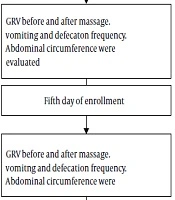
Parents completed an informed consent form. Figure 1 illustrates the study protocol.
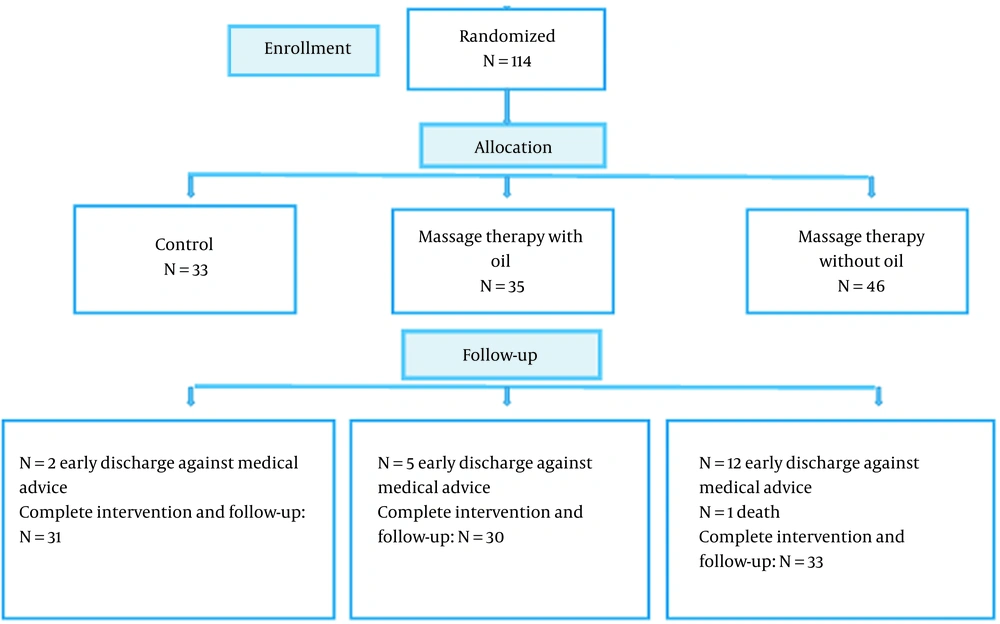
Figure 1.
Protocol study
This study was performed in the NICU of 2 educational hospitals affiliated with Shahid Beheshti University of Medical Sciences, Tehran, Iran, from September 2019 to April 2021.
Demographic information such as gestational age, calendar age, sex, birth weight, height, head circumference, daily weight, delivery method, maternal age, premature comorbidities (respiratory distress syndrome or RDS, sepsis, intraventricular hemorrhage), and serum triglycerides levels (on the first and on the fifth day of intervention) were recorded.
A speech therapist and a nurse were trained to massage the neonates according to the massage techniques booklet for babies, which is available in Iran (https://www.newsha.ir/product. Neonatal and Infant Massage, Neonatal Health Department of the Ministry of Health and Medical Education, Pajhwok Arman).
In intervention groups, the massage therapist performed a 15-minute massage twice daily for 5 days at 9 AM and also at 1 PM. In the first intervention group, body massage was applied with coconut oil, and in the second one, massage was applied with tepid water.
The intervention was conducted at least one hour after feeding. The patient was placed in a prone position under the warmer, and the appropriate diaper was worn. Body temperature, heart rate, respiration rate, and O2 saturation were monitored.
3.2. Intervention
3.2.1. Massage Therapy with Coconut Oil Group
First, coconut oil was tested on the baby’s wrist skin. Massage therapy was started if there was no skin reaction or side effects. Massage therapy was performed in 3 steps:
(1) Step 1: Touch the head, neck, shoulders, back, thighs, ankles, legs, and hands with her fingertips (5 minutes);
(2) Step 2: Touch the face and cheeks, chest, abdomen, plantar, and palm areas with her fingertips (5 minutes);
(3) Step 3: Open and close the joints (passive movements) of the shoulders, elbows, knees, and wrists separately (5 minutes).
3.2.2. Massage Therapy Without Oil Group
All steps were performed similarly to massage therapy with the coconut oil group, but tepid water was applied instead of oil.
3.2.3. Control Group
There was no intervention in the control group.
3.3. Sample Size
The sample size was determined by assuming a confidence interval of 95%, a power of 80%, a 2-sided significance level of α = 0.05, and a loss to follow-up of 20%. Considering an effect size of 3 g/kg/day (10), the sample size was estimated at 22 neonates for each group, although we recruited a higher number of patients. Equal randomization and an allocation ratio of 1: 1 were used for the intervention and control groups.
The massage therapists randomized eligible neonates into 3 groups using random number generation (https://www.random.org). Birth weight was considered a confounding variable, so normal weight distribution was considered in patients’ assignments.
The massage therapists were informed about the groups’ division, while the nurse who measured the daily weight and serum TG samples, the researcher who recorded the information, and the statistician who analyzed the data were blind to grouping.
Normally distributed data are presented as the mean and standard deviation. For comparison, Student’s t-test and Manne Whitney U test were used for continuous data, and the chi-square test and Fisher’s exact test were used for categorical data. SPSS software version 20.0 was used for all statistical analyses. P-value < 0.05 was considered statistically significant.
3.4. Ethical Code
The study was approved by the Ethical Committee of Shahid Beheshti University of Medical Sciences (IR.SBMU.MSP.REC.1398.550); also, this clinical trial was registered on the IRCT website (IRCT ID: IRCT20180610040036N3, link: https://www.irct.ir/trial/63327).
4. Results
In this study, 94 neonates were enrolled and divided into 3 groups.
From neonates, 51 cases (54.3%) were male. There were no statistically significant differences between groups based on sex (P value = 0.9).
The mean gestational age of all patients was 32.5 ± 2.24 weeks (range: 27, 36.6), birth weight was 1769.04 ± 472.8 grams, the birth head circumstance was 29.98 ± 2.5 cm, birth height was 42 ± 4 cm, and maternal age was 31.63 ± 7.06 years.
All groups had no statistically significant differences between gestational age, birth weight, or mother’s age. Demographic data of all patients are presented in Table 1.
Table 1.
Demographic Data of Patients in Different Groups (n = 94)
| Group | Total, No. (%) | Boy, No. (%) | Girl, No. (%) | Gestational Age (wk) | Birth Weight (g) | Maternal Age (y) | |||
|---|---|---|---|---|---|---|---|---|---|
| Mean ± SD | Min, Max | Mean ± SD | Min, Max | Mean ± SD | Min, Max | ||||
| Massage therapy | |||||||||
| With oil | 33 (35.1) | 18 (54.5) | 15 (45.5) | 32.06 ± 2.08 | (28, 36) | 1723.64 ± 404.36 | (1000, 2600) | 34.39 ± 8.07 | (22, 57) |
| Without oil | 30 (31.9) | 16 (53.3) | 14 (46.7) | 32.19 ± 2.54 | (27, 36) | 1710.17 ± 484.95 | (800, 2650) | 31.2 ± 5.8 | (22, 45) |
| Control | 31 (33) | 17 (54.8) | 14 (45.2) | 33.27 ± 1.96 | (28.3, 35.5) | 1874.35 ± 523.5 | (1070, 2780) | 29 ± 6.1 | (16, 44) |
| Total | 94 (100) | 51 (54.3) | 43 | P value = 0.23 | P value = 0.25 | P value = 0.73 | |||
In 84 (89.4%) cases, the neonates were delivered by cesarean section.
Based on the number of babies in pregnancy, 39 cases (41.5%) were single births, 39 cases (41.5%) were twins, 13 cases (13.8%) were triplets, and 3 cases (3.2%) were quadruplets. Sixty-three (67%) mothers had no medical history of diseases.
The most common original causes of patients’ admission were prematurity (51.1%), then RDS (38.3%), asphyxia (5.3%), sepsis (2.1%), hydronephrosis (2.1%), and intracranial hemorrhage (1.1%) respectively.
A comparison of weight gain per day in different groups in Figure 2 and the frequency of proper weight gain and neonatal weight during 5 days of this study in Table 2 are presented.
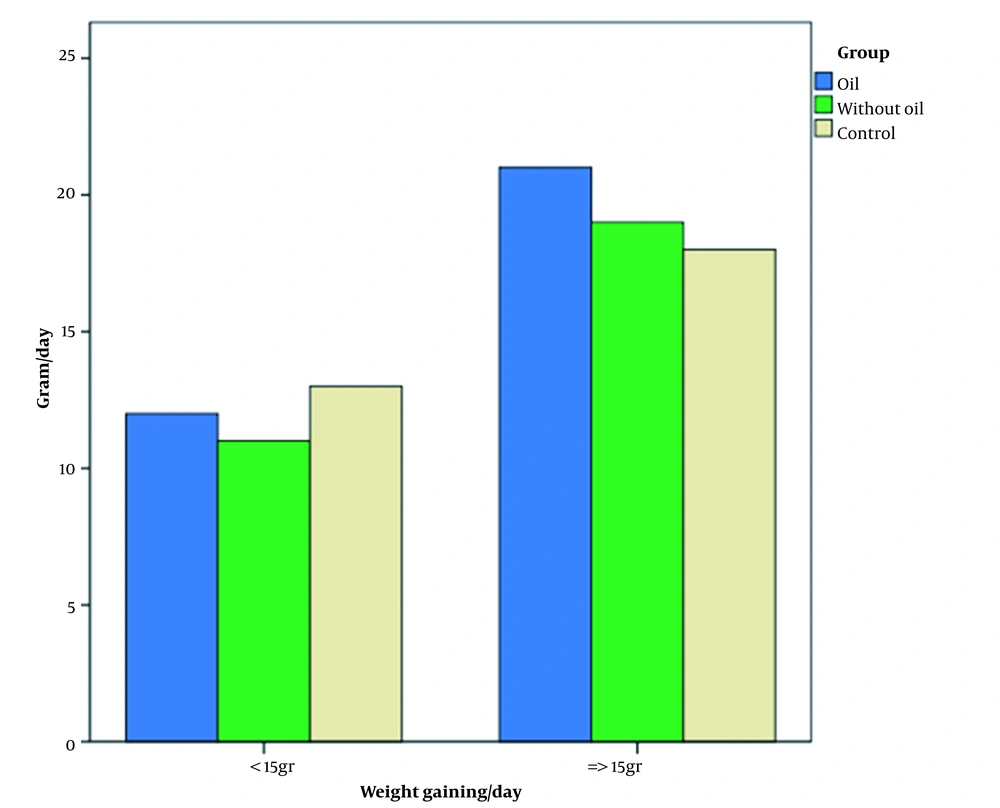
Figure 2.
Comparing weight gain per day in different groups
Table 2.
Neonates’ Weight in a 5-day Period of Study (n = 94) a
| Weight/Day | All Groups | Massage Therapy | Control Group | P Value | |
|---|---|---|---|---|---|
| With Coconut Oil | Without Oil | ||||
| W/1 | 1698.40 ± 442.62 | 1630.45 ± 397.47 | 1663.50 ± 424.68 | 1804.52 ± 496.54 | 0.6 |
| W/2 | 1663.07 ± 439.58 | 1633.30 ± 399.56 | 1660.33 ± 405.57 | 1701.07 ± 524.99 | 0.26 |
| W/3 | 1681.83 ± 407.92 | 1645.15 ± 399.55 | 1675.17 ± 399.52 | 1734.07 ± 436.45 | 0.45 |
| W/4 | 1702.06 ± 402.98 | 1655.61 ± 396.61 | 1683.33 ± 397.83 | 1779.63 ± 419.95 | 0.53 |
| W/5 | 1733.03 ± 422.02 | 1679.70 ± 408.43 | 1690.67 ± 399.67 | 1830.81 ± 452.73 | 0.40 |
| In 5-day period (g/d) | 34.62 ± 80.28 | 49.24 ± 94.32 | 27.16 ± 65.79 | 26.29 ± 77.09 | 0.49 |
| Total | 94 | 33 | 30 | 31 | |
| Weight gaining (g/d) | 36 (38.3) | 18 (36.4) | 11 (36.7) | 13 (41.9) | |
| < 15 | |||||
| ≥ 15 | 58 (61.7) | 15 (63.6) | 19 (63.3) | 18 (58.1) | |
a Values are expressed as mean ± SD or No. (%).
Weight gains during this study were 49 ± 94, 27 ± 66, and 26 ± 77 (grams per day) in the massage therapy with and without oil and control groups, respectively. Although the average weight gain of patients in the massage therapy with coconut oil group was higher than the 2 groups, those numbers did not reach statistical significance (P value = 0.49).
Table 3 presents serum triglyceride levels of patients before and on the fifth day after intervention in all groups. No statistically significant difference was observed between these groups.
Table 3.
Serum Triglyceride Level (n = 94) a
| Triglyceride/Day (mg/dL) | All Groups | Massage Therapy | Control Group | P Value in 3 Groups | |
|---|---|---|---|---|---|
| With Oil | Without Oil | ||||
| TG0 (Before intervention) | 77.04 ± 39.73 | 73.21 ± 32.77 | 91.53 ± 49.83 | 67.10 ± 31.91 | 0.29 |
| TG5 (After intervention) | 100.94 ± 44.66 | 86.97 ± 40.34 | 112.87 ± 56.86 | 104.26 ± 30.87 | 0.23 |
| TG5 - TG0 (TG during study) | 23.89 ± 47.91 | 13.75 ± 47.36 | 21.33 ± 59.24 | 37.16 ± 32.08 | 0.44 |
| Total | 94 | 33 | 30 | 31 | |
Abbreviation: TG, triglyceride
a Values are expressed as mean ± SD.
There was no skin reaction or adverse effects of oil application and massage therapy in this study.
5. Discussion
This study aimed to evaluate the effects of massage therapy with and without coconut oil on premature (gestational age (GA) < 37 weeks) neonates’ weight and serum TG level in a 5-day intervention. Our data showed that massage therapy with or without oil has no significant effect on weight gain and serum TG level during 5 days of intervention compared to the control group.
Regarding a systematic review published in 2017, the parameters of the massage therapy protocol for preterm, the average session length of the session was 15.18 ± 3.53 minutes, usually performed 2 - 3 times a day. The total duration of treatment varied from 5 days to 29 days (12).
Previous studies have shown that preterm infants who received massage therapy for 5 to 10 days had 21 to 48 percent better weight gain and 3 to 6 days less hospitalization than control infants (13-16).
Moreover, the Elmoneim et al. study has shown that 5 days of massage therapy increased average daily weight gain by 1.5 to 2 times compared to the routine care group (17).
Therefore, based on the review of the articles and our limitations, equipment, facilities, and securing a better follow-up of patients, 5-day massage therapy were considered when conducting this study.
Previous studies showed that oil application in neonates might promote the skin barrier and decrease the infection rate. Also, massage therapy stimulates the release of IGF1, improves vagal activity, gastric motility, abilities for sucking and feeding, sleep pattern, and finally, better weight gain. Hence, it would improve neonatal health and reduce neonatal morbidities and mortalities (12-14, 18).
Studies have stated that massage therapy, particularly with oil application, mainly affects growth parameters in neonates (12, 15, 16).
While this study found that although in massage therapy with the oil group, more weight gain per day was observed, the statistical differences between groups did not reach significance, perhaps due to the small sample size that may cause wide variations in our data.
Saeadi et al. reported that massage therapy with medium-chain triglycerides (MCT) oil increased premature neonates’ weight gain in a 7-day study (19). Additionally, Taheri et al. showed that 5 days of massage therapy with sunflower oil improved weight gain in preterm infants (20).
Also, Yoanita et al. also assessed the 10-day tactile-kinesthetic stimulation effect on babies’ growth index and saw improvements in weight gain, length, tone, and reflexes (21). Other studies supported the same findings (7, 22).
Those contradictory findings suggest that further studies are needed to confirm the positive effects of massage therapy with oil on neonatal weight gain, while its real effects and the adequate duration of intervention remain questionable.
Moreover, our patients had no significant differences in serum TG levels. Also, Kumar et al. reported massage therapy with oil in a 7-day-duration intervention had no significant effect on serum TG levels after 28 days post-intervention (23). On the other hand, Field et al. described that oil application in premature neonates increased serum TG levels by the transcutaneous absorption of oil (13). There is a lack of literature on this issue, and further studies with a larger sample size are recommended.
The strengths of this study include its randomized controlled study design and its evaluation of serum TG levels in premature neonates during the intervention.
The study’s limitations include its short course of intervention and its small sample size.
Additionally, the COVID-19 pandemic occurred during our study, and we were confronted with some difficulties and limitations in sample selection and performing massage therapy and patient follow-up.
We recommend performing a long-term evaluation of massage therapy’s benefits or adverse effects, and oil application in neonates is advised.
5.1. Conclusions
Massage therapy during 5 days of intervention with and without applying coconut oil to the skin had no significant effect on weight gain and serum TG levels in premature neonates.