
1. Background
Cyclic vomiting syndrome (CVS) is classified as a disorder of gut-brain interaction characterized by recurrent, stereotypical episodes of severe nausea and vomiting, with complete symptom resolution between attacks (1). In pediatric populations, diagnosis is generally based on the Rome IV criteria, whereas the International Classification of Headache Disorders, 3rd edition (ICHD-3), categorizes CVS among episodic syndromes potentially associated with migraine and defines its own minimum attack thresholds (2, 3). These overlapping frameworks underscore the gastrointestinal and neurological dimensions of CVS and the importance of thorough differential diagnosis.
The estimated prevalence of CVS was 16.7 per 100,000 in Commercial/Medicare populations and 42.9 per 100,000 in Medicaid populations. The incidence rates were 10.6 and 26.6 per 100,000, respectively (4, 5). The longstanding clinical association between CVS and migraine is formally acknowledged in headache classification systems. Many children with CVS have personal or family histories of migraine and later develop typical migraine headaches during adolescence or young adulthood (6, 7). Previous studies have also described a "migraine-associated" subtype of CVS that appears to respond favorably to antimigraine treatments, suggesting shared underlying mechanisms (8). Potential shared pathophysiological pathways include mitochondrial DNA abnormalities and autonomic dysfunction, such as diminished cardiac vagal tone (9-11).
Despite extensive North American and European literature, contemporary Middle Eastern data applying strict ICHD-3 migraine criteria remain sparse. An earlier series from our center in Shiraz described 181 consecutive children and provided initial insights into regional presentation and response to prophylaxis (12).
2. Objectives
The present study aimed to address this gap by describing age at diagnosis and follow-up patterns in a large, unselected CVS cohort, comparing patients with and without definite ICHD-3 migraine, and examining prophylactic medication use across pediatric and young-adult age groups.
3. Methods
3.1. Study Design
This retrospective cohort study was based on routinely collected clinical records from a tertiary pediatric gastroenterology service. The statistical analysis plan, including variable definitions, primary comparisons, distribution checks, and selection of nonparametric tests, was finalized before any inferential analyses. Reporting followed STROBE recommendations for observational studies.
3.2. Setting and Participants
The study was conducted in the Pediatric Gastroenterology clinics at Shiraz University of Medical Sciences, Shiraz, southern Iran. These clinics provide longitudinal care for functional and motility disorders and continue follow-up into early adulthood when clinically indicated. Patients with a physician-documented diagnosis of CVS and at least one clinic visit up to the data-freeze date in April 2025 were screened for inclusion. The study included patients with a physician-documented diagnosis of CVS who attended the Pediatric Gastroenterology clinics at Shiraz University of Medical Sciences between January 2010 and April 2025. Records were extracted from the institutional electronic registry. Duplicate records were identified and removed. Patients with an uncertain CVS diagnosis or administrative-only encounters without clinical evaluation were excluded. The final study cohort consisted of 472 patients.
3.3. Variables
CVS diagnosis was based on clinical evaluation by pediatric gastroenterologists and was documented in patient records, generally in accordance with the Rome IV criteria used in routine clinical practice. Migraine classification was based on documentation recorded during routine clinical care. Treating physicians assigned a diagnosis of definite migraine when ICHD-3 criteria were applied during patient evaluation. No retrospective reassessment or keyword-based chart review was performed by the research team. Referral to pediatric neurology was not standardized and occurred at the clinician's discretion; therefore, specialist involvement could not be determined consistently. Patients without documented migraine were classified as having "no definite migraine," which may include both patients who were assessed and found not to meet the criteria and those who were not formally evaluated.
Recorded variables included current age, age at first documented CVS diagnosis, definite migraine status (yes/no according to clinician application of ICHD-3 criteria), and prophylaxis status ("complete" vs "none"). Receipt of any prophylactic therapy was defined as documentation of preventive pharmacologic therapy for CVS and/or migraine at any point during follow-up. Because of the retrospective design, detailed data regarding medication type, dose, duration, and specific indication were not consistently available. Patients without clear documentation were classified as having no prophylaxis. Age was dichotomized at 18 years. Follow-up duration was derived by subtracting age at diagnosis from current age. Prespecified categorical follow-up bands were < 7, 7 - 12, 12 - 17, and ≥ 17 years, with a binary cut point (≤ 8 vs > 8 years) selected in advance to maintain adequate cell sizes.
3.4. Statistical Analysis
Descriptive statistics for continuous variables included means, standard deviations (SDs), medians, and interquartile ranges (IQRs). Normality of the data distribution was assessed using the Shapiro-Wilk test and visual inspection. The Mann-Whitney U test was used to compare 2 groups for variables that did not follow a normal distribution. Categorical associations were tested using the Pearson χ2 or Fisher exact test. Odds ratios with 95% confidence intervals (CIs) were calculated for the binary follow-up analysis. All analyses were performed using IBM SPSS Statistics version 26 and were 2-sided with α = 0.05. No correction for multiple comparisons was applied. Missing data were handled using available-case analysis. Four patients lacking exact diagnosis dates were excluded only from follow-up duration analyses.
3.5. Ethical Considerations
This retrospective chart review was approved by the Institutional Review Board of Shiraz University of Medical Sciences (approval number: IR.SUMS.MED.REC.1403.746). The requirement for informed consent was waived because of the retrospective nature of the study.
4. Results
A total of 472 patients met the inclusion criteria after screening clinic records and removing duplicate or ineligible entries; 68 (14.4%) met ICHD-3 criteria for definite migraine. Current age was available for all participants; 4 patients lacked an exact diagnosis date, and follow-up calculations were therefore based on 468 cases. Migraine status and prophylaxis status were complete for all 472 patients. Age at diagnosis was available for all patients, whereas follow-up duration was calculated for 468 patients because diagnosis dates were missing for 4 cases.
Patients with definite migraine were older at the time of data collection than those without migraine. However, age at initial CVS diagnosis did not differ significantly between groups. Consequently, follow-up duration was longer among patients with migraine (Table 1). When follow-up duration was categorized into 4 groups, the distributions differed significantly by migraine status (Table 2). A binary division using a cutoff of 8 years confirmed this association, with patients with migraine more likely to have more than 8 years of follow-up (Table 3).
Table 1.
Baseline Demographic and Clinical Characteristics of Patients with Childhood-Onset Cyclic Vomiting Syndrome Stratified by Migraine Status a
| Variables | No migraine (n = 404) | Migraine (n = 68) | P-Value |
|---|---|---|---|
| Current age (y) | 16.1 ± 4.0; 16 (13 - 19) | 17.7 ± 3.5; 18 (15 - 20) | < 0.001 |
| Age at CVS diagnosis (y) | 5.5 ± 2.8; 5 (3 - 7) | 6.1 ± 3.4; 5.5 (3 - 9) | 0.243 |
| Follow-up duration (y) | 10.6 ± 3.9; 10 (8 - 13) | 11.6 ± 3.6; 12 (9 - 16) | 0.028 |
a Data are presented as mean ± SD and median (IQR). P values were calculated using the Mann-Whitney U test. Abbreviations: CVS, cyclic vomiting syndrome; IQR, interquartile range.
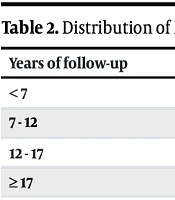
Table 2.
Distribution of Migraine Status According to Duration of Follow-Up a
| Years of follow-up | No Migraine | Migraine | Total |
|---|---|---|---|
| < 7 | 93 (23.3) | 11 (16.2) | 104 (22.2) |
| 7 - 12 | 195 (48.8) | 28 (41.2) | 223 (47.6) |
| 12 - 17 | 89 (22.3) | 26 (38.2) | 115 (24.6) |
| ≥ 17 | 23 (5.8) | 3 (4.4) | 26 (5.6) |
a Data are presented as number (%). Percentages are calculated within columns. P = 0.041 (χ2 test).
Table 3.
Association Between Follow-Up Duration and Migraine Status (Cutoff, 8 Years) a
| Years of follow-up | No migraine | Migraine | Total |
|---|---|---|---|
| ≤ 8 | 129 (32.3) | 13 (19.1) | 142 (30.3) |
| > 8 | 271 (67.7) | 55 (80.9) | 326 (69.7) |
a Note: Data are presented as number (%). Percentages are calculated within columns. P = 0.029 (χ2 test). OR = 2.01 (95% CI, 1.06 - 3.82). Abbreviations: OR, odds ratio; CI, confidence interval.
Prophylaxis data were complete for 295 (62.5%) of 472 patients. Adults (≥ 18 years) were more likely than younger patients to have received any prophylactic therapy (Table 4). The proportion with definite migraine did not differ significantly by prophylaxis status (Table 5). Consistent with their higher current age, patients with migraine had a longer follow-up duration.
Table 4.
Distribution of Prophylactic Therapy According to Age Group a
| Age Group (y) | No Prophylactic Therapy | Any Prophylactic Therapy | Total |
|---|---|---|---|
| < 18 (n = 298) | 124 (41.6) | 174 (58.4) | 298 (100) |
| ≥ 18 (n = 174) | 53 (30.5) | 121 (69.5) | 174 (100) |
| Total (n = 472) | 177 (37.5) | 295 (62.5) | 472 (100) |
a Data are presented as number (%). Percentages are calculated within rows. P = 0.016 (χ2 test).
Table 5.
Association Between Prophylactic Therapy and Migraine Status a
| Prophylactic therapy | No migraine | Migraine |
|---|---|---|
| No (n = 177) | 158 (89.3) | 19 (10.7) |
| Yes (n = 295) | 246 (83.4) | 49 (16.6) |
| Total (n = 472) | 404 (85.6) | 68 (14.4) |
a Data are presented as number (%). Percentages are calculated within rows. P = 0.078 (χ2 test).
5. Discussion
In this large single-center cohort of 472 individuals with childhood-onset CVS, only 14.4% had a definite ICHD-3 diagnosis of migraine (1, 2). Patients with migraine were older at the final assessment, whereas the age at which CVS was first recognized was virtually identical between groups. Therefore, the longer follow-up observed in patients with definite migraine appears to reflect greater current age rather than differences in the timing of disease onset (8). Prophylactic therapy was prescribed more frequently to patients who reached adulthood, but no clear statistical association was observed between prophylaxis status and migraine recognition (12).
These observations are consistent with longitudinal descriptions of CVS evolving into abdominal migraine or typical migraine headaches during later childhood and adolescence (6, 7). A recent systematic review of pediatric patients with recurrent vomiting episodes reported that migraine accounted for approximately 12.9% (95% credible interval, 11.2 - 14.7) of the differential diagnoses, making it one of the most common associated conditions after psychological stress, infections, and motion sickness (13). According to the 2025 guidelines from the North American Society for Pediatric Gastroenterology, Hepatology, and Nutrition, there is a strong recommendation supporting the use of antimigraine agents to abort CVS episodes, particularly in patients with a personal or family history of migraine (14). The relatively modest point prevalence may reflect the cohort’s age distribution and likely represents a snapshot before many patients reach the peak years of migraine expression. The apparent doubling of migraine odds after more than 8 years of follow-up may reflect this natural aging process rather than an independent effect of time under care (4, 5).
Higher rates of receipt of any prophylactic therapy among older patients may reflect cumulative opportunities for treatment trials, evolving prescribing practices, or differences in documentation over the study period. Importantly, prophylaxis itself did not appear to influence whether migraine was later identified. Within the smaller no-prophylaxis subgroup, an older age at diagnosis was observed among those who developed migraine, a pattern potentially explained by confounding by indication or temporal changes in clinical practice, although the numbers preclude firm conclusions (9-11).
5.1. Study Limitations
Strengths of this study include the complete clinic roster, which reduced selection bias; consistent application of contemporary ICHD-3 criteria; prespecified analytic decisions; and minimal missing data. The study also has several limitations. Its retrospective design precludes definitive temporal sequencing of migraine recognition relative to prophylaxis, and follow-up duration is inherently coupled with current age. Detailed information on sex, episode severity, specific prophylactic agents and doses, and additional comorbidities that might further refine the associations was unavailable. Migraine classification relied on clinician documentation without independent validation, which may have introduced misclassification bias due to variability in the application of ICHD-3 criteria. Recall and documentation biases inherent to retrospective chart review may also have affected the accuracy of recorded clinical information.
The binary classification of prophylactic therapy lacked information on medication type, dose, duration, and timing relative to symptom onset; therefore, these findings should be interpreted as descriptive only. The observed association between migraine status and longer follow-up duration is intrinsically confounded by current age and should be interpreted as an age-related finding rather than an independent effect of follow-up duration. In addition, the number of patients evaluated by pediatric neurologists could not be reliably determined, and migraine classification depended on routine clinical documentation rather than standardized reassessment, which may have introduced additional misclassification. Detailed information regarding prophylactic medications, including type, dose, duration, and indication (CVS vs migraine), was not consistently available and could not be analyzed.
Clinically, these findings support systematic migraine screening in all patients with CVS, with heightened vigilance during later adolescence and young adulthood. Families can be counseled that an early, typical CVS presentation does not preclude later migraine and that ongoing review remains essential. Future research should use adjusted multivariable models or time-to-event analyses that treat prophylaxis as a time-varying covariate and use age at CVS diagnosis as the time origin. Prospective designs incorporating standardized migraine screening tools and symptom diaries would further reduce misclassification and clarify whether early intervention modifies long-term migraine risk.
5.2. Conclusions
This study demonstrated a low prevalence of definite migraine among children with CVS in our cohort. Although no statistically significant association was observed between prophylactic therapy and migraine status, the findings raise the possibility of a clinically meaningful relationship. Early prophylactic therapy in CVS may influence the long-term risk of migraine development; however, this possibility could not be confirmed in the present study because of its limited sample size and retrospective design. Future large-scale prospective studies with extended follow-up into adulthood are warranted to clarify whether prophylactic therapy for childhood CVS may reduce the incidence or severity of migraine headaches later in life.