
1. Background
Epilepsy is a prevalent chronic neurological disorder in children that substantially affects development and quality of life and imposes considerable burdens on families and healthcare systems (1, 2). It disrupts education in 71.6% of children; 55.6% report mistreatment by family members, and two-thirds perceive unfair treatment at school (3). These social factors contribute to adverse psychological outcomes, while epilepsy itself may lead to cerebral hypoxia, injury, and long-term disability. Parents also experience substantial psychological, financial, and social burdens.
Electroencephalography (EEG) is an essential tool for evaluating the brain’s electrical activity. Although advanced neuroimaging modalities are available, EEG remains the most widely used ancillary technique for assessing seizure activity and seizure-like conditions (4). Furthermore, EEG helps predict seizure recurrence and guide treatment decisions (5). The timing of EEG recording in relation to the most recent seizure is crucial (6), and most EEG abnormalities in children are detected within 48 hours of the last seizure (7).
In Vietnam, epilepsy affects a substantial portion of the population; however, the application and study of EEG in pediatric epilepsy remain limited, and existing studies have mainly focused on epilepsy medications (8). Available data are often outdated and lack detailed analyses of factors associated with EEG findings in clinical practice. Can Tho Children’s Hospital serves as a key referral center for the Mekong Delta region, making it an appropriate setting to address this knowledge gap. However, findings from this referred cohort may not be directly applicable to children presenting with first seizures in primary care or community settings.
2. Objectives
This study aimed to evaluate factors associated with abnormal EEG findings in children with suspected epilepsy at our institution and to provide contemporary data to inform diagnostic strategies in similar settings.
3. Methods
3.1. Study Design and Setting
A hospital-based descriptive cross-sectional study with an analytical component was conducted at the Department of General Internal Medicine, Can Tho Children’s Hospital, Vietnam, from May to August 2024. As a tertiary referral center in Southern Vietnam, this selected cohort may not represent community or primary care populations, in which the seizure spectrum and pretest probability of abnormal EEG findings differ.
3.2. Study Population and Sampling
Children aged 2 months to 16 years who presented with seizures clinically suspected to be epilepsy and were referred for EEG were eligible. Epilepsy was suspected in children with at least 1 unprovoked seizure, defined as a seizure not due to an acute precipitating factor, accompanied by either 1) a second similar seizure or 2) clinical and EEG findings indicative of recurrent seizures (12). Written informed consent was obtained from parents or legal guardians.
Exclusion criteria included seizures due to acute metabolic disturbances, including Na+, K+, Cl-, Ca2+, and Mg2+ imbalance; central nervous system (CNS) infections; or chronic systemic diseases, such as leukemia, thalassemia, nephrotic syndrome, or immunodeficiency.
The sample size was calculated using the formula for estimating a single proportion:
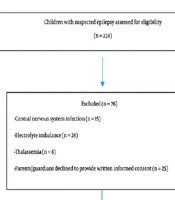
where Z = 1.96, corresponding to α = 0.05 for a 2-sided test; P = 0.868, the prevalence of abnormal EEG findings among children with epilepsy reported by Gauci et al. (9); and d = 0.07, the desired absolute precision, or margin of error. The minimum sample size was 176, and consecutive sampling was used. Of 258 assessed children, 76 were excluded, including 15 with CNS infections, 28 with electrolyte imbalance, and 8 with thalassemia; 25 declined participation, and 182 children were enrolled (Figure 1).
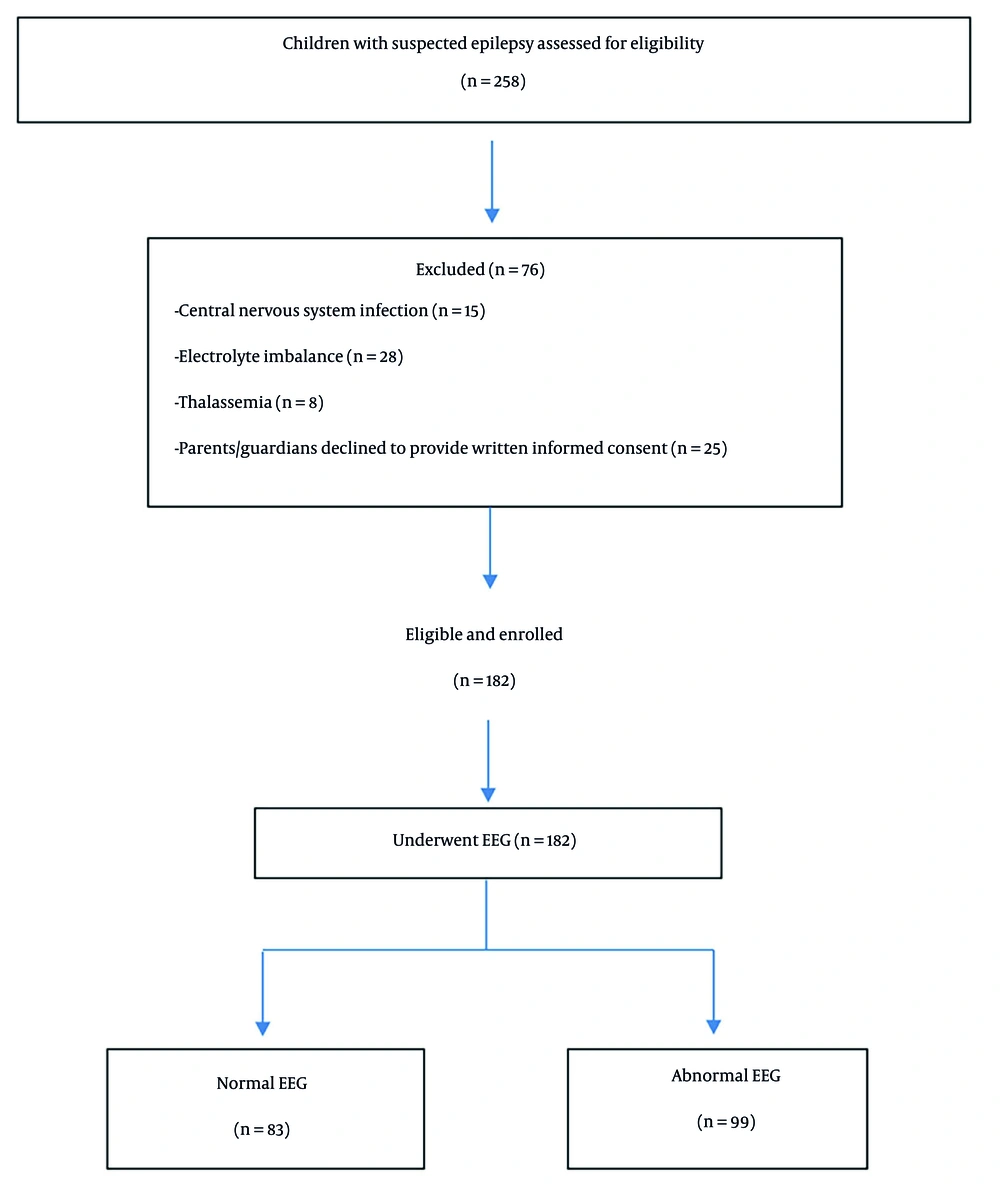
Figure 1.
Participant flow diagram
3.3. Data Collection and Variables
All children who met the inclusion criteria and did not meet the exclusion criteria were invited to participate. Data were extracted from medical records and standardized case report forms completed before EEG, which was performed within 24 - 48 hours of admission. Independent variables included age, categorized as < 3, 3 - <13, and ≥ 13 years; sex; a history of neurological disorders, including cerebral palsy (n = 31), developmental delay (n = 24), prior epilepsy (n = 12), structural brain abnormalities (n = 8), and genetic syndromes (n = 4); admission body temperature, measured tympanically within 1 - 2 hours before EEG, with fever defined as ≥ 38°C; seizure type, classified as generalized or focal according to the 2022 International League Against Epilepsy (ILAE) criteria and based on structured history, referral records, and video when available (10); comorbidities, including none, gastrointestinal (n = 10), and respiratory (n = 18) conditions; and complete blood count parameters, including hemoglobin, white blood cell, monocyte, lymphocyte, neutrophil, and platelet counts, classified according to age-specific reference ranges. The primary outcome was an abnormal EEG, defined as either epileptiform discharges or background activity inappropriate for the child’s age and state of consciousness, including wakefulness or sleep.
3.4. Electroencephalography Acquisition and Interpretation Protocol
Routine EEG was performed using a 21-channel digital system (Nihon Kohden, Japan), with Ag/AgCl cup electrodes placed according to the international 10 - 20 system and impedance maintained at < 5 kΩ. Recordings were conducted in a quiet, dimly lit room. All children were initially recorded while awake with eyes closed; if sleep did not occur spontaneously within 20 minutes, no sedative was administered, and recording continued during wakefulness. A minimum of 30 minutes of artifact-free recording was obtained for every child, and natural sleep was achieved in 48.4% of the cohort. Activation procedures included hyperventilation for 3 minutes in cooperative children aged ≥ 5 years and intermittent photic stimulation at 1 - 30 Hz. Sleep deprivation was not routine; when clinically indicated, EEG was rescheduled with partial sleep deprivation, defined as 4 - 6 hours less sleep, but this approach was not systematic. All EEGs were interpreted by a single board-certified pediatric neurologist with more than 10 years of experience, who was blinded to all clinical and laboratory predictors; only the indication of “suspected epilepsy” was known.
The primary outcome was an abnormal EEG, defined as either epileptiform discharges, including spikes or sharp waves, according to standard criteria (11), or background activity inappropriate for age and state of consciousness, based on pediatric norms. In children aged < 3 years, any background other than theta (θ) waves was considered abnormal; in children aged 3 - <13 years, any background other than alpha (α) waves during wakefulness or θ waves during sleep was considered abnormal; and in children aged ≥ 13 years, any background other than α and/or beta (β) waves during wakefulness or θ waves during sleep was considered abnormal (12).
3.5. Statistical Analysis
Data were analyzed using IBM SPSS Statistics version 22 (IBM Corp., USA). Categorical variables were described as frequencies and percentages and compared using the chi-square test or the Fisher exact test. Continuous variables were presented as medians and interquartile ranges.
Missing data occurred only for complete blood count data in 4 of 182 children (2.2%) because of hemolysis (n = 2) or an unsuccessful blood draw (n = 2). Little’s MCAR test confirmed that the data were missing completely at random (χ2 = 4.2, df = 6, P = 0.65). Complete-case analysis was used for laboratory variables; no imputation was performed. No missing data were present for any other variables.
Variables with a univariate P < 0.2, including age, neurological history, temperature, seizure type, and platelet count, were considered for multivariable logistic regression. Platelet count (P = 0.197) was excluded because of a lack of clinical plausibility. The final model included the other 4 variables, with no stepwise selection. Multicollinearity, variance inflation factor (VIF), the Hosmer-Lemeshow test, and the area under the curve (AUC) were assessed.
3.6. Ethical Approval
The study protocol was approved by the Ethics Committee in Biomedical Research of Can Tho University of Medicine and Pharmacy (Decision No. 24.028.SV/PCT-HĐĐĐ, dated May 24, 2024). Written informed consent was obtained from all parents or legal guardians.
4. Results
4.1. General Characteristics of the Study Population
During the study period, 258 children with suspected epilepsy were assessed for eligibility. After the exclusion of 76 children who met the exclusion criteria, including 15 children with CNS infections, 28 children with electrolyte imbalance, 8 children with thalassemia, and 25 children whose parents declined participation, 182 children were included in the final analysis (Figure 1). No enrolled participants had missing data for the primary outcome or key covariates. The median age was 45 months (IQR, 17.25 - 96). The age distribution was as follows: <3 years, 43.4% (n = 79); 3 - <13 years, 48.4% (n = 88); and ≥ 13 years, 8.2% (n = 15). Females accounted for 53.8% of the cohort (n = 98). A history of neurological disorders was present in 43.4% of participants (n = 79) (Table 1).
Table 1.
General Characteristics of Children with Suspected Epilepsy (N = 182) a
| Characteristics | Values |
|---|---|
| Gender | |
| Male | 84 (46.2) |
| Female | 98 (53.8) |
| Age (y) | |
| < 3 | 79 (43.4) |
| 3 - < 13 | 88 (48.4) |
| ≥ 13 | 15 (8.2) |
| Median (interquartile range) | 45 (17.25 - 96) |
| History of neurological disorders b | |
| Yes | 79 (43.4) |
| No | 103 (56.6) |
a Values are expressed as No. (%) unless otherwise indicated.
b History of neurological disorders includes cerebral palsy (n = 31), developmental delay/intellectual disability (n = 24), prior diagnosed epilepsy (n = 12), structural brain abnormalities (n = 8), and genetic syndromes with neurological involvement (n = 4). Some children had multiple conditions.
4.2. Clinical and Laboratory Characteristics
Most children (81.9%; n = 149) had an admission body temperature < 38°C. Generalized seizures were the predominant seizure type, reported in 82.4% of cases (n = 150). Most children (84.6%; n = 154) had no documented comorbidities (Table 2).
Table 2.
Clinical Characteristics of Children with Suspected Epilepsy (N = 182)
| Characteristic | No. (%) |
|---|---|
| Admission temperature (°C) | |
| < 38 | 149 (81.9) |
| ≥ 38 | 33 (18.1) |
| Seizure type | |
| Generalized | 150 (82.4) |
| Focal | 32 (17.6) |
| Comorbidities a | |
| No | 154 (84.6) |
| Gastrointestinal | 10 (5.5) |
| Respiratory | 18 (9.9) |
a Comorbidities included gastrointestinal conditions (acute gastroenteritis) and respiratory conditions (pneumonia, bronchiolitis, and upper respiratory infection). Children with multiple comorbidities were assigned to the most clinically significant category.
Complete blood count data were available for 178 of 182 children (97.8%); missing data were due to hemolysis (n = 2) or unsuccessful blood draw (n = 2). Most values were within age-specific normal ranges: hemoglobin was normal in 73.6% of children (n = 131), and platelet counts were normal in 68.0% (n = 121). Elevated monocyte and lymphocyte counts were observed in 55.6% (n = 99) and 56.2% (n = 100) of children, respectively (Table 3).
Table 3.
Laboratory Characteristics of Children with Suspected Epilepsy (N = 178) a
| Characteristic | Values |
|---|---|
| Hemoglobin (g/L) | |
| Decreased | 36 (20.2) |
| Normal | 131 (73.6) |
| Increased | 11 (6.2) |
| Median (interquartile range) | 121.5 (111 - 128.75) |
| White blood cell count (×109/L) | |
| Decreased | 0 (0) |
| Normal | 90 (50.6) |
| Increased | 88 (49.4) |
| Median (interquartile range) | 10.4 (8.2 - 13.4) |
| Neutrophil count (×109/L) | |
| Decreased | 45 (25.3) |
| Normal | 71 (39.9) |
| Increased | 62 (34.8) |
| Median (interquartile range) | 491.3 (311.3 - 769.5) |
| Monocyte count (×109/L) | |
| Decreased | 17 (9.6) |
| Normal | 62 (34.8) |
| Increased | 99 (55.6) |
| Median (interquartile range) | 59.2 (39.8 - 78.3) |
| Lymphocyte count (×109/L) | |
| Decreased | 23 (12.9) |
| Normal | 55 (30.9) |
| Increased | 100 (56.2) |
| Median (interquartile range) | 456.0 (260.8 - 638.1) |
| Platelet count (×109/L) | |
| Decreased | 1 (0.5) |
| Normal | 121 (68.0) |
| Increased | 56 (31.5) |
| Median (interquartile range) | 343 (279 - 414.8) |
a Values are expressed as No. (%) unless otherwise indicated. Complete blood count data were unavailable for 4 of 182 enrolled children (2.2%) for the reasons stated in the Results. Complete-case analysis was used; percentages reflect the available denominator (n = 178).
4.3. Electroencephalography Findings
Abnormal EEG findings were observed in 99 of 182 children (54.4%). The most common abnormality was isolated background activity (59.6%), followed by combined background abnormalities and epileptiform discharges (20.2%) (Figure 2). Recording states were nearly evenly distributed, with wakefulness in 51.6% and sleep in 48.4%. Specific waveforms are detailed in Figure 3.
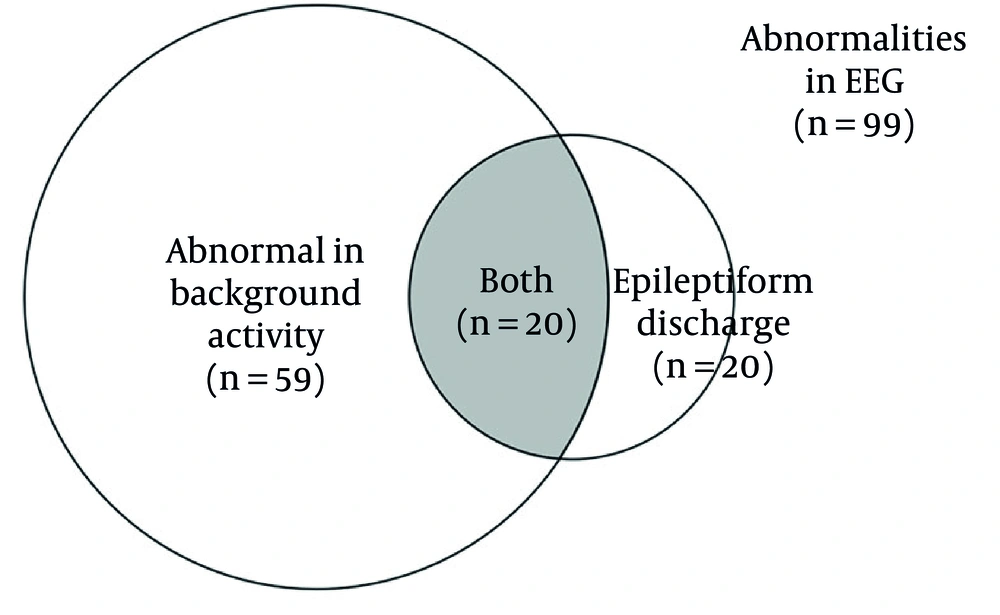
Figure 2.
Distribution of Electroencephalogram Abnormalities Among Children With Suspected Epilepsy (n = 99 Abnormal EEGs)
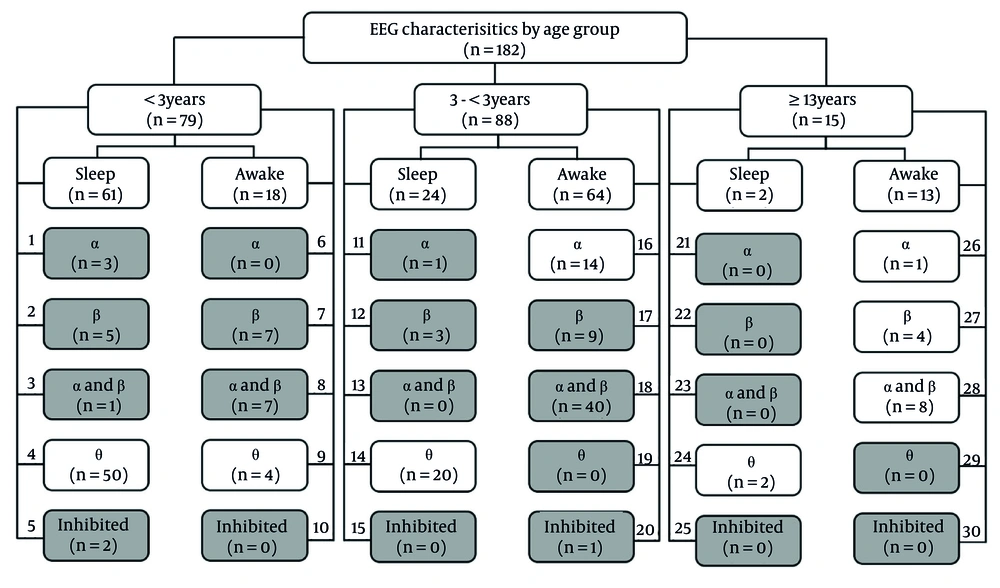
Figure 3.
Electroencephalogram Characteristics by Age Group (n = 182)
4.4. Factors Associated With Abnormal Electroencephalography Findings
Bivariate analysis (Table 4) showed that age group (P < 0.001), history of neurological disorders (P = 0.024), and admission temperature < 38°C (P = 0.035) were significantly associated with abnormal EEG findings. The prevalence of abnormalities was highest in the 3 - <13 years group (69.7%) compared with the < 3 years group (13.7%). No significant associations were observed for sex, seizure type, comorbidities, or any hematologic parameters.
Table 4.
Correlation Between Electroencephalogram Findings and Clinical and Laboratory Characteristics in Children with Suspected Epilepsy a
| Characteristics | Normal EEG (n = 83) | Abnormal EEG (n = 99) | P-Value |
|---|---|---|---|
| Gender | 0.589 b | ||
| Male | 36 (43.4) | 48 (48.5) | |
| Female | 47 (56.6) | 51 (51.5) | |
| Age (y) | < 0.001 | ||
| < 3 | 54 (29.7) | 25 (13.7) | |
| 3 - < 13 | 19 (22.9) | 69 (69.7) | |
| ≥ 13 | 10 (12.0) | 5 (5.1) | |
| History of neurological disorders | 0.024 b | ||
| Yes | 28 (66.3) | 51 (51.5) | |
| No | 55 (33.7) | 48 (48.5) | |
| Admission temperature (°C) | 0.035 | ||
| < 38 | 62 (74.7) | 87 (87.9) | |
| ≥ 38 | 21 (25.3) | 12 (12.1) | |
| Seizure type | 0.120 | ||
| Generalized | 69 (83.1) | 81 (82.7) | |
| Focal | 14 (16.9) | 17 (17.3) | |
| Comorbidities | 0.245 | ||
| No | 67 (80.7) | 87 (87.9) | |
| Gastrointestinal | 7 (8.4) | 3 (3.0) | |
| Respiratory | 9 (10.9) | 9 (9.1) | |
| Hemoglobin (g/L) | 0.453 b | ||
| Decreased | 17 (25) | 19 (17.3) | |
| Normal | 50 (73.5) | 81 (73.6) | |
| Increased | 1 (1.5) | 10 (9.1) | |
| White blood cell count (×109/L) | 0.764 b | ||
| Decreased | 4 (5.9) | 6 (5.5) | |
| Normal | 44 (64.7) | 75 (68.2) | |
| Increased | 20 (29.4) | 29 (26.3) | |
| Neutrophil count (×109/L) | 0.301 | ||
| Decreased | 24 (29.3) | 21 (21.9) | |
| Normal | 34 (41.5) | 37 (38.5) | |
| Increased | 24 (29.3) | 38 (39.6) | |
| Monocyte count (×109/L) | 0.260 | ||
| Decreased | 7 (10.3) | 10 (9.1) | |
| Normal | 17 (25) | 45 (40.9) | |
| Increased | 44 (64.7) | 55 (50) | |
| Lymphocyte count (×109/L) | 0.907 | ||
| Decreased | 10 (14.7) | 13 (11.8) | |
| Normal | 16 (23.5) | 39 (35.5) | |
| Increased | 42 (61.8) | 58 (52.7) | |
| Platelet count (×109/L) | 0.197 b | ||
| Decreased | 0 (0) | 1 (0.9) | |
| Normal | 40 (58.8) | 81 (73.6) | |
| Increased | 28 (41.2) | 28 (25.5) |
a Values are expressed as No. (%).
b Fisher exact test was used.
The final model, excluding platelet count, identified age 3 - <13 years (aOR = 6.44) and history of neurological disorders (aOR = 2.92) as independent predictors of abnormal EEG findings (both P < 0.01). Admission temperature ≥ 38°C showed a trend toward lower odds of abnormal EEG findings (aOR = 0.39; P = 0.06). Seizure type was not significant (P = 0.41). Model fit was good (Hosmer-Lemeshow P = 0.51; AUC = 0.72). No multicollinearity was detected (VIF < 1.2). Adding platelet count did not change the results (P = 0.74) (Table 5).
Table 5.
Multivariable Logistic Regression Model of Factors Associated with Abnormal Electroencephalogram Findings in Children with Suspected Epilepsy a
| Variables | OR | 95% CI | P-Value |
|---|---|---|---|
| Age (y) | |||
| 3 - < 13 vs < 3 | 6.44 | 2.95 - 14.75 | < 0.001 |
| ≥ 13 vs < 3 | 0.61 | 0.14 - 2.25 | 0.47 |
| History of neurological disorders (yes vs no) | 2.92 | 1.37 - 6.52 | 0.007 |
| Admission temperature (°C) | |||
| ≥ 38 vs < 38 | 0.39 | 0.14 - 1.03 | 0.06 |
| Seizure type (focal vs generalized) | 1.45 | 0.60 - 3.48 | 0.41 |
a Variables with P < 0.2 in univariate analysis, including age, history of neurological disorders, admission temperature, seizure type, and platelet count, were considered. Platelet count was excluded from the main model because of lack of clinical plausibility and no material impact on effect estimates (see Methods). VIF values were 1.15 for age, 1.10 for history of neurological disorders, 1.06 for admission temperature, and 1.04 for seizure type. The Hosmer-Lemeshow P value was 0.51, and the AUC was 0.72 (95% CI, 0.64 - 0.80).
5. Discussion
This cross-sectional study of 182 children with suspected epilepsy at a tertiary hospital in Southern Vietnam provides insight into routine EEG utilization and diagnostic yield. The prevalence of abnormal EEG findings was 54.4%, and age and neurological history were identified as robust independent predictors. These findings highlight the context-dependent nature of EEG interpretation in pediatric seizure disorders.
The strong association between older age (3 - < 13 years) and abnormal EEG findings is consistent with neurophysiological maturation, whereby epileptiform patterns become more reliable after infancy (12). A study from Indonesia reported abnormal EEG findings in 53.8% of children with first unprovoked seizures, most of whom were aged > 5 years (13). The prevalence in our cohort (54.4%) likely reflects a referred population with a higher pretest probability. Supporting evidence comes from Owolabi et al., who found that older age was independently associated with abnormal EEG findings in Saudi children (14). Conversely, the lower yield in children aged < 3 years highlights diagnostic challenges related to less specific electrographic patterns (12). However, cautious interpretation is warranted. Alternative explanations include referral bias, as younger children with febrile seizures may undergo EEG less often; the potential underrepresentation of sleep EEG in younger children because no sedation was used; and the peak incidence of mid-childhood epilepsy syndromes, such as absence epilepsy and Rolandic epilepsy (15). After adjustment for seizure type, the age effect remained robust (aOR = 6.44). Nevertheless, residual confounding by these factors cannot be excluded, suggesting that the age effect reflects both biological maturation and contextual factors.
The association between a history of neurological disorders and abnormal EEG findings was significant (aOR = 2.92), corroborating studies linking structural-genetic etiologies to EEG patterns (9). This finding supports prioritizing EEG in this high-risk subgroup, in contrast to some broader studies in which definitional differences may explain null findings (14).
Febrile presentation, defined as temperature ≥ 38°C, showed a strong trend toward normal EEG findings (aOR = 0.39; P = 0.06), supporting the distinction between acute symptomatic seizures and unprovoked epileptic activity. This contrasts another study, in which 83.2% of children with suspected epilepsy presented with fever, although the EEG correlation was not directly examined. Ko et al. (16) further demonstrated that EEG abnormalities in patients with febrile seizures are often linked to underlying encephalopathy rather than predicting future epilepsy.
The lack of an association between abnormal EEG findings and laboratory markers, such as monocytosis and lymphocytosis, is noteworthy. Although Shayo et al. reported a similarly high rate of generalized seizures (82.4% vs 66.7%), their analysis did not examine hematological correlates (17). This reinforces the principle that epilepsy diagnosis remains rooted in clinical history and EEG rather than routine bloodwork, as emphasized in recent reviews (18).
Clinical heterogeneity reflects real-world referral practice. The main findings remained robust in sensitivity analyses, including analyses excluding febrile children and analyses stratified by neurological history. However, the small febrile subgroup (n = 33) limits definitive inference, and the nonsignificant trend warrants caution. Unmeasured factors, such as vitamin D deficiency, which is highly prevalent in children with epilepsy treated with anticonvulsants, may confound associations between clinical history and EEG findings and should be explored in future research (19).
5.1. Limitations
Several limitations should be considered. First, clinical heterogeneity and modest sample sizes for key subgroups, including febrile children (n = 33), focal seizures (n = 32), and adolescents (n = 15), precluded robust stratified analyses and limited generalizability to these subgroups. Second, the EEG protocol did not systematically incorporate sleep deprivation, prolonged monitoring, or sedation; therefore, younger children may have had fewer sleep recordings, potentially underestimating abnormalities in this age group. Third, residual confounding by unmeasured variables, such as antiepileptic drug use, timing since the last seizure, and socioeconomic status, as well as possible referral bias, because physicians may order EEG more selectively in older children, cannot be excluded. Fourth, this single-center study was conducted in a referred, higher-risk population and may not be generalizable to community or primary care settings, although the findings are likely applicable to similar tertiary centers in low- and middle-income countries.
5.2. Conclusions
In conclusion, at a tertiary referral center in Southern Vietnam, EEG diagnostic yield varied by age and clinical context; children aged ≥ 3 years and those with neurological disorders benefited most. These findings apply primarily to selective referral settings in low- and middle-income countries and not to community or primary care populations. In febrile infants and young children, normal EEG findings should be interpreted cautiously. A stratified approach is recommended for afebrile children aged ≥ 3 years and those with neurological disorders. Extrapolation to febrile or focal seizure subgroups requires caution because of small sample sizes.