
1. Background
Asthma is one of the most common chronic respiratory diseases in children and remains a major global public health concern. It is characterized by chronic airway inflammation, variable expiratory airflow limitation, and recurrent respiratory symptoms. Despite advances in treatment, childhood asthma continues to contribute substantially to morbidity, healthcare utilization, and reduced quality of life worldwide (1, 2).
According to the Global Initiative for Asthma (GINA), inhaled corticosteroids (ICS), alone or in combination with long-acting β2-agonists (LABAs), are the cornerstone of maintenance therapy for persistent asthma. The fluticasone/salmeterol combination is widely used and has demonstrated efficacy in improving lung function and symptom control in pediatric patients (3, 4). In addition to pharmacological efficacy, long-term outcomes in pediatric respiratory diseases are strongly influenced by quality of life, disease severity, comorbid conditions, and continuity of care. Previous studies in children with chronic respiratory disorders, particularly cystic fibrosis, have highlighted the importance of comprehensive disease management and continuous follow-up in improving patient outcomes and well-being (5-8).
However, the effectiveness of inhaled therapy is influenced not only by the drug formulation but also by the inhalation device and the patient’s ability to use it correctly. Metered-dose inhalers (MDIs) and dry powder inhalers (DPIs) differ in aerosol generation, inspiratory flow requirements, and coordination demands, which may affect drug deposition in the lower airways (9, 10).
Inhaler technique errors remain highly prevalent among children and have been identified as a major barrier to optimal asthma control. Studies have reported that a large proportion of pediatric patients do not use their inhalers correctly, leading to poor disease outcomes and increased exacerbations (11, 12). A substantial proportion of pediatric patients are unable to use inhalers correctly even after instruction, which may reduce treatment effectiveness. These findings highlight the importance of device-related factors in asthma management (11).
Recent evidence suggests that technology-assisted follow-up and remote patient monitoring may improve treatment adherence and disease management in chronic respiratory conditions. Mobile health interventions, telemonitoring systems, and digital patient-support tools have shown promising results in facilitating long-term monitoring and patient engagement, particularly among children and families requiring continuous respiratory care (13-16).
Previous studies comparing DPIs and MDIs have generally reported similar clinical outcomes; however, findings remain inconsistent, particularly in pediatric populations in which inspiratory flow capacity and inhaler technique vary widely. Moreover, most available evidence is derived from parallel-group designs, and direct randomized crossover comparisons of fluticasone/salmeterol delivered via DPI and MDI in children with moderate asthma are limited. Therefore, a well-designed randomized crossover trial is needed to directly compare pulmonary outcomes between DPI and MDI delivery of fluticasone/salmeterol in pediatric asthma.
Furthermore, increasing interest in digital health, patient-centered monitoring strategies, and evidence-based management of chronic diseases has heightened the need for studies evaluating practical aspects of treatment delivery systems and patient–device interactions in real-world clinical settings (17-19).
2. Objectives
The primary objective was to compare pulmonary function outcomes after fluticasone/salmeterol administration via DPI and MDI in children with moderate asthma using a randomized crossover design. Secondary outcomes included patient-reported comfort and adverse effects, as patient acceptance of and comfort with inhaler devices may influence treatment adherence and long-term use in pediatric asthma (20).
3. Methods
3.1. Study Design and Setting
This randomized crossover clinical trial was conducted at the pediatric pulmonary clinic of the National Research Institute of Tuberculosis and Lung Disease (NRITLD), Tehran, Iran. The study compared the pulmonary effects of fluticasone/salmeterol administered via DPI and MDI in children with moderate asthma.
3.2. Study Participants
Children aged ≥ 6 years with a confirmed diagnosis of moderate persistent asthma requiring ICS/LABA therapy were eligible. The study population consisted of school-aged children with a relatively narrow age distribution; therefore, predefined age stratification and subgroup analyses were not performed. Diagnosis was established by a pediatric pulmonologist based on standard clinical criteria.
Inclusion criteria included clinical stability at enrollment and the ability to perform acceptable spirometry. Exclusion criteria included an acute exacerbation during the study period, the need for emergency treatment, or the inability to use inhaler devices despite training.
3.3. Randomization and Intervention
Participants were randomly assigned in a 1:1 ratio to 1 of 2 treatment sequences (DPI→MDI or MDI→DPI) using a computer-generated randomization list. Allocation was concealed using sealed opaque envelopes.
Each participant received fluticasone/salmeterol via the assigned inhaler for 1-month treatment periods. After completion of the first period, participants crossed over to the alternative inhaler for an additional 1-month period.
All participants received standardized inhaler training at baseline from the same trained pediatric respiratory nurse. Inhaler technique was demonstrated and corrected using a step-by-step instruction protocol, and identical education was provided for both DPI and MDI devices to ensure consistency across study groups.
3.4. Methodological Consideration
No washout period was implemented because both treatment phases involved the same active pharmacological agents delivered via different inhalation devices. Although this approach may introduce potential carryover effects, sequence and period effects were statistically evaluated to minimize bias.
3.5. Outcome Measures
The primary outcomes were spirometric parameters measured according to American Thoracic Society/European Respiratory Society (ATS/ERS) guidelines: forced expiratory volume in 1 second (FEV1), forced vital capacity (FVC), the FEV1/FVC ratio, and forced expiratory flow at 25 - 75% (FEF25 - 75%). Secondary outcomes included patient-reported inhaler comfort and adverse events.
3.6. Data Collection
Spirometry was performed at baseline and at the end of each treatment period using the same calibrated spirometry device. All measurements were obtained under standardized conditions.
A structured questionnaire completed by patients and caregivers was used to assess inhaler comfort and record adverse events.
Patients and caregivers rated inhaler comfort at the end of each treatment period using a structured questionnaire that assessed overall ease of use, convenience, and satisfaction with the inhaler device on a 5-point Likert scale ranging from 1 (very uncomfortable) to 5 (very comfortable).
3.7. Statistical Analysis
Data were analyzed using SPSS software. Continuous variables were expressed as mean ± standard deviation, and categorical variables were expressed as frequencies and percentages. Normality was assessed using the Shapiro–Wilk test. Baseline characteristics were compared using independent-samples t tests or chi-square tests, as appropriate. For the crossover design, repeated-measures analysis of variance (RM-ANOVA) was used to evaluate differences in pulmonary function outcomes between inhaler devices over time.
4. Results
4.1. Participant Characteristics
A total of 86 children with moderate asthma were enrolled and randomized into 2 treatment sequences (DPI→MDI and MDI→DPI), with 43 participants in each group. All participants completed the study and were included in the final analysis. Baseline spirometric parameters were comparable between groups, with no significant differences in FEV1 (P = 0.508), FEV1/FVC (P = 0.618), FVC (P = 0.171), or FEF25 - 75% (P = 0.415) (Table 1).
Table 1.
Baseline Characteristics of Participants a
| Characteristic | DPI→MDI (n = 43) | MDI→DPI (n = 43) | P-Value |
|---|---|---|---|
| Baseline FEV1 (%) | 76.02 ± 9.92 | 74.46 ± 12.18 | 0.508 |
| Baseline FEV1/FVC (%) | 76.00 ± 9.83 | 74.95 ± 10.01 | 0.618 |
| Baseline FVC (%) | 100.29 ± 7.87 | 97.93 ± 8.38 | 0.171 |
| Baseline FEF25 - 75 (%) | 65.09 ± 8.41 | 63.33 ± 7.29 | 0.415 |
a Values are expressed as mean ± SD.
Participant flow through the study is shown in the CONSORT diagram (Figure 1).
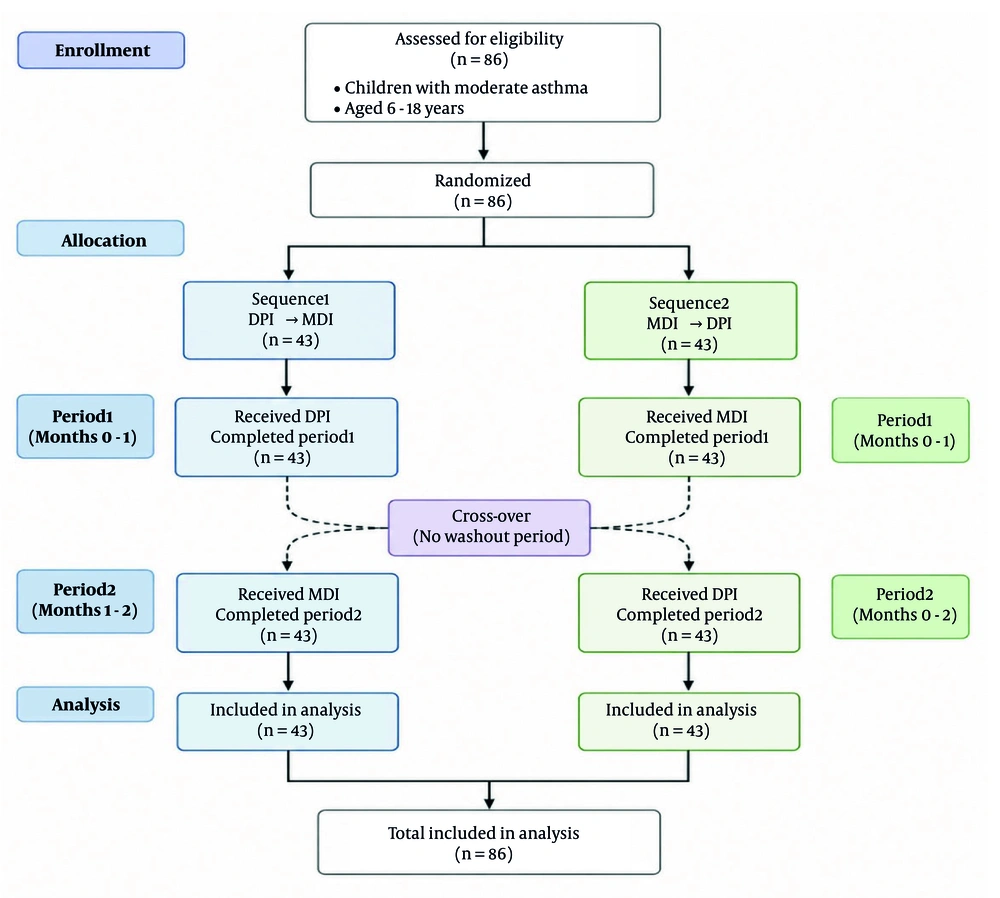
Figure 1.
CONSORT flow diagram of study participants. Eighty-six children with moderate asthma were enrolled and randomized to 1 of 2 crossover treatment sequences: DPI→MDI (n = 43) or MDI→DPI (n = 43). Each treatment period lasted 1 month. All participants completed follow-up assessments and were included in the final statistical analysis. DPI, dry powder inhaler; MDI, metered-dose inhaler.
Changes in pulmonary function over time are presented in Table 2.
Table 2.
Pulmonary Function Outcomes During Follow-Up a
| Outcome | Baseline | Month 1 | Month 2 | P-Value b |
|---|---|---|---|---|
| FEV1 (%) DPI→MDI | 76.02 ± 9.92 | 84.28 ± 8.64 | 86.42 ± 7.38 | - |
| FEV1 (%) MDI→DPI | 74.46 ± 12.18 | 83.08 ± 8.76 | 85.82 ± 9.12 | 0.544 |
| FEV1/FVC (%) DPI→MDI | 76.00 ± 9.83 | 82.26 ± 9.23 | 85.67 ± 7.08 | - |
| FEV1/FVC (%) MDI→DPI | 74.95 ± 10.01 | 81.91 ± 7.78 | 85.64 ± 8.11 | 0.579 |
| FVC (%) DPI→MDI | 100.29 ± 7.87 | 102.87 ± 6.73 | 100.27 ± 4.66 | - |
| FVC (%) MDI→DPI | 97.93 ± 8.38 | 100.84 ± 7.84 | 99.93 ± 8.72 | 0.359 |
| FEF25 - 75 (%) DPI→MDI | 65.09 ± 8.41 | 72.91 ± 8.42 | 76.02 ± 7.90 | - |
| FEF25 - 75 (%) MDI→DPI | 63.33 ± 7.29 | 70.53 ± 7.29 | 74.60 ± 9.54 | 0.671 |
a Values are expressed as mean ± SD.
b P values represent comparisons between inhaler devices using repeated-measures ANOVA.
4.2. FEV1
FEV1 improved over time in both treatment sequences. In the DPI→MDI sequence, mean FEV1 increased from 76.02 ± 9.92% at baseline to 84.28 ± 8.64% after period 1 and 86.42 ± 7.38% after period 2. In the MDI→DPI sequence, the corresponding values increased from 74.46 ± 12.18% to 83.08 ± 8.76% and 85.82 ± 9.12%, respectively.
Repeated-measures analysis showed no significant treatment effect between DPI and MDI (P = 0.544), and no significant period or sequence effects were observed.
4.3. FEV1/FVC Ratio
The FEV1/FVC ratio showed a similar pattern of improvement in both treatment sequences throughout the study period. No statistically significant differences were observed between DPI and MDI administration (P = 0.579).
4.4. FVC
FVC values increased modestly during follow-up in both treatment sequences. However, no statistically significant differences were identified between the inhaler devices (P = 0.359).
4.5. FEF25 - 75%
FEF25 - 75% improved over time in both treatment sequences. Nevertheless, no statistically significant differences were observed between DPI and MDI administration (P = 0.671).
4.6. Patient Comfort and Safety
Patient-reported comfort was slightly higher among participants using DPI devices than among those using MDI devices. However, no formal statistical comparison was performed for this exploratory outcome. No treatment-related adverse events were reported during the study period, and no participants discontinued therapy because of device-related complications.
No major device-related difficulties requiring treatment modification or withdrawal from the study were encountered. Minor handling issues were addressed through routine inhaler instruction during follow-up visits.
Overall, both DPI and MDI delivery systems were associated with improvements in pulmonary function over time. However, no statistically significant differences were observed between inhaler devices across all spirometric outcomes, including FEV1, FEV1/FVC ratio, FVC, and FEF25 - 75%. These findings suggest that fluticasone/salmeterol delivered via either DPI or MDI provides comparable clinical efficacy in children with moderate asthma.
Despite the lack of statistically significant differences, no clinically meaningful differences were observed between DPI and MDI across any spirometric outcomes, as the magnitude of changes in pulmonary function was comparable between the 2 devices throughout the study period.
5. Discussion
This randomized crossover clinical trial compared pulmonary function outcomes after the administration of fluticasone/salmeterol via DPI and MDI in children with moderate asthma. The main finding was that spirometric indices improved over time in both treatment sequences, with no statistically significant differences between inhaler devices. Specifically, no significant differences were observed between DPI and MDI with respect to FEV1, FEV1/FVC ratio, FVC, or FEF25 - 75%. These findings suggest that the clinical efficacy of fluticasone/salmeterol is comparable regardless of the inhalation device used, provided that appropriate inhaler technique is achieved and maintained (3, 4).
The results of this study are consistent with previous research reporting similar efficacy between DPI and MDI devices in asthma management. Another study demonstrated no significant differences in pulmonary outcomes between DPI and MDI administration of inhaled corticosteroid-based therapies in pediatric patients with asthma. Similarly, Pitrez et al. reported comparable improvements in lung function among children treated with fluticasone delivered via different inhalation devices (21). In addition, Patil et al. found that real-world asthma outcomes were generally independent of inhaler type when patients used their devices correctly (22).
The observed equivalence between DPI and MDI may be explained by several factors. First, all participants received standardized inhaler training before treatment initiation, which likely minimized technique-related variability. Previous studies have identified incorrect inhaler use as a major contributor to poor asthma control and reduced treatment effectiveness in children, emphasizing the importance of inhaler education and technique assessment (23, 24).
Second, the study population consisted of school-aged children capable of generating adequate inspiratory flow for DPI use while also demonstrating sufficient coordination for MDI administration. Previous investigations have shown that both DPI and MDI devices can achieve effective pulmonary drug delivery in children when used appropriately and with adequate training (25).
Third, because both interventions contained the same active pharmacological agents, differences related to drug formulation were eliminated, allowing the inhalation device itself to be the primary variable under investigation. This design strengthened the comparison between delivery systems and reduced the likelihood that observed outcomes were attributable to medication-related factors rather than device performance.
These findings have important clinical implications. Given the absence of significant differences in pulmonary outcomes, inhaler selection in pediatric asthma should be individualized according to patient preference, inhaler technique, accessibility, cost, and ease of use rather than expectations of superior efficacy from a particular device. This approach is consistent with current international asthma management guidelines, which emphasize personalized inhaler selection and regular assessment of inhaler technique as essential components of effective asthma care (4, 26).
Recent studies have further highlighted the importance of comprehensive pediatric asthma management, including educational interventions for caregivers (27), the impact of patient-related factors such as body mass index on asthma severity (28), and the burden of acute asthma exacerbations in pediatric populations. These findings support a multidimensional approach to asthma care that integrates both pharmacological treatment and patient-centered management strategies (29).
In addition, patient preference may play an important role in promoting long-term adherence to inhaled therapy. When comparable clinical efficacy is achieved, involving children and their caregivers in inhaler selection may improve treatment acceptance and satisfaction in routine clinical practice.
From a practical perspective, these findings support the use of either DPI or MDI in routine pediatric practice, provided that appropriate inhaler training is delivered and the selected device matches the child's abilities and preferences.
5.1. Study Limitations
Several limitations should be acknowledged. First, the absence of a washout period may have introduced carryover effects, although statistical analysis did not reveal significant sequence or period effects. Second, the study was conducted at a single center, which may limit generalizability. Third, adherence to inhaler therapy was not objectively measured using electronic monitoring systems. Finally, patient-reported comfort was assessed using a nonvalidated questionnaire.
In addition, the absence of age-stratified subgroup analyses may have limited the ability to explore potential age-related differences in response to inhalers.
5.2. Conclusions
In this randomized crossover clinical trial, fluticasone/salmeterol delivered via DPI and MDI resulted in similar improvements in pulmonary function in children with moderate asthma, with no statistically or clinically meaningful differences between devices across spirometric outcomes. Although patient-reported comfort was slightly higher with DPI use, this did not translate into measurable differences in lung function. These findings support selecting inhalers for pediatric asthma based on patient preference, inhaler technique, cost, and accessibility rather than expected differences in clinical efficacy. From a practical standpoint, both inhaler devices can be considered suitable options in routine pediatric care when appropriate training is provided. Further multicenter studies with objective adherence monitoring are warranted.