
1. Background
Sleep disorders are reported in 30% to 70% of children with congenital heart diseases (CHD), far exceeding rates in the general pediatric population. Such disturbances not only impair physical health, cognition, and neurodevelopment but may also compromise quality of life and clinical outcomes (1-3). In addition to physiological factors and the sequelae of multiple surgeries, the psychological climate of the household and parents’ mental health have emerged as key influences on children’s sleep (3, 4). Evidence indicates that elevated parental anxiety and stress are linked with increased nighttime awakenings, reduced sleep quality, and more pervasive behavioral issues (4-6). Likewise, parental depression is associated with diminished emotional involvement, fewer positive interactions, and a higher risk of both behavioral and sleep disorders in children (4, 7).
The intensive nature of CHD care, including complex treatments, recurrent hospitalizations, and reliance on parental support, makes caregivers’ emotional and behavioral stability critical for optimal child outcomes (8, 9). Persistent parental anxiety and stress can interfere with establishing and maintaining healthy sleep routines, lead to inconsistent bedtime practices, and foster an overreliance on sleep-assistive behaviors such as holding the child until asleep or staying beside them through the night (5, 9, 10). Although well-intentioned, these practices may inadvertently limit the child’s autonomy and hinder self-regulated sleep. Parental depression, in turn, may blunt responsiveness to the child’s needs, reduce the frequency of positive interactions, and contribute to fragmented or shallow sleep with frequent awakenings (7, 11).
Given the high prevalence of parental mental health concerns and the substantial burden of sleep disorders among children with CHD, investigating the links between stress and anxiety in parents and their children’s sleep patterns is of critical importance. Insights from such research can inform the design of targeted psychoeducational and supportive interventions, enabling clinicians to address modifiable family-level factors and reduce the risk of secondary complications (9, 12, 13). This study therefore examined the association between parental stress, anxiety, and depression and sleep disorders in children with CHD.
3. Methods
3.1. Study Design
This study was conducted as a cross-sectional study aiming to examine the relationship between parental stress, anxiety, and depression and sleep disorders in children with CHD. The study was approved by Arak University Medical Sciences Ethics Committee (date: 12.01.2025, number: IR.ARAKMU.REC.1403.322). The study population included all children aged 4 to 12 years with a confirmed diagnosis of congenital heart disease and their parents who visited the pediatric cardiology clinic at Shahid Rajaee Cardiovascular, Medical, and Research Center in Tehran during the winter of 2025. Enrollment in the study took place after the confirmation of the CHD diagnosis by a pediatric cardiologist. Sampling was performed using a convenience sampling method. Based on the study by Roberts et al. (12), a total of 147 children and their mothers, who provided informed consent, were included in the research. This article was improved based on the STROBE checklist.
3.2. Inclusion and Exclusion Criteria
Children with a confirmed diagnosis of congenital heart disease by a pediatric cardiologist, aged between 4 and 12 years, and parental consent to participate in the study were included. Additional criteria included the child’s alertness and mental health, absence of primary sleep disorders, developmental disorders (such as autism), intellectual disabilities, or other diseases (such as adenoid hypertrophy), parental mental and verbal health, no history of psychiatric medication use in either the parent or the child, and sufficient literacy and awareness in parents to provide valid responses to the questionnaires. Children were excluded in cases of lack of cooperation from the parent or child, withdrawal of consent at any stage of the study, or diagnosis of developmental disorders (such as autism spectrum disorder, intellectual disability). Other significant comorbidities that could independently affect sleep (such as adenoid hypertrophy requiring surgical intervention, severe neurological disorders, or chronic lung disease) were removed from the study.
3.3. Data Collection
For data collection, in addition to a demographic questionnaire (age, gender, ethnicity, marital status of parents, parental education, place of residence, and household income), two validated instruments were used:
3.3.1. Children’s Sleep Habits Questionnaire (CSHQ)
This questionnaire consists of 45 items, of which 33 items are used to score sleep problems in children aged 4 to 12 years. The tool assesses eight subscales: bedtime resistance, sleep onset delay, sleep duration, sleep anxiety, night wakings, parasomnias, sleep disordered breathing, and daytime sleepiness. The questionnaire is completed by the child’s parents. Its reliability and validity (Cronbach’s alpha 0.70 to 0.79, test-retest validity up to 0.97) have been confirmed in Iranian studies (14).
3.3.2. Depression, Anxiety, and Stress Scales 21 (DASS-21)
This instrument is used to assess the psychological health of parents (mothers) and contains 21 items (7 questions for each subscale). It is completed by self-report. Scores for each subscale, after being multiplied by 2, are interpreted based on the standard severity categories (normal to extremely severe). The tool has demonstrated good validity and reliability (overall Cronbach’s alpha about 0.90) in both Iranian and international studies (15).
After obtaining written informed consent, demographic and clinical information was collected using a checklist. The DASS-21 was completed by the parents (usually the mothers), and the CSHQ was completed with the assistance and guidance of the researcher and the parents. Additional information was extracted from medical records and interviews with parents.
3.4. Data Statistical Analysis
The research data was entered into SPSS software version 18 for data analysis. Descriptive statistics characterized and presented the types of sleep disorders by frequency tables. The associations of the CHD with the variables under consideration were evaluated using logistic regression analysis, independent t-test analysis, and a chi-square (χ²) test. The data were analyzed using SPSS version 26 and JMP version 16. At first, descriptive characteristics of the sample and main variables were reported using means, standard deviations, frequencies, and percentages. To evaluate the relationships between parental stress, anxiety, and depression and children’s sleep disorders, Pearson’s correlation coefficient was used. To assess the predictive role of parental psychological variables in the occurrence of child sleep disorders, both simple and multiple linear regression analyses were conducted. For comparing demographic data among different groups, independent t-tests and analysis of variance (ANOVA) were applied. A significance level of 0.05 was considered for all statistical tests (Table 1).
Table 1.
Univariable and Multivariable Linear Regression Analyses for Total Children’s Sleep Habits Questionnaire Score
| Variables | Unadjusted Β (95% CI) | P-Value | Adjusted Β (95% CI) a | P-Value |
|---|---|---|---|---|
| Parental anxiety (DASS-21 anxiety score, per 1-point increase) | 0.53 (0.36 - 0.70) | < 0.001 | 0.36 (0.19 - 0.53) | < 0.001 |
| Parental stress (per 1-point increase) | 0.37 (0.18 - 0.56) | 0.001 | 0.15 (-0.05 - 0.35) | 0.14 |
| Parental depression (per 1-point increase) | 0.35 (0.12 - 0.58) | 0.003 | 0.10 (-0.12 - 0.32) | 0.37 |
| Child age (y) | -0.19 (-0.49 - 0.11) | 0.21 | -0.14 (-0.41 - 0.13) | 0.31 |
| Male sex (vs. female) | 1.1 (-1.2 - 3.4) | 0.34 | 0.9 (-1.1 - 2.9) | 0.38 |
| History of cardiac surgery (yes vs. no) | 2.6 (0.1 - 5.1) | 0.042 | 1.4 (-0.9 - 3.7) | 0.23 |
| Rural residence (vs. urban) | 5.1 (2.4 - 7.8) | < 0.001 | 3.7 (0.8 - 6.6) | 0.013 |
| Low household income (< 10 million IRR vs. others) | 5.4 (2.6 - 8.2) | < 0.001 | 3.9 (0.7 - 7.1) | 0.018 |
| Parental education ≤ high school | 3.4 (1.0 - 5.8) | 0.006 | 1.7 (-0.7 - 4.1) | 0.16 |
| Parents divorced/widowed (vs. married) | 6.5 (3.1 - 9.9) | < 0.001 | 4.7 (1.3 - 8.1) | 0.008 |
a All variables listed were entered simultaneously into the multivariable model. Adjusted R² for the full model = 0.27; model ANOVA: F = 7.91; P < 0.001.
4. Results
4.1. Participants
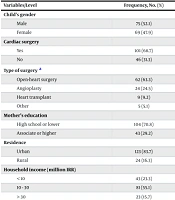
In this study, 147 children with congenital heart disease (52.1% boys and 47.9% girls) along with their mothers participated. More than two-thirds of the children had a history of cardiac surgery, which was mostly performed as open-heart surgery (63.3%) or angioplasty (24.5%). The majority of families were urban residents (83.7%), most parents were married (91.8%), and about seventy percent of mothers had a high school diploma or lower education (Table 2).
Table 2.
Demographic Characteristics of Participants
| Variables/Level | Frequency, No. (%) |
|---|---|
| Child’s gender | |
| Male | 75 (52.1) |
| Female | 69 (47.9) |
| Cardiac surgery | |
| Yes | 101 (68.7) |
| No | 46 (31.3) |
| Type of surgery a | |
| Open-heart surgery | 62 (63.3) |
| Angioplasty | 24 (24.5) |
| Heart transplant | 9 (9.2) |
| Other | 5 (5.1) |
| Mother’s education | |
| High school or lower | 104 (70.8) |
| Associate or higher | 43 (29.2) |
| Residence | |
| Urban | 123 (83.7) |
| Rural | 24 (16.3) |
| Household income (million IRR) | |
| < 10 | 43 (23.3) |
| 10 - 30 | 81 (55.1) |
| > 30 | 23 (15.7) |
| Parental marital status | |
| Married | 135 (91.8) |
| Divorced/widowed | 12 (8.2) |
a Percentage calculated out of those with history of heart surgery.
The mean score of children’s sleep disorders according to the CSHQ was 48.3 ± 7.2, indicating a considerable level of sleep problems in this group. The mean scores for parental stress, anxiety, and depression were as follows:
4.1.1. Parental Stress Effect on Sleep Disorders
Statistical findings showed that parental stress had a significant correlation with children’s sleep disorders (r = 0.28, P = 0.001). Parental anxiety showed the strongest association with child sleep disorders (r = 0.36, P < 0.001), and depression was also significantly correlated with the child’s overall sleep disorder score (r = 0.25, P = 0.003) (Table 3).
Table 3.
Summary Statistics of Main Variables (Mean ± SD)
| Variables | Correlation Coefficient with Child Sleep Disorder | P-Value |
|---|---|---|
| Parental stress | 0.28 | 0.001 |
| Parental anxiety | 0.36 | < 0.001 |
| Parental depression | 0.25 | 0.003 |
4.1.2. Parental Anxiety Effect on Sleep Disorders
In the multivariate linear regression model, where demographic variables were entered, only parental anxiety remained as the strongest predictor of children’s sleep disorders (β = 0.36, P < 0.001). Other individual characteristics of the child, such as age and gender, and demographic variables like income, parental education level, or marital status, did not have a statistically significant impact on child sleep disorders. However, rural residence, low income, and parental divorce were associated with increased child sleep problems. None of the studied variables showed a significant association with the subscale “sleep disordered breathing” in children (Table 4).
Table 4.
Correlation Coefficients Between Parental Psychological Health Variables and Child Sleep Disorders
| Variables | Correlation Coefficient with Child Sleep Disorder | P-Value |
|---|---|---|
| Parental stress | 0.28 | 0.001 |
| Parental anxiety | 0.36 | < 0.001 |
| Parental depression | 0.25 | 0.003 |
5. Discussion
In this study of 147 children with CHD and their mothers, we found a substantial prevalence of sleep problems, with a mean CSHQ score of 48.3 ± 7.2. More than two-thirds of the children had undergone cardiac surgery, primarily open-heart procedures, and most families resided in urban areas. Psychological assessment of parents revealed mean DASS-21 scores of 12.5 for stress, 11.7 for anxiety, and 10.2 for depression. All three psychological factors showed significant correlations with child sleep disorders, with parental anxiety demonstrating the strongest association (r = 0.36, P < 0.001) and remaining the only significant predictor after multivariate adjustment. Certain socio-demographic factors, including rural residence, low income, and parental divorce, were associated with higher sleep problem scores.
Sleep disturbance in CHD is a multifactorial condition potentially influenced by both physiological and psychosocial mechanisms (14). Increased parenting stress, particularly in early life, is linked to subsequent child anxiety and difficulties with sleep regulation (16). Bishop reported reciprocal interactions between parenting stress, poor sleep quality in children, and impaired emotional regulation, reinforcing the bidirectional nature of parent-child sleep dynamics in CHD populations (17).
The role of the broader family environment, as highlighted in the American Heart Association scientific statement (2021), is also evident in our results, which position parental anxiety as a key driver of sleep disturbances (4). Elevated parental stress and maladaptive coping strategies could affect neurodevelopment in CHD infants, indirectly disrupting sleep patterns (12). Our data strengthen this link, suggesting that anxiety, more than stress or depression, may generate hypervigilant caregiving behaviors that hinder children’s ability to develop consistent and independent sleep routines.
However, our results diverge from studies emphasizing physiological contributors to sleep disorders (10, 15) that identify obstructive sleep apnea (OSA) and cardiopulmonary limitations as primary factors affecting sleep in CHD. In our cohort, no meaningful association emerged between any measured variables and the sleep disordered breathing subscale. This suggests that, at least in our setting, psychosocial risk factors may play a more prominent role in most sleep problems than physiological ones. Variations in CHD severity, age distribution, and surgical correction rates likely contribute to these observed differences across studies.
An innovative element in our study is the identification of socioeconomic and marital instability as correlates of poor sleep, even after accounting for medical variables. While not extensively studied in CHD populations, this finding resonates with the general pediatric literature linking poverty, rural residence, and family disruption with increased bedtime resistance, irregular sleep schedules, and nighttime awakenings. Our results suggest that these contextual stressors may exacerbate the psychological burden on parents, further influencing child sleep quality. Integrating psychosocial screening into routine pediatric cardiac care is recommended (10, 13). Early identification and targeted intervention for parental anxiety could yield dual benefits: improving parental mental health and fostering healthier sleep patterns in children, thereby supporting optimal neurodevelopmental trajectories (8). Although further longitudinal and multicenter studies are needed, our results highlight the pressing need for multidisciplinary care models that include psychological services for parents of children with CHD.
Despite efforts to conduct all research stages with precision, the present study faced limitations that may affect the generalizability or interpretation of its results. One of the most important limitations was the lack of presence of some mothers with their child at the time of completing the questionnaires; in some cases, mothers were not present when the child visited the treatment center, which limited the collection of data related to parental psychological status. Additionally, incomplete cooperation of some participants in responding to the questionnaires was another challenge. Some respondents lacked sufficient willingness or patience to answer thoroughly, which impacted the quality of the collected data. Moreover, a number of questionnaires were partially completed, requiring follow-up or, in some cases, leading to their exclusion and a reduction in the effective sample size. Finally, some mothers were unwilling to answer self-report questionnaires (such as the DASS-21) in the presence of their child; some felt discomfort or preferred not to respond, which could influence the honesty and accuracy of responses, and this should be considered when interpreting the results.
In summary, our findings demonstrate that sleep disturbances are highly prevalent among children with CHD and are influenced more strongly by psychosocial than physiological factors in this cohort. Parental anxiety emerged as the most robust predictor of child sleep problems, with additional contributions from socioeconomic disadvantage and family instability. These results highlight the importance of integrating routine psychosocial screening and targeted intervention, particularly for parental anxiety, into pediatric cardiac care. Such an approach may simultaneously improve parental mental health, enhance children’s sleep quality, and support better neurodevelopmental outcomes, underscoring the need for multidimensional, family-centered care models.
5.1. Recommendations
It is recommended that psychological counseling and educational workshops for parents aimed at reducing anxiety, stress, and depression, as well as strengthening parenting skills, be implemented in treatment centers. Screening the mental health of parents and paying special attention to low-income families is also advised, as these factors are associated with more severe sleep problems in children. Providing psychotherapy services, especially cognitive-behavioral therapy (CBT), and collaboration between pediatric cardiologists and psychologists is of considerable importance. Furthermore, the development of clinical guidelines for the management of children’s sleep disorders that take parental psychological status into account, as well as the design of future prospective studies to evaluate the effectiveness of such interventions, are strongly recommended.
5.2. Conclusions
According to the results of this study, parental anxiety, stress, and depression, especially anxiety, are significant predictors of sleep disorders in children with congenital heart disease. Therefore, improving parental mental health and providing regular psychological and supportive services could enhance sleep quality and improve the physical, psychological, and behavioral well-being of these children. It is recommended that the treatment team consider the integration of psychological interventions as an inseparable part of the care process for these patients and their families.