
1. Background
Neonatal abstinence syndrome (NAS), more recently termed neonatal opioid withdrawal syndrome, is a growing public health concern resulting from in utero opioid exposure (1, 2). Affected newborns may develop neurologic, gastrointestinal, and autonomic symptoms that often require prolonged hospitalization and pharmacologic treatment (3, 4). Despite advances in the management of maternal opioid use disorder, the incidence of opioid exposure among infants remains substantial, placing a considerable burden on neonatal intensive care resources. Morphine and methadone remain the most commonly used first-line pharmacologic therapies; however, evidence regarding their comparative effectiveness in reducing treatment duration and hospital length of stay remains mixed. Recent studies suggest that outcomes may be influenced by medication choice, gestational age, polysubstance exposure, adjunctive therapies, feeding difficulties, and nonpharmacologic care models such as Eat, Sleep, Console. Contemporary research has demonstrated that ESC-based care and family-centered interventions can reduce pharmacologic treatment requirements and shorten hospitalization, highlighting the need to evaluate pharmacologic treatments while accounting for important clinical confounders (5, 6). Further investigation of treatment outcomes among opioid-exposed newborns receiving methadone or morphine remains clinically relevant and may help optimize treatment protocols for this vulnerable population.
2. Objectives
This study aimed to compare methadone and morphine for symptom control and treatment duration and to evaluate demographic and clinical factors affecting outcomes.
3. Methods
3.1. Study Design and Setting
This prospective comparative clinical study evaluated methadone and morphine for NAS during 2024 - 2025 at Mahdiyeh Hospital, Tehran, Iran. The clinical trial registration number was IRCT20260329069018N1. The study was approved by the Deputy of Education at Shahid Beheshti Medical School on July 7, 2024. Pharmacologic treatment was initiated after two assessments with Finnegan scores ≥ 8, performed 3 - 4 hours apart. Newborns were alternately assigned to receive methadone or morphine. The principal researcher developed inclusion criteria to select comparable groups of neonates, including those with similar family socioeconomic backgrounds. The physician on duty assigned treatment alternately as patients were recruited.
3.2. Participants
Neonates with a gestational age ≥ 34 weeks who were diagnosed with NAS were eligible. Neonates with major congenital anomalies and those requiring neonatal intensive care and respiratory support from birth were excluded.
3.3. Diagnosis
Diagnosis was based on maternal history, toxicology, and a Finnegan score ≥ 8.
3.4. Intervention
Morphine was administered at 0.04 mg/kg every 3 - 4 hours, up to a maximum of 0.2 mg/kg. Methadone was administered at 0.05 - 0.1 mg/kg every 6 hours and titrated as needed. Doses were adjusted according to the neonate's clinical condition. If symptoms worsened after dose reduction, the dose was increased accordingly.
For morphine treatment, neonates with Finnegan scores of 9 - 12 received an initial morphine sulfate dose of 0.04 mg/kg; those with scores of 13 - 16 received 0.08 mg/kg; those with scores of 17 - 20 received 0.12 mg/kg; those with scores of 21 - 24 received 0.16 mg/kg; and those with scores above 24 received 0.2 mg/kg. The initial morphine dose was repeated every 3 - 4 hours, coinciding with feeding. If the withdrawal score remained below 9 for more than 48 hours, the dose was reduced by 10% every 24 hours until treatment was discontinued. Dose adjustment continued until clinical improvement allowed progressive dose reduction without further increases.
The initial oral methadone dose was 0.05 - 0.1 mg/kg every 6 hours. Depending on the severity and persistence of symptoms, the dose was increased by 0.05 mg/kg per dose, or the dosing interval was shortened from every 6 hours to every 4 hours. In asymptomatic neonates, methadone was weaned by reducing the dose by 10% - 20% or extending the dosing interval, with adjustments every 1 - 2 days. Methadone was discontinued when the dose reached 0.05 mg/kg/day.
Treatment adherence was ensured for all participating neonates. No protocol deviations or crossover between treatment groups occurred.
3.5. Second-Line Therapy
In cases of severe withdrawal, predominantly characterized by gastrointestinal symptoms, phenobarbital was administered at a loading dose of 10 - 20 mg/kg, followed, if needed, 8 - 12 hours later by 3 - 4 mg/kg/day divided into one or two doses. Treatment duration was also longer in these cases.
Phenobarbital was used as a second-line medication in neonates with severe withdrawal symptoms who did not respond adequately to first-line pharmacologic treatment. The loading dose was 10 - 20 mg/kg and was administered intravenously, orally, or intramuscularly, depending on symptom severity. If symptoms persisted, the loading dose was repeated 8 - 12 hours after the initial administration, up to a maximum cumulative loading dose of 40 mg/kg. Subsequent maintenance doses were 3 - 4 mg/kg/day, divided into one or two doses. Phenobarbital weaning began after the first-line medication was completely discontinued, with daily dose reductions of 10% - 20%.
Decisions to administer phenobarbital were based on withdrawal severity, including tremors, irritability, excessive crying, sleep disturbance, feeding difficulties, vomiting or diarrhea, and autonomic signs. Other considerations included the need to escalate medication because of an inadequate response to opioid therapy, possible concurrent exposure to other substances, and the infant's clinical condition.
3.6. Data Collection and Outcome Definition
Demographic, clinical, and outcome data were collected. Neonates with incomplete data were excluded from the final patient count. No nonpharmacologic care was provided or evaluated in this study. Treatment began when the neonate was referred to the hospital and diagnosed with NAS. The primary outcome was treatment duration, measured from treatment initiation to cessation, when the neonate was clinically stable. Actual hospital discharge dates were not used to define this outcome. Because most neonates did not have a stable home to return to, discharge often occurred several days after treatment ended.
Clinical discharge criteria required the neonate to feed well and have no clinically adverse findings 24 hours after medication cessation. Discharge decisions were made by the physicians who had admitted the patients; these physicians were not necessarily members of the research team.
There were no transfers, readmissions, deaths, or withdrawals from care among participating neonates. Nonmedical discharge delays were common, but the study outcome ended when treatment was no longer required.
No treatment-emergent adverse events occurred in either group. The seizures and fever reported in Table 2 were presenting or baseline findings. All neonates recovered from NAS, and no deaths occurred. No respiratory depression, oversedation, bradycardia, treatment discontinuation, or transfer to intensive care occurred.
Table 2.
Baseline Characteristics of the Two Treatment Groups (N = 158) a
| Characteristic | Methadone (n = 89) | Morphine (n = 69) |
|---|---|---|
| Gestational age, wk | 36.82 ± 2.17 | 37.06 ± 2.15 |
| Birth weight, g | 2748 ± 556 | 2724 ± 460 |
| Gender | ||
| Female | 41 (46.1) | 31 (44.9) |
| Male | 48 (53.9) | 38 (55.1) |
| Marked irritability | 84 (94.4) | 64 (92.8) |
| Seizure | 0 (0.0) | 2 (2.9) |
| Diarrhea | 1 (1.1) | 3 (4.3) |
| Fever | 0 (0.0) | 1 (1.4) |
| Milk intolerance | 19 (21.3) | 15 (21.7) |
| Phenobarbital use | 17 (19.1) | 43 (62.3) |
| Polysubstance exposure | 14 (16) | 17 (25) |
| Initial treatment dose | 0.182 ± 0.072 | 0.270 ± 0.093 |
| Initial dosing interval, h | 6.16 ± 1.05 | 5.42 ± 1.85 |
a Values are expressed as mean ± SD or No. (%). Abbreviation: SD, standard deviation.
Intention-to-treat principles were followed: all participants who were alternately assigned to each treatment were included in the analysis according to their original treatment assignment.
Of the 126 cases included in the model, 70 were in the methadone group, with a total loss of 22% because of incomplete data, and 56 were in the morphine group, with a total loss of 38% because of incomplete data.
3.7. Statistical Analysis
Analyses were performed using SPSS version 25 and included t tests, analysis of variance, and multivariable linear regression. P < 0.05 was considered statistically significant. Baseline covariates included birth weight, gestational age, and milk intolerance, which was measured before assignment. Phenobarbital was administered after assignment.
The sample-size calculation for comparing two independent means assumed a standard deviation of 4 days, a 1:1 allocation ratio, a two-sided significance level of 0.05, and 80% statistical power. The required sample size per group was:
where Δ = anticipated difference between groups = 2 days; σ = assumed standard deviation = 4 days; Z (1-α/2) = 1.96 for α = 0.05; Z(1-β) = 0.84 for 80% power.
Approximately 63 participants per group, or 126 in total, were required before accounting for missing data or withdrawal. Allowing for an anticipated rate of 10% missing data or withdrawal increased the target to approximately 70 participants per group. The study recruited 90 neonates for each treatment group. However, missing data resulted in losses of 1 (1%) in the methadone group and 21 (77%) in the morphine group. Further missing data identified during multivariable analysis led to additional exclusions.
The Consolidated Standards of Reporting Trials (CONSORT) 2025 flow diagram presents participant progress through enrollment, intervention allocation, follow-up, and analysis in this two-group parallel clinical trial (Figure 1).
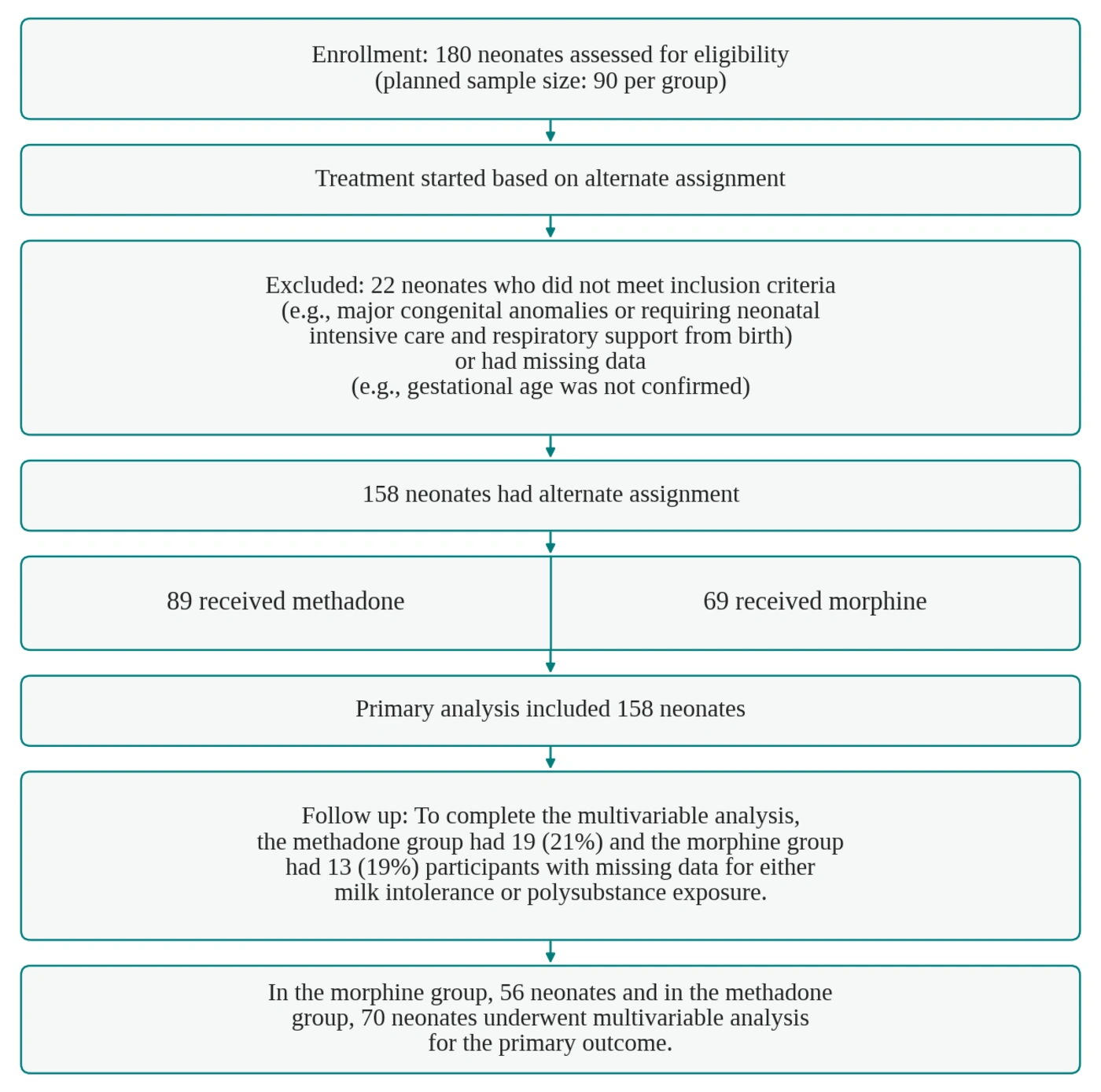
Figure 1.
Flowchart of participant enrolment, treatment allocation, and inclusion in the primary and multivariable analyses.
3.8. Ethical Considerations
This prospective comparative study used alternating allocation and followed CONSORT guidance for reporting parallel-group trials. The study was approved by the institutional ethics committee of Shahid-Beheshti University of Medical Sciences (IR.SBMU.MSP.REC.1404.742) and adhered to the institution's research guidelines, which are aligned with the Declaration of Helsinki. The rights and welfare of participating neonates were prioritized, including through informed consent procedures. Measures were taken to maintain confidentiality and data security.
3.9. Safety Monitoring
Both medication-related harms and complications of undertreated withdrawal were monitored. Cardiorespiratory events included apnea, slow or irregular breathing, oxygen desaturation, bradycardia, and any need for oxygen, stimulation, or respiratory support.
Excess sedation or impaired function was monitored, including unusual sleepiness, reduced arousability, poor tone, weak sucking, or feeding difficulty. This monitoring is particularly important with opioids and phenobarbital because phenobarbital can depress the central nervous system and impair sucking.
Intake, feeding assistance, vomiting or diarrhea, weight change, dehydration, and the need for intravenous fluids or other interventions were monitored. Withdrawal complications or rebound symptoms, including seizures, worsening symptoms during dose reduction, and symptom recurrence after treatment cessation, were also monitored.
4. Results
A total of 158 neonates treated for NAS were included in the analysis: 89 received methadone, with a mean treatment duration of 19.3 days, and 69 received morphine, with a mean treatment duration of 21.2 days. The primary outcome was treatment duration in days (Table 1). Although a 1:1 treatment allocation ratio was intended, missing data reduced the sample size. Variability was high in both groups, with standard deviations of 9.1 and 10 days, respectively. The unadjusted independent-samples t test showed that treatment lasted an average of 1.9 days longer in neonates receiving morphine; however, the difference was not statistically significant (P = 0.212).
Table 1.
Treatment Duration by Treatment Group (N = 158) a
| Treatment duration (d) | Methadone (n = 89) | Morphine (n = 69) | P value |
|---|---|---|---|
| Mean ± SD of treatment duration | 19.3 ± 9.1 | 21.2 ± 10.0 | 0.212 |
| Median treatment duration | 17 | 20 | — |
| Range | 7 - 50 | 8 - 51 | — |
a Abbreviation: n, number.
Baseline characteristics of the two treatment groups are presented in Table 2.
The primary multivariable analysis evaluated the independent association between treatment type and treatment duration, adjusting for gestational age, birth weight, milk intolerance, and polysubstance exposure, but not phenobarbital use. Morphine was associated with an estimated 2.05-day longer treatment duration than methadone, but this difference was not statistically significant (β = 2.05 days; 95% confidence interval [CI], −1.29 to 5.40; P = 0.229). In a sensitivity analysis additionally adjusted for phenobarbital use, the estimated treatment effect was attenuated and reversed in direction (β = −0.34 days; 95% CI, −3.70 to 3.01; P = 0.841). Thus, morphine remained unassociated with treatment duration compared with methadone.
Neonatal abstinence syndrome severity was not included in the adjusted model. However, most neonates with severe NAS also received phenobarbital.
Cases with missing data for variables such as milk intolerance or polysubstance exposure were excluded from the adjusted model (n = 126) (Table 3).
Table 3.
Treatment Associations with Treatment Duration in Adjusted Linear Regression Models (N = 126) a
| Model | Morphine vs Methadone β (d) | 95% CI | P value |
|---|---|---|---|
| Primary model: without phenobarbital | +2.05 | −1.29 to 5.40 | 0.229 |
| Multivariable regression: with phenobarbital | −0.34 | −3.70 to 3.01 | 0.841 |
a P values < 0.05 were considered statistically significant. Abbreviation: CI, confidence interval.
The primary-model coefficients for the remaining covariates were as follows: gestational age, β = 0.25 days/week (95% CI, −0.53 to 1.02; P = 0.534); birth weight, β = −0.00056 days/g (95% CI, −0.00364 to 0.00251; P = 0.720); milk intolerance, β = 0.36 days (95% CI, −3.53 to 4.26; P = 0.855); and polysubstance exposure, β = 2.11 days (95% CI, −1.43 to 5.64; P = 0.243).
Because phenobarbital use may be a consequence of NAS severity or treatment response after treatment assignment, it was not included as a baseline confounder in the primary model. Phenobarbital use was associated with longer treatment duration (β = 5.79 days; 95% CI, 2.33 to 9.24; P = 0.001). This association should not be interpreted as a causal effect of phenobarbital because it is susceptible to confounding by indication: phenobarbital was administered to neonates with more severe NAS at baseline.
In total, two neonates had seizures, and one had fever at presentation.
Including phenobarbital changed the treatment coefficient from +2.05 days to −0.34 days, a shift of approximately 2.40 days and a reversal in direction. This supports the concern that phenobarbital materially alters the estimated treatment effect and should not simply be included as a conventional baseline confounder.
The primary analysis population comprised neonates diagnosed with NAS. Participants were analyzed according to their original treatment assignment. Of the 126 cases included in the model, 70 were in the methadone group, with a 22% loss because of incomplete data, and 56 were in the morphine group, with a 38% loss because of incomplete data.
Because phenobarbital may have been initiated after treatment assignment in response to greater NAS severity or an inadequate treatment response, it was not considered a conventional baseline confounder. Therefore, the primary multivariable model adjusted for prespecified baseline or pretreatment covariates. A secondary sensitivity analysis additionally adjusted for phenobarbital use to assess the robustness of the estimated association between treatment and treatment duration.
Gestational age, birth weight, milk intolerance, and polysubstance exposure were not significantly associated with treatment duration after adjustment.
The association between neonatal sex and treatment duration was evaluated. There was no statistically significant difference in treatment duration between male and female neonates (P > 0.05) (Table 4).
Table 4.
Role of Sex in Treatment Duration (N = 158) a
| Effect | P value | Interpretation |
|---|---|---|
| Treatment (methadone vs morphine) | 0.212 | Not significant |
| Sex (female vs male) | 0.688 | Not significant |
| Treatment × sex interaction | 0.606 | Not significant |
a P values < 0.05 were considered statistically significant.
These findings suggest that, after adjustment for relevant neonatal and clinical confounders, methadone and morphine were associated with comparable treatment durations, whereas adjunctive phenobarbital therapy was associated with longer treatment duration.
5. Discussion
In this study, no statistically significant difference in treatment duration was found between neonates receiving methadone and those receiving morphine for NAS. Although treatment lasted slightly longer in the morphine group, with a mean difference of 1.9 days, this difference was not statistically significant and occurred alongside substantial variability. These findings suggest that the choice of opioid agent alone may not be a primary determinant of treatment duration.
A quality improvement study reported improved NAS outcomes after implementation of nonpharmacologic care, function-based assessment, and methadone treatment (7). A clinical report provides recommendations for managing infants with opioid exposure (8).
Recent evidence has increasingly highlighted the importance of nonpharmacologic interventions. Approaches such as rooming-in, breastfeeding, and caregiver engagement significantly reduce hospital length of stay, regardless of the pharmacologic agent (9, 10). The ESC model, in particular, has been associated with shorter hospitalization and a reduced need for pharmacologic therapy compared with traditional Finnegan-based approaches (11).
Disease severity and the need for adjunctive therapy are also key determinants of hospitalization duration. Infants requiring phenobarbital or exposed to multiple substances tend to have prolonged hospital stays (12). Previous studies have identified adjunctive pharmacologic therapy as one of the strongest predictors of increased length of stay, reflecting more severe withdrawal syndromes (13). In our study, the low explanatory power of treatment type (R2 ≈ 0.01) further supports the conclusion that factors beyond the primary opioid agent play a more significant role.
Pharmacokinetic differences between methadone and morphine have been proposed as a potential explanation for differences in outcomes. Methadone's longer half-life may provide more stable symptom control, whereas morphine requires more frequent dosing. However, comparative studies have not demonstrated consistent clinical superiority of either agent with respect to hospitalization duration (14).
5.1. Study Limitations
This study has several limitations. Despite its prospective design, missing data reduced the analyzable sample size; in some cases, such as those involving abandoned newborns, data collection was impossible. This reduced the power of the statistical analyses, limited causal inference, and introduced potential selection bias. Residual confounding is likely, particularly with respect to NAS severity and polysubstance exposure. No nonpharmacologic care was provided or evaluated, which should be considered when interpreting the findings. In addition, social determinants, such as caregiver readiness and discharge logistics, were not captured.
Despite these limitations, our findings contribute to the growing evidence that the overall model of care may be more important than the choice of opioid therapy alone. Future research should integrate pharmacologic and nonpharmacologic strategies within standardized care frameworks to better isolate treatment effects.
5.2. Conclusions
Methadone and morphine were associated with comparable treatment durations in neonates with NAS. Efforts to reduce treatment duration should prioritize optimizing supportive care and addressing clinical severity rather than focusing solely on the choice of opioid treatment.