1. Background
In recent years, due to the prevailing economic conditions, our country's hospitals, despite having an important role in promoting public health, are facing difficult conditions. This, coupled with the fierce competition from hospitals to attract the limited resources of insurance companies, has greatly reduced profit margins. On the other hand, due to various information sources, customers in the field of health services are very aware and armed with a variety of choices, they demand that every time they go to the hospital, they finally leave satisfied (1). In today's competitive environment, the importance of the health workforce and its nurses in the quantitative and qualitative development of health care systems is recognized. Following this, creating a positive organizational atmosphere to improve the productivity and performance of nurses seems necessary (2). Because a positive organizational climate can increase nurses' job commitment and reduce their intention to leave, creating an organizational climate that has a positive impact on the ethics, behavior and attitude of nurses is a major concern for the management of the health sector (3).
If organizations are able to create an organizational environment that is perceived as positive by employees, it is likely to increase the level of motivation, commitment and interaction of employees and ultimately lead to improved organizational performance (4).
In addition, the organizational climate that motivates and engages employees has a positive effect on organizational performance (5) Studies conducted at the organizational and team level have shown the positive effect of organizational climate on performance. Since when employees work in an environment where there is a sense of freedom in the performance of duty, they have more control over their ideas and work processes and improve their performance (6).
Organizational climate is described as repetitive models of behavior, attitude and emotions which identify the lifestyle in the organization and are most associated with organizational culture and values (7).
Farooqi (8) claimed that the organizational climate is a set of features that explain an organization and distinct it from the other organizations. Organizational climate is defined as a set of measurable features that personnel can understand directly or indirectly in their workplace.
In hospitals and health centers, nurses want to have better working conditions that make them feel valued while performing their duties. Unhealthy work environments are an important indicator of many adverse consequences for nurses, including burnout and dissatisfaction of job (9). Conversely, nurses who consider their work environment to be patronage and friendly are more probably to show positive behaviors and suitable performance (10).
Organizational climate is related to different kinds of organizational performance, particularly the performance of nurses. In the hospital environment, nurses' performance is identified as an important factor in providing qualitative medical services and its quantity and quality are considered as a main factor in employees' decisions like promotion and payment. Nurses' performance is defined as how to perform their duties and responsibilities effectively in accordance with established standards. The performance of nurses in the form of patient care has been the core of the hospital. Therefore, how nurses work in achieving the goals and mission of an organization is essential. Patients want the ideal treatment; they want their nurse to be learned, expert, competent, and compassionate and humane. These features make them feel safe and comfortable. By analyzing the performance of nurses and identifying their educational needs, nurses' competence can be improved (11). Also, repeated measurement of nurses' performance produce a health care system that present efficient, effective and high performance (12).
In this regard, Rubel et al. (13) stated that organizational climate minimize turnover intention. organizational climate also has a substantial influence on both employee performance and turnover intention. Li et al. (14) in order to improve the performance of nurses, Reduce turnover and increase job satisfaction hospital managers should Increase the level of participation in teamwork, participation in decision making and access to information and resources in nurses. Also, another study was conducted in Egypt to investigate the relationship between organizational climate and job consequences of nurses and discovered that organizational climate is related to nurses' job performance outcomes (15).
2. Objectives
According to the above, the purpose of this study is to investigate the relationship between organizational climate and job performance of nurses in private hospitals in Rasht in 2019.
3. Methods
This descriptive-analytical study was conducted in the first six months of 2019 in private hospitals in Rasht. Due to the legal restrictions on obtaining the necessary permits, public hospitals have not been considered in this study. The statistical population of this study is 112 nurses working in the pediatric ward of private hospitals in Rasht, including Golsar, Pars, Ghaem and Aria hospitals. Due to the limitations of the statistical population, the census method was used to select the respondents. For this purpose, a meeting was held with the management of these hospitals and the reason for the research was agreed upon. Then, by holding a training session with the head nurses of the pediatric ward of the mentioned hospitals, they were taught how to complete the performance evaluation checklists of the nurses. Finally, out of the total number of distributed questionnaires, 108 questionnaires were used according to the cooperation.
The questionnaire used in the present study includes three sections: personal and job characteristics, organizational climate and performance evaluation of nurses. The first section take into account the personal and occupational features of the study sample including age, sex, marital status, education and work experience. The second part of the questionnaire in the form of Martin (2006) organizational climate questionnaire evaluates this variable in the concerned hospitals. This section included ten areas related to work-related facilities, nurses' interests, team building, decision-making, participation, communication, customer service, hospital credibility, employees' relations, and payments. The organizational climate questionnaire is assessed using the 5-point Likert scale. The score obtained varies from 30 - 150, and obtaining a score of at least 60% is considered as a criterion for positive evaluation of organizational climate.
In the third part of the nurses' performance evaluation, the Cobb observational checklist (2008) was used. This checklist includes 60 items that are grouped into four areas of concerned hospital behavior (25 cases), nursing process (18 cases), quality of care (13 cases) and education (four cases). This assessment of nurses' performance is also measured on a 5-point Likert from unacceptable (1) to outstanding (5). The scores can be obtained on this scale vary between 60 and 300. A score of at least 60% will be the criterion for a positive evaluation of nurses' performance. This checklist was completed by the head nurses of the pediatric ward of the researched hospitals in July 2019. Validity and reliability research tools were used to ensure accuracy. Content validity ratio (CVR) and content validity index (CVI) were used to assess the validity of the questionnaire. The validity of the measuring instrument was confirmed according to the obtained values for these two indicators (CVR = 0.82) and (CVI = 0.71). Cronbach's alpha index was also used to measure reliability, which was confirmed by 81.81%. After collecting the data, the normality of the observations was first confirmed using the Kolmogorov-Smirnov test. Then descriptive statistics methods were used to describe the research variables in terms of criteria such as mean, standard deviation and variance. In order to test the research hypotheses, inferential statistics in the form of variance one-way analysis, t-test with two independent samples and Pearson correlation coefficient were utilized using SPPSS24 software. It is noteworthy that ethical considerations were observed throughout the research.
4. Results
Findings obtained from the study show that out of 108 subjects studied, most of the respondents (87%) were female in terms of gender. Also, in terms of age range, nurses over 40 years old (56%) formed the majority of the sample. Also, in terms of marital status, the majority of the sample of the study (85%) and the highest level of education of the respondents (77%) were bachelor. In addition, the highest percentage of participants in this study (49%) has 20 to 30 years of work experience. Finally, in terms of the type of employment, nurses were in the first rank with a plan-contract employment rate of 52%. Demographic information of nurses is shown in Table 1.
Table 1.
Demographic Characteristics of Nurses in the Sample
| Variable & Grouping | Frequency (%) |
|---|---|
| Gender | |
| Man | 13 (0.13) |
| Female | 95 (0.87) |
| Age | |
| > 30 | 18 (0.16) |
| 30 > 40 | 32 (0.30) |
| ≤ 40 | 58 (0.54) |
| Marital status | |
| Married | 91 (0.85) |
| Single | 16 (0.15) |
| Education | |
| Diploma & associate degree | 12 (0.11) |
| Bachelor | 83 (0.77) |
| Masters | 11 (0.10) |
| PhD | 2 (0.02) |
| Work experience | |
| > 10 | 9 (0.08) |
| 10 > 20 | 22 (0.2) |
| 20 > 30 | 62 (0.58) |
| ≥ 30 | 15 (0.14) |
| Employment type | |
| Official | 18 (0.16) |
| Contract | 35 (0.32) |
| Work plan - contract | 55 (0.52) |
Table 2 showed the organizational climate perceived by nurses. In this table, it is mentioned that more than half of the nurses (66 people) with a mean score (93.1 ± 17.1) have a positive perception of the organizational climate in the mentioned hospitals. Among the items in this section, customer service with an average score (12.15 ± 2.25) is in the first category, followed by the hospital reputation (10.23 ± 3.11) in the second category, while the payment variable for service compensation has an average score (2.08 ± 5.37) in the last row.
Table 2.
Perceived Organizational Climate According to Nurses (108 People)
| Perceived Organizational Dimensions | Positive Perception of Organizational Climate, No. (%) | Min | Max | Mean ± SD |
|---|---|---|---|---|
| Customer service | 40 (37.03) | 4 | 14 | 12.21 ± 2.25 |
| Hospital reputation | 24 (22.22) | 4 | 15 | 10.23 ± 3.11 |
| Work facilities | 35 (32.4) | 3 | 15 | 10.9 ± 2.43 |
| Participation | 21 (19.44) | 3 | 14 | 9.25 ± 2.98 |
| Communication | 29 (26.85) | 3 | 15 | 9.02 ± 3.76 |
| Interpersonal relationships | 28 (25.92) | 4 | 15 | 8.22 ± 3.11 |
| Nurses' interests | 23 (21.29) | 4 | 15 | 7.05 ± 2.09 |
| Team building | 15 (15.5) | 5 | 14 | 6.78 ± 2.45 |
| Decision making | 16 (13.88) | 3 | 15 | 6.32 ± 3.11 |
| Compensation payments | 12 (11.11) | 3 | 15 | 5.37 ± 2.08 |
| Total | 66 (61.11) | 43 | 134 | 93.1 ± 17.26 |
Table 3 showed job performance between the nurses. It should be pointed out that less than one third of the nurses had a decent area of performance (179.67 ± 16.37). Among the performance indicators, the expected behavior of the hospital with an average score (73.41 ± 12.02) is in the first place and education with an average score (21.91 ± 7.49) are in the last rank. Table 3 presents the relationship between nurses' performance level and their personal and occupational characteristics. As it was observed that there is a significant relationship between nurses' performance levels and their individual and professional features.
Table 3.
Relationship between Nurses' Average Score of Organizational Climate and Their Personal and Professional Characteristics
| Personal and Professional Characteristics | Organizational Climate | ||
|---|---|---|---|
| Mean ± SD | Statistics | P | |
| Gender | |||
| Man | 92.5 ± 17.12 | t = 1.69 | 0.002 |
| Female | 105.8 ± 16.96 | ||
| Age | |||
| > 30 | 95.12 ± 15.28 | ||
| 30 > 40 | 87.95 ± 19.57 | F = 2.37 | 0.031 |
| ≤ 40 | 97 ± 15.72 | ||
| Marital status | |||
| Married | 93.07 ± 18.01 | t = 2.59 | 0.000 |
| Single | 96.57 ± 19.8 | ||
| Education | |||
| Diploma & associate degree | 94.02 ± 11.21 | ||
| Bachelor | 94.05 ± 19.76 | F = 0.543 | 0.041 |
| Masters | 8922 ± 13.28 | ||
| P.H.D | 88.01 ± 16.39 | ||
| Work experience | |||
| > 10 | 87.23 ± 18.21 | ||
| 10 > 20 | 79.38 ± 16.34 | F = 2.117 | 0.003 |
| 20 > 30 | 89.17 ± 17.78 | ||
| ≥ 30 | 86.09 ± 18.89 | ||
| Employment type | |||
| Official | 81.34 ± 16.89 | ||
| Contract | 85.39 ± 18.21 | F = 2.438 | 0.000 |
| Work plan - contract | 79.09 ± 19.21 | ||
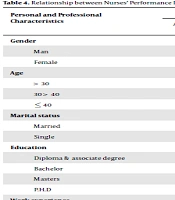
Table 4 shows the relationship between the average perceived organizational score of nurses and their personal and occupational characteristics. As shown in the table, the highest mean scores obtained from the perceived organizational climate in female nurses and women over 40 years of age who had 20 to 30 years of work experience and contract employment status and bachelor's degree. Also, the relationship between the mean perceived organizational score of nurses and their personal and occupational characteristics is statistically significant. Table 4 shows the relationship between organizational climate and nurses' job performance. According to the data in the table, it can be deduce that there is a statistically significant relationship between nurses' perceptions of organizational climate and their job performance (P ≤ 0.048).
Table 4.
Relationship between Nurses' Performance Levels and Their Personal and Professional Characteristics
| Personal and Professional Characteristics | Nurses' Performance Levels | |||
|---|---|---|---|---|
| Acceptable Performance (32) Frequency (%) | Unacceptable Performance (76) Frequency (%) | Statistics | Sig | |
| Gender | ||||
| Man | 1 (7.69) | 12 (92.31) | t = 2.37 | 0.041 |
| Female | 31 (32.63) | 64 (67.37) | ||
| Age | ||||
| > 30 | 10 (55.55) | 8 (44.45) | ||
| 30 > 40 | 8 (25) | 24 (75) | F = 8.44 | 0.000 |
| ≤ 40 | 18 (31.03) | 40 (68.97) | ||
| Marital status | ||||
| Married | 21 (23.07) | 70 (76.93) | t = 2.62 | 0.003 |
| Single | 11 (68.75) | 5 (31.25) | ||
| Education | ||||
| Diploma & associate degree | 3 (25) | 9 (75) | ||
| Bachelor | 11 (13.25) | 72 (86.72) | F = 8.42 | 0.004 |
| Masters | 8 (80) | 2 (20) | ||
| P.H.D | 2 (100) | 0 (0) | ||
| Work experience | ||||
| >10 | 3 (33.33) | 6 (66.67) | ||
| 10 > 20 | 7 (46.66) | 15 (53.34) | ||
| 20 > 30 | 18 (29.04) | 44 (70.96) | F = 6.11 | 0.029 |
| ≥ 30 | 4 (26.66) | 11 (73.34) | ||
| Employment type | ||||
| Official | 8 (44.44) | 10 (55.56) | ||
| Contract | 15 (42.85) | 20 (57.15) | F = 3.98 | 0.031 |
| Work plan - contract | 9 (16.36) | 46 (83.64) | ||
5. Discussion
Organizational climate reflects the behavior and emotions of employees towards the work environment. Creating a positive climate in the organization is the key to success and progress of the organization and is fundamental to obtain the desired level of nurses' performance (16). Therefore, the current study investigates the relationship between nurses' perceptions of organizational climate and their performance.
Findings showed that nurses evaluated the dimensions of organizational climate, customer service, hospital reputation and work facilities as positive and the decision-making, team building and payments for service compensation as negative. Also, the findings showed that more than half of the nurses inferred a positive organizational climate. In this context, Zhang and Liu suggested that the organizational climate is a measurable feature that staff inferred in their workplace (7). Abd El-Megeed and Ahmed also came to the conclusion that ideal morale and association and humane behavior among nurses indicate a light and positive organizational climate (17). Prior researchers have also discovered that organizational support, participatory workplace, and equitable rewards are indexes of a positive perceived organizational climate (18-20).
As mentioned earlier, nurses had the maximum average score for customer service, which indicated they respected patients and presented them with quick and efficient service.
These findings are consistent with Wu and Norman (21) and Abd El-shafy, who suggested that nurses interact well with patients and the others people (22).
In contrast, the lowest average point was considered for payment of service compensation. This showed that most nurses stated that they did not have adequate score and fair salaries compared with other hospitals. The results of the study are in accordance with Aiken et al., Who based on a study of the workplace of nurses in 12 European countries concluded a high percent of nurses had a positive view of the organizational climate (10). In addition, the results of the study were consistent with El-Ghabbour; who discover that nurses perceive their organizational status positively (20). These results are consistent with the results of San Giacomo (23) and Mrayyan (24). Conversely, Van Bogaert et al, stated nurses were dissatisfied with their workplace (24). In addition, El-Salam et al. suggested that most nurses working in various units understand an average organizational climate (25).
This study also showed that less than one third of nurses have a high level of performance. Meanwhile, most of them have an unacceptable level of performance, which is somewhat consistent with Atia studies (26). Regarding the areas of performance, the research findings showed that based on the average score obtained, the expected behavior of the hospital, nursing process, quality of care and education are in the first to fourth ranks, respectively. This level of poor performance indicates that most nurses need training to improve their performance and change their attitude in order to increase the quality of care provided to patients. This is in line with the results of Fathi's research, who claimed the quality of nurses' performance is under the influence by the absence of training and instruction in performing their duties (27). In this regard, Ali clarified that education and development as well as the supportive organizational climate is urgent requirements for improving the performance of nursing staff (28).
The present study noted: Married and elderly nurses who have experience and level of undergraduate education have statistically significant difference better performance than other nurses. The reason for this is that this category of nurses has worked in the hospital for a long time and has enough knowledge and skills to improve performance. This result is consistent with the results of Rubel et al.'s research, who claimed that nurses with years of nursing experience have a high performance due to the expertise and knowledge gained (13). This is consistent with the results of Asgari et al. research who claimed that there is a significant relationship between performance level and nursing competence. In this way, nurses with higher education compared to nurses with lower education, generally have a higher level of performance (29). In addition, the positive relationship between age and performance was consistent with the findings of Serra who demonstrated that there is a positive statistical relationship between nurses' age and their performance (30). Atia also discovered that older nurses have more experience in providing nursing care to patients with serious illness. In addition, they had more confidence in pursuing and enforcing nursing care standards (26).
In addition, the results of the study show that there is a significant positive relationship between nurses' inference of climate and their performance. This result is consistent with the results of the study of Mohamadzadeh Nojehdehi et al. who compared the relationship between organizational climate and nurses' leave intention to their jobs in various hospitals and stated that organizational climate is an important issue in increasing the quality of performance and achieving the goals of hospitals (31). Also, Sonmez et al. stated that a positive work climate motivates employees and leads them to use all their capacity and abilities to perform work duties. As a result, it leads to better job performance (2). This claim is also confirmed by Ghosh and Awad (6, 9). They argued that when an organization that has a positive work climate and seeks to raise the effectiveness of its staff with the help and support, it can expect to see its employees more satisfied and committed to the organization (32). This is in line with the opinion of Bahramia et al (33). Mohamed also indicated that a favorable workplace reflects the loyalty of employees to the organization and their high efficiency in performing their duties (32). In other studies, researchers have found positive relationship between organizational climate and employee performance (30).
Kabeel et al., on the other hand, found that an unhealthy climate was detrimental to nurses' performance in providing quality services to patients (34). Finally, Ali (28); and Abdollah Mohamad and Gaballah (15) ensured that the favorable organizational conditions that support employees and provide good working conditions for them lead to job satisfaction and as a result can lead to a top level of performance and consequently can have a high level of performance.
5.1. Conclusions
The present study concludes that there is a significant positive relationship between nurses' perceptions of the organization and job performance. According to many researchers, the prevailing climate in the work environment is a factor that affects performance. As a result, hospital managers must create a positive work environment in which nurses are allowed to generate ideas, increase teamwork and creativity, and lead nurses' performance to a high level of set standards. Finally, some suggestions are made to improve the performance of nurses as follows:
(1) All levels of health managers from the executive director to the team leader must strive to create a typical work environment which values nurses and empowers them.
(2) Using efficacious and infallible leadership styles that pays- attention for nurses' recognition, encouragement, appreciation and professional development - they have proved satisfactory impact on improving work climate.
(3) Clarity, support and challenge should be taken into consideration as a crucial motivational behavior in fostering nurses' performance.
(4) The nurse's competence can be improved by frequent measurement of nurses' performance and the identification of training needs to improve poor areas of performance.
(5) Reward and sanction system in hospitals should be applied as a main component of nurse motivation.
(6) Further research must be carried out by the scholars in this scope from other points of view considering the impact of any other overlapping variables.