


1. Background
Human resources are an essential factor in every organization in terms of the power of thinking, creativity, and innovation. Humans implement productivity, change, and improvement in technical and organizational systems and processes. Utilizing the intellectual capacity and capabilities of organizational employees, also known as the ‘hidden capital’, requires developing structures to direct their abilities and achieve current and future organizational goals (1). On the other hand, communication may take many forms in an organization, such as verbal, written, and physical communication. If such communications are blocked or disrupted, the flow of information and experiences to achieve organizational goals will stop, thereby leading to an organizational behavior phenomenon known to experts as organizational silence (2).
Organizational silence refers to a phenomenon where employees ignore issues such as illegal/immoral activities, disrespect, and disregard for legal standards within the organization, showing no reaction. Organizational silence could cause numerous problems and destroy an organization in the face of obstacles. Therefore, one of the most critical challenges in today's organizations is breaking the silence and encouraging employees to express their opinions and views on vital issues (3). Different motivations of employees could create three types of organizational silence. The first type is acquiescent silence, which signals withdrawn behavior and is more passive than active. Acquiescent silence is the passive acceptance of the current situation, with employees surrendering to the current situation without making an effort to change the situation. Defensive silence is another form of organizational silence, which is caused by the feeling of fear. Consequently, employees refuse to offer ideas and opinions in order to protect themselves. This is considered a passive silence, adopted as a strategy by an employee. The third type of organizational silence is altruistic silence, which causes employees to refuse to express their ideas with altruistic and cooperative motives. Altruistic silence is focused on others (4).
An organizational manager attempts to increase the institution's prosperity by creating a sustainable competitive advantage through improving organizational performance. Performance evaluation is essential to organizational survival. The primary reason for evaluating and measuring organizational performance is to increase the overall efficacy and business processes of the organization. Performance evaluation also allows managers to focus on the areas that need improvement (5).
Hershey and Goldsmith identified some of the influential factors in organizational performance and productivity, which included seven crucial dimensions of motivation, decision validity, job recognition, environmental compatibility, administrative support, performance feedback, and ability. These factors are divided into individual characteristics (motivation and ability) and organizational environment characteristics (administrative support, job recognition, and environment/performance evaluation). In this context, ability refers to the knowledge and skills of employees, which enable a task to be accomplished. Clarity refers to understanding and accepting processes and mechanisms. The help dimension expresses that employees need help and support from the organization to perform efficiently. Incentive (motivation) refers to the reasons behind employees’ tasks or the motivation to complete a specific task successfully. Evaluation refers to daily and periodic performance feedback, and credit feedback reflects the managers’ decisions regarding human resources, which should be aligned with organizational policies. Finally, the environment refers to the external factors that affect organizational performance despite having ability, clarity, support, and motivation (6).
Several foreign and domestic studies have indicated a strong correlation between organizational silence and organizational performance. Some of these studies have been performed on physicians and nurses in Turkey (7), the headquarters staff in Iran University of Medical Sciences (8), the nurses of Bu-Ali Sina Hospital in Mazandaran (Iran) (9), and the staff of the teaching hospitals affiliated to Shahid Sadoughi University of Medical Sciences in Yazd (Iran) (10).
2. Objectives
Organizations need employees who are responsive to the challenges of their environment, are not afraid of decision-making, express ideas about organizational problems and challenges, and share information and knowledge to survive and stay competitive. Therefore, the managers and officials of the health sector (especially hospitals) must take serious measures to reduce employee silence since inattention to such an important issue could adversely impact organizational performance and community health. Limited studies in this regard propelled us to assess this critical issue, highlight the importance of each dimension of organizational silence from healthcare workers’ perspective, and determine their impact on their performance.
The present study aimed to investigate the effect of organizational silence and its dimensions on the professional performance of health workers in the medical centers in Qazvin province, Iran in 2020.
3. Methods
This was a descriptive-analytical study in terms of objective and a cross-sectional study in terms of design. Since a solution could be provided based on the obtained results, the nature of the research was practical.
3.1. Participation
This study was conducted at the medical centers affiliated to Qazvin University of Medical Sciences. Four hospitals were selected randomly, including Quds Hospital, Velayat Hospital, Shahid Rajaei Hospital, and Bu-Ali Sina Hospital. Initially, participants were selected via stratified sampling based on employment groups (paraclinical, logistic, administrative, and financial), and a random sampling of each class ensued in a particular proportion. The selected hospitals had 2,256 employees; since the variance of the target population was not available, we used the Morgan table. Determining a sample size by the Morgan table is easier than the Cochran's formula. We only needed to find the community size (N) in this table by checking the corresponding column to extract the sample size (N). The sample population included 2,256 employees. As is shown in Table 1, the sample size was estimated to be 322 - 333, which was eventually determined to be 331.
Table 1.A Look-up Table for Sample Sizes from Different Sized Universes a
| Universe | Sample | Universe | Sample | Universe | Sample | Universe | Sample |
|---|---|---|---|---|---|---|---|
| 10 | 10 | 100 | 80 | 1250 | 294 | 6000 | 361 |
| 15 | 14 | 200 | 132 | 1500 | 306 | 7500 | 366 |
| 20 | 19 | 300 | 169 | 2000 | 322 | 10000 | 370 |
| 30 | 28 | 400 | 196 | 2500 | 333 | 15000 | 375 |
| 40 | 36 | 500 | 217 | 3000 | 341 | 20000 | 377 |
| 50 | 40 | 600 | 234 | 3500 | 346 | 30000 | 379 |
| 60 | 44 | 700 | 248 | 4000 | 351 | 40000 | 380 |
| 70 | 59 | 800 | 260 | 4500 | 354 | 50000 | 381 |
| 80 | 66 | 900 | 269 | 5000 | 357 | 75000 | 382 |
| 90 | 73 | 1000 | 278 | 5500 | 359 | 1000000 | 384 |
a Adapted from Krejcie and Morgan (1970) (11).
In total, 365 questionnaires were distributed in proportion to the number of the healthcare workers in hospitals considering 10% sample loss. The inclusion criterion of the study was the willingness, satisfaction, and ability to participate. In case of leaving the study, the participant would be replaced by another person.
3.2. Measurement Tools
Data were collected using two standard questionnaires. The first tool was the organizational silence questionnaire by Vacula and Borados, which consists of 13 items and three components of defensive silence, acquiescent silence, and altruistic silence. In this questionnaire, organizational silence is assessed by various statements (e.g., “In this organization, my colleagues refuse to provide information so that they could maintain their position.”). The items are scored based on a five-point Likert scale (completely agree-completely disagree). The reliability of the scale has been confirmed by Salavati et al. (12) using the Cronbach's alpha, which is estimated at 0.881 and 0.889 for the components of effective communication and organizational silence, respectively. In the present study, the validity of the scale was measured using the content validity method, exploratory and confirmatory factor analysis, and the KMO index.
3.3. Organizational Performance Questionnaire by Hershey and Goldsmith
This questionnaire consists of 42 items and seven dimensions, including motivation, decision validity, job recognition, environmental compatibility, organizational support, performance feedback, and ability. The questionnaire items are scored based on a five-point Likert scale (Very Low = 1, Very High = 5). The validity of the questionnaire has been confirmed based on the opinions of supervisors and advisors. In addition, Asadi et al. (13) have estimated the reliability of the scale at 0.86.
3.4. Data Collection and Analysis
In this study, the questionnaires were self-administered. Initially, the researcher visited the selected hospitals to explain the research objectives and structure to the participants. By allocating adequate time, the participants completed the scales.
Data analysis was performed in SPSS version 22 using descriptive and inferential statistics. In terms of the descriptive statistics, we used tables of frequency distribution, percentage, mean, and standard deviation to assess the participants' demographic characteristics and the variables in the organization. As for the inferential statistics, we used correlation-coefficient tests to investigate the correlation between organizational silence and performance. In addition, multiple regression analysis was applied to predict the effective components. In all the statistical analyses, the level of significance was set at 0.05.
4. Results
In this study, 33.3% of the participants were male, and 66.7% were female. In addition, 70.3% were married, and 29.7% were single. The mean age of the participants was 35.21 ± 9.04 years, and the majority (42%) were administrative staff (Table 2). Table 3 shows the calculated mean score of each dimension of the research variables. Among the dimensions of organizational silence, acquiescent silence had the highest mean score (15.633 ± 4.291), and altruistic silence had the lowest mean score (12.180 ± 3.719). Among the dimensions of professional performance, the highest mean score (29.075 ± 6.071) belonged to evaluation, while the lowest mean score (15.087 ± 3.206) in the help dimension.
Table 2.Demographic Properties of Participants
| Variables | No. (%) |
|---|---|
| Sex | |
| Male | 111 (33.3) |
| Female | 222 (66.7) |
| Work experience | |
| < 5 | 120 (36.0) |
| 6 - 10 | 62 (18.6) |
| 11 - 20 | 89 (26.7) |
| > 20 | 62 (18.6) |
| Education | |
| < MSc | 29 (8.7) |
| MSc | 206 (61.9) |
| BSc | 51 (15.3) |
| MD | 23 (6.9) |
| PhD | 24 (7.2) |
| Marital status | |
| Single | 99 (29.7) |
| Married | 234 (70.3) |
| Employment | |
| Conscription law's conscripts | 103 (30.9) |
| Under -a-contract / contractual | 23 (6.9) |
| Temporary-to permanent | 67 (20.1) |
| Permanent | 140 (42.0) |
| Hospital name | |
| Booali | 85 (25.5) |
| Rajaei | 88 (26.4) |
| Ghods | 70 (21.0) |
| Velayat | 90 (27.0) |
| Organizational position | |
| MD | 46 (13.8) |
| Nurse | 111 (33.3) |
| Administrative and financial | 86 (25.8) |
| Para clinic | 90 (27.0) |
Table 3.Values of Dimensions Correlation Coefficient
| Mean | Std. Deviation | 1 | 2 | 3 | 4 | 5 | 6 | 7 | 8 | 9 | 10 | |
|---|---|---|---|---|---|---|---|---|---|---|---|---|
| Ability | 16.885 | 2.548 | 1 | |||||||||
| Clarify | 25.096 | 4.502 | 0.396 a | 1 | ||||||||
| Help | 16.018 | 3.655 | 0.229a | 0.645a | 1 | |||||||
| Incentive | 18.399 | 4.095 | 0.278 a | 0.617a | 0.651a | 1 | ||||||
| Evaluation | 29.675 | 6.071 | 0.176a | 0.546a | 0.516a | 0.534a | 1 | |||||
| Validity | 19.564 | 5.068 | 0.108 b | 0.529a | 0.644a | 0.675a | 0.580a | 1 | ||||
| Environment | 15.087 | 3.206 | 0.173a | 0.505a | 0.670a | 0.606a | 0.505a | 0.684a | 1 | |||
| Defensive silence | 15.069 | 3.907 | -0.077 | -0.292 a | -0.322 a | -0.313 a | -0.301 a | -0.415 a | -0.321 a | 1 | ||
| Acquiescent silence | 15.633 | 4.291 | 0.010 | 0.375 a | 0.463 a | 0.336 a | 0.359 a | 0.453 a | 0.359 a | -0.415 a | 1 | |
| Prosocial silence | 12.180 | 3.719 | -0.014 | 0.351 a | 0.460 a | 0.348 a | 0.326 a | 0.433 a | 0.326 a | -0.386 a | 0.672 a | 1 |
a Correlation is significant at the 0.01 level (2-tailed)
b Correlation is significant at the 0.05 level (2-tailed)
According to the obtained results, the professional performance of the healthcare workers had a significant correlation with organizational silence (P < 0.05). In addition, the strongest correlation was observed between acquiescent silence and the help dimension, while the weakest correlation was denoted between defensive silence and the validity dimension (P < 0.05). Except for the correlation between each dimension of organizational silence and the ability dimension, all the dimensions of professional performance were significantly correlated with the dimensions of organizational silence (P < 0.05). Table 3 shows the details of the correlation-coefficient values between the study variables, as well as the mean value of each. According to the standard estimation coefficients of the structural equation model, all the available paths were significant.
According to the obtained values of the fitness indices (Table 3), χ2/df, GFI, RMSEA, CFI, and NFI were within the defined ranges. Therefore, it was concluded that the fitness model obtained at this stage had good fitness. In this model, χ2 was equal to 3,970.54, df was estimated at 1,419, χ2/df was equal to 2.798, RMSEA was calculated to be 0.067, NFI was estimated at 0.901, GFI was equal to 0.915, and CFI was calculated to be 0.913 (Table 4).
Table 4.Comparison of Fitness Indices in Proposed Model
| Index | Limit | Proposed Model |
|---|---|---|
| χ2/df | Less than 3 | 2.798 |
| GFI | Higher than 0.9 | 0.915 |
| RMSEA | Less than 0.8 | 0.067 |
| CFI | Higher than 0.9 | 0.913 |
| NFI | Higher than 0.9 | 0.901 |
According to regression analysis, organizational silence affected professional performance, which described each component of organizational silence and professional performance (Table 5). Figure 1 shows the correlations between the components of the structural equation model. Accordingly, organizational silence directly affected professional performance (β = -0.67; P < 0.05). Furthermore, organizational silence was directly correlated with defensive silence (β= 0.54; P < 0.05), acquiescent silence (β = -0.86; P < 0.05), and prosocial silence (β = -0.88; P < 0.05). Professional performance was also directly correlated with ability (β = 0.16; P < 0.001), clarity (β = 0.48; P < 0.05), help (β = 0.91; P < 0.05), incentive (β = 0.93; P < 0.05), evaluation (β = 0.69; P < 0.05), validity (β = 0.94; P < 0.05), and environment (β = 0.92; P < 0.05). Table 5 shows the standard and non-standard coefficients, the final model, and the level of correlation between the organizational silence variable and professional performance based on the structural equation model.
Table 5.Regression Weights in the Parameters of the Structural Equation Model in the Final Model a
| Non-standardized Estimate | Standardized Estimate | S.E. | T | P | |||
|---|---|---|---|---|---|---|---|
| Professional performance | ← | Organizational silence | -0.151 | -0.665 | 0.062 | -2.429 | 0.015 |
| Defensive silence | ← | Organizational silence | 1.000 | 0.542 | |||
| Acquiescent silence | ← | Organizational silence | -1.641 | -0.862 | 0.204 | -8.063 | *** |
| Prosocial silence | ← | Organizational silence | -1.581 | -0.879 | 0.202 | -7.839 | *** |
| Ability | ← | Professional performance | 1.000 | 0.161 | |||
| Clarify | ← | Professional performance | 3.028 | 0.484 | 1.252 | 2.419 | 0.016 |
| Incentive | ← | Professional performance | 2.649 | 0.927 | 1.124 | 2.357 | 0.018 |
| Evaluation | ← | Professional performance | 1.577 | 0.689 | 0.702 | 2.246 | 0.025 |
| Validity | ← | Professional performance | 5.675 | 0.937 | 2.263 | 2.508 | 0.012 |
| Environment | ← | Professional performance | 1.710 | 0.916 | 0.776 | 2.204 | 0.028 |
| Help | ← | Professional performance | 5.979 | 0.913 | 2.374 | 2.519 | 0.012 |
a ***Correlation is significant at the 0.001 level (2-tailed).
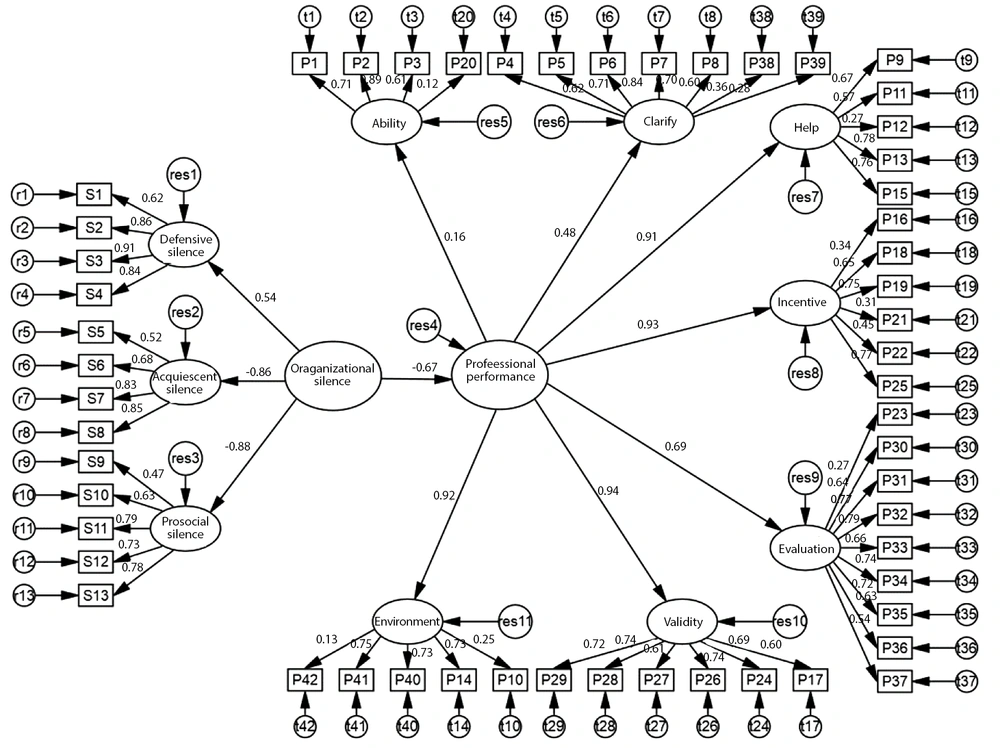
Figure 1.
The paths between the components in the final model
5. Discussion
An important question raised by policymakers in the health sector is whether the variable of organizational silence could affect the professional performance of hospital workers. The present study aimed to address this question by structural equation modelling. The path analysis results indicated a significant, inverse (negative) correlation between organizational silence and the professional performance of the healthcare workers. In other words, a one-unit increase in organizational silence was associated with the reduction of professional performance by 0.67. Therefore, employee silence could be extremely detrimental to healthcare organizations and often increases dissatisfaction in healthcare workers, manifesting as frequent absenteeism, transfers, and other unpleasant behaviors.
Few studies have investigated the correlation between these two variables in the health sector. Consistent with our study, Ghanbari et al. (14) reported the direct effect of organizational silence on performance reduction in university staff. Our findings indicated that in the selected hospitals, the professional performance of the staff could directly affect the degree of their silence, and this negative effect manifested in service-related behaviors. In line with the results of the present study, Askari et al. (10) evaluated the healthcare workers of the teaching hospitals affiliated to Shahid Sadoughi University of Medical Sciences in Yazd (Iran), reporting a significant correlation between the components of organizational silence and professional performance. Therefore, an organization whose employees have more freedom of expression and participation in organizational decision-making will consider themselves committed to the organization and perform their duties more competently, motivated, and satisfied.
According to the findings of Najafi and Khaleikhah (9), organizational silence could explain about 29% of the job performance variance. In another study in Turkey, Gozde et al. (15) also observed a significant, inverse (negative) correlation between job performance and organizational silence. The other findings of our research showed that the employees' professional performance was correlated with various dimensions of organizational silence, with the most significant correlation observed between acquiescent silence and the help dimension and the weakest correlation denoted between defensive silence and the credibility dimension. Except for the correlations of the three dimensions of organizational silence with the help dimension, the dimensions of professional performance were also significantly correlated with the dimensions of organizational silence. In other words, a significant, negative correlation was observed between defensive silence and the dimensions of professional performance, except for the help dimension.
Defensive silence is a self-protective behavior caused by fear. Since professional performance involves dimensions such as motivation, ability, and adaptability, defensive silence may undermine such skills. Since the hospital environment is highly strict and the staff cannot easily comment on every issue, the extent of this silence may be significant in such environments. Therefore, this issue should be considered, and necessary management measures should be taken, such as creating a sense of security in healthcare workers to express their ideas or interpret a motivational logic to speak to reduce and eliminate an issue. In the current research, a significant, positive correlation was observed between acquiescent silence and the dimensions of professional performance, except for the help dimension.
Acquiescent silence is a withdrawn behavior, which is more passive than active. With this type of silence, individuals imply that they have accepted the status quo and have no desire to participate or change a given situation (4). In contrast to similar findings, the results of the present study demonstrated the positive effect of acquiescent silence on professional performance. Therefore, it could be concluded that hospital staff with a conscious choice of acquiescent silence will have high security to maintain their job and position, while their performance may be affected by such security. Furthermore, a significant, positive correlation was observed between altruistic silence and professional performance, except for the help dimension. Altruistic silence is based on the principle of organizational citizenship behavior. The nature of such silence is to consider and pay attention to others in decision-making and avoid expressing opinions and ideas (16). Since hospitals offer more specialized and sensitive jobs than other organizations, issues such as confidentiality, self-control, cooperation, and task sharing are essential in their environment. Therefore, altruistic silence in such environments may increase the professional performance of the staff. In other words, actions such as avoiding expressing ideas and opinions due to loyalty to the organization, avoiding disclosing confidential information for cooperation, protecting specialized knowledge, decision-making as a group, and giving importance to working groups and committees positively influence professional performance.
Consistent with these findings, a negative, significant correlation was observed between defensive silence and professional performance in the study by Mousavi Kashi and Mohseni (17). In other words, increased defensive silence among workers reduced their performance. The mentioned study also indicated a direct, significant correlation between altruistic silence and professional performance. In the studies by Bazli (2) in Tehran (Iran) and Erdirencelebi and Shandogdu (18) in Turkey, a positive, significant correlation was observed between altruistic silence and professional performance, as well as a negative, significant correlation between defensive silence and professional performance. However, no significant correlation was reported between acquiescent silence and professional performance in the study by Kilic and Olsavi (19) in Turkey and the study by Mousavi Kashi and Mohseni (17) in Iran. Inconsistent with the findings of the current research, a significant, negative correlation was reported between these variables in the studies by Bazli (2) in Iran and Erdirencelebi and Shandogdu (18) in Turkey.
Organizational silence may have different causes and consequences. The main influential factors in organizational silence are organizational culture, organizational focus, lack of organizational transparency, and managers' mental attitude. Since each of these causes has different conditions in different organizations, the organizational consequences also vary. Therefore, the discrepancies in this regard may be due to the differences in study environments, participants, and research tools and methods.
Organizational silence could influence various aspects of professional life, thereby affecting the productivity of organizational employees. In other words, organizational silence may be a predictor of the influential factors in the productivity of healthcare workers and result in long-term adverse effects on their productivity (20). Organizational silence also causes pessimism in employees, as well as the intention to leave their job. Administrative and organizational causes play a pivotal role in the organizational silence of employees (21). Therefore, organizational managers should minimize organizational silence by taking measures such as promoting employee-manager trust, adopting flexible organizational structures to increase communication between managers and employees, creating a democratic atmosphere, and encouraging employees to state their work-related problems (22).
If healthcare managers become familiar with the dimensions of organizational silence and their impact on employees' professional performance, they will be able to create an organizational atmosphere in which employees can provide feedback without concern and the fear of criticism by colleagues and superiors. In addition, managers will be able to assess the performance of employees and determine the influential factors in this regard at different intervals. These measures could be introduced to organizational managers and hospitals workers by implementing workshops and training courses, which are key steps toward improving organizational performance.
5.1. Limitations of the Study
Since this study was conducted on the healthcare workers in Qazvin province only, generalizing the findings to other organizations should be with caution. Another limitation of the study was using a questionnaire to collect data, which might have undermined the honesty of the participants in their responses.
5.2. Conclusions
According to the results, organizational silence adversely affected the performance of the healthcare workers in the medical centers of Qazvin province. Therefore, it is recommended that a proper organizational atmosphere be provided so that healthcare workers could express their ideas without the fear of being criticized by colleagues and superiors. Given the significant correlation between the attitudes of senior managers toward silence and organizational silence (8), they should encourage their employees to express their opinions by creating a safe and stress-free atmosphere and providing proper mechanisms for free expression and constructive criticism. The negative attitude of senior managers toward employees’ comments and feedback further limits the opportunities for communication and exchange between senior managers and employees, thereby intensifying silent behaviors on behalf of the employees. Our findings could help organizational managers understand organizational silence and its dimensions and take steps toward eliminating this issue by being aware of its effects on professional and organizational performance. Finally, it is suggested that further investigations be conducted regarding the influential factors in organizational silence in other organizations, especially in the health sector.

