1. Background
Diabetes is the most prevalent endocrine disease which is caused by the impairment in insulin secretion and/or its function and is characterized by a chronic increase in blood sugar or hyperglycemia (1, 2). At the moment, globally 43% of the disease burden is due to non-communicable diseases and it is estimated that by 2020, 60% of the total burden of diseases and 73% of death will be related to these diseases (3). Diabetes mellitus (DM) is a big public health problem that is associated with lifetime complications and huge expenses for the healthcare services system. According to the international diabetes federation (IDF), the number of people with diabetes has been 378 million people in 2014 and it is expected to reach 592 million people by 2035. According to IDF estimations, Iran will be one of the areas with a high prevalence of diabetes by 2030 and the prevalence of diabetes will reach 3.9% in it (4). Identifying the contributing factors to the status of visiting health centers by diabetic patients from the viewpoint of those who have direct experience with it, may play a key role in planning interventional programs to increase regular visits by patients. Therefore this is one of the health priorities of society to conduct studies on situations and real needs of patients to improve their participation (5, 6). Qualitative methods are ideal to collect data to expand this understanding. Qualitative methods may help health educators to better understand health problems and their behavioral and environmental causes and contributors from the viewpoint of people who are involved with diabetes (7). Qualitative research is a systematic method to investigate issues that are not quantitatively explainable. The health belief model is one of the oldest and most used methods of behavior change. This model focuses on one’s motivation and past experiences and it has been used in many interventions with diabetic patients (8, 9). To our best knowledge, no study has been conducted on the quantity and quality of visiting rural health centers by diabetic patients and all previous studies have been conducted in urban areas (5, 10).
2. Objectives
This study aimed to understand the experience of diabetic patients, their families, and providers about visiting rural health in Ahvaz using Health Belief Model.
3. Methods
This is a qualitative study conducted by directed content analysis method and by using the health belief model conducted in rural health houses under cover Ahvaz eastern health center. Health houses that are supervised by rural health centers play an important role in providing primary health care in rural settings. “Main village,” selects for the establishment of a rural health house based on a set of criteria. Each health house provides health services for several “satellite” villages. Primary health care in the health house is provided by trained community health worker, behvarz (11).
The Ahvaz eastern health center includes 3 rural health centers, and 12 health houses which cover 48 satellite villages. Participants were 14 patients, 6 health care providers (behvarz), 3 family physicians, and 3 members of patients’ families. The inclusion criteria included being a type 2 diabetic patient with a profile in the health center, being a diabetes patient’s family member, being a provider of health services to a patient with type 2 diabetes, having the desire to participate in the interview, and being able to speak Persian. By using the list of patients with diabetes type 2 in the mentioned health centers, patients, health care personnel, and family members of patients were selected purposively and were invited by phone call to participate in this study. In case they were not able to come to the health center, the interviewers were going to their homes to do the interview. To comply with the ethics, written consent was taken from participants before the interview and they were assured about the confidentiality of their identity and details of the interview. The data was collected through semi-structured interviews. After getting the agreement of the participants, their interview was recorded, and also some notes were taken. The interviewer tried to record the nonverbal movements like facial expressions, voice tone, and so on. The questions were designed to be open and according to the objectives of the study. Besides, during the conversation, some quarry questions like “why”, “would you explain more” and “please tell me an example” were asked of the participants to clarify their answers and we repeated that to reach data saturation (12). After doing 23 interviews, the answers to questions became similar and repetitive and no new data was collected. To be cautious, after reaching the saturation level, we interviewed 3 more people. After each interview, the collected data was typed immediately and recited by the researcher several times to make sure about its accuracy. Analysis of the data was performed simultaneously with doing interviews. After the primary categorization of data by MAXQDA 12, keywords and phrases were extracted in form of primary codes and after that, these codes were used to make sub-themes. Finally, these themes were matched with the 5 structures of the health belief model. The validity of the findings and scientific accuracy was evaluated by Lincoln & Guba criteria (13). To increase the validity of the findings continues communication and review of the finding by participants were done. Peer review was used for the assessment of the reliability of the findings. Avoiding any presumptions in the process of the study was a technique for conformability ensuring. The study proposal was approved by the ethics committee of Ahvaz Jundishapur University of Medical Sciences with the reference code of IR. AJUMS. REC. 1395. 502.
4. Results
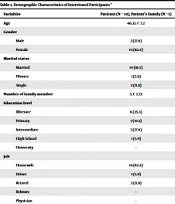
The demographic characteristics of interviewed participants are presented in Table 1. By data analysis, 285 initial codes, and 32 sub-themes that were matched to the 5 constructs of the health belief model were extracted (Table 2).
Table 1.
Demographic Characteristics of Interviewed Participants a
| Variables | Patients (N = 14), Patient's Family (N =3) | Physician (N = 3) | Behvarz (N = 6) |
|---|---|---|---|
| Age | 46.35 ± 7.2 | 30.33 ± 1.52 | 43 ± 4.60 |
| Gender | |||
| Male | 3 (17.6) | 2 (66.7) | 3 (50) |
| Female | 14 (82.4) | 1 (33.3) | 3 (50) |
| Marital status | |||
| Married | 14 (81.5) | 3 (100) | 5 (83.6) |
| Divorce | 1 (5.9) | - | - |
| Single | 2 (11.8) | - | 1 (16.7) |
| Number of family member | 5 ± 2.73 | NA | 4.66 ± 0.51 |
| Education level | |||
| Illiterate | 6 (35.3) | - | - |
| Primary | 7 (41.2) | - | - |
| Intermediate | 3 (17.6) | - | 3 (50) |
| High School | 1 (5.9) | - | 3 (50) |
| University | - | 3 (100) | - |
| Job | |||
| Housewife | 14 (82.4) | - | - |
| Driver | 1 (5.9) | - | - |
| Retired | 2 (11.8) | - | - |
| Behvarz | - | - | - |
| Physician | - | 3 (100) | 6 (100) |
a Values are expressed as mean ± SD or No. (%).
Table 2.
Main Themes and Sub-themes of Experience of Diabetic Patients About Visiting Rural Health Centers Using HBM
| Main Themes | Sub-themes |
|---|---|
| Perceived threat | Patient’s knowledge |
| Family history | |
| Patient’s acceptance of the disease | |
| Fear of diabetes complications | |
| Perceived benefits | Fair cost of treatment |
| Family cooperation | |
| Accessibility | |
| Patient reverence | |
| Satisfaction from personnel | |
| Perceived barriers | Patient’s poor knowledge |
| Denial of the disease | |
| Lack of patient cooperation | |
| Too busy and time-limited | |
| Physical inability | |
| No employment and poverty | |
| Medical costs | |
| Local traditions | |
| Low family support | |
| Transportation difficulties | |
| Unfavorable weather | |
| Referral system barriers | |
| Inadequate equipment | |
| Low provider motivation | |
| Disrespectful Behavior in Health centers | |
| Personnel’s absenteeism | |
| Lack of regular follow-up by patients | |
| Weakness of communication between physician and patient | |
| Guide to action | Symptoms |
| Guide by personnel | |
| Disease in family and relatives | |
| Self-efficacy | Following diet and advice on medicine consumption |
| Self-care |
4.1. Description of Main Themes and Sub-themes
4.1.1. Perceived Threat
Due to understanding the complications of diabetes, diabetic patients felt feared more especially if they had seen such complications in people around them, they felt under threat of these complications. Therefore they had more regular visits and followed recommendations better.
4.1.1.1. High Knowledge of Patients
some of the patients knew about this disease, methods of controlling that, on-time consumption of medications, regular visits to the health center, and disease complications. One of the patients said: “I come to this center every month and every 6 months I visit an optometrist and cardiologist. I take my drugs regularly because I know complications of this disease are serious” (a female patient, married, 37 years old with primary school education level). A behvarz also said: “some of the patients read about it and have good knowledge about diabetes. They are scared of the complications so they come to check their blood sugar on time” (a male behvarz with 25 years of job experience).
4.1.1.2. History of Disease in the Family
Patients who had a history of diabetes in their family were more sensitive about this disease and were proceeding to diagnose their disease earlier. One of the patients said:” my parents had high blood sugar. I have been always scared of getting high blood sugar. I think high blood sugar is hereditary. Two years ago I visited a doctor to check my blood sugar and I found out that I have diabetes. I take my drugs regularly” (a female patient, married, primary school education level).
A behvarz said: “some of the patients who have had a diabetic patient around themselves, have some information about it and that’s why they are scared of it. So they come earlier for tests and follow recommendations” (a female behvarz with 16 years job experience).
4.1.1.3. Accepting the Disease
Some patients had completely accepted the disease, and they were following the recommendation. On this issue, one of the physicians said: “patients who have accepted their disease, listen to us better and pay more attention to their treatment. Thus they come for visiting on time” (a male physician with 2 years of job experience). One of the diabetic patients said: “Diabetes is just like cancer. So we have to cope with it. I know that it has no treatment but I do exercise and take my medicines on time and also listen to what behvarz tells me” (51 years old, male, 25 years occupational experience).
4.1.1.4. Fear of Complications
By observing other patients’ complications or seeing patients’ photos, most of the patients will be scared of the probable complications and visit their doctor and also take their medicines timely. One of the patients said:” Sometimes my kidneys get painful. My kidneys and legs have problems. My eyes get blurred and I am scared that if my blood sugar goes up I will die so I take my medicines on time”. On this issue, a behvarz said: “since many of the patients think that high blood sugar won’t make any problem, we remind them of the probable complications to push them to take their medicines on time and visit the doctor regularly”.
4.1.2. Perceived Benefits
Most of the patients understood the contributing factors of regular visiting and on-time medical care (affordable cost of treatment, family cooperation, health insurance, availability, transportation, patient reverence, patient follow-up, satisfaction, and personnel’s low turnover).
4.1.2.1. The Affordable Cost of Treatment
Most diabetic patients do not have a good income. Considering the low cost of visiting doctors and cheap medicines, patients are less worried at the first level of health care. On this issue, one behvarz said: “in the main village there is a pharmacy. Besides, on two days of the week laboratory comes here and they take samples. Since it is free of charge, patients in this village are happy” (a female behvarz with 23 years occupational experience). One of the patients said: “When I go to Sina hospital with my sealed insurance note, it is very good because I can meet my doctor and my medicines will be cheap as well” (a female patient, 35 years old, married with primary school education level).
4.1.2.2. Family Cooperation
The family’s financial and spiritual support is very important to have regular visits and control of the disease. A patient’s wife said: “my husband’s health is very important to me. So I always try to cook suitable food for him and every evening we go out hiking” (patient’s wife, 27 years old). A patient said: “my wife takes care of me a lot and tries to make suitable and healthy foods for me” (a male patient, 61 years old with a primary school education level).
4.1.2.3. Accessibility
A health center must be located on the main road from which many villagers have traffic. A physician said: “since small villages are scattered, we have the plan to visit them regularly every month. We go to the health house once a week as well. Therefore patients can even walk to come and see the doctor” (a male physician with 2 years job experience). A patient said: “health house is near here so whenever the doctor comes I can walk there and there is no problem” (a female patient, married, 41 years old, and uneducated).
4.1.2.4. Patient Reverence
Most patients like to visit the doctor without delay and they like a physician or behvarz’s sympathy. A behvarz said: “I always talk to the patients affably so that they come again on time. I put those who are older in priority to check their blood pressure and blood sugar” (a female behvarz with 16 years job experience). Another behvarz said: “patients like to be visited respectfully and without delay. We always respect them to motivate them to come again” (a male behvarz with 18 years of occupational experience).
4.1.2.5. Satisfaction from Personnel
Most of the patients were satisfied with the services that behvarzs was offering them at the first level. They also had relative satisfaction from physicians. One of the patients said: “I am happy of behvarzs. Whenever I go to the health house they help me and check blood pressure and blood sugar.” (A female patient, 35 years old, married with primary school education level). Another patient said: “the doctor is good-tempered. Whenever I go to the health center he prescribes laboratory tests and medicines. He also checks my blood pressure.” (A female patient, 39 years old, married. Guidance school education level).
4.1.3. Perceived Barriers
Based on the view of patients and health care personnel barriers to the ordered visit to the health centers are poor knowledge of patients, disease denial, patient’s poor cooperation, too busy and time-limited, physical inability, no employment and poverty, Medical costs, local traditions, low family support, transportation difficulties, Unfavorable weather, referral system barriers, inadequate equipment, low provider's motivation, turnover of physicians, disrespectful behavior in health centers, lack of regular follow-up by patients, weakness of communication between physician and patient (18).
4.1.4. Guide to Action
Some external events such as having a diabetic patient in relatives, physician and other health care workers’ advice, and some internal events including pain and fear from complications will affect patients’ behavior in terms of coming to the health centers.
4.1.4.1. Clinical Symptoms
Physical signs like pain, blurred vision, vertigo, and so on stimulating patients to meet a doctor. A patient said: “whenever my mouth gets dried or I have a headache or blurred vision, I go to the health house so that behvarz checks my blood sugar and blood pressure.” (a female patient, 37 years old, married, primary school education level).
4.1.4.2. Personnel Guidance
It includes information that one may get from media or health care personnel. On this issue, a patient’s daughter said: “it’s been a long time since my mother has diabetes and it’s about 10 years that she is taking pills. behvarz comes to our house and checks my mother’s blood sugar and advises her to take her medicine on time.” (a female patient’s daughter, 40 years old, single, housewife, primary school education level).
4.1.4.3. A Disease in Family and Relatives
Patients who had a history of diabetes in the family or relatives, were more sensitive about this disease and came earlier for a checkup. A patient said: “my parents had diabetes too. I was always afraid that I will get diabetes. I think diabetes is hereditary. Two years ago, I went to a doctor and found out that I have diabetes. Now I consume my medicines regularly.” (A female patient, 39 years old, married, primary school education level).
4.1.5. Self-efficacy
A diabetic patient’s belief in the ability to follow the advice in various situations including on-time consumption of medicines, following the diet, and self-care, affects his behavior of coming for follow-up.
4.1.5.1. Diet and Medicine Consumption
Patients have the most important role in controlling blood sugar. A patient said: “my father had diabetes too. It’s about 10 years that I have had diabetes and I’m scared of the complications. So I take my medicine on time and follow the diet.” (A female patient, 37 years old, primary school education level).
4.1.5.2. Self-care
In controlling diabetes, the patient’s role is more important than the health care personnel’s role. On this issue a patient said: “I check my blood sugar every morning and my daughter injects Insulin for me. I take my pills on time and do exercise. I eat a lot of fruit and vegetables and less rice and potato.” (a female patient, 39 years old, guidance school education level.
5. Discussion
Regular medical appointments engage patients in diabetes care, and can prevent severe complications of the disease. About 12 - 36% of patients with type 2 diabetes missed regular appointments. Understanding the distributing factors of regular appointments can improve diabetes care in patients with diabetes (14, 15).
In the present study, findings were extracted in 285 initial codes and were matched with 5 structures of the health belief model (perceived threats, perceived benefits, perceived berries, guide to action, and self-efficacy). Sun et al. in a systematic review evaluated associated risk factors with missed appointments by patients with type 2 diabetes. Results of this review showed that a variety of multilevel factors is associated with an irregular appointment in this population with inconsistency in findings. They found that most of the published reports examined patients' features and ignored the role of interpersonal factors (14). Davoodi et al. in a Qualitative Study explored barriers and incentive factors for patients with type 2 diabetes to refer urban health center of Ahvaz. Two main categories were extracted including individual and systemic factors. Individual barriers included two sub-categories of economic and occupational factors. The 4 sub-categories of systemic barriers were lack of information resources, lack of specialized equipment and services, limited access, and long waiting lines. Individual incentives for referring to health center was patients' awareness and systematic incentives included the financial ability and appropriate public relations (16).
5.1. Perceived Benefits Theme
Perceived benefits mean belief in the efficacy of the recommended action to reduce the risk of disease. There is a relationship between the perceived benefits of behavior and the amount of following that (17). Results of the current study showed that patients who had regular visits, had a high understanding of benefits, were on time coming to the health center and following the recommended diet, and taking medicine. In Zare-Farashbandi’s study, patients who had a better relationship with their physician had a better understanding of his advice (18). Similarly, Dehi et al. showed that visiting a diabetic patient at home and having a good relationship with the patient was more effective in controlling the disease (reducing glycosylated hemoglobin) than following up by phone (19).
In the current study also, the role of some factors, like active follow-up at a patient’s house by behvarz, on the behavior of visiting health centers was mentioned. Bigdeli et al. showed that the relationship between physician and patient could predict self-care behaviors in patients with diabetes type 2. The positive effect of easy access to health centers on an increase in patient visits was also mentioned (20).
5.2. Perceived Barriers Theme
In the present study, the perceived barriers category was considered as the most important category affecting the behavior of visiting rural health centers by participants. Patients felt some barriers to adopting the behavior of regular visits and getting on-time care which confirms the findings of previous studies (16, 21, 22).
Patients who felt that complications of their disease or their situation is threatening (an increase in blood sugar, losing eyesight, foot amputation, renal problem, and cardiac stroke) and considered themselves at risk of those complications, paid more attention to the personnel and family doctor’s recommendations including following the diet, consumption of medicines, monitoring blood sugar and doing the needed tests. Their visits to the health center were regular as well. Also, the findings of this study showed that the threat was more felt in diabetic patients who had seen complications of this disease in people around them.
Perceived barriers were reported as the most powerful predictor of preventive health behavior (23). In line with our findings, Sabzmakan et al. showed that patients who felt that disease complications or their situation is threatening and found themselves at risk of those complications were following the recommended diet better. It was also observed that the feeling of threat was more in diabetic patients who had seen the complications in other patients around them (21).
5.3. Guide for Action Theme
Some internal and external factors may activate a person’s readiness for action (24). External factors like a television program, diabetes poster, seeing a patient around, guide of health care personnel, and internal factors such as pain, and fear of complications affect the behavior of patients to come to the health centers. In present study many patients were visiting doctors based on the symptoms like pain, vertigo, visual problem, or renal problem. Besides patients who had seen some diabetes complications like foot sore or renal or cardiovascular problems in patients around them had more regular visits to test their blood sugar and get the services.
5.4. Self-efficacy Theme
In this study, some of the patients were sure about their ability to come regularly to the health center and do self-care. This is an indicator of action self-efficacy which means someone’s assurance about his ability to start a new or tough behavior. Several researchers have shown the role of self-efficacy in the initiation of and keeping health-related behaviors (25, 26).In the present study, findings were extracted into HBM constructs. Melkamu et al. showed perceptions (Health Belief Model constructs) are relatively good predicator for self-care and can describe about 48% of the variance of self-care practice in patients with diabetes mellitus (22). Also, Subhi et al. in a qualitative study conducted in Muscat, Oman applied Health Belief Model to understand the barriers to diabetes care (27).
5.5. Strength and Limitations
This is a qualitative study and its results may help to a deep understanding of the related factors of the behavior of regular visiting by diabetic patients. The advantage of this study was the location of it which was in a rural area. Most of the previous studies have been done in diabetes clinics in cities. In addition to the limitations caused by the nature of the study (qualitative approach), the current research was conducted in rural settings and cannot be generalized to urban areas with different cultural beliefs and different patterns of access to health care.
5.6. Conclusions
The findings of this study provide an in-depth understanding of factors affecting rural health centers' appointments among diabetic patients. According to the participants’ experiences, the status of visiting is a phenomenon that is shown by understanding the contributing factors which are necessary to promote the quality of health care, treatment, and follow-up of patients. Identifying the barriers and benefits of the status of visits by diabetic patients may be helpful in the planning of the national health system to control disease and prevent its complications.