


1. Background
Cancer is now emerging as a life-threatening illness and is the third cause of death in developing countries and is responsible for more than 7 million deaths each year worldwide (1-3). According to the report of Statistics Center of Iran, 140 of every 100000 individuals have cancer in Iran (4). It is expected more than 70000 cases are added to the number of cancer patients and more than 30000 individuals died from cancer each year (5, 6). Therefore, managing the problems related to cancer and its treatments has been one of the priorities of the health system (7, 8).
In addition to the problems caused by the disease, therapeutic intervention (including surgery, radiotherapy, and chemotherapy) are associated with several side effects, which can significantly affect the level of patient’s physical, psychological and social performance, and their adherence to the treatment (8). Patients with cancer often experience a large number of psychological problems for coping with their illness (7, 9, 10). According to the fact, the existential distress, such as anxiety engendered by the awareness of imminent death, is more prevalent than physical problems (7, 10, 11).
The results of the studies show that 50% - 80% of patients with cancer suffer from a wide range of psychological distress simultaneously, ranging from hopelessness, anxiety and depressive symptoms to the lack of meaning in life and spiritual well-being (7, 9, 10). Research finding indicates that patients with higher spiritual well-being have a better coping skill during the process of terminal diseases (12). After knowing the anticipating demise, patients face the existential challenge which is the extermination of the integrity of existence (13, 14).
Anxiety is a common psychological response to death and dying (15). Death anxiety is variable noticeably due to many various influences (16) such as individuals’ attitudes toward death and dying and their perception about the meaning of life, which varies over the life span (14, 17). As a result, the management of psychological symptoms is considered one of the main component of palliative care, especially in advanced or terminal illness (7, 10, 11). World Health Organization (WHO) suggests early palliative care during the course of illness, along with other treatments to improve patients’ quality of life and longer life (18).
Several studies have shown that early involvement of specialized palliative care services can help them e.g. improving the meaning of life is called logotherapy. The group logotherapy can improve the quality of life, extend satisfaction with care, and reduce symptoms of patients with advanced cancer (18, 19). The term of group therapy can refer to any form of psychotherapy when delivered in a group format. Yalom, who developed logotherapy, proposed a number of therapeutic factors such as cohesiveness (20) as a primary therapeutic factor. Humans are herd animals with an instinctive need to belong to groups, and personal development can only take place in an interpersonal context. A cohesive group is one in which all members feel a sense of belonging, acceptance, and validation.
Logotherapy through the improvement of the meaning of life can help patients manage their stress. The psychosocial and spiritual distress is considered an important issue in the care plan that may accompany the disease symptoms, pain, and suffering of patients with advanced cancer. Owing to this reason, the care provides effective communication skills for patients and teaches them to be involved in culturally meaningful activity, personal meaning, and social relatedness in life (21).
Finding the meaning of life is the most influential driving and motivating force in peoples’ life. Logotherapy as a type of psychotherapy with existentialist analysis focuses upon the view that is the will to discover the meaning of life (22). The therapist makes an effort to expand the person’s discernment of meaning through creative, experiential, and attitudinal values in the past, present, and future. Consequently, it is not the meaning of life generally but rather the particular meaning of an individual’s life at a specified time. Logotherapy can help the patients accept the unchangeable destiny and improve their spiritually well-being for the rest of life. Spiritually well-being may decrease the anxiety of patients on the verge of death (9, 22).
2. Objectives
This study aimed to determine the effect of group logotherapy on spirituality and death anxiety of patients with cancer.
3. Materials and Methods
3.1. Study Design
This study design was an open-label randomized controlled trial, which was conducted on 64 eligible patients with cancer who were selected from Imam Khomeini Hospital via convenience sampling in 2017.
3.2. Settings and Population
The study settings involved Imam Khomeini Hospital located in Sari, Iran. These centers are well-established under the supervision of Mazandaran University of Medical Sciences. Patients with cancer undergoing chemotherapy in the morning and afternoon were recruited and randomly allocated to two intervention (n = 32) and control (n = 32) groups (Figure 1). The inclusion criteria were the willingness to participate in research, no history of physical disabilities or psychiatric disorder before occurring cancer, age over 18 years old, and no experience of participating in the logotherapy or workshop with the same content. Exclusion criteria were immigration, patients who died during the study.
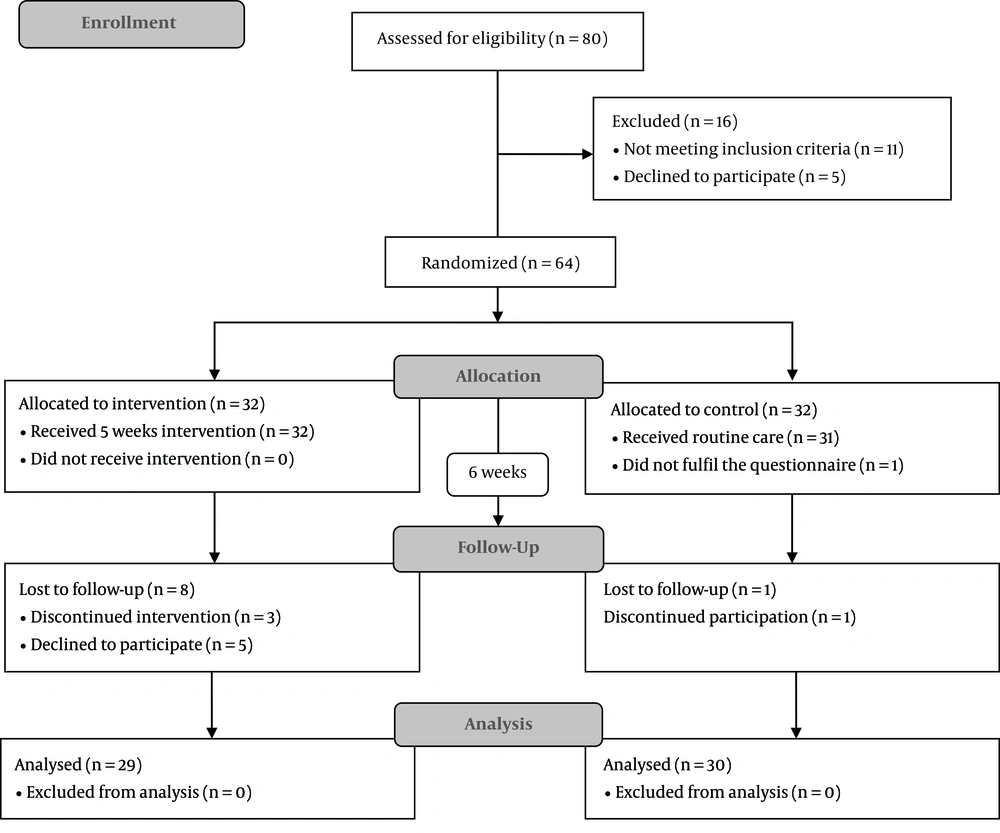
Figure 1.
Flow diagram of the patients is illustrated
3.3. Intervention
Researchers provided written informed consent prior to the initiation of the intervention. Patients in the intervention group participated in a 10-session logotherapy program as meaning-oriented psychotherapy. Initially to start therapy sessions, researchers arranged material pertaining to the logotherapy based on Frankl’s approach. The program was comprised of five following contents “Three natures of the human mind”, “Creative value”, “Experiential value”, “Attitudinal value”, and “Becoming the master of my life”. For setting the group, researchers divided the patients into five smaller groups of 6 - 7 in each.
The intervention group participated in 10 logotherapy sessions besides routine care. The sessions were carried out twice a week, over a 5-week period, based on patients’ preferred time to encourage them for highly participation. Therapy sessions were held at the conference hall of the Oncology ward in the Hospital. The therapist had over 5 years of experience in psychotherapy and logotherapy. Each session lasted about 2 hours. The patients in the control group received routine care without any intervention.
3.4. Outcome Measurements and Tools
The primary outcome of this study was death anxiety and the secondary outcome was spirituality. The measurement tools were a questionnaire consisted of demographic characteristics, including age, gender, marital status, educational level, occupational status, and cancer site, Templer Death Anxiety Scale (DAS), and Spirituality Questionnaire (SQ). The questionnaires were administered twice to each group; one week before the intervention and seven weeks afterward.
3.4.1. Death Anxiety Scale (DAS)
Death anxiety was measured using the DAS, which is a self-administered instrument consists of 15 true-false items and a true answer indicates the presence of the anxiety in a person. Scale scores ranged from 0 to 15, patients with higher scores indicated greater anxiety about death. The internal reliability of the Persian version of DAS was acceptable (Cronbach’s α = 0.85) (23, 24).
3.4.2. Spirituality Questionnaire
We used the 29-item Spirituality Questionnaire that focuses on the concepts of inner-self and meaning in life. It has four subscales, including Self-awareness, Importance of spiritual beliefs in life, Spiritual practices, and Spiritual needs. The items were rated on a 4-point Likert scale for determining the levels of agreement (strongly disagree = 1, disagree = 2, agree = 3, and strongly agree = 4). The scale scores range from 29 to 116. A Persian study showed internal consistency measure was over .93 and more than 0.8 for subscale (25, 26).
3.5. Sample Size Estimation
The sample size was estimated using the outcome data from the previous study (27) using the formula as follows:
Therefore, 30 subjects in each group were needed to reject the null hypothesis, with a power of 90%. Taking into consideration potential drop-outs, 32 patients in each group and totally, 64 patients were recruited.
3.6. Data Collection and Analysis
At the initial contact, the aim of the study was explained to the managers of the hospital and patients. Eighty eligible patients were invited to the study and 64 patients were agreed to participate in the study and signed written informed consent. They were assured about the confidentiality of private information and their voluntary for participation. Questionnaires were subsequently administered by the primary investigator (MM) and the patients were requested to fulfill the questionnaires. After pre-test data collection was carried out, patients were randomly allocated to two intervention and control groups in a 1:1 ratio. In this study, random sequence allocation was performed by MM using a computer random number generator considering an even number as an intervention, and an odd number as a control. A 5-week logotherapy program was started a week after pre-test data collection for the intervention group. A week after endpoint of logotherapy, the patients in the intervention group fulfilled the questionnaires once more. Seven weeks after pre-test data collection, the patients in the control group were requested to fulfill the same questionnaires for the second time. Data were analyzed using independent t-test, Mann-Whitney U test, Wilcoxon t-test in SPSS V. 16 software.
4. Results
The findings showed that the mean age of patients was 46.78 ± 11.50 years (ranged from 27 to 68 years). The majority of the patients were female (66.1%) and married (78%). Most of the patients had a diagnosis of breast cancer (33.9%). An overview of the demographic characteristics of the patients is given in Table 1.
Comparison of the demographic characteristics of the patients between the intervention and control groups at baseline showed that there were no statistically significant differences (Table 1).
Table 1.Demographic Characteristics of the Intervention and Control Groups
| Intervention (N = 29) | Control (N = 30) | P Value | |
|---|---|---|---|
| Gender | 0.572 | ||
| Female | 19 (65.5) | 19 (65.5) | |
| Male | 10 (34.5) | 10 (34.5) | |
| Marital Status | 0.339 | ||
| Married | 25 (86.2) | 21 (70) | |
| Single | 0 (0) | 3 (10) | |
| Divorce | 1 (3.4) | 1 (3.3) | |
| Separated | 2 (6.9) | 3 (10) | |
| Widowed/widower | 1 (3.4) | 1 (3.3) | |
| Education | 0.531 | ||
| Primary | 5 (17.2) | 3 (10.35) | |
| Guidance | 3 (10.3) | 5 (17.2) | |
| Diploma | 15 (51.7) | 11 (37.9) | |
| Associate degree | 2 (6.9) | 2 (6.9) | |
| Bachelor of science degree | 2 (6.9) | 6 (20.7) | |
| Master degree | 2 (6.9) | 2 (6.9) | |
| Occupational status | 0.774 | ||
| Housewife/unemployed | 11 (37.9) | 11 (37.9) | |
| Worker | 1 (3.4) | 10 (34.5) | |
| Employee | 8 (27.6) | 4 (13.8) | |
| Self-employed | 3 (10.3) | 4 (13.8) | |
| Retired | 6 (20.7) | 0 (0) | |
| Living place | 0.785 | ||
| City | 19 (65.5) | 19 (69) | |
| Village | 10 (34.5) | 9 (31) | |
| Cancer site | 1 | ||
| Lung | 2 (6.9) | 4 (13.8) | |
| Breast | 10 (34.5) | 9 (31) | |
| Intestine | 4 (13.8) | 5 (17.2) | |
| Esophagus | 1 (3.4) | 1 (3.4) | |
| Stomach | 3 (10.3) | 6 (20.7) | |
| Uterus | 2 (6.9) | 2 (6.9) | |
| Others | 3 (10.3) | 1 (3.4) |
The findings also showed that the mean and SD of death anxiety score of the patients in both groups before the intervention was high (more than 8). In addition, the mean and SD of the spirituality score of patients in the intervention and control groups before the intervention was 81.62 ± 11.62 and 85.59 ± 12.85, respectively. There were no statistically significant differences in death anxiety and spirituality scores between the logotherapy and control groups, indicating that two groups were matched in terms of death anxiety and spirituality. Also, the mean of death anxiety score in both groups was more than 8 which indicates the high death anxiety (Table 2).
After the intervention, the mean score of the patients’ death anxiety in the intervention and control groups was 7.14 ± 4.12 and 9.76 ± 2.64, respectively, which was significantly lower than the patients’ score before the intervention (P < 0.05). The mean and SD of patients’ spirituality score in the intervention and control groups was significantly higher than the patients’ score before the intervention (P < 0.05) (Table 2). On the other hand, in the intervention group spirituality score was increased, whereas death anxiety score was decreased (Figure 2).
Table 2.Mean and SD of Death Anxiety and Spirituality Score Before and After the Intervention in Both Groupsa
| Group | Before | After | P Value |
|---|---|---|---|
| Death Anxiety | |||
| Intervention | 9.69 ± 2.66 | 7.14 ± 4.12 | 0.005 |
| Control | 9.03 ± 3.09 | 9.76 ± 2.64 | 0.011 |
| P value | 0.011 | 0.39 | |
| Spirituality | |||
| Intervention | 81.62 ± 11.62 | 101.27 ± 12.53 | 0.001 |
| Control | 85.59 ± 12.85 | 84.14 ± 11.07 | 0.06 |
| P value | 0.22 | 0.001 |
aValues are expressed as mean ± SD.
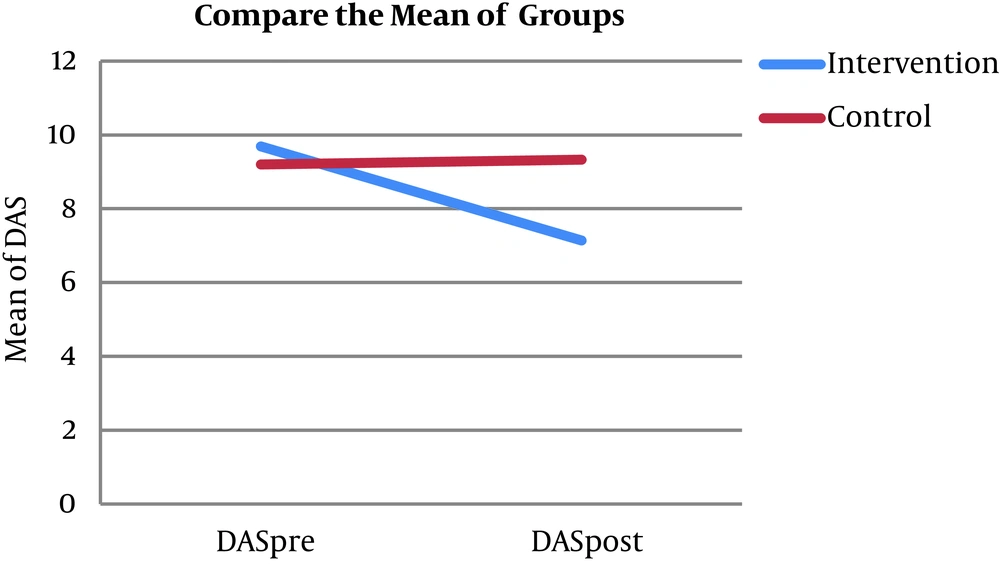
Figure 2.
Comparison of pre- and post-intervention death anxiety score in the intervention and control groups is shown
The research results have shown that there was a statistically significant difference in spirituality and death anxiety scores of patients in the intervention groups before and after logotherapy, indicating that group logotherapy was effective on death anxiety and spirituality scores (P < 0.05) (Table 2).
An overview of the patients’ spirituality score in Table 3 represents that patients’ score in the intervention group increased in all four subscales, including self-awareness, the importance of spiritual beliefs in life, spiritual practices, and spiritual needs after logotherapy. There were no statistically significant differences in all subscales of spirituality scores between the intervention and control groups before logotherapy, but after logotherapy the differences were statistically significant (P < 0.05), moreover in the intervention group before and after logotherapy it was significant in all subscales (Table 3).
Table 3.Mean and SD of Spirituality Subscales Before and After the Intervention in the Intervention and Control Groupsa
| Group | Before | After | P Value |
|---|---|---|---|
| Self-Awareness | |||
| Intervention | 27 ± 4.5 | 32.83 ± 5.91 | 0.001 |
| Control | 27.41 ± 5.39 | 28.17 ± 5.21 | 0.37 |
| P value | 0.28 | 0.001 | |
| Importance of spiritual beliefs in life | |||
| Intervention | 11.1 ± 2.21 | 14.86 ± 8.09 | 0.001 |
| Control | 11.59 ± 2.95 | 11.62 ± 2.8 | 0.86 |
| P value | 0.48 | 0.009 | |
| Spiritual practices | |||
| Intervention | 16.34 ± 2.92 | 20.34 ± 2.54 | 0.001 |
| Control | 17.48 ± 3.46 | 17.7 ± 3.34 | 0.26 |
| P value | 0.18 | 0.001 | |
| Spiritual needs | |||
| Intervention | 27.17 ± 3.49 | 31.86 ± 2.57 | 0.001 |
| Control | 28.10 ± 3.97 | 27.27 ± 3.44 | 0.04 |
| P value | 0.35 | 0.001 |
aValues are expressed as mean ± SD.
5. Discussion
The findings showed that before logotherapy, the mean score of death anxiety in both groups was more than 8, indicating the high death anxiety. These results are consistent with the findings of some studies (28, 29), but the findings of other studies were contradictory (14, 30, 31). This difference can be influenced by several factors such as the culture, belief, knowledge, the disease progress, time since diagnosis, prior experience with cancer, and patients’ characteristics (14, 32, 33). Since the level of death anxiety depends on some factors and differs from patient to patient, measuring death anxiety is necessary for patients with cancer because it may be helpful for healthcare providers to explore this problem and to take appropriate intervention for resolving it. They can consider it a part of routine assessment and care.
The findings of the current study showed that before logotherapy, the mean score of spirituality in all domains was more than the median score of the questionnaire, indicating the tendency to spirituality in patients. These results are consistent with the findings of Puchalski et al., indicating that more than 70% of patients tended to talk to the healthcare providers about spiritual issue (34). Findings of a study in Iran showed that the Spiritual and existential well-being of the patients was high (12), while research findings from Breitbart et al., showed that the spiritual well-being score of cancer patients who were attending psychotherapy sessions was low. It means spirituality can be influenced by several factors that need to be investigated (7).
After logotherapy, there was a statistically significant difference in death anxiety scores between the intervention and control groups, indicating that group logotherapy was effective in decreasing death anxiety scores of the patients. The results of this study are consistent with other studies, showing logotherapy is an effective intervention in reducing psychological problems such as anxiety and depression, and it is helpful for increasing the quality of life. Mascaro and Rosen investigated the role of existential meaning as a way to reduce stress in 143 graduates of the university; the results indicated that having a meaning in the life acts as an obstacle to stress-induced depression (35). The finding of the qualitative research that carried out on 15 patients with severe depression showed that the spirituality and meaning have an effective role in depression (36). Also, believing in life after death and the meaning of life can reduce death anxiety in difficult and complicated conditions, especially in the case of malignancies (37-39).
Despite the fact that logotherapy was effective to reduce patients’ death anxiety in the intervention group. In the control group, not only it did not reduce but also the score of death anxiety increased. Previous studies indicated that it is expected to intensify death anxiety by worries about the possibility of suffering, and preparation of end of life at the time that disease progresses (14, 33, 40, 41). According to the finding, there was a statistically significant difference between the mean of spirituality score in the intervention group before and after logotherapy, but it was not significant in the control group, indicating that group logotherapy was effective in increasing the spirituality score of the patients. An overview of the patients’ spirituality score represents that the patients’ score in the intervention group increased all four subscales; self-awareness, the importance of spiritual beliefs in life, spiritual practices, and spiritual needs after logotherapy. There were no statistically significant differences in all subscales of spirituality scores between the intervention and control groups before logotherapy, but after logotherapy the differences were statistically significant. Moreover, before and after logotherapy, it was significant in all subscales in the intervention group. Participating in group logotherapy help them share their emotion and experiences with others, and the therapist diverts the patients away from their problems towards something else meaningful in the world, which varies from person to person and from day to day.
Although logotherapy was an effective intervention in reducing death anxiety, there were some limitations in this study. Group sessions schedule was challenging for some patients because of illness-related symptoms, for those reasons the patients were permitted to attend to another intervention group to continue their participation. There is another limitation in our study that the participants were selected from varied types of cancer. Also, we did not compare logotherapy with other existing approaches to eliminate death anxiety. Therefore, we suggest to researchers to compare different approaches for death anxiety management in patients with advanced cancer. Furthermore, this study also did not include follow up measurements, which would facilitate the assessment of the effect of the intervention effectiveness. Further study should be conducted to investigate the long-term effects of logotherapy on death anxiety.
5.1. Conclusions
The findings of this research showed that group logotherapy might improve all aspects of spirituality as a one of the important aspect of human life. In addition, it can decrease death anxiety of patients who suffer from cancer, through changing their mind about life and death. It offers to healthcare providers to consider referring patients with advanced cancer to the consulting center because they have to learn living by focusing on “here and now”. In this situation, they can live in real life and enjoy the rest of life using the opportunities of the actual reason for its meaningfulness and the meaning of human existence have based on the doubtless nature of death.
In conclusion, they have to accept the fact that in spite of they could not change some events of their lives; they could acquire skills to accept some painful experiences that could be known as the gifts of life. If they found the meaning of life, they can modify the painful experiences. As a result, considering psychological intervention as routine care is required for them to control their concerns and sense of anxiety.




